



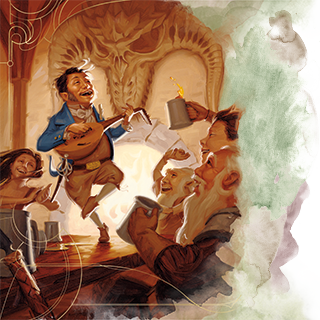
"Steel tells the truth that rank delays."
— common saying among Thorn Hall officers
Description
As an Iron Thorn Cadet, you were forged within the disciplines of the Iron Thorn Academy, the premier dueling school of the March of Draeven and the most openly martial of the Four Great Dueling Schools of Aetheris. Yours was never a soft education in elegance, nor a merely ceremonial study of formal challenge. The Academy teaches that the duel is a crucible, and that honor means very little until pain, exhaustion, humiliation, and pressure begin pressing a person hard enough to reveal what survives intact. In Thorn Hall, grace is admired. Composure under strain is revered.
The Iron Thorn Academy exists at the crossroads of noble legitimacy, officer tradition, martial judiciary, and personal combat. It trains duelists, yes, but also officers, household champions, master-seconds, military representatives, and public bearers of Draeven’s hard-edged culture of honor. The Academy does not flatter talent. It tempers it. Students are expected to withstand cold, fatigue, correction, public failure, and bruising repetition until vanity is either burned away or sharpened into something useful and controlled. Where other schools may ask whether a movement is beautiful, the Academy asks whether it still functions after blood loss, bad footing, cold wind, and three exchanges too many.
You may have entered through noble sponsorship, officer recommendation, retainer lineage, or earned admission from a lower circuit through sheer visible merit. Perhaps you began as a Thorn Novice, learning bearing, drill, and the ruthless basics of posture under scrutiny. You may have risen as a Steel Cadet, trusted with formal sparring, live-steel exercises, and representation in internal contests. Some continue further as Iron Challengers, certified to issue or answer Academy-sanctioned formal challenges, while the greatest rise toward the ranks of Sword of the Thorn Hall and beyond. Whatever your path, the Academy taught you that excuses are a softer kind of surrender, that endurance is a weapon, and that title alone cannot stand for long once steel is drawn under proper witness.
Now, whether you still serve a house, command, or patron tied to Thorn Hall, or travel the world carrying Draeven steel into foreign rooms, you remain marked by its culture. You mistrust ornamental softness. You notice who loses discipline when tired. You understand that command is revealed not by who speaks first, but by who remains exact after the body starts complaining. In a world full of polished challengers, social duelists, and ambitious pretenders, you are one of those trained to hold measure when conditions stop being kind.
Attribute Bonuses
Life in the Academy hardened your body, sharpened your bearing, and taught you to remain dangerous under strain.
Choose one of the following:
- Strength +2, Wisdom +1
- Strength +1, Constitution +1, Wisdom +1
- Dexterity +2, Constitution +1 for sabre duelists, mounted cadets, and lighter-form specialists
Using the Iron Thorn Cadet Background
This background is ideal for Fighters, Rangers, Paladins, Rogues, Bards, Monks, Clerics, and certain Artificers or Wizards who want ties to officer culture, noble challenge law, battlefield-hardened duel traditions, and the Academy’s harsh merit-versus-lineage tensions.
An Iron Thorn Cadet might be:
- A Thorn Novice cast into real danger before training was complete
- A Steel Cadet carrying academy discipline into wider service
- An Iron Challenger already marked by public measure and reputation
- A master-second or witness-trained retainer on politically delicate assignment
- A common-born rising duelist forced out by old blood resentment
- A veteran Sword of the Thorn Hall who has seen too much war to remain purely ceremonial
This background works especially well in campaigns involving:
- officer rivalries
- noble-house disputes
- harsh rank trials
- inter-school challenges
- battlefield honor
- merit versus birth tensions
- military prestige
- formal disputes that carry political or command consequences
"Anyone can look formidable when rested. The Academy teaches the rarer thing: to remain exact when the world has become too tired, cold, and painful for vanity."
- Ability Scores: Life in the Academy hardened your body, sharpened your bearing, and taught you to remain dangerous under strain.
Choose one of the following:
- Strength +2, Wisdom +1
- Strength +1, Constitution +1, Wisdom +1
- Dexterity +2, Constitution +1 for sabre duelists, mounted cadets, and lighter-form specialists
- Feat: Your background grants the following feat options, representing trained toughness and readiness under pressure:
- Tough
- Alert
At the DM’s discretion, Defensive Duelist or Skilled may also fit certain Iron Thorn cadets and challengers.
- Skill Proficiencies: Your Academy training emphasized endurance, command bearing, and the ability to function under scrutiny and stress.
- Athletics
- Intimidation
- Tool Proficiencies: You were taught the practical tools of martial readiness, military decorum, and campaign-grade self-maintenance.
- Land Vehicles
- One type of Gaming Set
- Choose one: Smith’s Tools, Calligrapher’s Supplies, or Pistol Maintenance Kit (DM’s equivalent if firearms are present)
- Languages: The Academy moves in noble, military, and inter-school circles.
- Common
- One additional language of your choice
- One military, officer, or legal-martial cant at the DM’s discretion
- Equipment: You begin with the following equipment:
- A fitted dueling coat, cadet’s training jacket, or officer-cut practice attire
- A personal training weapon or martial sidearm appropriate to your discipline
- Land Vehicles training papers, rider tags, or cavalry straps
- One Gaming Set
- A Thorn Hall insignia, silver thorn clasp, or cadet cord
- A whetstone, oilcloth, and proper maintenance tools for your weapon
- A copy or excerpt of the Oath of Iron Conduct or challenge terms handbook
- A pair of reinforced gloves or wrist wraps
- A belt pouch containing 15 gold pieces
Roll a d8 or choose an option from the table below to define the trial that shaped you.
| d8 | Iron Thorn Experience |
|---|---|
| 1 | You survived the Thorn March and learned exactly when your body first starts lying to you. |
| 2 | A rank trial on the Red Sand Circle exposed a flaw in you that no master ever let you forget. |
| 3 | You trained under a master who believed kindness was best delivered in the form of survivable humiliation. |
| 4 | You witnessed a formal challenge whose outcome mattered more to military stability than to personal honor. |
| 5 | Your talent earned you advancement others thought your birth did not deserve. |
| 6 | You held your line in a prolonged bout and discovered endurance is uglier and holier than elegance. |
| 7 | A noble favorite was protected from proper disgrace, and the memory changed how much you trust the Academy’s purity. |
| 8 | You carry the lesson of an old duelist, officer, or second whose bearing under pain taught you what real command looks like. |
You were trained to judge people, formations, and duelists not by how they perform in comfort, but by how they hold together when conditions turn ugly. In military encampments, officer halls, noble courts, martial academies, caravan barracks, garrison towns, and places where personal challenge intersects with command and public standing, you can usually identify:
- who actually understands discipline,
- who is bluffing with title or posture,
- and where a chain of command, challenge, or rivalry is beginning to strain.
When you spend time observing a duelist, officer, guard unit, noble retainer, or martial household, you can usually determine one of the following:
- whether they are steady, brittle, vain, or battle-tested,
- the point at which their discipline is likely to break under pressure,
- whether their authority rests on competence, fear, lineage, or habit,
- or whether a formal dispute is likely to end in lawful resolution, humiliation, or violence disguised as honor.
You also know how to navigate formal challenge and officer-duel culture. If local martial law, noble challenge codes, or military witness traditions exist, you can usually find the kind of second, witness, drill master, adjutant, or quarter-captain who understands how such things are properly handled.
Suggested Characteristics
| d6 | Personality Trait |
|---|---|
| 1 | I trust people more after I have seen them tired, cold, and under pressure. |
| 2 | I have little patience for theatricality that cannot survive contact with reality. |
| 3 | I speak plainly, train hard, and recover quietly. |
| 4 | I respect competence even in people I dislike. |
| 5 | I keep my gear, posture, and routines strict because slackness spreads. |
| 6 | I am hard to shame once steel is on the floor, but I remember embarrassment as a teacher. |
| d6 | Ideal |
|---|---|
| 1 | Discipline. What matters is not talent, but what remains when talent is exhausted. (Lawful) |
| 2 | Endurance. Pain is not failure. It is information. (Neutral) |
| 3 | Earned Honor. Birth may begin a reputation, but pressure finishes judging it. (Good) |
| 4 | Command. No one should lead others who cannot master themselves first. (Lawful) |
| 5 | Merit. A blade should be allowed to prove what a name refuses to admit. (Good) |
| 6 | Revelation. Pressure strips lies from people faster than comfort ever will. (Neutral) |
| d6 | Bond |
|---|---|
| 1 | I still bear loyalty, gratitude, or resentment toward the master who forged me hardest. |
| 2 | A trial, duel, or ranking judgment at Thorn Hall changed the course of my life forever. |
| 3 | I owe my advancement to skill that others wished to deny. |
| 4 | My name is tied to a house, command, or patron whose honor I still carry whether I wish to or not. |
| 5 | I know the Academy preserves truths in its ledgers that would discomfort more than one powerful family. |
| 6 | There is one rival, second, or officer I still measure myself against in private. |
| d6 | Flaw |
|---|---|
| 1 | I judge softness too quickly and too harshly. |
| 2 | I can mistake suffering for virtue when it is merely suffering. |
| 3 | I have trouble respecting people who have never been properly tested. |
| 4 | I default to pressure when patience or gentleness might work better. |
| 5 | I can become stubborn to the point of injury rather than admit I am near my limit. |
| 6 | I do not forgive fraud hidden beneath form. |
Contacts
Your time at the Academy left you with a network of stern, useful, and politically charged contacts. These may include an officer-cadet peer now serving a major house, a witness-captain who remembers how you held or failed measure, a riding master from the Stable of Ash Spurs, a severe master of iron measure, a quartermaster with opinions on which cadets will last, a fellow challenger who respects your steel more than your company, or a veteran attached to the Winter Yard who knows how quickly pretty technique falls apart in bad weather. Such contacts can provide introductions in Draeven martial circles, information on noble or officer disputes, access to proper witnesses or seconds, training opportunities, military rumors, or warnings when a formal challenge is really a political execution dressed in law. They are rarely sentimental, but they do not easily forget discipline honestly shown.
Comments