



 Base Class: Rogue
A nimble orphan gnome taken in by a traveling bard. A plucky street kid raised in a thieves' guild who has been distracting marks for older members since he was old enough to run from the guards. A member of a travelling dance troupe rumoured to leave their audience with empty pockets.
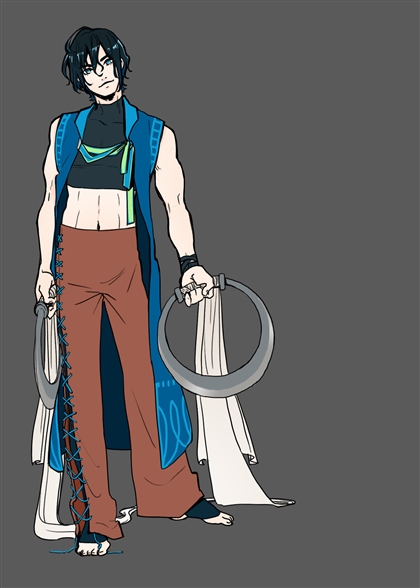
Rogues who follow the Dancer Archetype employ an elegant, graceful, and agile method to their exploits. They rarely work alone, using bardic magic channeled through dance to support their allies; Infiltrating as entertainment or a partygoer, providing their allies help from the inside; Distracting guards with a performance while their friends, guided by the dancer's magic, sneak past unseen. As they hone their magical skill, Dancers learn to provide innate boons to those they support.
(image credit: illiaccrest. tumblr.com/post/179066433632/im-really-pleased-at-the-number-of-male-dancer)
Nimble Performer
Beginning when you choose this archetype at 3rd level, while you are wearing no armour and no shield, your AC equals 10 + your Dexterity modifier + your Charisma modifier and your movement speed increases by 5 feet. Your unarmored movement speed increases by an additional 5 feet at 9th, 13th, and 17th levels in this class.
You also gain proficiency in the Performance skill if you did not already have it.
Spellcasting
When you reach 3rd level, you gain the ability to cast spells. See Spells Rules for the general rules of spellcasting and the Spells Listing for the bard and paladin spell lists plus the guidance cantrip, which you can cast as a bonus action to a range of 30 feet. These all count as bard spells for you.
Spellcasting Focus
As long as your movement is not 0, you may use your dance as a spellcasting focus. Using dance as a spellcasting focus removes material components, with the normal limitations of using a spellcasting focus, and verbal components of your spells as you cast with magic imbued into and generated from your artful movement.
Cantrips
You learn three cantrips: guidance which you can cast as a bonus action with a range of 30 feet and two other cantrips of your choice from the bard spell list. You learn another bard cantrip of your choice at 10th level.
Spell Slots
The Dancer Spellcasting table shows how many spell slots you have to cast your spells of 1st level and higher. To cast one of these spells, you must expend a slot of the spell’s level or higher. You regain all expended spell slots when you finish a long rest.
For example, if you know the 1st-level spell charm person and have a 1st-level and a 2nd-level spell slot available, you can cast charm person using either slot.
Spells Known of 1st-Level and Higher
You know three 1st-level bard spells of your choice, two of which you must choose from the enchantment and abjuration spells on the bard or paladin spell list.
The Spells Known column of the Dancer Spellcasting table shows when you learn more bard spells of 1st level or higher. Each of these spells must be an enchantment or abjuration spell of your choice, and must be of a level for which you have spell slots. For instance, when you reach 7th level in this class, you can learn one new spell of 1st or 2nd level.
The spells you learn at 8th, 14th, and 20th level can come from any school of magic.
Whenever you gain a level in this class, you can replace one of the bard spells you know with another spell of your choice from the bard spell list. The new spell must be of a level for which you have spell slots, and it must be an enchantment or abjuration spell, unless you’re replacing the spell you gained at 3rd, 8th, 14th, or 20th level from any school of magic.
Spellcasting Ability
Charisma is your spellcasting ability for your bard spells, since you learn your spells through the mastery of dance. You use your Charisma whenever a spell refers to your spellcasting ability. In addition, you use your Charisma modifier when setting the saving throw DC for a spell you cast and when making an attack roll with one.
Spell save DC = 8 + your proficiency bonus + your Charisma modifier
Spell attack modifier = your proficiency bonus + your Charisma modifier
Dancer Spellcasting
|
Rogue Level |
Cantrips Known |
Spells Known |
— Spell Slots per Spell Level — |
|||
|---|---|---|---|---|---|---|
|
1st |
2nd |
3rd |
4th |
|||
|
3rd |
3 |
3 |
2 |
— |
— |
— |
|
4th |
3 |
4 |
3 |
— |
— |
— |
|
5th |
3 |
4 |
3 |
— |
— |
— |
|
6th |
3 |
4 |
3 |
— |
— |
— |
|
7th |
3 |
5 |
4 |
2 |
— |
— |
|
8th |
3 |
6 |
4 |
2 |
— |
— |
|
9th |
3 |
6 |
4 |
2 |
— |
— |
|
10th |
4 |
7 |
4 |
3 |
— |
— |
|
11th |
4 |
8 |
4 |
3 |
— |
— |
|
12th |
4 |
8 |
4 |
3 |
— |
— |
|
13th |
4 |
9 |
4 |
3 |
2 |
— |
|
14th |
4 |
10 |
4 |
3 |
2 |
— |
|
15th |
4 |
10 |
4 |
3 |
2 |
— |
|
16th |
4 |
11 |
4 |
3 |
3 |
— |
|
17th |
4 |
11 |
4 |
3 |
3 |
— |
|
18th |
4 |
11 |
4 |
3 |
3 |
— |
|
19th |
4 |
12 |
4 |
3 |
3 |
1 |
|
20th |
4 |
13 |
4 |
3 |
3 |
1 |
Dance Partners
Starting at 9th level, you can further support your allies. While concentrating on a spell affecting an allied creature you can see, you can expend a use of this feature to grant any one of the following effects per use to the allied creature:
- Use your bonus action to grant temporary hit points equal to a roll of your sneak attack dice. These temporary hit points last until you are no longer concentrating on the spell affecting the creature.
- When an attack roll is made against your ally, you can use your reaction to subtract 1d6 from the attack roll made against them, potentially turning a hit into a miss. You may use this reaction after the attack roll has been made but before damage has been rolled.
- When your ally fails an attack roll or saving throw, you can use your reaction to grant them a bonus to the roll equal to 1d6, potentially turning a failure into a success.
You can use this feature a number of times equal to your proficiency bonus, and you regain all expended uses when you finish a long rest.
Your speed increases by an additional 5 feet while you are not wearing armour or wielding a shield.
Improved Dance Partners
Starting at 13th level, you gain and confer benefits while concentrating on spells affecting allied creatures:
- You have advantage on attack rolls made against creatures within 5 feet of the target(s) of a spell you are concentrating on.
- Any allied creature affected by a spell you are concentrating on that ends its turn at least 20 feet from any hostile creature does not provoke any opportunity attacks until the end of their next turn.
- Any allied creature affected by a spell you are concentrating on has advantage on attack rolls made against creatures within 5 feet of you.
Your speed increases by an additional 5 feet while you are not wearing armour or wielding a shield.
Master of Dance
At 17th level, you've mastered the magic of your dance. Upon finishing a short or long rest, you may choose an amount of allied creatures up to half of your proficiency bonus to be your dance partners. While these dance partners are within 30 feet of you, you no longer have to be concentrating on a spell affecting them to use your Dance Partners and Improved Dance Partners features with them.
Your speed increases by an additional 5 feet while you are not wearing armour or wielding a shield.
Comments