



 Base Class: Fighter
Some Fighters choose to enter battle with a loyal canine companion at thier side, often raised from a mere pup, and usually selected from a range of specialized breeds.
In the Moonshae Isles a particularly large breed of dog, known as a Moorhound, are frequently encountered across the isles as both a companion, guardian, and hunter. With a back as high as a tall man's waist, these massive animals hailed from the isle of Moray. The Moorhound is a solidly built animal with the nose of a bloodhound and the jaws of an iron vise, packed with enough muscle to give even a Dire Wolf pause. It is said that the High King of legend, Tristan Kendrick, was accompanied into battle and hunt alike by his powerful moorhoud, Canthus.
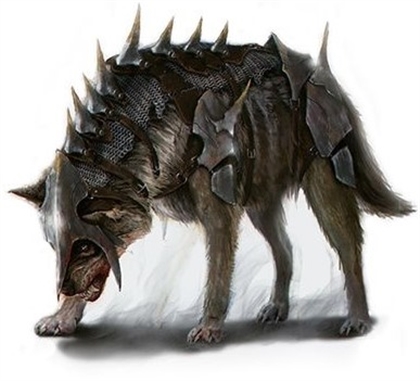
Often seen around the Moonsea region, as well as the nations of Cormyr and Sembia, warriors trained hounds known as War Dogs. These fierce and dangerous beasts were often employed by scouting patrols and border guards. War Dogs were also often used to hunt and stalk wanted criminals and were often equipped with studded leather armor and heavily spiked collars.
Raised from a Pup
You gain proficiency in the Animal Handling skill and may double your proficiency bonus to checks made with Animal Handling when dealing with dogs, wolves, and other canine creatures.
War Dog
Beginning when you choose this archetype at 3rd level, you obtain a loyal hound bred for battle, trained in the art of war, and completely loyal to only yourself and those you denote as friends. This hound can be incapacitated, but not killed (for game mechanics reasons).
The hound obeys all of your commands and shares your initiative count acting immediately after your turn finishes. It can move and use its reaction on its own, but the only action it can take on its turn is the Dodge action, unless you use a bonus action on your turn to command it to take another action. That action can be one on it's stat block or some other action. If you are incapacitated, the hound immediately Disengages and moves back to your body. It then takes the Dodge action, using its reaction to grant disadvantage to one melee attack each turn that would target you.
The Hound shares the stat block of a wolf, with the following changes;
- Its Hitpoints equal 2 + your Constitution modifier + five times your Fighter level.
- Itadds your proficiency bonus instead of its own for all attack rolls.
- It adds your Proficiency Bonus to its damage rolls.
- The hound adds your Proficiency Bonus to it's Dexterity Saving throws, Constitution saving throws, and the Athletics and Perception skills.
- It retains the Keen Hearing and Smell feature, as well as the Pack Tactics feature.
- Also, if you have the Extra Attack feature; you may exchange any number of your attacks with your hound, and allow your hound to attack in your place.
Obedience Training
Starting at 7th level, you can train your hound with additional skills allowing you to work as a cohesive team that can overcome all obstacles. By spending time training your hound you can equip it with maneuvers that help you gain the upper hand.
Maneuvers. You teach your hound one maneuver of your choice, which are detailed under "Maneuvers" below. Many maneuvers can enhance your hounds attacks in some way. You can use only one maneuver per attack.
You can teach your hound an additional maneuver of your choice at 10th and 15th level. Each time your hound learns new maneuvers, you can also replace one maneuver your hound knows with a different one.
You can use these maneuvers a number of times equal to your proficiency bonus. You regain all of your expended uses when you and your hound finishes a short of long rest.
Saving Throws. Some of your hounds maneuvers require your target to make a saving throw to resist the maneuver's effects. The saving throw is calculated as follows:
Maneuver save DC = 8 + your proficiency bonus + your hounds Strength of Dexterity (your choice).
Maneuvers
The maneuvers are presented in alphabetical order.
Ambush
When you or your hound makes a Dexterity (Stealth) check or an initiative roll, you can roll with advantage provided you aren’t incapacitated.
Bait and Switch
When you’re within 5 feet of your hound on your turn, you can switch places with that creature, provided you spend at least 5 feet of movement and you are not incapacitated. This movement doesn’t provoke opportunity attacks.
Charging Attack
If your hound moves at least 15 feet towards a target before making a succesful attack against the creature it can attempt to push the target, provided the target is Large or smaller. The target must make a Strength saving throw. On a failed save, the hound ushes the target up to 15 feet away from itself. A Small creature has disadvantage on this saving throw.
Disarming Attack
When your hound hits a creature with a melee attack, you can command it to attempt to disarm the target, forcing it to drop one item of your choice that it is holding. The target must make a Strength saving throw. On a failed save, it drops the object you choose. The object lands at its feet.
Distracting Bite
When the hound hits a creature with a melee weapon attack it can attempt to distract the creature, giving your allies and opening. The next attack roll against the target has advantage.
Evasive Movement
When the hound moves you can add a 1d6 bonus to its AC until it stops moving.
Goading Attack
When your hound hits a creature with an attack it can attempt to goad that creature into attacking it. The target must make a Wisdom saving throw. On a failed save, the target has disadvantage on all attack rolls against targets other than your hound until the end of your next turn.
Grappling Bite
Immediately after the hound hits a creature with an attack, you can instruct it to try to grapple the target using its bonus action (see the Player's Handbook for rules on grappling).
Lunging Attack
When your hound makes an attack against a target it can increase the range of the attack by 5 feet.
Menacing Growl
When your hound hits a creature with an attack it can give out a menancing snarl directed at its target. The target must make a Wisdom saving throw. On a failed save it is frightened of you and your hound until the end of your next turn.
Trip Attack
When your hound hits a creature with an attack, you can command the hound to knock down the target. If the target is Large of smaller, it must make a Strength saving throw. On a failed save, the target is knocked prone.
Guard Dog
Starting at 10th level, your hound is always on alert, even while you rest.
Your hound cannot be suprised, unless it is incapacitated, and will let you know when danger is nearby unless you are incapacitated.
Bond of the Pack
At 15th level, when you roll initiative and you have no more uses of Obedience Training left, you regain the use of one maneuver.
A good boy? No... the BEST boy!
The countless hours put in training with your hound has bore fruit as your loyal canine companion reaches the pinnacle of form and ferocity.
- Your hound is now classed as a Large creature.
- The hound deals an additional die of damage on all its attacks.
- Also, your hound gains a +2 bonus to its Armor Class.
- Whenever your hound makes a successful attack against a creature, the target takes an additional 1d6 bleed damage at the start of each of its turns. The creature can make a Constitution saving throw at the end of each of its turns to end the bleed effect. This damage is cumulative, and each additional attack made agaisnt the creature by the hound adds an additional 1d6 bleed damage per turn, unless the creature makes a successful Constitution saving throw (to a maximum of 5d6 damage per turn).
Comments