



 Base Class: Fighter
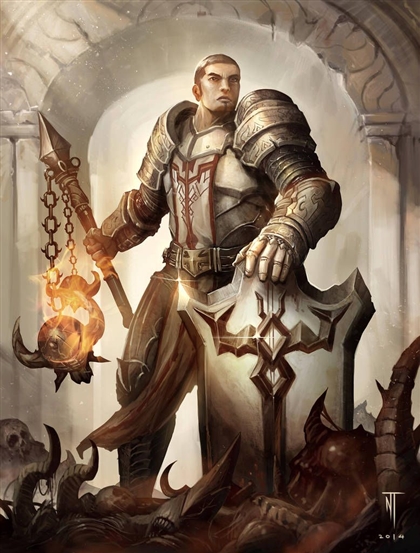
Every religion has clerics, those tasked with performing the duties of the religion. Many also have faithful members who leave their homes to travel distant lands, spreading the word of their god or pantheon. Given the inherent danger of most settings, these preachers need to either be combat-capable themselves or have someone next to them who is. This is where a templar comes in. Templars are ordained warriors tasked with spreading the faith and defending the faithful, while also beating down the foes of a deity.
Templars are the militant arm of their church and/or cause. They are often guards of sacred places, dispatched away from the temples as agents of higher powers, or simply wander to share the virtues of their philosophy and ideal with others. Initially able and zealous warriors combining martial abilities with the power of their deity, they eventually become an active sword or shield for their deity, with high levels of offensive prowess and devastating crowd control. Whether as a bodyguard or a support character, they often find themselves in the ranks of adventuring parties who can make use of the talents.
A templar generally exemplifies a particular ideology of life, and associated nomenclature may depend on the side with which he aligns himself. A good templar, for instance, might assume the title of paladin while those who embrace evil are often known as blackguards and those who serve neutrality are called gray wardens. What truly differentiates these characters are the vows that they swear to uphold.
Spellcasting
When you reach 3rd level, you augment your martial prowess with the ability to cast spells. See Spells Rules for the general rules of spellcasting and the Spells Listing for the wizard spell list.
Cantrips
You learn two cantrips of your choice from the cleric spell list. You learn an additional cleric cantrip of your choice at 10th level.
Spell Slots
The Templar Knight Spellcasting table shows how many spell slots you have to cast your cleric spells of 1st level and higher. To cast one of these spells, you must expend a slot of the spell’s level or higher. You regain all expended spell slots when you finish a long rest.
For example, if you know the 1st-level spell bless and have a 1st-level and a 2nd-level spell slot available, you can cast bless using either slot.
Spells Known of 1st-Level and Higher
You know three 1st-level cleric spells of your choice.
The Spells Known column of the Templar Knight Spellcasting table shows when you learn more cleric spells of 1st level or higher. Each of these spells must be of a level for which you have spell slots. For instance, when you reach 7th level in this class, you can learn one new spell of 1st or 2nd level.
Whenever you gain a level in this class, you can replace one of the cleric spells you know with another spell of your choice from the cleric spell list. The new spell must be of a level for which you have spell slots.
Spellcasting Ability
Wisdom is your spellcasting ability for your cleric spells, since you learn your spells through study and memorization. You use your Wisdom whenever a spell refers to your spellcasting ability. In addition, you use your Wisdom modifier when setting the saving throw DC for a cleric spell you cast and when making an attack roll with one.
Spell save DC = 8 + your proficiency bonus + your Wisdom modifier
Spell attack modifier = your proficiency bonus + your Wisdom modifier
Templar Knight Spellcasting
|
Fighter Level |
Cantrips Known |
Spells Known |
— Spell Slots per Spell Level — |
|||
|---|---|---|---|---|---|---|
|
1st |
2nd |
3rd |
4th |
|||
|
3rd |
2 |
3 |
2 |
— |
— |
— |
|
4th |
2 |
4 |
3 |
— |
— |
— |
|
5th |
2 |
4 |
3 |
— |
— |
— |
|
6th |
2 |
4 |
3 |
— |
— |
— |
|
7th |
2 |
5 |
4 |
2 |
— |
— |
|
8th |
2 |
6 |
4 |
2 |
— |
— |
|
9th |
2 |
6 |
4 |
2 |
— |
— |
|
10th |
3 |
7 |
4 |
3 |
— |
— |
|
11th |
3 |
8 |
4 |
3 |
— |
— |
|
12th |
3 |
8 |
4 |
3 |
— |
— |
|
13th |
3 |
9 |
4 |
3 |
2 |
— |
|
14th |
3 |
10 |
4 |
3 |
2 |
— |
|
15th |
3 |
10 |
4 |
3 |
2 |
— |
|
16th |
3 |
11 |
4 |
3 |
3 |
— |
|
17th |
3 |
11 |
4 |
3 |
3 |
— |
|
18th |
3 |
11 |
4 |
3 |
3 |
— |
|
19th |
3 |
12 |
4 |
3 |
3 |
1 |
|
20th |
3 |
13 |
4 |
3 |
3 |
1 |
Channel Divinity
Starting at 3rd level, you can use your Channel Divinity to strike with supernatural accuracy. When you make an attack roll, you can use your Channel Divinity to gain a +10 bonus to the roll. You make this choice after you see the roll, but before the DM says whether the attack hits or misses.
Guardian Bond
As a bonus action you create a link with up to 3 willing creatures you choose within 30ft of you and creates a mystic connection between you and the targets for 1 minute. While the targets are within 60 feet of you, each time they take damage they take half of the damage, while you take the other half of the damage. You can end this feature as a free action. Once you use this feature, you must finish a long rest before you can use it again.
Anchored Howl
As a reaction when you take damage, you can wreathe yourself in holy light, which dissipates at the end of your next turn. You gain 10 temporary hit points per fighter level, which take as much of the triggering damage as possible. Immediately after you take the damage, you gain vulnerability to necrotic damage, your speed is reduced to 0, and you are incapacitated. These effects, including any remaining temporary hit points, all end when the light dissipates.
Once you use this feature, you can’t use it again until you finish a short or long rest.
Divine Fortitude
At 15th level, you gain a godly fortitude, giving you an edge to withstand harmful effects. You have advantage on Constitution saving throws against effects that you can see, such as traps, spells and poisons. To gain this benefit, you can’t be blinded, deafened, or incapacitated.
Improved Bond
When you activate Guardian Bond, any attack made against creatures that are linked will be made with disadvantage as well as have their AC increased by a +1.
Comments