



 Base Class: Bard
Most bards consider themselves artists. No matter what college they belong to, one thing they have in common is their dedication to whatever form of art they choose to pursue, be it music, acting, painting, or even less conventional forms such as the arts of diplomacy or espionage. Despite what contention there may be regarding what exactly can be considered an art form, or the frequent and passionate rivalries that arise between colleges, bards hold in high regard, as a rule of thumb, the values of creativity and originality. Perhaps that is why so many of them hold so much distaste for the College of Copycats. Bards of the oft-maligned College of Copycats hold different beliefs. Art shouldn't be selfishly kept to oneself but shared with as many people as possible by any means available. Originality is overrated, ideas come cheap, and the true art is in the execution and the constant improvement of the piece through each performance, with different artists adding to it in new and interesting ways. Though someone else may have come up with the concept if a copycat bard can do the same performance,but better, why should credit not go to them instead? These bards proudly wear their copycat label as a badge of honor... whenever that doesn't get them into hot water, that is. People can be so uptight!
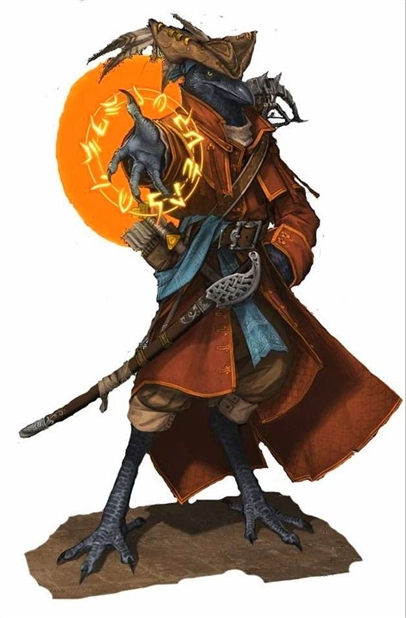
Copycat bards have no qualms about impersonating others to get ahead, borrowing not just their ideas, but their voices, appearances, and identities when necessary. It's no wonder this college appeals to a lot of kenku, who can put their unique, innate talents to great use for this purpose. That isn't to say these bards are simply content to pass as someone else for the rest of their lives — quite the contrary. A lot of them aspire to greater heights, to take something mediocre and make it into something wonderful and truly their own, proving to the world that their way to produce art is just as legitimate as any other.
COPYCAT TROUBLE
Any bard worth their salt has gotten into their fair share of trouble, but the peculiar methods of Copycat bards tend to attract more than the normal amount of problems. These bards often have to live with some sort of complication or enmity their actions have wrought in the past — it's a good thing that one of the first things they learn is to not care too much about it. If you wish, you can roll on the table below to determine a trouble your bard may have gotten into.
| d6 | Trouble |
| 1 | You're being actively pursued by artists you've "borrowed" from. Maybe one day they'll see through your layers of alternate identities and catch up. |
| 2 | Your blatant plagiarism has gotten you kicked out of several venues you've performed at. Nothing that a pair of glasses and a fake mustache can't solve, though! |
| 3 |
You're wanted in several different towns. Why is impersonating a noble or member of the guard a crime, anyway? Not that you're about to stop... |
| 4 |
You got your hands on some papers you thought were new innovative work, though some less than legitimate means... Turns out that the information inside is dangerous, and the owner is most definitely looking for it. Oops. |
| 5 |
You're deeply in debt. Dead people's work should be alright to use! Who could have guessed that their wealthy family would come for everything you own...? |
| 6 |
Your fantastic performances have granted you immense recognition... as the artist you were copying. You're mistaken for them everywhere you go, and no one has actually ever heard of you. |
Identity Theft
3rd-1eve1 College of Copycats feature
At 3rd level, you have become an expert in copying others' talents. As an action, you can touch a creature and force it to make a Wisdom saving throw. A creature can choose to fail this saving throw. On a failed save, you select a skill, tool, or language that creature is proficient in and become proficient in it as well until you finish your next long rest or gain a different proficiency with this ability. If you select a skill, tool, or language that creature is not proficient in, you gain one of its proficiencies at random instead.
Additionally, you gain proficiency with disguise kits.
Credit Where it's Due
3rd-level College of Copycats feature
Also at 3rd level, imitating others becomes so second nature that you can even copy the effects of your own Bardic Inspiration.
Whenever a creature that you can see within 60 feet rolls a Bardic Inspiration die that it got from you, you can use your reaction to record the number rolled. Once within the next minute, you can add that number to any roll that Bardic Inspiration can apply to.
You can only have one of these bonuses at a time. If a creature that you can see within 60 feet rolls another of your Bardic Inspiration dice while you already have one recorded, the new result replaces the old one.
Arcane Plagiarism
6th-leveI College of Copycats feature
At 6th level, you have upped your game and started copying spells. When a creature other than you that you can see within 60 feet casts a spell, you can use your reaction to commit that spell to memory temporarily, even if it's not on your class' spell list. The spell must be of a level you can cast, between 1st and 5th level, and have a casting time no longer than 1 action. The spells you've memorized in this way count as bard spells for you, and you can cast them as normal until you finish a long rest, at which point you lose all spells you have memorized.
You can cast one of your memorized spells without spending a spell slot, and ignoring any material components. Once you cast a spell in this way, you can't do so again until you finish a long rest.
You can have a number of spells memorized in this way equal to your proficiency bonus divided by 2, rounded down. If you use this ability to memorize a new spell while already at maximum capacity, you forget one of your choice that you memorized previously
Sincerest Flattery
14th-leve1 College of Copycats feature
At 14th level, you've flipped the tables: it's others' turn to copy you. As a bonus action, you can target a creature you can see within 30 feet of you and force them to make a Charisma saving throw. A creature can choose to fail this saving throw. On a failed save, the creature feels compelled to imitate you to the best of its ability for 1 minute. Once on each of your turns, you can force that creature to use its reaction in a variety of manners, depending on what you do in that turn:
Attack. If you take the Attack action, you can force the creature to make an attack of your choice against a creature of your choice within its reach.
Cast a Spell. If you take the Cast a Spell action, you can force the creature to cast a cantrip of your choice that it knows on a
target of your choice.
Movement. If you'll use any movement on this turn, you can force the creature to move in a straight line up to the distance you've moved. You can also fall prone or stand up to cause the creature to do the same.
Disengage, Dodge, Hide, Search. If you take one of these actions, you can force the other creature to take the same action.
Use an Object. If you take the Use an Object action, you can force the other creature to use an object of your choice within its reach. You can also toss an object away to cause it to throw away something that it's holding.
You must concentrate on this effect as you would on a spell. Once you use this ability, you can't do so again until you finish a long rest unless you spend a 4th-level spell slot to do so.
Previous Versions
| Name | Date Modified | Views | Adds | Version | Actions |
|---|---|---|---|---|---|
|
3/7/2022 1:26:03 AM
|
2
|
1
|
--
|
Coming Soon
|
Comments