



 Base Class: Bard
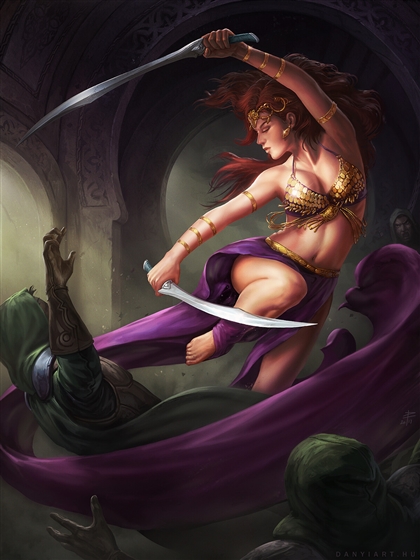
Many bards use music and instruments to channel their magical powers, but you learnt to achieve it through your body. Bladedancers don't simply produce music, they absorb it, and redirect its essence through pirouettes and gracious movements. Enhancing their physical capabilities, they spin unharmed through the battlefield, punishing those who attempt to stop their performance without skipping a step.
Bladedancing
At 3rd level, you learn a particular style of dancing called Bladedance. While Bladedancing, you gain the following benefits:
- If you aren't wearing medium or heavy armour or using a shield, your AC becomes 10 + your Dexterity modifier + your Charisma modifier (if it wasn't already higher).
- When there is exactly one enemy within 5 feet of you, you gain a +2 bonus to AC against attacks made by that enemy.
- Once per round, when an enemy moves within 5 feet of you, you may immediately move up to 10 feet without provoking opportunity attacks, without spending your reaction.
You can start and stop Bladedancing at any time you want to (no action required), but you get those benefits only if you aren't incapacitated or prone, and your speed must be greater than 0.
Favoured Partner
3rd-level College of Bladedancing feature
At 3rd level, you specialise in the use of a particular weapon, called your Partner Weapon. During a long rest you can attune yourself to one melee weapon you're touching that lacks the heavy and special properties, Your weapon does not add any bonus to your spell save DC and attack rolls, it cannot stack with any caster attunements. You are now considered proficient with that weapon, and it counts as a finesse weapon for you. You can also use your Partner Weapon as a spellcasting focus for your bard spells. When you attune to your Partner Weapon, you can also choose one of the following fighting styles:
- Dueling. When you are wielding a melee weapon in one hand and no other weapons, you gain a +2 bonus to attack and damage rolls made with that weapon.
- Great Weapon Fighting. When you roll a 1 or 2 on a damage die for an attack you make with a melee weapon that you are wielding with two hands, you can reroll the die and must use the new roll, even if they are a 1 or 2. The weapon must have the two-handed or versatile property for you to gain this benefit.
- Two-Weapon Fighting. When you engage in two-weapon fighting, you can add your Charisma modifier to the damage of the second attack.
While there is no more than one enemy within 5 feet of you, you have your partner weapon in hand and you are Bladedancing, you get the benefits of your chosen fighting style.
Endless Waltz
6th-level College of Bladedancing feature
At 6th level, you have perfected your Bladedance. While Bladedancing, you gain the additional following benefits:
- When an enemy misses you with a melee attack roll, you can use your reaction to make a weapon attack roll against a creature within your reach.
- When you are forced to make a Dexterity saving throw, you can use your reaction to roll one of your bardic inspiration dice and add it to the total. If you succeed, you can then move 10 feet as part of the same reaction without provoking opportunity attacks.
Whirlwind of Grace and Death
14th-level College of Bladedancing feature
At 14th level, your Bladedance becomes a true extension of your body and you become a true master of the art:
- Whenever you make an attack roll as a reaction due to your Endless Waltz feature and hit, you gain one extra use of your reaction, that you must use before the start of your next turn to perform one of your Endless Waltz reactions. You can do so up to a number times equal to your Charisma modifier each round.
Previous Versions
| Name | Date Modified | Views | Adds | Version | Actions |
|---|---|---|---|---|---|
|
12/20/2022 7:12:14 PM
|
13
|
1
|
--
|
Coming Soon
|
Comments