



 Base Class: Monk
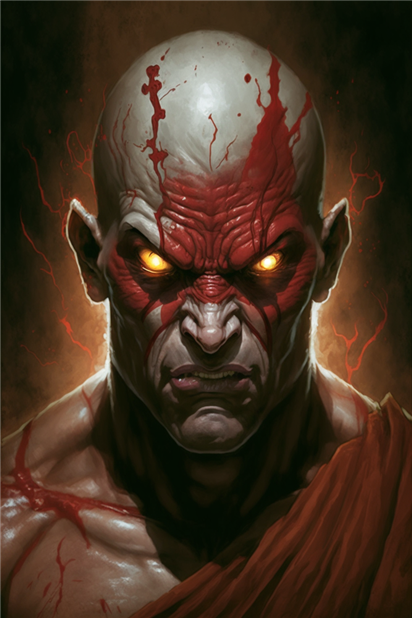
For many monks, violence is a last resort to protect yourself or others. For you, violence is your first and only response. Blood and violence are your life and, fortunately for you, you're quite good at all forms of combat. You excel at dealing damage and maneuvering around a battlefield, ruthlessly taking out enemies with a sense of glee. You never retreat from a fight.
Way of Blood monks are typically self-taught rather than training at a monastery. They often join mercenary groups or enter the service of a nation close to war. Their bloodlust can make it challenging for such monks to form or maintain close bonds, causing them to frequently switch parties or loyalties. Way of the Blood monks live by a simple principle - if it can bleed, it can be die.
Martial Arts Savant
3rd-level Way of Blood feature
You are a master of all forms of martial arts and adapt your style based on your opponent. You adopt a particular style of fighting as your specialty. Choose one of the following options. You can’t take a Fighting Style option more than once, even if you later get to choose again. At the end of a long rest, you may change your selection.
Archery
You gain a +2 bonus to attack rolls you make with ranged weapons.
Blind Fighting
You have blindsight with a range of 10 feet. Within that range, you can effectively see anything that isn’t behind total cover, even if you’re blinded or in darkness. Moreover, you can see an invisible creature within that range, unless the creature successfully hides from you.
Defense
While you are wearing armor, you gain a +1 bonus to AC.
Dueling
When you are wielding a melee weapon in one hand and no other weapons, you gain a +2 bonus to damage rolls with that weapon.
Great Weapon Fighting
When you roll a 1 or 2 on a damage die for an attack you make with a melee weapon that you are wielding with two hands, you can reroll the die and must use the new roll, even if the new roll is a 1 or a 2. The weapon must have the two-handed or versatile property for you to gain this benefit.
Interception
When a creature you can see hits a target, other than you, within 5 feet of you with an attack, you can use your reaction to reduce the damage the target takes by 1d10 + your proficiency bonus (to a minimum of 0 damage). You must be wielding a shield or a simple or martial weapon to use this reaction.
Protection
When a creature you can see attacks a target other than you that is within 5 feet of you, you can use your reaction to impose disadvantage on the attack roll. You must be wielding a shield.
Superior Technique
You learn one maneuver of your choice from among those available to the Battle Master archetype. If a maneuver you use requires your target to make a saving throw to resist the maneuver’s effects, the saving throw DC equals 8 + your proficiency bonus + your Strength or Dexterity modifier (your choice).
You gain one superiority die, which is a d6 (this die is added to any superiority dice you have from another source). This die is used to fuel your maneuvers. A superiority die is expended when you use it. You regain your expended superiority dice when you finish a short or long rest.
Thrown Weapon Fighting
You can draw a weapon that has the thrown property as part of the attack you make with the weapon.
In addition, when you hit with a ranged attack using a thrown weapon, you gain a +2 bonus to the damage roll.
Two-Weapon Fighting
When you engage in two-weapon fighting, you can add your ability modifier to the damage of the second attack.
Unarmed Fighting
Your unarmed strikes can deal bludgeoning damage equal to 1d6 + your Strength modifier on a hit. If you aren’t wielding any weapons or a shield when you make the attack roll, the d6 becomes a d8.
At the start of each of your turns, you can deal 1d4 bludgeoning damage to one creature grappled by you.
Archery
You gain a +2 bonus to attack rolls you make with ranged weapons.
Blind Fighting
You have blindsight with a range of 10 feet. Within that range, you can effectively see anything that isn’t behind total cover, even if you’re blinded or in darkness. Moreover, you can see an invisible creature within that range, unless the creature successfully hides from you.
Defense
While you are wearing armor, you gain a +1 bonus to AC.
Dueling
When you are wielding a melee weapon in one hand and no other weapons, you gain a +2 bonus to damage rolls with that weapon.
Great Weapon Fighting
When you roll a 1 or 2 on a damage die for an attack you make with a melee weapon that you are wielding with two hands, you can reroll the die and must use the new roll, even if the new roll is a 1 or a 2. The weapon must have the two-handed or versatile property for you to gain this benefit.
Interception
When a creature you can see hits a target, other than you, within 5 feet of you with an attack, you can use your reaction to reduce the damage the target takes by 1d10 + your proficiency bonus (to a minimum of 0 damage). You must be wielding a shield or a simple or martial weapon to use this reaction.
Protection
When a creature you can see attacks a target other than you that is within 5 feet of you, you can use your reaction to impose disadvantage on the attack roll. You must be wielding a shield.
Superior Technique
You learn one maneuver of your choice from among those available to the Battle Master archetype. If a maneuver you use requires your target to make a saving throw to resist the maneuver’s effects, the saving throw DC equals 8 + your proficiency bonus + your Strength or Dexterity modifier (your choice).
You gain one superiority die, which is a d6 (this die is added to any superiority dice you have from another source). This die is used to fuel your maneuvers. A superiority die is expended when you use it. You regain your expended superiority dice when you finish a short or long rest.
Thrown Weapon Fighting
You can draw a weapon that has the thrown property as part of the attack you make with the weapon.
In addition, when you hit with a ranged attack using a thrown weapon, you gain a +2 bonus to the damage roll.
Two-Weapon Fighting
When you engage in two-weapon fighting, you can add your ability modifier to the damage of the second attack.
Unarmed Fighting
Your unarmed strikes can deal bludgeoning damage equal to 1d6 + your Strength modifier on a hit. If you aren’t wielding any weapons or a shield when you make the attack roll, the d6 becomes a d8.
At the start of each of your turns, you can deal 1d4 bludgeoning damage to one creature grappled by you.
Feral Senses
3rd-level Way of Blood feature
Your senses are honed for battle allowing you to pick up even the slightest scent of blood. You gain advantage on perception and survival checks for detecting blood, detecting injured creatures, and tracking injured creatures.
Battle Ready
3rd-level Way of Blood feature
You are always ready for battle; with your lightning-fast reflexes, you can pre-empt your opponents when you sense they are about to strike. At the cost of 1 ki point, you may add your Wisdom modifier to your initiative roll. You must activate this ability before rolling initiative.
Ruthless Warrior
6th-level Way of Blood feature
You are able to quickly identify your opponent's weak points and ruthlessly exploit them. Whether it's kicking a bad knee or literally pouring salt in a wound, you will do whatever it takes to win. You can add 1d8 to the damage of a weapon attack that hits a foe missing any of its hit points. You may only activate this feature once per turn.
This damage increases to 2d8 at level 11 and 3d8 at level 17.
Battlefield Master
6th-level Way of Blood feature
You are an expert at maneuvering on the battlefield. You do not provoke opportunity attacks by moving out of your enemy's reach.
Quickdraw
11th-level Way of Blood feature
You are skilled with both melee and ranged weapons. Starting at 11th level, you can choose one simple or martial ranged weapon that lacks the heavy and special properties. The longbow is also a valid choice. You gain proficiency with this weapon if you don’t already have it. Weapons of the chosen type are monk weapons for you. When you would make a bonus action unarmed strike, you can instead make an attack with a monk weapon.
Hemophilia
17th-level Way of Blood feature
Your already impressive reflexes become even sharper when a foe draws your blood. When you would take damage, you can use your reaction to halve that damage and immediately make one melee weapon attack.
Comments