



 Base Class: Barbarian
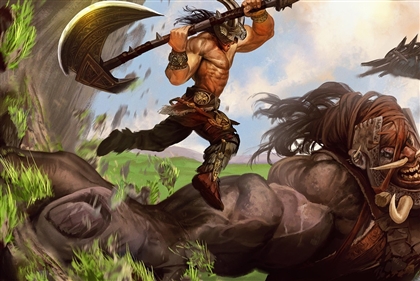
The Path of the Slayer belongs to those who dedicate their life to the hunting and removal of continuously larger and more dangerous foes. Whether it be seeking glory, a death wish, revenge, or the protection of innocents, the Slayer seeks out their prey with skill and lays down their life to finish the hunt.
The Art of Monster Slaying
Beginning at 3rd level, you have significant experience slaying, tracking, hunting, and even talking to a certain type of enemy. You know their weaknesses and how to exploit them through the experience of slaying or capturing them.
You Gain proficiency in Nature and Survival
Also choose a type of creature: aberrations, beasts, celestials, constructs, dragons, elementals, fey, fiends, giants, monstrosities, oozes, plants, or undead to become a favored enemy. Also after your take a long rest you can swap one of your favored enemies for another as long as you have seen or slain the type of creature you are swapping to beforehand.
You have advantage on Wisdom (Survival) checks to track your Favoured enemies and recall knowledge about how to track and slay them, as well Intelligence (Nature) checks on information about them and how to harvest them.
When you gain this feature, you also learn one language of your choice that is spoken by your favored enemies, if they speak one at all.
You choose one additional favored enemy, as well as an associated language, at 6th, 10th and 14th level. As you gain levels, your choices should reflect the types of monsters you have slain on your adventures.
Aberrations
Aberrations are utterly alien beings. Many of them have innate magical abilities drawn from the creature's alien mind rather than the mystical forces of the world. The quintessential aberrations are aboleths, and slaad
Beasts
Beasts are nonhumanoid creatures that are a natural part of the fantasy ecology. Some of them have magical powers, but most are unintelligent and lack any society or language. Beasts include all varieties of ordinary animals, dinosaurs, and giant versions of animals
Celestials
Celestials are creatures native to the Upper Planes. Many of them are the servants of deities, employed as messengers or agents in the mortal realm and throughout the planes. Celestials are good by nature, so the exceptional celestial who strays from a good alignment is a horrifying rarity. Celestials include angels, couatls, and pegasi.
Constructs
Constructs are made, not born. Some are programmed by their creators to follow a simple set of instructions, while others are imbued with sentience and capable of independent thought. Golems are the iconic constructs. Many creatures native to the outer plane of Mechanus, such as modrons, are constructs shaped from the raw material of the plane by the will of more powerful creatures.
Dragons
Dragons are large reptilian creatures of ancient origin and tremendous power. True dragons, including the good metallic dragons and the evil chromatic dragons, are highly intelligent and have innate magic. Also in this category are creatures distantly related to true dragons, but less powerful, less intelligent, and less magical, such as wyverns and pseudodragons.
Elementals
Elementals are creatures native to the elemental planes. Some creatures of this type are little more than animate masses of their respective elements, including the creatures simply called elementals. Others have biological forms infused with elemental energy. The races of genies, including djinn and efreet, form the most important civilizations on the elemental planes. Other elemental creatures include azers, invisible stalkers, and water weirds.
Fey
Fey are magical creatures closely tied to the forces of nature. They dwell in twilight groves and misty forests. In some worlds, they are closely tied to the Feywild, also called the Plane of Faerie. Some are also found in the Outer Planes, particularly the planes of Arborea and the Beastlands. Fey include dryads, pixies, and satyrs.
Fiends
Fiends are creatures of wickedness that are native to the Lower Planes. A few are the servants of deities, but many more labor under the leadership of archdevils and demon princes. Evil priests and mages sometimes summon fiends to the material world to do their bidding. If an evil celestial is a rarity, a good fiend is almost inconceivable. Fiends include demons, devils, hell hounds, rakshasas, and yugoloths.
Giants
Giants tower over humans and their kind. They are humanlike in shape, though some have multiple heads (ettins) or deformities (fomorians). The six varieties of true giant are hill giants, stone giants, frost giants, fire giants, cloud giants, and storm giants. Besides these, creatures such as ogres and trolls are giants.
Monstrosities
Monstrosities are monsters in the strictest sense -- frightening creatures that are not ordinary, not truly natural, and almost never benign. Some are the results of magical experimentation gone awry (such as owlbears), and others are the product of terrible curses (including minotaurs). They defy categorization, and in some sense serve as a catch-all category for creatures that don't fit into any other type.
Oozes
Oozes are gelatinous creatures that rarely have a fixed shape. They are mostly subterranean, dwelling in caves and dungeons and feeding on refuse, carrion, or creatures unlucky enough to get in their way. Black puddings and gelatinous cubes are among the most recognizable oozes
Plants
Plants in this context are vegetable creatures, not ordinary flora. Most of them are ambulatory, and some are carnivorous. The quintessential plants are the shambling mound and the treant. Fungal creatures such as the gas spore and the myconid also fall into this category.
Undead
Undead are once-living creatures brought to a horrifying state of undeath through the practice of necromantic magic or some unholy curse. Undead include walking corpses, such as vampires and zombies, as well as bodiless spirits, such as ghosts and specters.
The Art of Humanoid Slaying
At 3rd level, You can select two races of humanoid (such as gnolls and orcs) as favored enemies applying the Rulings of The Art of Monster Slaying to the checks made . These two races can be swapped between long rests so long as you have slain that type of creature before. Also after your take a long rest you can swap one of your Favored enemies for another as long as you have seen or slain the type of creature you are swapping to beforehand. Note that the humanoids that are your Favoured Enemies will likely affect your alignment (DM's Discretion)
Humanoids are the main peoples of a fantasy gaming world, both civilized and savage, including humans and a tremendous variety of other species. They have language and culture, few if any innate magical abilities (though most humanoids can learn spellcasting), and a bipedal form. The most common humanoid races are the ones most suitable as player characters: humans, dwarves, elves, and halflings. Almost as numerous but far more savage and brutal, and almost uniformly evil, are the races of goblinoids (goblins, hobgoblins, and bugbears), orcs, gnolls, lizardfolk, and kobolds.
Dragonborn
Born of dragons, as their name proclaims, the dragonborn walk proudly through a world that greets them with fearful incomprehension. Shaped by draconic gods or the dragons themselves, dragonborn originally hatched from dragon eggs as a unique race, combining the best attributes of dragons and humanoids. Some dragonborn are faithful servants to true dragons, others form the ranks of soldiers in great wars, and still others find themselves adrift, with no clear calling in life.
Dwarves
Kingdoms rich in ancient grandeur, halls carved into the roots of mountains, the echoing of picks and hammers in deep mines and blazing forges, a commitment to clan and tradition, and a burning hatred of goblins and orcs—these common threads unite all dwarves.
Elves
Elves are a magical people of otherworldly grace, living in the world but not entirely part of it. They live in places of ethereal beauty, in the midst of ancient forests or in silvery spires glittering with faerie light, where soft music drifts through the air and gentle fragrances waft on the breeze. Elves love nature and magic, art and artistry, music and poetry, and the good things of the world.
Gnolls
Gnolls are feral humanoids that attack settlements along the frontiers and borderlands of civilization without warning, slaughtering their victims and devouring their flesh.
Gnomes
A constant hum of busy activity pervades the warrens and neighborhoods where gnomes form their close-knit communities. Louder sounds punctuate the hum: a crunch of grinding gears here, a minor explosion there, a yelp of surprise or triumph, and especially bursts of laughter. Gnomes take delight in life, enjoying every moment of invention, exploration, investigation, creation, and play.
Goblinoids
Goblins belong to a family of creatures called goblinoids. Their larger cousins, hobgoblins and bugbears, like to bully goblins into submission. Goblins are lazy and undisciplined, making them poor servants, laborers, and guards.
Grimlock
The degenerate subterranean grimlocks were once human, but their worship of the mind flayers over generations of prowling the Underdark transformed them into blind, monstrous cannibals long ago.
Halflings
The comforts of home are the goals of most halflings’ lives: a place to settle in peace and quiet, far from marauding monsters and clashing armies; a blazing fire and a generous meal; fine drink and fine conversation. Though some halflings live out their days in remote agricultural communities, others form nomadic bands that travel constantly, lured by the open road and the wide horizon to discover the wonders of new lands and peoples. But even these wanderers love peace, food, hearth, and home, though home might be a wagon jostling along a dirt road or a raft floating downriver.
Humans
In the reckonings of most worlds, humans are the youngest of the common races, late to arrive on the world scene and short-lived in comparison to dwarves, elves, and dragons. Perhaps it is because of their shorter lives that they strive to achieve as much as they can in the years they are given. Or maybe they feel they have something to prove to the elder races, and that’s why they build their mighty empires on the foundation of conquest and trade. Whatever drives them, humans are the innovators, the achievers, and the pioneers of the worlds.
Kobolds
Kobolds are craven reptilian humanoids that commonly infest dungeons. They make up for their physical ineptitude with a cleverness for trap making.
Lizardfolk
Lizardfolk are primitive reptilian humanoids that lurk in swamps and jungles. Fiercely territorial, they kill when it is expedient and do whatever it takes to survive.
Merfolk
Merfolk are aquatic humanoids with the lower body of a fish. They live in small tribes beneath the waves.
Orcs
Orcs are burly raiders with prominent lower canines that resemble tusks. They gather in tribes that satisfy their bloodlust by slaying any humanoids that stand against them.
Sahuagin
Across fog-shrouded coasts or endless ocean swells, an ominous drone sounded on a conch shell chills the blood of all who hear it. This is the sound of the sahuagin hunting horn — a call to raid and battle. Coastal settlers refer to sahuagin as “sea devils,” for sahuagin have no compassion in them, slaughtering the crews of ships and decimating coastal villages.
Werebeasts
A werebeast is a humanoid that can appear as a beast, or in a terrifying hybrid form—These creatures can often be shape changers or are Humanoids that bare beast like features
Deathseeker's Frenzy
Starting at 3rd level, Your melee weapon attacks deal a bonus damage dice depending on the size of the enemy you are attacking: [roll]1d4[/roll]for a Small creature, [roll]1d6[/roll] for a Medium creature, [roll]1d8[/roll] for a Large creature, [roll]1d10[/roll]for a Huge creature, and [roll]1d12[/roll] for a Gargantuan creature.
Additionally, when below half of your hit point maximum, your bonus rage damage is doubled.
The Mark of the Slain
The Mark of the Slain is a symbolic representation of what the slayer has killed and what creatures are soon to be slain.
Starting at 6th level You can cast Hunter's Mark at 3rd level a number of times equal to your Wisdom modifier per day on a creature and maintain concentration on it even whilst raging.
When you make a Reckless Attack against a creature marked with Hunters Mark or is a Favoured Enemy, you may spend one hit dice per attack to add to the damage of that attack. Those hit dice are spent as though you had used them on a short rest, but you do not regain any health.
Relentless Hunter
At 6th level you have become a hunter that borders on having supernatural abilities.
If you eat the flesh of a Favoured Enemy provided the creature is edible (DM's Discretion), roll a Survival check DC 14, on a success you gain up to 2 memories of the creature of the DM's choice. This ability does not work on (Constructs, Elementals or Oozes)
Also, you can choose to extend your rage by thinking about one of your favoured enemies and can use your Strength modifier for (Acrobatics, Intimidation, Perception, Nature, Stealth or Survival Ability checks) whilst raging.
Giant Feller
At the Beginning at 10th level, you can’t be frightened While raging . If you are frightened when you enter your rage, the effect is suspended for the duration of the rage. In addition, you have gained significant knowledge and experience fighting dangerous foes. You have advantage on saving throws against effects caused by large or Larger Creatures.
This does not effect things in the environment placed by the creature, such as a trap.
The Slayer's Oath
As a Slayer continues to carve a massive toll of beast upon his axe, they often take the names of the beast they slay. Such names includes becoming a Trollslayer, or a Giantslayer. The greatest of these already formidable warriors are the infamous Daemonslayers or Dragonslayers, warriors who have managed to survive the encounter with two of the most ferocious creatures to ever live, slaying it and surviving to tell the tale.
Starting at 14th level, Once you kill a creature that is at least 2 sizes larger you gain the title of Slayer pertaining to that creature type. (Beast, Celestial, Dragon, Fiend, Giant, Monstrosity, Plant, Undead)
Once per Long Rest you may issue a challenge to a hostile creature that is marked with Hunter's Mark or is a Favored Enemy. This creature must have the highest CR of any hostile creature in combat. All creatures other than the challenged creature that attempts to attack you must make a Wisdom Saving throw DC 8+Proficiency+Strength Modifier. On a Failure that attack automatically misses. On a Success they can attack as normal. Both you and the challenged creature gain vulnerability to each other's damage. When you move, you must attempt to move towards the challenged creature taking the shortest route possible to get there. Your movement speed increases by 10 when moving towards the challenged creature. You have advantage on perception checks to detect the challenged creature. If the creature provokes an opportunity attack from you or damages you, you can use your reaction to make two attacks against that creature instead. This effect lasts for 1 minute. The effect ends early if you fall unconscious or die or if the creature falls unconscious or dies.
Comments