



 Base Class: Bard
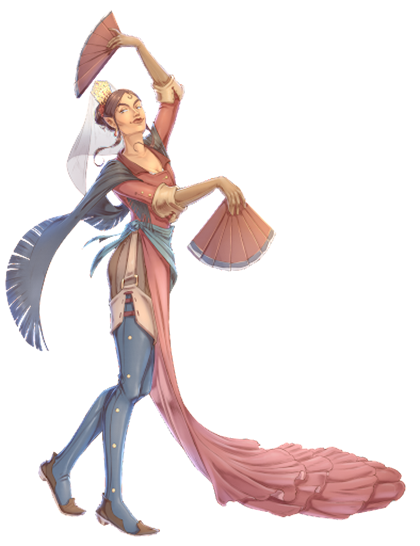
This bard subclass leans on the support role that the bard can embody. The cornerstone of the subclass is the Dance ability. A Dancer’s main job in the battlefield is to keep their dance ability up for as long as possible to enhance the damage capabilities of their allies and to prevent having to restart their dance with additional uses of inspiration. The bonuses gained by dancing are very strong, providing an ongoing bardic inspiration bonus to an ally once per turn and several advantages for the bard themselves. This is balanced by the ability’s drawbacks: the bardic inspiration roll decays every round; the bard needs to stay close to the ally they are inspiring while maintaining concentration on their dance, which puts them at risk of losing concentration because of enemy attacks; and the bard cannot cast concentration spells while dancing, as they have to maintain concentration on their dance.
In order for the bard to survive being closer to danger, they gain bonuses as they level up that make them harder and harder to hit as they go up in levels, culminating in an agile combatant who casts spells and deals damage, all while expertly avoiding the enemy’s blows and enhancing their allies’ attacks.
Somatic Performance
Starting at 3rd level, you are able to cast your magic using only the precise, meticulous, and elegant movements of your body.
You may choose to replace all verbal or material components of a spell with only the somatic component of dancing, so long as the material components of the spell do
Deadly Dance
At 6th level, your calculated movements blend dance with battle prowess, allowing you to double your attack prowess while you dance while moving across the battlefield seamlessly.
While you’re using your Dance ability, your movement increases by 10 feet and you can attack twice, instead of once, when you take the Attack action on your turn.
Danse Macabre
When you reach 14th level, you have mastered the art of dancing on the battlefield, your very presence inspiring even more combatants to transcend their physical limits in combat, becoming even deadlier in turn.
The radius of your Dance ability is now 20 feet. When you use your Dance ability, you may empower two allies simultaneously. Both allies must remain inside the 20-foot area of effect to receive the benefits of your dance. If one leaves while the other one remains in the dancing area of effect, the one remaining still enjoys the benefits, but you must use a bonus action and roll your bardic inspiration die if you wish to empower a second ally again. The new roll overrides the previous one.
For instance: The original bardic inspiration roll is 8, and you are inspiring two creatures. One creature leaves the radius of your dance and loses the benefits of the dance. A new creature enters the radius and you use your bonus action to roll your bardic inspiration die to inspire that second creature, the result being a 4. Both creatures now add 4 instead of 8 to their ability checks, saving throws, or attacks.
-
View User Profile
-
Send Message
Posted Jan 7, 2024Honestly very interesting subclass, I'll be using it the next time I play as a bard. :)