



 Base Class: Wizard
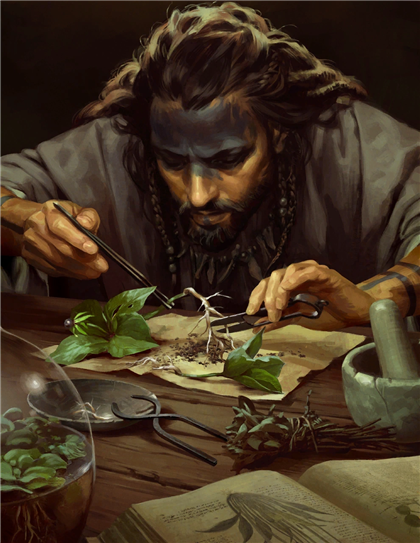
Herbamancers are Wizards that use and study plants as their principal praxis for working magic. Their studies initially lead them to investigate unusual and rare plants to make use of their properties in spellcasting. At higher levels, they create new types of plants, find more uses for herbs, and imbue plants with sentience and mobility.
Herbamancers are sometimes mistaken for Druids because of their frequent use of mystical herbs in their spellcasting. However, the Herbamancer does not have the spiritual connection to nature that the Druid has, and their special insights into nature are limited to plantlife and plant-animal interactions. Druids consider experimentation with nature to be hubristic and dangerous, but still often find much in common with Herbamancers.
This peaceful-appearing profession studies the properties of plants and plant creatures, which includes poisons and mind-altering drugs. Classified by my many as hedge magicians because of their low-cost component substitutes and perpetually dirty hands, Herbamancers would be the first to agree that their Art is cheaper and dirtier. But where hedge magicians scrounge for magical power, picking up whatever they can find, Herbamancers grow their understanding carefully and consciously, like the plants in their conservatories.
The following spells on the Herbamancer spell list already have material components that are at least partially made up of herbs or plant materials, most typically gum arabic, twigs, or incense.
- Cantrips: Dancing Lights, LIght, Shillelagh
- 1st Level: Find Familiar, Goodberry, Sleep, Witch Bolt
- 2nd Level: Acid Arrow, Barkskin, Darkvision, Dragon's Breath, Gust of WInd, Invisibility, Locate Object, Melf's Acid Arrow, Pass without Trace
- 3rd Level: Haste, Stinking Cloud, Summon Fey Spirit, Water Breathing
- 4th Level: Confusion, Hallucinatory Terrain, Otiluke's Resilient Sphere, Resilient Sphere
- 5th Level: Passwall
- 6th Level: Create Homunculus, True Seeing, Wall of Thorns
- 7th Level: Whirlwind
- 8th Level: Control Weather
- 9th Level: True Polymorph
Herbomancy Initiate
You have integrated herb lore into your arcane studies. This specialization gives you two benefits.
Nature Magic. You learn the Druidcraft cantrip. This cantrip is treated as a Wizard spell for you and is in addition to any cantrips you know by virtue of your Wizard class level. You can also attune to magic items normally restricted to Druids..
Arcane Herbalist. You learn how to harvest herbs and plant reagents and how to use them to craft antitoxin and healing potions. You gain proficiency with the Herbalism Kit. As you progress in level as a Wizard, you learn to craft additional (expendable) items.
Economical Spellcasting
You begin to understand how herbalism can aid in spellcasting. These insights change some of your material component requirements and broaden your spell list to include some Druid spells.
You can create an herbalism component pouch (also called an herb pouch), which functions as both a spell component pouch and an herbalism kit. An herb pouch costs 30 gp and weighs 4 lbs. While you have an herb pouch, you substitute herbs, extracts, incense, roots, or plants for the the normal material components of your Wizard spells. Using an herb pouch to satisfy a material component requires a free hand, but it can be the same hand you use to satisfy a gesture component.
The pouch starts with 30 gp of components. You can add herbs to your pouch to increase the gp value of its stored herbal components by spending money to purchase more components or by using the herbalism kit to gather component herbs (using rules for gathering). There is no limit to the value of the herbs you keep in your component pouch.
When you cast a spell with a costly material component using an herb pouch, you reduce the value of the component pouch by half the cost of the component listed in the spell description. As long as your pouch has a non-zero value, you can assume that you have the right herbs for spells with a zero cost material component available in your herb pouch. If the value of your pouch equals 0, you cannot use the pouch to cast spells--even spells with negligible cost components.
You cannot use herbs to replace focus components of spells, like the focus required to cast Scrying. You must still supply any focus requirements that are described in the spell description.
You can use the value of the component pouch to supply raw materials in the creation of specific magic items mentioned in the class features of this subclass. At tenth level, you can create items associated with the Herbalism kit at half the normal time and cost.
The following Druid class spells are added to your Wizard class spell list: Barkskin, Commune with Nature, Entangle, Goodberry, Pass without Trace, Plant Growth, Regenerate, Shillelagh, Speak with Plants, Transport Via Plants, Tree Stride, and Wall of Thorns.
Botanical Menagerie
Your experimentation with plants and growth cycles has given rise to your very own botanical menagerie. Pick a room or small building or fenced garden that you control (not necessarily own). You always have the herbs you need on hand within this botanical menagerie, although you must spend the appropriate time to harvest them. Any plant that you acquire that is not a creature becomes one of your specimens in your menagerie. You can harvest from your menagerie, and you are treated as though you have expertise with Herbalist Kits when you harvest from your own menagerie.
You gain proficiency in the Nature skill. Also, you can use your herbalism kit to create perfume of bewitching, potions of water breathing, and Keoghtom's Ointment (also known as Restorative Ointment) in the same manner you create Potions of Healing and Antivenom.
Complex Biogenesis
At 10th level, you can use crafting to construct creatures with the plant type within your botanical menagerie. Crafted plants are loyal to you. You can maintain control over a combined CR of creatures equal to your level. These plants cannot have the myconid subtype and cannot have a CR above your level divided by three (rounded down). A creature's XP value determines the length of time crafting requires.
Each day which you devote to a specific creature costs you 100 GP in herbal reagents and generates 100 XP worth of progress. It takes 8 hours to launch such a project. You only need to contribute an hour of your attention during the process, but last day also requires 8 hours of your attention. You do not need to contribute to the process each day, and can start a project and leave it standing untouched for weeks at a time. The creature is inert until the process is complete, at which point the creature animates as the desired plant creature.
The plant is dominated by you for 30 days and is not bound to your botanical menagerie (although it might be the most comfortable place for such a creature).Treat this effect as a dominate beast spell, with the following exceptions: The duration is 30 days. The plant does not get a saving throw. Damage does not grant the plant a saving throw. If the charm effect is ended, the plant's dominated phase ends early and the DM decides its attitude. Depending on how you treated it, it may emerge from its dominated phase with a helpful, hostile, or neutral attitude towards you.
If creating a plant would require more CRs than you have available and you don't destroy plants of your choice before the end of the process, the highest CR creature (excluding the new plant) is released from your control until you have enough space for the new one. Tearing control away from a plant is painful to it, and so any plants released early automatically become hostile to you.
For example, at 15th level you could construct a Shambling Mound, which would take 18 days and leave you with 10 more CRs to construct. But you already have four vine blights (CR 1/2), 2 yellow musk creepers (CR 2), and two kelpies (CR 4) for a total of 14 CR worth of creatures. One of the kelpies breaks free of your control and becomes hostile to you when you finish the Shambling Mound.
You continue to learn about herbalism from your menagerie. At 10th level you gain expertise with herbalism kits. You have double-expertise with herbalism kits used in your Botanical Menagerie. You can now make potions of vitality with your herbalism kit the same way you make potions of healing. Also at tenth level, you can create items associated with the Herb Pouch at half the normal time and cost.
Awakened Menagerie
Your botanical menagerie is now weaponized and can respond to threats to itself and you . You gain lair actions while within your botanical menagerie.
If you are in your botanical menagerie on initiative count 20 (losing initiative ties), you can take a lair action to cause one of the following magical effects.
- Obnoxious Overgrowth. You can change 4 contiguous 5 ft squares within the confines of the menagerie into difficult terrain. The terrain returns to normal after 1 hour.
- Vexatious Vines. You choose three squares that are difficult terrain. Any creature other than you that enters one of those squares must make a STR save against your spellcasting DC or be restrained. Restrained creatures can use an action to make another STR save. Huge and larger creatures cannot be targeted.
- Psychedelic Spores. All creatures in a 10 ft burst from a square of difficult terrain are affected by the spell Color Spray. Roll 6d10, this is the number of hit points of creatures the spores can affect, starting with creatures with the lowest current hit points (ignoring unconscious creatures). Affected creatures are blinded for one round.
- Blurring Billow. Your pollen-bearing plants shake, releasing a cloud that counts as heavy obscurement in a 10 ft burst originating from any square of difficult terrain in the menagerie.
The menagerie reacts to intruders when you are not there. When invaded, it acts on initiative 0 and can only use vexatious vines, psychedelic spores, or blurring billow and selects one of them randomly.
You continue to learn about herbalism from your menagerie. You can now produce chromatic roses like you make potions of healing.
Previous Versions
| Name | Date Modified | Views | Adds | Version | Actions |
|---|---|---|---|---|---|
|
7/24/2020 11:11:14 PM
|
18
|
4
|
1
|
Coming Soon
|
|
|
3/22/2024 3:02:36 AM
|
82
|
16
|
2
|
Coming Soon
|
Comments