



 Base Class: Fighter
Patiar uri, vinciri, verberari ferroque necari.
I will endure to be burned, to be bound, to be beaten, and to be killed by the sword.
- Gladiator Oath
Provocator
One of the oldest and most common types of gladiator, is the Provocator (from the Latin "to challenge" ). Their armature is styled after the Roman Legionary, those men who have won empire for their people under the guidance of the Gods, the Caesar, and the Senate.
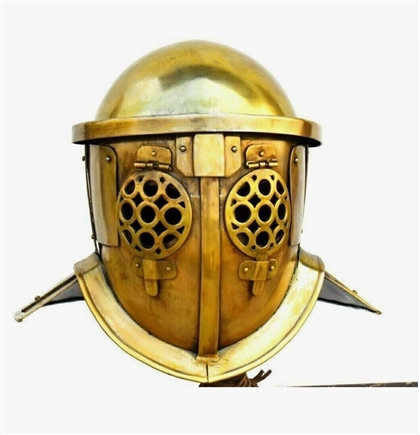
Gladiators are always highly styleized in appearance, their current armor and weapons looking dramatically different from their original source inspiration, and this is the case with the Provocator. Their helmet, the Galea Provocator, has suggestions of the Legionary helmet, but it was much closer to the source material at first. Some Provocatores even wore standard issue Legionary helmets when the type first debuted in the latter days of the Republic.
But, as time went on, modifications came about like a face mask being added along with large, grated eye hole covers, making the Provocator look like some sinister form of insect. Functionally, though, it is likely a better helmet than the standard issue Legionary's coolus.
- Armor and Weapons
The Provocator is armed and armored in much the same style as the Murmillo, though the Provocator is usually a smaller and quicker combatant. Smaller here means Roman Legionary smaller, more lythe and athletic compared to a Murmillo or Secutor who are both beefier and well-fed. They carry the Roman shortsword (gladius) and the Roman dagger (pugio). That's as far as their weaponry goes.
They employ the large, rectangular Roman Legionary shield called a scutum on their left arm though the shield is on the shorter side these days, making it a little lighter - a concession to fighting in the arena as opposed to in formation.
The rest of their armor is sparse. A manica (an arm covering that protects the arm from hand to shoulder and is made of either quilted linen or quilted linen used as padding under cured leather, banded mail, scale mail, or chain mail) is the only armor on the gladiator's right side.
Their helmet is one of the distinct elements of their armature that separates the Provocator from the Murmillo. The Galea Provocator, which means, simply, Provocator's helmet in Latin, has a small visor compared to the wide brim of the Cassis Crista worn by the Murmillo. It also has no crest, just a rounded crown. Less adornment in favor of functionality.
There is an additional piece though that you won't find on any other gladiator. That is a small rectangular or crescent shaped breastplate made of bronze, scale, or lamellar armor called a cardiophylax, spongia, or pectorale. This small plate offers some limited protection for the area around the heart and, in some cases, the entire chest and upper back. The pectorale is sometimes worn loose like a giant necklace on a strip of leather around the neck. More frequently it is held in place by straps and buckles that go around the back and over the shoulders. This simple element alone makes the Provocator one of the most heavily armored gladiators in the arena at little expense in weight added.
The Provocator's battle stance, left foot and shield forward, calls for extra armor on the left, specifically the part of the left leg exposed beneath the now shorter scutum. That is covered by an ocrea, a bronze greave over quilted linen padding (fasciae) that covers the front of the leg from the top of the foot, past the shin, to just below or just above the knee.
Other than that, the Provocator wears the same style loincloth (subligaculum) held up by a broad leather belt (baltae) that almost every gladiator wears, but it does offer some nominal slashing protection for the fighter's abdomen.
They wear or don't wear shoes as they see fit. If they do wear them, they're typically the same as those worn by the Legionaries, sturdy hobnail sandals called caligae.
An interesting side note: the Roman emperor Gaius Julius Caesar Germanicus, took his nickname from that same style of footwear when he was called "Little Boots" in his youth. In Latin, that name is Caligula.
- Provocator Tactics
Note: Most of your special attacks and your bonus attacks rely on you using your scutum as an offhand weapon. If you haven't taken the two-weapon fighting style, you need to retroactively do that before starting play as a Provocator or you won't be able to get maximum benefit from the subclass.
Gladiatorial contests almost always feature the same expected pairings of combatants. The Murmillo fights the Thraex, or the Hoplomachus. The Retiarius fights the Secutor. So it's worth noting that Provocatores fight only one another almost exclusively.
There are a few theories regarding why that's so, this one makes sound sense: as discussed, the Provocator is something of an homage to the Roman Legionary and the Legions. It's speculated that the ranks of the Provocatores are made up of former Roman soldiers, Legionaries themselves. Perhaps in need of money or fame. They may be slaves, bound into servitude due to debts or criminal activity. They are a step above the foreign prisoner of war that many other gladiators arenat any rate. They know battle from the perspective of close formation, drilling, and well disciplined order. All of these are rarities among the barbarian captives.
Ergo, the tactics employed by the Provocator in the arena. This combatant is going to take things at a slower, more deliberate pace, just like a Legion advancing, hastati first, on an unruly mob of Vandals or Franks. They're going to probe for weaknesses in a defense by making quick stabs at their enemy from behind their scutum, and by using their scutum to shove their enemy and keep them off balance.
The Provocator, like a Legionary, employs a synergy between gladius and scutum that comes with many hundreds of hours of drilling and use in the field. One tactic which demonstrates this synergy is when the Provocator pushes forward while raising his scutum from the bottom. With his sword arm coming up from underneath the scutum, and under his opponent's shield as well, they're aiming for an unobstructed shot to the groin and abdomen, areas usually lightly armored or unarmored. With scutum raised, the enemy can't even tell that the Provocator has gone low with their attack, the shield providing so much cover for its wielder.
The tactics employed by the Provocator are all about control, timing, synchronization, and engagement. Those things are realized through their scutum and gladius and done with honor and efficiency.
They know maneuvers to knock down, disarm, grievously harm, learn from, subdue, knock out, and kill their enemies with frightening quickness. The length of their gladius from behind their scutum just enough to allow for rapid thrusts, well-aimed at the most vital spots. In short, a Provocator is a killing machine, not unlike a slaughterman in an abettoir. Skill, precision, and speed like none other in the arena.
Descriptions of type to type battles between Provocatores spill over with words like intense, flawless, inspiring, masterful, and finally "a chess match." Provocatores are delivering the competent military prowess of the Roman army to any citizen who can fill their pockets with aureas.
This, the quality of their matches, certainly points to much more training, military that is, than many of these other warriors have received at the ludus.
There are different tiers of gladiators coming from the many ludi around Rome, they all cost their lanistae considerable coin, but a Provocator is of a different caliber. You can't say better because there are many armies around the mundus and many styles of warfare. A Legionary, strong next to other Legionaries, but perhaps not so much alone, has a different mindset and respect for warfare than a Thracian, German, Celt, Viking, Dacian, Ostrogoth, or Gaul.
There are undoubtedly warriors from those places who are amazing combatants, Flamma is from Syria after all, but none have the mental discipline or dedication to the art of war than that found in a well-trained Legionary. For the Provocator, half the fight is cerebral. A rare quality, indeed.
It should be noted that the name Provocator comes supposedly from these fighters challenging other gladiators, or being challenged themselves to fight. This can be in defense of one's ludus, one's honor, perhaps just for fame and lucre, but it's a different matchup from the rest of them before the fight even begins.
To the Dungeon
Granted, this time it's voluntary, your last time in a dungeon wasn't, and that makes a world of difference. Now you go out to seek your fortune and your future.
What might await your adventurous spirit in those dark and dank places underground, unused for centuries? More importantly, how will you spend your wealth?
Most certainly, the lessons you've taken from the Legion and the ludus will serve you well. You are made like no other. Certainly Pluto will smile on you as you deliver soul after soul to his Underworld home, keeping him sated so that he fills your purse with coin. There are worse ways to retire from the arena.
Note: You need to create a custom inventory entry labeled Provocator Armor, making the cost 50 gp and the weight 20 pounds.
Provocator Skills
- Maneuvers
You know four maneuvers from your Legionary training that are applicable to the arena. The synergy between gladius and scutum unmatched by any other type of gladiator.
The Uppercut: Pushing into your opponent while going down to one knee, you swing upward with your sword arm underneath your shield and theirs, stabbing up and into their likely unarmored groin and abdomen areas doing 3d6 + STR modifier piercing damage. This maneuver can be used a number of times per long rest equal to your proficiency bonus, but only once successfully on any given opponent. Whether or not this attack is successful, it counts against your number of uses. Damage for this attack scales with level, doing 4d6 at 7th level, 5d6 at 10th level, 6d6 at 15th level, and 8d6 at 18th level.
Note: This maneuver, like the rest, is intended to be used against a shielded humanoid opponent, but its use is as effective against any creature less than large in size. Your DM must determine its potential effect on large and larger creatures.
Shove and Thrust: A number of times per long rest equal to your proficiency bonus, you can shove into your opponent with your shield going left to right, moving their shield and exposing their side to a thrust of your gladius to their rib area. This attack does 3d6 + STR modifier piercing damage if successful and can only be used once successfully on an opponent. Damage for this attack scales with level, doing 4d6 at 7th level, 5d6 at 10th level, 6d6 at 15th level, and 8d6 at 18th level.
Down and Over: A number of times per long rest equal to your proficiency bonus, you can shove down and into your opponent with your shield, exposing their chest, shoulder, and head area to a thrust of your gladius over the top of your shield. This attack does 3d6 + STR modifier piercing damage if successful and can only be used once successfully on an opponent. Damage for this attack scales with level, doing 4d6 at 7th level, 5d6 at 10th level, 6d6 at 15th level, and 8d6 at 18th level.
Shield Kick: A number of times per long rest equal to your proficiency bonus, you can open your stance and kick into your opponent's shield attempting to knock them back and down. If your attack is successful, they must make a DC 13 STR saving throw or be knocked back 5 feet and prone, taking 1d4 + STR modifier bludgeoning damage, and you will have advantage on them if you attack in your next turn. If their saving throw is successful, they remain upright and take no damage. The DC and damage on this attack scale with level. The DC is 15 at 7th level, 17 at 10th level, 19 at 15th level, and 21 at 18th level. The damage dice are 2 at 7th level, 4 at 10th level, 6 at 15th level, and 8 at 18th level.
- Offhand Shield
You can use your scutum for offhand bonus attacks that do 1d4 + STR modifier bludgeoning damage on a successful hit. This damage scales to 2d4 at 10th level. Note that the STR modifier is only added if you're using the two-weapon fighting style.
- Acrobatics and Athletics
If you don't already have them, you gain proficiency in both the Dexterity (Acrobatics) and Strength (Athletics) skills.
- Improved Critical
You score critical hits on rolls of 19 and 20.
- Improved Initiative
Your time in the legion taught you well to anticipate the actions of your enemy. This knowledge translates into a +2 bonus to your initiative rolls.
- Savage Attacker
As calm and emotionless as you can look in battle, it means nothing. Your attacks are meted out with a strength and precision to match the most savage opponents' raw emotion and brute force. You gain the Savage Attacker feat.
Provocator Armor and Weapons
- Your Armor
The Provocator is equipped for the arena much like the Murmillo and Secutor. Their panoply consists of a knee high greave on their left leg (ocrea) over padding (fasciae), as well as either a quilted linen padding by itself or padding under a leather or scale, banded, or chain mail sleeve (manica) that goes from hand to shoulder, and a slightly shortened Legionary shield (scutum) on their left forearm.
- The Cardiophylax, Pectorale, or Spongia
Separating them from their peers is a thing unique among gladiators, a metal chest covering called either a cardiophylax, pectorale, or spongia. The piece either hangs freely from their neck like a very large necklace, or is fastened to the chest with leather straps and buckles that go over the shoulders and around the back. This piece of armor is either bronze or iron and is either a solid plate, scale mail (lorica squamata), or lamellar (lorica laminata). Though leaving a lot to be desired if you want full coverage, the pectorale is still a bit of added insurance when compared to doing without.
- Restrictions
Playing as a gladiator subclass is a little different than playing other subclasses and necessarily so. A huge part of the draw is aesthetic, and a desire for historical accuracy. Other than that, for gladiators, many hundreds of hours went into training on how to effectively use the weapons and armor specific to the type you've chosen. So changing any of it is not to be taken lightly. You may add weapons that aren't part of your kit such as a bow (arcus) or maul (malleus), and you may add protective items of a magical nature that don't replace a piece of your Provocator Armor, i.e. Gauntlets of Ogre Power, Cloak of Protection, etc. Rings, amulets, boots, torques, even bracers could be usable, but the ultimate decision on acceptable or not resides with your DM.
- Your Armor Class
With the addition of the pectorale, your base AC starts at 14. It scales to 16 at 10th level, and 18 at 15th level.
- Your Weapons
The weapons of the Provocator are very basic. In fact, they only use two, and one of them 99 percent of the time. There's the Roman stabbing shortsword (gladius) and the Roman dagger (pugio).
You are welcome to use other weapons, you can even replace your gladius with a magical shortsword because it's an apples to apples exchange. But if you use a scimitar, you can't use any of your special features or attacks. Same with your scutum though it's much more strict. You cannot swap out another type of shield with the scutum. It's size and shape are a large part of your training and technique.
You can use a bow (arcus), but none of your special feature attacks go with it. You can use the malleus (a Roman maul) or the spatha (Roman longsword) but none of your special attacks can be used while you're wielding them.
- Ranged Attacks
It's recommended that you have some sort of ranged weapon, of course. Although none of your special attacks are ranged, you'll want to have the option to make a ranged attack every once in a while. The arcuballista is a Roman light crossbow and the arcus is the standard Roman bow - a short composite bow that does longbow damage but has a range of 120/480. Additionally, you can use things like a javelin (pilum) or spear (hasta) for closer thrown options. This type of homebrew must be discussed with and agreed upon with your DM.
- Playing a Gladiator
Much of the enjoyment of playing a gladiator comes from having the restrictions you do. These are iconic historical figures, and that's a large part of the draw in playing as one. In your hands, a shortsword becomes something greater.
Your special features and maneuvers set you apart from other subclasses at the expense of some options. So ask yourself if that's acceptable in the long term. This is a session zero conversation with your DM.
Support Skill Expertise
At 3rd level, you can choose in which one of several support skills you have expertise. The skill is still dependent on the associated ability score. You are able to choose another expertise when you reach 10th level.
Alchemist's Supplies
You have expertise with Alchemist's Supplies.
Animal Handling
You have expertise with Animal Handling.
Arcana
You have expertise with Arcana.
Cartographer's Tools
You have expertise with Cartographer's Tools.
Cook's Utensils
You have expertise with Cook's Utensils.
Deception
You have expertise with Deception.
Herbalism Kit
You have expertise with Herbalism Kit.
History
You have expertise with History.
Leatherworker's Tools
You have expertise with Leatherworker's Tools.
Mason's Tools
You have expertise with Mason's Tools.
Medicine
You have expertise with Medicine.
Nature
You have expertise with Nature.
Religion
You have expertise with Religion.
Smith's Tools
You have expertise with Smith's Tools.
Survival
You have expertise with Survival.
Take Down (Pulsate ad Terram)
- Take Down (Pulsate ad Terram)
At 7th level, you learn the Take Down attack in which you charge your opponent with your scutum, push them to the ground, and stick your gladius in their ribs while sitting atop them.
The attack begins with a roll to hit. If successful, your opponent must roll a DC 15 STR saving throw or be knocked prone and take normal shield damage. Once prone, you may make another attack roll on them with advantage to stab them in the ribs doing 4d6 + STR modifier piercing damage. Additionally, you can choose to stay stop them and attack with advantage in the next round, but they can make another saving throw to knock you off and negate your action for that turn. If you stay on top of them, you can do another 4d6 + STR piercing damage. Your opponent can strike back at you but with disadvantage. If the initial attack is unsuccessful, you've overexposed yourself to your opponent, they take no damage and can attack you with advantage on their next turn.
The DC for the saving throw for this attack and the attack's damage scale with level. The DC is 17 at 10th level, 19 at 15th level, and 21 at 18th level. The damage dealt is 5d6 at 10th level, 6d6 at 15th level, and 8d6 at 18th level.
You can attempt this maneuver 3 times per long rest but not on the same opponent twice, whether the attack is successful or not.
- Improved Critical
Starting at 7th level, you score critical hits on rolls of 18-20.
- Battle Preparedness
Your ability to rapidly assess battle situations along with your exhausting training regimen have given you a +2 bonus to initiative rolls, improved your movement speed by 5 feet per round, and given you advantage on Intelligence ability checks. You've also gained 1 hit point per level due to your pain management skills.
Controlled Frenzy (Imperium Furor)
- Controlled Frenzy (Imperium Furor)
At 10th level, you've learned how to enter a controlled frenzy, as if you were under the effect of a Haste spell. For three rounds, you get an extra attack and an extra bonus attack, as well as a +2 bonus to your AC score. This frenzy can last for up to three rounds, but when the frenzy ends, you suffer one level of exhaustion. This limits your ability to perform this maneuver repeatedly, but you can use it up to three times per long rest.
- Improved Armor Class
At 10th level, your AC improves by 2 points, making your base AC 16.
- Improved Accuracy
Your training is paying great dividends, gaining you a +2 bonus to all of your melee attack rolls.
Mighty Cleave (Fortis Adhaesit)
- Fortis Adhaesit
At 15th level, you've learned a technique called Mighty Cleave (Fortis Adhaesit), in which you strike down on the top of your opponent's shield and into their upper chest and neck area doing 6d6 + STR modifier piercing damage and reducing their AC by 2 points.
It's up to your DM how to handle this attack against a non-humanoid or a creature with natural armor. Perhaps you damage them so badly that they're less able to defend themselves. You may attempt this maneuver 3 times per long rest but not twice on the same opponent whether the attack was successful or not. If the opponent has a higher Strength score than yours, they can attempt a DC 19 STR saving throw to take only half damage. When you reach 18th level, that DC becomes 21 and the damage dice 8d6.
- Improved Armor Class
At 15th level, your AC score improves by 2 points as your base AC becomes 18.
- Improved Initiative
Your training has elevated your ability to predict an opponent's actions to the point where you have advantage on your initiative rolls.
- Strong Parry (Fortis Eludere)
At 15rh level, you've gained such an effective parry maneuver that you can deduct 2 from an opponent's attack roll retroactively, potentially making them miss when they would have hit. You can use this maneuver 3 times per long rest.
- Superior Critical
You now score critical hits on rolls of 17-20.
The Killing Stroke (Occisio Plaga)
- The Killing Stroke (Occisio Plaga)
At 18th level, you've learned to watch your opponents so intently that you can catch them mid-movement, transitioning their grip, or even blinking, giving you just enough time to slide your blade into their armpit, severing their brachial artery and inducing a quick death.
You make your attack roll for this maneuver with a -5 to hit. If successful, your initial strike does 10d6 + STR modifier piercing damage and will continue to do 6d6 bleeding damage per round until your opponent dies or they have a Heal spell cast on them.
While bleeding out, they perform any action at disadvantage. If your opponent makes a DC 21 DEX saving throw, they can halve this damage and avoid the rapid blood loss.
You may attempt this maneuver a number of times per long rest equal to your proficiency bonus but not on the same opponent twice.
Comments