



 Base Class: Monk
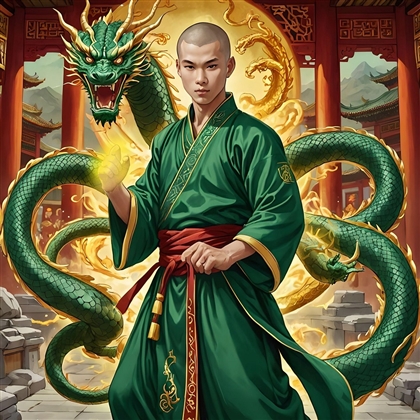
Millenia ago, in the early days of what would be the Shou empire, the Immortal Dragons descended from heaven in human form, to lead mortals as the first monarchs of Shou Lung. Each of them, during their reign, taught the mortals one of the nine heavenly virtues: compassion, bravery, literacy, tradition, industry, love, justice, prosperity and artifice. In their wisdom, however, they predicted that their principles would be abandoned or corrupted by the fallible humans after they left the world, and in order to preserve these ideals they selected a few virtuous men and established a monastic order to champion their cause. The headquarters of this order would be the Temple of the Immortal Dragons, located at a mountain top in a mystical island. There, the Immortal Dragons taught the monks the secret to channel their inner chi into radiant energy, just like dragons harness their energy into their breath. In order to protect their champions from their worldly foes, the Dragons made the island unreachable, except when the path to the mortal world is open, for one month - a lunar cycle - every nine years. During its abscence, the monks of Mount Penglai spend each year studying and meditating over one of the nine heavenly virtues, and after each cycle they visit and observe the mortal world to check if their interference is needed to promote and maintain peace and order.
Dragon Fist
At the 3rd level, when you hit a creature with an unarmed attack you can spend a ki point to deal radiant damage to the target, in addition to the martial arts bludgeon damage. This extra damage is 2d8, for a cost of 1 ki point spent. You can increase the damage at higher levels, raising it by 1d8 for each extra ki point spent, to a maximum damage of 5d8. This damage increases by 1d8 if the target is an undead or fiend, to a maximum damage of 6d8. The maximum number of ki points a monk can spend with this power is shown in the table below:
monk level maximum ki points damage dealt*
3-5 1 2d8
6-8 2 3d8
9-11 3 4d8
12+ 4 5d8
* add 1d8 if the enemy is a fiend or undead
Lay On Hands
At 6th level, you channel your ki to heal wounds. You have a pool of healing power that replenishes when you take a long rest. With that pool you can restore a total number of hit points equal to your monk level x5. As an action, you can touch a creature as you draw power from the pool to restore a number of hit points to that creature, up to the maximum amount remaining in the pool. Alternatively you can expend 5 hit points from your pool of healing to cure the target of one disease only, or to neutralize one poison affecting it. You can cure multiple diseases and neutralize multiple poisons with a single use of Lay on Hands, expending hit points separately for each one. This feature, though, has no effect on undead and constructs.
Chosen Weapon
At 11th level, you gain proficiency with a "chosen weapon". This weapon can be any melee or ranged weapon, simple or martial, that lacks the "heavy" and "special" properties. The glaive is also a valid choice. A chosen weapon is considered a monk's weapon to all purposes. As an alternative, you can chose any of the traditional monk weapons to be your "chosen weapon". In addition, you gain the ability to augment your chosen weapon's effectiveness with your ki. As a bonus action, you can expend up to 3 ki points to grant your chosen weapon a bonus to attack and damage rolls when you attack with it. This bonus equals the number of ki points you spent, and lasts for one minute or until you use this feature again. Furthermore, attacks with a ki-augmented weapon count as magical for the purpose of overcoming resistance and immunity to nonmagical attacks and damage. Note that this feature has no effect on a magical weapon that already have a bonus to attack and damage rolls.
Deceive the Mind
Beginning at the 17th level, you can spend your ki points to cast spells from the schools of illusion and enchantment (charm spells). By connecting your ki with the targets' you can access and manipulate their minds, both by exerting a more direct influence or by inserting in their minds what you want them to see, experience or feel. To cast one of these spells you use its casting time and other rules, but you don't need material components for it. To cast a spell a monk must spend its level plus one ki points. If the spell has an increased effect, you can enhance its level by 1 for each additional ki point you spend. The maximum number of ki points you can spend to cast a spell this way (including its base ki point cost and any additional ki points you spend to increase its level) is six, to a maximum spell level of 5. Wisdom is your spellcasting ability.
Previous Versions
| Name | Date Modified | Views | Adds | Version | Actions |
|---|---|---|---|---|---|
|
6/17/2024 9:10:35 PM
|
24
|
0
|
1
|
Coming Soon
|
|
|
6/20/2024 11:05:27 PM
|
29
|
0
|
1.1
|
Coming Soon
|
-
View User Profile
-
Send Message
Posted Jun 29, 2025This subclass works for the 2014 Legacy Monk. For an update using the 2024 Monk version, check:
https://www.dndbeyond.com/subclasses/2624122-warrior-of-the-immortal-dragons