



 Base Class: Fighter
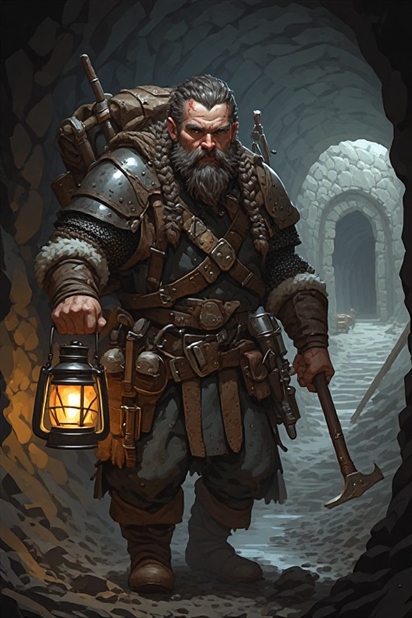
Pioneers are fighters trained to lead expeditions through dangerous environments. Some serve as military engineers or ruin scouts, while others work as surveyors, rescuers, fire wardens, or salvage specialists. When a company encounters a collapsed passage, trapped vault, abandoned mine, or unfamiliar machine, the Pioneer is usually sent forward to determine whether the way can be made safe.
Their expertise is practical rather than academic. A Pioneer may know little about the people who built an ancient ruin, but they understand how structures bear weight, how machinery fails, and how hazards shape movement. They combine martial discipline with field engineering, investigation, emergency response, and a trained eye for useful terrain.
Pioneers read constructed spaces as carefully as other warriors read an opponent. They recognize weakened supports, concealed passages, mechanical traps, and prepared ambush sites. They know when to reinforce a route, find another way around, or force an opening. In combat, they turn those same observations against their enemies by controlling movement and creating opportunities for their allies.
Some Pioneers learn their trade as military sappers or expeditionary engineers. Others gain experience in mines, fire brigades, siege crews, ruined districts, or treasure-hunting companies. Whatever their background, they share one guiding principle:
Entering a dangerous place is easy—the hard part is getting out.
Level 3: Bricolage
Your professional and expeditionary experience has prepared you for hazardous structures and forgotten places.
Fieldwork. Gain expertise in the Survival skill.
Handy. You gain proficiency with Tinker’s Tools, Thieves' Tools, and another tool of your choosing.
Conversant. You gain proficiency in one of the following skills: Arcana, Investigation, Medicine, Nature, Religion, or Survival.
Eye for Quality. You can accurately estimate the age, general quality, and approximate value of a nonmagical constructed object after examining it for 1 minute.
Level 3: Exploit Terrain
You know how to turn confined spaces, obstacles, and poor footing into tactical advantages.
Exploit Terrain. Once on each of your turns when you hit a creature with a weapon attack, you can deal an additional 1d6 damage of the weapon’s type if at least one of the following is true:
- The target is within 5 feet of a wall, pillar, large fixed object, or another creature.
- The target is standing in difficult terrain.
- The target has Half Cover or Three-Quarters Cover from you.
After dealing this additional damage, choose one of the following effects:
Reposition. You move up to 5 feet without provoking Opportunity Attacks from the target.
Dislodge. If the target is no more than one size larger than you, move it up to 5 feet to an unoccupied space you can see. This movement does not provoke Opportunity Attacks.
Hamper. The target’s Speed is reduced by 10 feet until the start of your next turn.
A creature can take this additional damage only once per turn.
Level 7: Passagewright
Years spent in dangerous structures have taught you to move quickly without overlooking the details that keep you alive.
You gain the following benefits:
Climber. You gain a Climb Speed equal to your Speed.
Rapid Assessment. You can take the Search or Study action as a Bonus Action.
Hazard Awareness. You have Advantage on saving throws against traps and non-creature environmental hazards. You also have Advantage on ability checks made to identify or understand:
- traps
- secret doors
- concealed compartments
- unstable structures
- mechanical devices
- recent alterations to a building or ruin
- the probable cause of a collapse, explosion, or fire
Evacuation Route. While you remain on the same plane of existence, you always know the approximate direction of the route by which you entered the current building, dungeon, cave system, or enclosed complex. This does not reveal a safe path if the original route has been blocked, altered, or destroyed.
Level 10: Sapper
You have learned to create openings where none should exist and to use the architecture of a battlefield against your enemies.
Demolition. Your weapon attacks deal double damage to objects and structures. You automatically recognize whether destroying a visible structural feature—such as a support, bridge mechanism, door brace, chain, or retaining wall—is likely to produce an immediate collapse or other obvious hazard. This knowledge does not reveal concealed consequences or magical effects.
Abuse Terrain. The additional damage from Exploit Terrain becomes 2d6.
You gain another Exploit Terrain option:
Sunder. When you use Exploit Terrain, you can turn the space the target occupied into a 5-foot-square area of difficult terrain. The terrain takes a form appropriate to the environment and remains until it is cleared or otherwise removed. Attack rolls against a creature occupying that area have Advantage.
Level 15: Contingency Plan
You are accustomed to reacting when floors give way, traps activate, machinery fails, or an ally steps exactly where you told them not to.
When you or another creature you can see within 15 feet of you is hit by an attack or fails a Strength or Dexterity saving throw, you can use your Reaction to roll 1d10.
Apply the result to one of the following:
- Add the number rolled to the creature’s AC against the triggering attack, potentially causing the attack to miss.
- Add the number rolled to the creature’s saving throw, potentially causing the save to succeed.
You can use this Reaction after seeing the attack roll or saving throw, but before the effects of the attack or failed save are resolved.
If this feature causes the attack to miss or the saving throw to succeed, the protected creature can immediately move up to 10 feet without provoking Opportunity Attacks.
You can use this feature a number of times equal to your Proficiency Bonus. You regain all expended uses when you finish a Long Rest.
Level 18: Master Expeditioner
You can read a battlefield as though you had studied its plans for years.
As a Bonus Action, you enter a state of complete tactical and environmental awareness for 1 minute. This state ends early if you have the Incapacitated condition. Once you use this feature, you cannot use it again until you finish a Long Rest unless you expend a use of Second Wind to activate it again.
While this feature is active, you gain the following benefits:
Perfect Spatial Awareness. You have Blindsight with a range of 20 feet.
Unimpeded Advance. Difficult Terrain costs you no additional movement. Your movement is not reduced while squeezing, climbing, or moving through the space of a creature that is at least one size larger than you. You cannot end your movement in another creature’s space.
Total Exploitation. The additional damage from Exploit Terrain becomes 2d10, and you may apply two of its effects at a time. You can also use Exploit Terrain when you hit with an Opportunity Attack, even if you already used it during your turn.
Perfect Contingency. Once during each round, you can use Contingency Plan without expending one of its uses. You must still use your Reaction normally.
Comments