



 Base Class: Fighter
Witchers are mutated monster hunters trained to face creatures that ordinary warriors cannot survive. Through brutal alchemical alteration, harsh physical conditioning, and years of specialized combat training, a Witcher becomes faster, sharper, and more resilient than a common soldier.
A Witcher is not made through casual training, battlefield experience, or a late-life decision. To choose this Martial Archetype, a character must have begun Witcher training as a child, usually before the age of 5, and must have undergone years of harsh instruction, monster study, alchemical exposure, and physical conditioning. For most human-like races, a character must have entered Witcher training before reaching 18 years of age. This subclass represents a lifelong path that began long before the character became an adventurer.
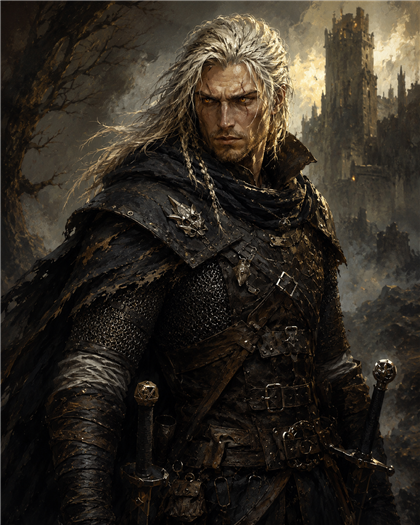
A Witcher’s body is permanently changed by mutation. When the mutation fully manifests, the character’s hair becomes silver or white, regardless of its original color, and their eyes become yellow or orange with cat-like pupils. These changes are permanent and visibly mark the character as something no longer entirely ordinary.
Unlike traditional spellcasters, Witchers do not rely on complex magic, spell slots, or broad spell lists. Instead, they use simple combat magic known as Signs: quick cantrips cast through gestures and woven directly into swordplay. The only spells granted by this subclass are Witcher Signs. These Signs are unique to the Witcher subclass and cannot be replaced with other cantrips unless the DM allows it.
Witchers fight with preparation, instinct, and precision. They carry both steel and silver blades, choosing the correct sword for the enemy before them. Steel is used against mortal foes, while silver is reserved for monsters, cursed beings, undead, fiends, and other unnatural creatures.
Witchers are also skilled investigators, trackers, and alchemists. They study monsters, curses, poisons, wounds, tracks, and weaknesses, using that knowledge to craft specialized potions and blade oils. Their alchemical creations require proper tools, ingredients, and preparation, and are dangerous or poisonous to those without Witcher mutations.
The Witcher Martial Archetype is not compatible with multiclassing. A character cannot normally become a Witcher through late training, casual study, or ordinary battlefield experience. Likewise, a Witcher cannot normally abandon this path for another class. This restriction may only be changed if the DM specifically allows it.
Level 3: Witcher Training
When you choose this archetype at 3rd level, you gain proficiency in two of the following skills of your choice: Arcana, Investigation, Medicine, Nature, Perception, Stealth, or Survival.
You also gain proficiency with either alchemist’s supplies or herbalism kits.
In addition, you have advantage on Intelligence checks made to recall information about aberrations, beasts, fiends, monstrosities, undead, curses, and magical diseases, at the DM’s discretion.
Level 3: Mutant Physiology
Your body has been permanently altered through dangerous alchemy, brutal conditioning, and unnatural mutation. You gain the following benefits:
-
You gain darkvision out to a range of 60 feet. If you already have darkvision, its range increases by 30 feet.
-
You have advantage on saving throws against poison.
-
You have resistance to poison damage.
-
You can add half your proficiency bonus, rounded down, to any Wisdom (Perception) or Wisdom (Survival) check you make that does not already include your proficiency bonus.
Your mutation also leaves a visible mark. Your hair becomes silver or white, regardless of its original color, and your eyes become yellow or orange with cat-like pupils. These changes are permanent and mark you as something no longer entirely ordinary.
Level 3: Steel and Silver
You are trained to carry and fight with paired monster-hunting blades: one of steel and one of silver.
You can designate two longswords you possess as your Witcher swords: one steel sword and one silver sword. You can designate these weapons at the end of a long rest.
Your Witcher swords gain the following benefits for you:
-
You can draw or stow both Witcher swords as part of the same object interaction.
-
Your silver sword counts as silvered for the purpose of overcoming resistance and immunity to nonmagical attacks.
-
When wielding one of your Witcher swords in one hand, while not wielding a shield or a second weapon, you gain a +1 bonus to AC.
-
At 7th level, both Witcher swords count as magical for the purpose of overcoming resistance and immunity to nonmagical attacks.
Steel for Mortals, Silver for Monsters
Your training teaches you when to use each blade.
Once on each of your turns, when you hit a humanoid, giant, or beast with your steel sword, you can deal extra damage equal to your proficiency bonus.
Once on each of your turns, when you hit an aberration, celestial, construct, dragon, elemental, fey, fiend, monstrosity, ooze, plant, undead, or cursed creature with your silver sword, you can deal extra damage equal to your proficiency bonus.
You must be wielding the correct sword for the target’s creature type to gain this extra damage.
At the DM’s discretion, certain magically altered, cursed, possessed, or transformed humanoids may count as monsters for the purpose of your silver sword.
Level 3: Witcher Signs
You learn five simple forms of combat magic known as Witcher Signs: Aard, Igni, Quen, Axii, and Yrden.
These Signs are treated as cantrips for you. They do not require spell slots, and you can use them at will. Unlike most cantrips, Witcher Signs are designed to be cast quickly in the flow of melee combat. Each Witcher Sign has a casting time of 1 bonus action.
Intelligence is your spellcasting ability for your Witcher Signs.
Witcher Sign save DC = 8 + your proficiency bonus + your Intelligence modifier.
Witcher Sign attack modifier = your proficiency bonus + your Intelligence modifier.
A Witcher Sign requires one free hand to cast. You may use the same hand that is holding a one-handed or versatile weapon, but not while wielding a shield, a second weapon, or a two-handed weapon.
You can cast only one Witcher Sign on your turn.
The only spells granted by this subclass are Witcher Signs. These Signs are unique to this subclass and cannot be replaced with other cantrips unless the DM allows it.
Level 7: Witcher Alchemy
Your altered body can withstand dangerous alchemical mixtures that would poison or kill ordinary creatures. You also learn how to craft specialized Witcher potions and blade oils using alchemist’s supplies or an herbalism kit.
When you finish a long rest, you can create a number of Witcher alchemical items equal to your proficiency bonus, provided you have access to alchemist’s supplies or an herbalism kit and suitable ingredients, as determined by the DM. Each item you create must be a Witcher potion or Witcher blade oil.
Each alchemical item has one use. Once used, it is consumed. Unused alchemical items remain potent until the end of your next long rest, after which they lose their effectiveness.
Drinking a Witcher potion or applying a Witcher blade oil requires a bonus action.
You can have only one Witcher potion active at a time. If you drink another Witcher potion while one is already active, the previous potion ends. Witcher blade oils do not count against this potion limit.
If a creature other than you consumes one of your Witcher potions, it must succeed on a Constitution saving throw against your Witcher Sign save DC or become poisoned for 1 minute. The poisoned creature can repeat the saving throw at the end of each of its turns, ending the effect on itself on a success.
The available Witcher alchemical items are Black Blood, Cat, Swallow, Thunderbolt, and Blade Oil, though the DM may allow additional Witcher formulas to be discovered during the campaign.
Level 10: Monster-Slayer’s Instinct
As a bonus action, choose one creature you can see within 60 feet of you. For 1 minute, you mark it as your quarry. The mark ends early if the creature drops to 0 hit points, if you are incapacitated, or if you mark another creature.
While the creature is marked, you gain the following benefits:
-
You have advantage on Wisdom (Perception) and Wisdom (Survival) checks made to find or track it.
-
Once on each of your turns when you hit it with a weapon attack, you deal extra damage equal to your Intelligence modifier, minimum of 1.
-
When it forces you to make a saving throw, you can add 1d4 to the roll.
If the marked creature is an aberration, beast, fiend, monstrosity, undead, or cursed creature, the extra damage becomes equal to your proficiency bonus instead of your Intelligence modifier.
You can use this feature a number of times equal to your proficiency bonus, and you regain all expended uses when you finish a long rest.
Level 15: Superior Mutations
Your mutations have stabilized, making you stronger, faster, and harder to kill.
You gain the following benefits:
-
You are immune to disease.
-
You have advantage on saving throws against being charmed or frightened.
-
You can maintain up to two Witcher potions at the same time instead of one.
-
Your Blade Oil damage from Witcher Alchemy increases from 1d6 to 1d8.
Mutant Reflex
When a creature you can see hits you with an attack, you can use your reaction to reduce the damage by 1d10 + your Fighter level.
If this reduces the damage to 0, you can move up to 10 feet without provoking opportunity attacks.
You can use this reaction a number of times equal to your proficiency bonus, and you regain all expended uses when you finish a long rest.
Level 18: Master Witcher
You have become a nightmare to monsters and a legend among common folk.
When you mark a creature with Monster-Slayer’s Instinct, you can enter a heightened hunting state for 1 minute. While in this state, you gain the following benefits against your marked quarry:
-
Your weapon attacks against the marked creature score a critical hit on a roll of 19 or 20.
-
Once on each of your turns, after you take the Attack action against the marked creature, you can cast one Witcher Sign as part of the same bonus action used to mark the creature, or as a bonus action on later turns.
-
If the marked creature is an aberration, beast, fiend, monstrosity, undead, or cursed creature, it cannot regain hit points while it is marked by you.
-
When the marked creature misses you with an attack, you can move up to 10 feet without provoking opportunity attacks.
Once you use this feature, you cannot use it again until you finish a long rest.
Previous Versions
| Name | Date Modified | Views | Adds | Version | Actions |
|---|---|---|---|---|---|
|
7/1/2026 11:55:18 AM
|
2
|
0
|
1
|
Coming Soon
|
|
|
7/1/2026 12:04:32 PM
|
2
|
0
|
1.1
|
Coming Soon
|
-
View User Profile
-
Send Message
Posted Jul 1, 2026There is currently an issue with getting the Signs to be the known spells for the sub-class. I am working on it. It will be fixed ASAP. (If you're interested, I also made the Signs into individual spells/cantrips, as well as making a Witcher Initiate background and the arsenal of a Witcher. Check them out.)