



 Base Class: Monk
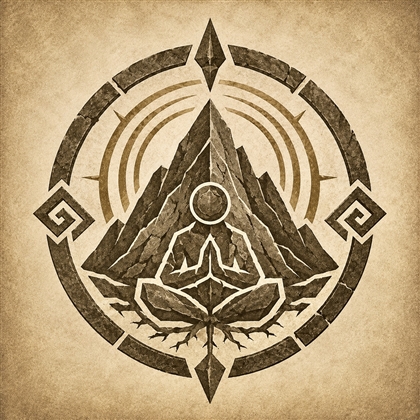
Monks of the Way of the Enduring Mountain reject the idea that victory belongs only to the swift. Where other Monks flow like water, vanish like shadow, or strike like lightning, these disciples become stone. They endure. They anchor. They stand between danger and those who cannot survive it alone.
The tradition teaches that motion is powerful, but stillness can be stronger. A properly rooted Monk does not merely refuse to move; they become the point around which the battlefield must change. Charging enemies break against them. Spells that seek to drag or bind them find little purchase. Blades that strike them meet disciplined flesh, hardened breath, and an unshakable will.
Enduring Mountain Monks often serve as guardians, temple wardens, caravan protectors, siege-line defenders, bodyguards, and patient judges. They are not passive, despite their reputation for stillness. When they strike, they do so with the inevitability of falling stone: short, direct, and final. Their blows pin enemies in place, deny escape, and punish those who waste strength against the immovable.
In Aetheris, this tradition fits mountain monasteries, dwarven-adjacent martial schools, highland hermitages, fortified temples, border strongholds, and any culture that reveres endurance, oath-keeping, stone, silence, or guardianship.
Origins in Aetheris
The Way of the Enduring Mountain is most commonly associated with highland monasteries, cliff temples, ancient stone roads, and fortified sanctuaries built in places where retreat was rarely possible. Its earliest forms likely arose among monks tasked with guarding mountain passes, pilgrimage roads, hidden vaults, sacred caves, or communities threatened by raiders, monsters, and warlords.
In Thaldrinor, Enduring Mountain monasteries may stand among cold peaks, where students learn to hold stances in snow, wind, and thin air until pain becomes instruction. These monks often develop a severe but honorable reputation, serving as protectors of isolated settlements and keepers of old mountain roads.
In Arganthyr, the tradition may appear among wardens who guard entrances to the Underdark and inland-sea cavern systems. There, the ability to resist forced movement, tremors, crushing pressure, and subterranean monstrosities is not symbolic; it is survival.
In Ozythralis, Enduring Mountain Monks may serve as bulwarks against Shadowfell incursions, standing at breached gates, sanctuary thresholds, and warded roads where civilians must be protected during evacuation.
In Drakthar and other harsh lands, the tradition may be practiced by hermits, resistance fighters, or oath-bound defenders who believe that tyranny often begins by making people move: from homes, from graves, from temples, from memory. To stand is to resist.
Philosophy and Doctrine
The Way of the Enduring Mountain teaches that strength is not loud. True strength is patient, rooted, and capable of bearing weight without complaint. Students are taught to hold difficult stances for hours, meditate beneath falling water, breathe through pain, and endure insult without surrendering judgment.
Its core teachings include:
The mountain does not chase the storm. An Enduring Mountain Monk does not waste energy answering every provocation.
Root before strike. Power begins in contact: foot to earth, breath to body, will to purpose.
Protection is action. Standing firm for another is not passivity; it is a sacred martial act.
The body remembers stone. Through discipline, flesh can learn the patience of granite, the density of iron, and the inevitability of avalanche.
This philosophy can create tension. Enduring Mountain Monks may become stubborn, slow to compromise, or overly willing to suffer rather than adapt. The wisest among them know the difference between resolve and pride. The foolish mistake immovability for wisdom.
Visual Identity
Enduring Mountain Monks favor simple, durable garments: heavy sashes, wrapped forearms, stone-bead prayer cords, reinforced training robes, sleeveless coats, thick belts, and layered cloth in slate, ochre, iron-gray, deep green, umber, or snow-white. They rarely wear armor, but their clothing often suggests weight and structure.
Their bodies may be marked with geometric tattoos, mountain-line patterns, stone-circle brands, cracked-earth symbols, or vows written along the spine, ribs, palms, or shoulders. Some carry smooth stones from their home monastery, oath tablets, iron prayer rings, or carved weights used in meditation.
Their fighting style is compact and grounded. They use low stances, short steps, hip-driven strikes, shoulder checks, knee traps, elbow blocks, and open-palm blows that feel like being struck by a door of stone. A master of this tradition can appear almost motionless while controlling the entire space around them.
Role in Aetheris
On the battlefield, Enduring Mountain Monks serve as defenders, anchors, and area-denial combatants. They are especially effective when protecting vulnerable allies, holding chokepoints, resisting forced movement, locking down enemies, and punishing foes who fail to move them.
Socially, they are often guardians, judges, oath-keepers, wardens, and protectors of sacred places. Their reliability makes them valuable to temples, militias, caravans, mountain settlements, and adventuring companies that need someone who will not break when the situation turns against them.
Adventuring Enduring Mountain Monks are ideal for campaigns involving sieges, retreats, Underdark expeditions, defensive battles, bodyguard missions, sacred-vault protection, and moral dilemmas where standing firm has a cost.
Subclass Integration
Major Polities
In Thaldrinor, the tradition may be respected among mountain peoples, fortress monasteries, and oath-bound defenders.
In Arganthyr, Enduring Mountain Monks may work with Underdark wardens, inland-sea fortress orders, and communities that understand the danger of things rising from below.
In Ozythralis, they may serve alongside defenders of the Concord of Veltrion, especially where civilians must be shielded against Shadowfell raids, monstrous assaults, or corrupted terrain.
In the Republic of Aurimundus, they may be valued as military auxiliaries, bodyguards, and disciplined defensive specialists, though their monastic independence can clash with formal command structures.
In the Helbrann League, their patient strength and defensive discipline may be admired by canton militias and mountain communities.
Organizations, Guilds, and Orders
Enduring Mountain Monks may belong to fortress monasteries, pilgrim-road guardian orders, stone-vault protectors, anti-Underdark watch-posts, bodyguard schools, or oath-bound martial circles.
Religious and Philosophical Movements
They often gravitate toward deities, philosophies, or ancestral traditions tied to protection, endurance, earth, law, memory, duty, or sacrifice.
Rival Factions and Enemies
Their enemies include raiders, tyrants, siege-breakers, slavers, monsters that rely on forced movement or grappling, corrupt armies, Underdark predators, and any faction that seeks to break communities by uprooting them.
Playing This Subclass
The Way of the Enduring Mountain is a defensive Monk tradition built around anchoring space, protecting allies, and punishing enemies who try to force movement or break through the party’s line. You are less evasive than many Monks, but far more capable of holding ground.
Your core loop begins with Stone Stance. Choose the moment when standing still matters: a doorway, a wounded ally’s side, the edge of a cliff, the front line of a retreat, or the center of a battlefield where enemies must pass through you. Once rooted, use Earthen Strike to stop mobile enemies and Mountain Ward to reduce damage against nearby allies.
At 11th level, Pillar of Stillness makes your defensive presence more significant. You become harder to hit, harder to move, and more useful as a shelter for allies. At 17th level, Avatar of the Enduring Mountain turns you into a true bastion, allowing you to resist immense punishment and punish enemies who fail to break you.
Your main weakness is mobility tradeoff. You are still a Monk, but your subclass rewards careful positioning rather than constant movement. If you root yourself in the wrong place, enemies may ignore you. Good Enduring Mountain play depends on choosing the right ground.
Roleplaying This Subclass
Enduring Mountain Monks are often patient, deliberate, protective, and slow to anger. They may speak rarely, but when they do, their words carry weight. Many are deeply loyal, sometimes to a fault. Others are stubborn, grim, or burdened by vows they refuse to abandon.
They often measure people by what they stand for rather than what they say. A coward can be forgiven. A liar can be taught. But someone who abandons the helpless may earn an Enduring Mountain Monk’s permanent contempt.
Possible personality patterns include:
- A quiet guardian who stands watch while others sleep.
- A former soldier who turned from war to protection.
- A mountain ascetic who believes stillness reveals truth.
- A bodyguard who treats every promise as sacred stone.
- A grim survivor who once failed to hold a gate and will never fail again.
- A gentle giant of spirit who hates violence but excels at enduring it.
Faction and Organization Connections
Enduring Mountain Monks may be connected to:
- Fortress monasteries.
- Mountain hermitages.
- Pilgrim-road guardian orders.
- Underdark watch-posts.
- Bodyguard schools.
- Temple protector circles.
- Dwarven, giant-taught, or earth-venerating martial traditions.
- Military units that specialize in holding gates, bridges, tunnels, and defensive lines.
- Communities that have survived siege, displacement, or invasion.
They may oppose:
- Slavers and raiders who uproot communities.
- Siege-breakers and terror armies.
- Monsters that drag victims underground.
- Corrupt rulers who force people from ancestral homes.
- Aberrant or elemental forces that destabilize earth and stone.
- Any faction that believes endurance is the same as weakness.
Adventure Hooks
- The Gate That Must Not Fall. An ancient mountain gate is the only barrier between a valley settlement and an approaching army.
- The Monk Who Became Stone. A revered master entered meditation decades ago and has slowly transformed into living granite. Now cracks are spreading across his body.
- The Broken Vow Road. A pilgrimage route protected by Enduring Mountain Monks has become haunted by the spirits of guardians who abandoned their posts.
- The Siege Beneath the Shrine. Something from the Underdark is pushing upward beneath a monastery, cracking the floor stones from below.
- The Avalanche Trial. To earn a lost technique, a student must hold a stance beneath a controlled avalanche — but someone has sabotaged the ritual.
- The Unmoving Prisoner. A captured villain refuses to be moved from the spot where they surrendered, claiming an ancient vow protects them.
- The City That Walks Away. An entire refugee district is being forcibly relocated, and an Enduring Mountain order has vowed to stand in the streets until the edict is withdrawn.
- The Stone Remembers. A battlefield cliffside has begun echoing the final vows of Monks who died holding the line centuries ago.
Notable NPCs
Master Orun Stonebreath
A vast-shouldered Monk from a Thaldrinor cliff monastery who can stand barefoot in snow for an entire night without shivering. He teaches that endurance without compassion is only pride.
Sister Caela Varr, the Gate-Holder
A former Aurimundian military protector who became a Monk after holding a breached gate long enough for hundreds of civilians to escape. She now trains bodyguards and refugee defenders.
Torgann Deepstill
An Arganthyr tunnel-warden who guards an Underdark passage beneath an inland-sea fortress. He speaks rarely, listens through stone, and knows the footsteps of monsters he has never seen.
Balance Notes
Intended Role: Defender, controller, and frontline protector.
Damage Profile: Moderate. The subclass does not focus on burst damage. Its offensive value comes from lockdown, Prone effects, Force damage conversion, and punishing missed attacks.
Survivability: High when positioned correctly. Temporary Hit Points, forced movement resistance, damage reduction, cover, defensive reactions, and the capstone resistance state make the subclass very durable. This is offset by its limited mobility while using its strongest tools.
Utility: Moderate. Tremorsense, anti-forced-movement tools, chokepoint control, and protective reactions are highly useful in defensive scenarios, Underdark exploration, sieges, and bodyguard missions.
Resource Economy: Stone Stance uses Proficiency Bonus per Long Rest with Focus Point backup. Earthen Strike and extra uses of Mountain Ward consume Focus Points, requiring the Monk to choose between offense, defense, and core Monk options.
Comparison to Similar Subclasses: Compared to evasive Monk traditions, the Enduring Mountain is slower but far more protective. Compared to a Fighter or Paladin defender, it lacks armor and weapon durability but has superior mobility when not rooted and stronger resistance to forced movement. Compared to Barbarian-style durability, it is more tactical and ally-focused, but less broadly aggressive.
Potential Balance Risks: The capstone’s broad damage resistance is powerful, but it arrives at 17th level, lasts 1 minute, and excludes Psychic damage. Stone Stance’s immovability should be interpreted with reasonable DM judgment against divine, artifact-level, siege-scale, or narrative forces.
Summary
The Way of the Enduring Mountain is a Monk tradition for players who want to stand firm, protect allies, and make the battlefield revolve around their refusal to yield. Its features emphasize rooted defense, temporary hit points, enemy lockdown, protective reactions, tremorsense, resistance, and a powerful high-level avatar state. In Aetheris, these Monks are guardians of gates, roads, shrines, tunnels, refugees, and sacred vows — living proof that stillness can be a weapon.
“Strike if you must. Rage if you must. Break yourself upon me if you must. I will still be here when the storm has spent its name.”
Stone Stance
Action Type: Bonus Action and Passive
Uses: Proficiency Bonus per Long Rest, or by expending Focus Points
Duration: Until the start of your next turn
Scaling: Temporary Hit Points scale with Monk level
You learn to become immovable when you choose to be. By rooting your breath, stance, and will into the earth beneath you, you can turn your body into a living pillar.
While you are not wearing armor or wielding a Shield, you gain the following benefits.
Mountain’s Root
You have Advantage on ability checks and saving throws you make to avoid being shoved, knocked Prone, or moved against your will.
In addition, while you are standing on solid ground and are not Incapacitated, you can choose to reduce any distance you are pushed, pulled, or moved against your will by 10 feet.
Stone Stance
As a Bonus Action, you enter a Stone Stance that lasts until the start of your next turn. The stance ends early if you are Incapacitated, if you willingly move more than 5 feet, or if you are no longer standing on solid ground.
While in this stance, you gain the following benefits:
- Your Speed becomes 0, unless you choose to end the stance.
- You gain Temporary Hit Points equal to your Monk level + your Wisdom modifier.
- You cannot be knocked Prone unless you choose to be.
- You cannot be pushed, pulled, or moved against your will unless the effect is created by a creature whose CR or level is higher than your Monk level, or by an Artifact, deity, or similarly overwhelming force at the DM’s discretion.
You can enter Stone Stance a number of times equal to your Proficiency Bonus, and you regain all expended uses when you finish a Long Rest. If you have no uses remaining, you can expend 1 Focus Point to enter the stance again.
Earthen Strike
Once per turn when you hit a creature with an Unarmed Strike, you can expend 1 Focus Point to force the target to make a Strength saving throw against your Monk save DC.
On a failed save, the target’s Speed becomes 0 until the end of its next turn, and it cannot take the Dash or Disengage action during that time.
On a successful save, the target’s Speed is reduced by 10 feet until the end of its next turn.
Iron Shelter
Action Type: Reaction and Passive
Uses: Reaction uses Focus Points or limited free uses
Duration: Instantaneous
Scaling: Protective range improves at higher levels through later features
You draw on internal discipline to shield others as well as yourself. Your body becomes a sheltering wall, and your stillness teaches allies how to survive the blow.
While you are not wearing armor or wielding a Shield, you gain the following benefits.
Mountain Ward
When a creature you can see within 10 feet of you is hit by an attack roll, you can take a Reaction to protect it. Roll your Martial Arts die and reduce the damage by the number rolled + your Wisdom modifier + your Proficiency Bonus.
If you are in Stone Stance when you use this Reaction, you can also move up to 5 feet toward the protected creature without ending Stone Stance, provided this movement places you closer to the creature and you remain on solid ground.
You can use Mountain Ward a number of times equal to your Wisdom modifier, and you regain all expended uses when you finish a Long Rest. If you have no uses remaining, you can expend 1 Focus Point to use it again.
Unshakable Frame
You have Resistance to Force damage.
In addition, you have Advantage on saving throws you make to avoid or end the Grappled, Restrained, Paralyzed, or Petrified condition on yourself.
Weight of the Mountain
When a creature misses you with a melee attack while you are in Stone Stance, you can cause that creature’s Speed to be reduced by 10 feet until the end of its current turn. This effect represents the attacker’s momentum breaking against your rooted defense.
Pillar of Stillness
Action Type: Passive
Uses: At-will
Duration: Until the start of your next turn
Scaling: Expands your defensive presence and battlefield control
Your body becomes a fortress of divine calm. When you refuse to yield, your stillness creates shelter for those around you.
While you are not wearing armor or wielding a Shield, you gain the following benefits.
Living Bastion
If you move no more than 5 feet on your turn, you gain Half Cover until the start of your next turn.
If you are in Stone Stance, this improves to Three-Quarters Cover.
Shelter of Stone
When you are in Stone Stance, allies of your choice within 10 feet of you gain Resistance to Bludgeoning, Piercing, and Slashing damage from nonmagical attacks.
At 17th level, this benefit applies to Bludgeoning, Piercing, and Slashing damage from magical and nonmagical attacks.
No Force May Move Me
While you are in Stone Stance, you cannot be teleported against your will, and you have Advantage on saving throws against effects that would banish you, shift you to another plane, or move you through magical force.
Tremor-Root Awareness
While you are standing on earth, stone, metal, worked masonry, or another solid surface connected to the ground, you have Tremorsense out to 10 feet.
If you are in Stone Stance, this Tremorsense increases to 30 feet until the stance ends.
Avatar of the Enduring Mountain
Action Type: Bonus Action
Uses: Once per Long Rest, or by expending Focus Points
Duration: 1 minute
Scaling: Capstone feature
You become a living bastion of stone and will. Your flesh hardens with spiritual density, your breath becomes the silence before an avalanche, and your stance turns the battlefield around you into sacred ground.
As a Bonus Action, you enter your Avatar of the Enduring Mountain for 1 minute. The effect ends early if you are Incapacitated. You can also end it early at any time, no action required.
While this avatar is active and you are not wearing armor or wielding a Shield, you gain the following benefits:
Stone-Soul Endurance
You have Resistance to all damage except Psychic damage.
Avalanche Reprisal
Once per turn, when a creature misses you with a melee attack or deals damage to your Temporary Hit Points, you can force that creature to make a Strength saving throw against your Monk save DC.
On a failed save, the creature falls Prone, and its Speed becomes 0 until the end of its current turn.
On a successful save, the creature’s Speed is reduced by 10 feet until the end of its current turn.
Mountain-Breaking Fist
Your Unarmed Strikes can deal Force damage instead of their normal damage type.
In addition, when you hit a creature with an Unarmed Strike, you can ignore Resistance to Bludgeoning and Force damage.
Unfallen Guardian
When an ally of your choice within 10 feet of you takes damage, you can take a Reaction to reduce that damage by an amount equal to two rolls of your Martial Arts die + your Wisdom modifier + your Monk level.
If this reduces the damage to 0, you regain one expended use of Stone Stance.
Once you use Avatar of the Enduring Mountain, you cannot use it again until you finish a Long Rest unless you expend 5 Focus Points to use it again.
Previous Versions
| Name | Date Modified | Views | Adds | Version | Actions |
|---|---|---|---|---|---|
|
7/18/2026 2:54:41 AM
|
18
|
4
|
1
|
Coming Soon
|
Comments