



 Base Class: Blood Hunter
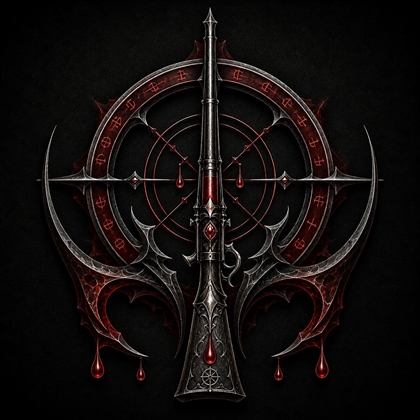
Blood Hunters of the Order of the Eldritch Musketeer combine occult blood rites with the precision, discipline, and destructive potential of advanced firearms. Where other hunters close with their prey using blade, claw, or transformed flesh, the Eldritch Musketeer studies the battlefield from a distance and ends the hunt with a single carefully prepared shot.
Members of the order treat firearms as more than mechanical weapons. Each gun is calibrated to the hunter’s pulse, marked with blood-conductive runes, and altered to withstand the passage of hemocraft through its chamber and barrel. When an Eldritch Musketeer activates a Crimson Rite, the firearm becomes an extension of the hunter’s circulatory system. The weapon hums with occult pressure, its shot carries impossible momentum, and its report may echo with voices from beyond the mortal world.
The order was founded to combat threats that conventional soldiers could not safely approach. Fiends, aberrations, planar invaders, spellcasters, flying monsters, and creatures surrounded by corrupting auras all became favored quarry. Eldritch Musketeers learned to study such enemies from beyond the reach of claw and spell, using supernatural marks and impossible trajectories to ensure that distance offered no protection.
An Eldritch Musketeer is expected to embody patience, discipline, and restraint. Their rites can turn a firearm into an instrument of extraordinary destruction, and an uncontrolled hunter can cause as much devastation as the creature being pursued. The order therefore teaches that every shot must have a purpose, every target must be understood, and every weapon must remain subordinate to the hunter’s will.
Origins in Aetheris
The Order of the Eldritch Musketeer emerged independently in several firearm-producing regions before its scattered techniques were consolidated into a recognizable Blood Hunter tradition.
The earliest surviving records describe monster hunters operating along the unstable frontiers of Ozythralis. These hunters faced Shadowfell predators, aberrant creatures, and corrupted warbands whose presence made close combat exceptionally dangerous. Conventional ammunition proved unreliable against such enemies, leading several Blood Hunters to experiment with channeling Crimson Rites through firearm barrels.
Similar practices appeared within the Helbrann League, where mountain riflemen adapted long-range weapons for use against fiends, flying monsters, and supernatural predators hiding among inaccessible peaks. The discipline, craftsmanship, and precision associated with Helbranni rifle culture strongly influenced the order’s formal training methods.
The Freeholds of Rhonadral contributed compact firearms, repeating mechanisms, and practical battlefield modifications. Independent hunters and privateers refined the order’s mobile shooting techniques, particularly those involving ricochets, rapid target acquisition, and combat aboard ships or within crowded settlements.
The Shorin Dominion later introduced highly refined barrel inscriptions and spirit-resistant weapon seals. These techniques helped stabilize the transfer of hemocraft through precision firearms and reduced the risk that extraplanar entities could corrupt a bonded weapon.
Modern Eldritch Musketeers may use firearms produced by respected organizations such as the Hushcoil Technical House, Eisenlauf Rifle Compact, Dragoncoil Armory, Coilwright Syndics, Brasswake Foundry, or regional gunsmiths capable of meeting the order’s demanding tolerances.
No single nation controls the order. It is divided into semi-independent chapters known as Chambers. Each Chamber maintains its own armorers, target archives, blood formulae, and lists of sanctioned quarry.
Philosophy and Doctrine
The Order of the Eldritch Musketeer teaches that power without precision is merely destruction.
Its members follow a doctrine built around observation, preparation, and decisive action.
Know the Target
A hunter must understand the nature, habits, defenses, and vulnerabilities of a creature before attempting its destruction. A missed shot may reveal the hunter’s position or allow the quarry to escape.
Master the Weapon
A firearm is neither a companion nor a master. It is a tool whose function depends entirely upon the discipline of its wielder. Hunters who become emotionally dependent on a particular weapon are warned that attachment can become a weakness.
Blood Must Purchase Certainty
Hemocraft always carries a cost. The order teaches that a hunter should spend blood only when doing so meaningfully improves the likelihood of success.
Distance Is a Defense, Not a Refuge
Eldritch Musketeers prefer range, but they are not taught cowardice. A hunter must be prepared to advance, reposition, or stand their ground when the mission requires it.
The Shot Must Be Justified
The order’s methods make assassination disturbingly easy. Responsible Chambers maintain strict rules governing sanctioned targets, acceptable collateral damage, and the use of hemocraft against mortal opponents.
The central tension of the order lies between discipline and obsession. Eldritch Musketeers are trained to pursue quarry relentlessly, but prolonged hunts can transform vigilance into fixation. Some hunters begin to reduce every problem to a target, every relationship to a firing angle, and every moral choice to whether they can make the shot.
Visual Identity
Eldritch Musketeers favor fitted coats, reinforced shooting jackets, cross-belts, bracers, and practical armor designed to protect the torso without restricting the arms. Their clothing often combines military structure with the individualized equipment of a professional hunter.
Long coats are especially common. These garments conceal ammunition, blood vials, cleaning tools, spare mechanisms, and ritual components while protecting a firearm from rain and dust.
Colors vary by Chamber, but charcoal, dark blue, burgundy, gunmetal gray, and weathered brown are widespread. Crimson accents typically indicate hemocraft channels, while silver or pale blue markings are used for planar wards.
Each bonded firearm carries visible or concealed alterations, which may include:
- Blood-conductive channels along the receiver or stock
- Runes etched around the chamber
- A narrow reservoir for ritual blood
- Reinforced barrels resistant to magical pressure
- Spirit wards along the sights
- A proof mark identifying the weapon’s maker
- A personal kill mark or oath inscription
- A sealed compartment containing a token from the hunter’s first quarry
When a Crimson Rite is active, glowing veins may spread across the firearm. Smoke coils against the wind, the muzzle briefly reveals impossible constellations, and fired projectiles leave thin arcs of crimson, violet, or pale eldritch light.
Eldritch Musketeers fight with controlled posture and deliberate economy of motion. They rarely fire wildly. Even during rapid engagements, each shot appears measured and intentional.
Role in Aetheris
The Order of the Eldritch Musketeer serves as a ranged striker, supernatural tracker, and specialist against magically protected or highly mobile enemies.
On the battlefield, its members identify priority targets, establish favorable firing positions, and deliver concentrated damage. They are especially effective against spellcasters, flying creatures, extraplanar enemies, and opponents that depend on invisibility, teleportation, or cover.
Socially, Eldritch Musketeers may serve as sanctioned monster hunters, military marksmen, private investigators, bounty hunters, caravan wardens, shipboard sharpshooters, or covert executioners.
Their knowledge of firearms and occult engineering also makes them valuable to artificers, armorers, and military organizations. However, many gunsmiths distrust the order’s habit of permanently altering expensive weapons through blood rites.
Within an adventuring party, an Eldritch Musketeer excels at ranged damage, target designation, and pursuit. The subclass is less effective when deprived of ammunition, forced into cramped melee, or confronted by numerous weaker creatures rather than a small number of dangerous targets.
Subclass Integration
Major Polities
Helbrann League
The Helbrann League contains several respected Chambers, particularly among mountain cantons with strong rifle traditions. Helbranni Eldritch Musketeers are known for discipline, long-range accuracy, and methodical preparation.
Freeholds of Rhonadral
The Freeholds produce unconventional hunters who favor repeaters, revolvers, and practical battlefield improvisation. Some serve aboard privateer vessels or protect settlements from supernatural raiders.
March of Draeven
The March employs Eldritch Musketeers as military specialists against fiends, enemy officers, flying monsters, and hostile spellcasters. Draevenite authorities expect strict obedience and detailed records of every sanctioned kill.
Shorin Dominion
Shorin Chambers emphasize craftsmanship, restraint, and spiritual purification. Their weapons often incorporate carefully balanced warding inscriptions and refined mechanical tolerances.
Republic of Aurimundus
Aurimundan hunters combine magical research with firearm innovation. They are more likely than other members to experiment with arcane optics, rune-guided ammunition, and specialized alchemical charges.
Kingdom of Aurvalis
Aurvalian Eldritch Musketeers favor elegant weapons inscribed with clean magical glyphs. Many serve as royal wardens, investigators of magical crimes, or hunters of threats that endanger elven and human settlements alike.
Dominion of Xathrin
The Dominion considers the order a serious threat because its hunters frequently target slavers, soul binders, planar conjurers, and senior enforcers. Xathrin agents seek to capture Eldritch Musketeers and reproduce their blood-bound weapon techniques.
Obsidian Hegemony
The Hegemony values the destructive potential of the order but rejects its restraints. Several corrupted Chambers serve Hegemony commanders as execution squads and monster handlers.
Organizations, Guilds, and Orders
The order maintains relationships with firearm manufacturers and technical guilds, including:
- Hushcoil Technical House
- Eisenlauf Rifle Compact
- Dragoncoil Armory
- Coilwright Syndics
- Brasswake Foundry
- Independent artificer lodges
- Military armories
- Privateer companies
- Monster-hunting organizations
- Planar research societies
These relationships are not always friendly. Gunsmiths may resent hunters who modify carefully crafted weapons without permission, while Chambers accuse some manufacturers of placing profit above safety.
Religious and Philosophical Movements
Most Eldritch Musketeers follow the dominant faiths of their homeland. The order itself is practical rather than religious.
Members may interpret their discipline as service to justice, protection, balance, vengeance, or civilization. Some believe that their shots are instruments of divine judgment. Others reject such claims and insist that responsibility belongs entirely to the hunter pulling the trigger.
Rival Factions and Enemies
Common enemies include:
- Planar invaders
- Fiends
- Aberrations
- Old One cultists
- Soul traffickers
- Magical slavers
- Corrupted artificers
- Rogue gunsmiths
- Flying monsters
- Hostile spellcasters
- Agents of the Dominion of Xathrin
- Warbands of the Obsidian Hegemony
- Rival Chambers that have abandoned the order’s restraints
Subclass Features
Order of the Eldritch Musketeer Features
|
Blood Hunter Level |
Feature |
|
3rd |
Ballistic Hemocraft, Bonded Armament |
|
7th |
Arcane Precision |
|
11th |
Eldritch Quarry |
|
15th |
Bloodbound Arsenal |
|
18th |
Musketeer’s Vengeance |
Level 3: Ballistic Hemocraft
You learn to channel your Crimson Rites through the mechanisms of a firearm.
Action Type: Passive; part of Crimson Rite activation
Uses: At-will, subject to the normal rules for Crimson Rite
Duration: While the Crimson Rite remains active
Scaling: Additional firearm benefits at higher subclass levels
You gain proficiency with firearms.
If firearms are divided into separate weapon categories in the campaign, you gain proficiency with all simple and martial firearms.
You can activate a Crimson Rite on a firearm. When you do so, the rite extends to all ammunition fired from that weapon until the rite ends.
While wielding a firearm bearing one of your active Crimson Rites, you gain the following benefits.
Hemocraft Ballistics
The firearm’s normal and long ranges increase by an amount equal to half their original values.
For example, a firearm with a range of 80/240 feet instead has a range of 120/360 feet.
Arcane Ammunition
Attacks made with the firearm count as magical for the purpose of overcoming resistance and immunity to nonmagical attacks and damage.
Blood-Forged Shot
Once during each of your turns when you hit a creature with the firearm, you can deal additional rite damage equal to one roll of your Hemocraft die.
You can use Blood-Forged Shot a number of times equal to your proficiency bonus. You regain all expended uses when you finish a long rest.
Beginning at 7th level, these uses become part of your Eldritch Focus resource.
Stable Chamber
If the firearm possesses a misfire score, reduce that score by 1, to a minimum of 1.
If the campaign does not use misfire rules, you instead ignore the first firearm malfunction or ammunition-related failure you suffer after each long rest.
Bonded Armament
You perform a blood-binding ritual that connects you to a chosen firearm.
Action Type: Ritual performed during a short or long rest
Uses: One bonded firearm at a time
Duration: Until you bond with another firearm or willingly end the bond
Scaling: Expanded interactions through later subclass features
At the end of a short or long rest, you can touch one firearm and bind it to yourself through hemocraft.
The firearm remains bonded to you until you bond with a different firearm, willingly end the bond, or die.
You gain the following benefits while using your bonded firearm:
- You can use Intelligence instead of Dexterity for its attack and damage rolls.
- You cannot be disarmed of it unless you are incapacitated.
- You always know the direction of the firearm while it is on the same plane of existence and within 1 mile of you.
- You can use the firearm as a spellcasting focus for any spells or magical abilities you possess.
- You can draw or stow the firearm as part of making an attack with it.
- You can perform ordinary cleaning, maintenance, and ammunition loading for the firearm during a short rest.
If your bonded firearm is within 60 feet of you and is not being worn or carried by another creature, you can summon it to an empty hand as a bonus action.
Level 7: Arcane Precision
Your hemocraft allows you to perceive impossible trajectories and guide projectiles through the narrowest openings.
Action Type: Passive or triggered as part of a firearm attack
Uses: Eldritch Focus pool equal to your proficiency bonus per long rest
Duration: Instantaneous or until the end of the current turn
Scaling: Eldritch Focus powers later subclass features
You gain a pool of Eldritch Focus uses equal to your proficiency bonus. You regain all expended uses when you finish a long rest.
Your remaining uses of Blood-Forged Shot are added to this pool when you gain this feature. Thereafter, Blood-Forged Shot expends one Eldritch Focus use.
You can expend Eldritch Focus in the following ways.
Deadeye Calculation
When you make a firearm attack, you can expend one Eldritch Focus before making the attack roll.
Choose one of the following benefits:
- You gain advantage on the attack roll.
- The attack ignores half cover and three-quarters cover.
- Attacking at long range does not impose disadvantage.
- You add one roll of your Hemocraft die to the attack roll.
If the attack already has advantage and both d20s would hit the target, the attack scores a critical hit on a roll of 19 or 20.
Deadeye Calculation cannot convert a die directly into a natural 20.
Ricochet Shot
When you miss a creature with a firearm attack, you can expend one Eldritch Focus to redirect the projectile.
Choose another creature within 30 feet of the original target and within the firearm’s range. Make a new attack roll against the chosen creature.
The second attack cannot benefit from advantage, and you cannot use Ricochet Shot again as a result of missing with the redirected attack.
Countershot
When a creature you can see within your firearm’s normal range makes a ranged weapon attack or a ranged spell attack, you can use your reaction and expend one Eldritch Focus to fire an intercepting shot.
Make a firearm attack roll. If the result equals or exceeds the triggering attack roll, the triggering attack misses.
You must have your bonded firearm in hand and loaded to use Countershot.
Measured Breath
As a bonus action, you can expend one Eldritch Focus to steady yourself until the end of the current turn.
During that time:
- Your firearm attacks ignore disadvantage caused by being within 5 feet of a hostile creature.
- Your movement does not impose any campaign-specific penalties on firearm accuracy.
- You ignore disadvantage caused by nonmagical wind, rain, or unstable footing.
Level 11: Eldritch Quarry
You can mark a supernatural enemy with a resonance carried through its blood, spirit, or planar presence.
Action Type: Bonus action
Uses: One Eldritch Focus per mark
Duration: 1 hour
Scaling: Additional benefits against the marked creature
As a bonus action, choose one creature you can see within 120 feet and expend one Eldritch Focus. The creature becomes your Eldritch Quarry for 1 hour.
The mark ends early if you mark another creature, dismiss it without using an action, or become unconscious.
While a creature is your Eldritch Quarry, you gain the following benefits.
Bloodhound’s Eye
You know the direction of the quarry while it is within 1 mile of you and on the same plane of existence.
If it is within 120 feet of you, you also know its precise location unless it is behind total cover.
Revealed Prey
The quarry gains no benefit against you from being invisible.
You can perceive a faint outline of the quarry through illusions and magical disguises, though this feature does not automatically reveal its true form.
Your firearm attacks against the quarry do not suffer disadvantage because you cannot see it, provided it is not hidden from you and you know its location.
Hunter’s Impact
Once during each of your turns when you hit the quarry with your bonded firearm, you deal additional damage equal to one roll of your Hemocraft die.
The additional damage is the same type as the firearm’s active Crimson Rite damage.
Dimensional Wound
When the quarry attempts to teleport or travel to another plane while within 120 feet of you, you can use your reaction to make one firearm attack against it.
On a hit, the quarry must succeed on a Charisma saving throw against your Hemocraft save DC.
On a failed save, the teleportation or planar travel fails, and the associated action, spell slot, charge, or other resource is expended.
On a successful save, the effect functions normally.
Once you attempt to prevent a quarry’s movement in this way, you cannot do so again until the start of your next turn.
Sharpshooter’s Grace
You do not suffer disadvantage when attacking at long range with a firearm.
Your firearm attacks ignore half cover. If you expend one Eldritch Focus as part of the attack, the attack also ignores three-quarters cover.
Level 15: Bloodbound Arsenal
Your bonded firearm becomes a conduit capable of carrying multiple layers of destructive hemocraft.
Action Type: Passive; triggered effects as part of attacks
Uses: Eldritch Focus or proficiency bonus, depending on the ability
Duration: While the Crimson Rite remains active or instantaneous
Scaling: None
You gain the following benefits.
Rite of Eldritch Power
When you activate a Crimson Rite on your bonded firearm, choose necrotic, psychic, or radiant damage.
Once during each of your turns when you hit with the firearm, you can change the rite damage dealt by that attack to the chosen type.
Alternatively, when you use Blood-Forged Shot, you can divide its additional damage equally between the original rite damage type and the chosen type. If the damage cannot be divided evenly, you choose which type receives the remaining point of damage.
Choosing a damage type does not add a second full instance of Crimson Rite damage to every attack.
Explosive Strike
When you hit a creature with your bonded firearm, you can expend two Eldritch Focus to detonate the projectile with eldritch force.
The target and each other creature of your choice within 10 feet of it must make a Dexterity saving throw against your Hemocraft save DC.
The original target automatically fails this saving throw.
On a failed save, a creature takes damage equal to two rolls of your Hemocraft die. On a successful save, it takes half as much damage.
Choose acid, force, necrotic, psychic, or radiant damage when you use this feature. The explosion deals the chosen damage type.
A creature cannot take this damage more than once from the same Explosive Strike.
Blood-Sealed Mechanism
Your bonded firearm cannot be rendered inoperable by nonartifact magic unless you are incapacitated.
You have advantage on ability checks and saving throws made to prevent the weapon from being jammed, broken, transformed, or magically disabled.
If the firearm misfires or malfunctions, you can expend one Eldritch Focus to ignore the malfunction and resolve the attack normally.
Level 18: Musketeer’s Vengeance
You become an executioner of creatures that believe distance, magic, or supernatural resilience can protect them.
Action Type: Bonus action; special attack sequence
Uses: Once per long rest, with limited reuse through Eldritch Focus
Duration: 1 minute
Scaling: Final subclass feature
You gain the following abilities.
Marked for Obliteration
As a bonus action, choose one creature you can see within 300 feet. The creature becomes Marked for Obliteration for 1 minute.
If the creature is not already your Eldritch Quarry, it also becomes your Eldritch Quarry for the duration without requiring an additional Eldritch Focus use.
The mark ends early if you are incapacitated or mark another creature for obliteration.
While the mark lasts, you gain the following benefits against that creature:
- Your firearm attacks score a critical hit on a roll of 19 or 20.
- Your firearm attacks ignore resistance to their damage.
- If the creature is immune to the attack’s damage, treat that immunity as resistance instead.
- Once during each of your turns when you hit the creature, you deal additional force damage equal to two rolls of your Hemocraft die.
- The creature cannot regain hit points until the start of your next turn after you hit it.
- The creature gains no benefit against your firearm attacks from shield, sanctuary, or similar effects that directly prevent attacks or increase Armor Class, unless the effect was produced by an artifact or a creature of a higher level or challenge rating than you.
Marked for Obliteration does not dispel protective magic and does not remove bonuses that protect the creature against attacks made by your allies.
Once you use Marked for Obliteration, you cannot use it again until you finish a long rest.
You can expend three Eldritch Focus uses to regain the ability to use it, but you cannot do so while a previous Marked for Obliteration remains active.
Final Reprisal
When your Marked for Obliteration creature reduces you to half your hit point maximum or fewer, damages one of your allies within 30 feet of you, or attempts to teleport, you can use your reaction to make one firearm attack against it.
You can use Final Reprisal only once per round.
Ultimate Volley
Once per long rest, when you reduce a hostile creature to 0 hit points with your bonded firearm, you can unleash a sequence of blood-guided shots.
Choose a number of hostile creatures you can see within your firearm’s normal range up to your Intelligence modifier, with a minimum of one creature.
Make one firearm attack against each chosen creature.
You must have sufficient ammunition for each attack. These attacks are made as part of the triggering attack’s resolution and do not require an action.
A creature can be targeted only once by this volley.
Crimson Rite damage applies normally to each attack, but Blood-Forged Shot, Explosive Strike, and the additional damage from Marked for Obliteration can each apply to only one attack made as part of the volley.
Once you use Ultimate Volley, you cannot use it again until you finish a long rest.
Perfect Calibration
Whenever you roll initiative and have no Eldritch Focus remaining, you regain two expended uses.
In addition, once during each of your turns when you roll your Hemocraft die for an Order of the Eldritch Musketeer feature, you can reroll the die and use either result.
Previous Versions
| Name | Date Modified | Views | Adds | Version | Actions |
|---|---|---|---|---|---|
|
7/24/2026 4:03:00 PM
|
13
|
9
|
1
|
Coming Soon
|
Comments