



 Base Class: Blood Hunter
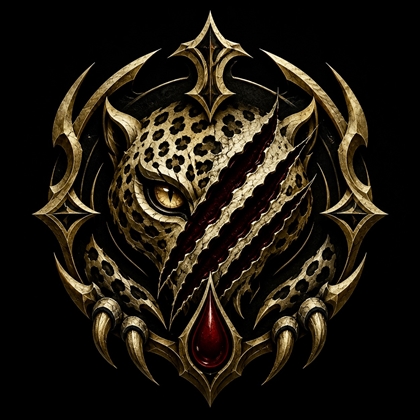
Blood Hunters of the Order of Pardus bind their altered blood to the predatory essence of the leopard. Through carefully controlled lycanthropic rites, they assume a sleek hybrid form built for speed, concealment, and sudden violence.
Unlike hunters who overwhelm enemies through brute strength, members of the Order of Pardus rely upon patience and position. They observe from concealment, approach along routes others consider impassable, and strike only when their quarry has nowhere safe to turn.
Their transformation grants them spotted fur, feline eyes, heightened senses, powerful limbs, and claws capable of carrying a Crimson Rite. Experienced hunters can climb sheer surfaces, disappear into broken terrain, and cross a battlefield before enemies understand that the hunt has begun.
The leopard spirit within them is not merely an animal instinct. It is a supernatural predatory presence shaped by hemocraft. It urges the hunter toward dominance, isolation, and the exhilaration of pursuit. Members must learn to draw upon those instincts without allowing the hunt to become more important than its purpose.
Some members serve as monster hunters, frontier guardians, assassins of supernatural tyrants, or protectors of isolated communities. Others become solitary predators who trust instinct more than law and gradually lose interest in anything they cannot stalk, challenge, or dominate.
Origins in Aetheris
The Order of Pardus originated among Blood Hunters living in the tropical forests, rocky highlands, and dense wilderness of Myrdrithis and southern Velmyris.
Its earliest practitioners observed great spotted cats whose behavior had been altered by Feywild incursions and unstable leylines. These predators displayed unnatural intelligence, passed through vegetation without sound, and occasionally vanished from one shadow only to emerge from another.
Rather than slaughter the creatures, several Blood Hunters studied them. They discovered that the animals carried a stable predatory resonance capable of moderating certain forms of lycanthropic hemocraft. The resulting transformation retained the power of a beast form without sacrificing all reason to hunger or rage.
Amazarae hunters contributed techniques based on tropical stalking, vertical movement, and hunting among dense vegetation. Faeborn Clann traditions added respect for territorial spirits and the understanding that a predator could serve as a guardian rather than merely a killer.
Additional chapters later appeared in the Verdant Confederacy, the Evershade Sovereignty, the Kingdom of Aurvalis, and the Freeholds of Rhonadral. Each adapted the transformation to local terrain.
The order’s chapters are known as Prowls. A Prowl rarely contains more than a dozen full members, as the order believes large concentrations of dominant predators encourage rivalry and instability.
Each Prowl protects a territory called its Hunting Veil. The Veil may be a forest, mountain range, island, urban district, ruin complex, or network of trade roads threatened by monsters and raiders.
Philosophy and Doctrine
The Order of Pardus teaches that a successful hunt is an act of understanding rather than rage.
Its members commonly observe the following doctrines.
Observe Before Striking
A predator that attacks without understanding its quarry is merely hungry. A hunter studies behavior, terrain, fear, and opportunity.
Speed Must Serve Precision
Movement without purpose wastes energy and reveals intent. Every leap, climb, and feint should create a killing opportunity or deny one to the enemy.
The Strong Do Not Need to Boast
True dominance is demonstrated through control. Loud threats and unnecessary cruelty reveal insecurity rather than power.
Territory Creates Duty
A hunter who claims a place must protect those who depend upon it. Dominion without responsibility is merely predation.
Hunger Must Be Named
Every member possesses desires intensified by transformation: blood, pursuit, victory, solitude, dominance, or recognition. A hunter must identify these hungers before they begin making decisions in secret.
Leave the Helpless Unharmed
The order distinguishes quarry from prey. Creatures incapable of meaningful resistance are not worthy targets unless destroying them is necessary to protect others.
The central tension of the order lies between guardianship and dominance. Members are trained to become apex predators, but an apex predator can easily begin treating companions as lesser creatures and every disagreement as a challenge.
Visual Identity
Members of the Order of Pardus favor fitted, flexible armor that protects the torso without restricting climbing, crouching, or sudden bursts of speed.
Common materials include:
- Supple leather
- Studded leather
- Darkened chain
- Hardened hide
- Layered cloth
- Flexible scale
- Bone or claw fasteners
- Climbing wraps
- Silent buckles
- Reinforced gloves and boots
Common colors include black, gold, tawny brown, deep green, rust red, charcoal, and muted ivory.
Members frequently wear spotted or broken patterns that blur their outlines without directly imitating natural leopard fur. Senior hunters may display a mantle, sash, or partial pelt taken from a supernatural predator they defeated.
Every hunter carries a Pardus Mark. This is normally a ritual tattoo or scar consisting of spotted circles surrounding a blood drop, claw, or feline eye. The mark grows darker when the hybrid transformation is near.
In hybrid form, a hunter becomes taller and more powerfully built while retaining an agile, balanced silhouette. Spotted fur covers part or all of the body. The face becomes feline, the eyes reflective, and the hands lengthen into clawed hunting weapons.
The precise appearance varies. Some hunters resemble golden leopards, while others bear black, gray, white, or reddish coats shaped by ancestry and local magical influence.
When a Crimson Rite is active on the claws, light gathers beneath them like blood beneath translucent horn. Each strike leaves a brief glowing claw mark in the air.
Role in Aetheris
The Order of Pardus functions as a mobile striker, ambusher, and pursuit specialist.
On the battlefield, its members:
- Transform into a powerful hybrid predator
- Move rapidly between targets
- Climb walls and structures
- Exploit concealment and elevation
- Prevent enemies from reacting
- Pursue fleeing quarry
- Deliver sudden melee damage
- Withdraw before retaliation
- Hunt invisible or hidden creatures
Outside combat, they often serve as:
- Monster trackers
- Frontier wardens
- Bodyguards
- Infiltrators
- Scouts
- Bounty hunters
- Assassins of dangerous supernatural targets
- Protectors of isolated settlements
- Hunters of poachers and slavers
- Guardians of sacred or contested territories
Within an adventuring party, a Pardus hunter excels at reaching vulnerable enemies, disrupting ranged combatants and spellcasters, and eliminating isolated targets.
The subclass is less effective when forced to remain stationary, defend a narrow position for long periods, or fight enemies that cannot be reached through ordinary movement.
Subclass Integration
Major Polities
Verdant Confederacy
The Confederacy contains several respected Prowls. These hunters protect forest settlements, hunting routes, and regions threatened by the Wild Hunt or corrupted predators.
Evershade Sovereignty
Evershade Pardus hunters emphasize concealment, moonlit stalking, and black-coated hybrid forms. They are often employed against Fey predators, infiltrators, and enemies operating within the Whispering Veil.
Kingdom of Aurvalis
Aurvalian Prowls combine elven hunting traditions with disciplined hemocraft. They frequently protect royal preserves, ancient forests, and vulnerable border settlements.
Freeholds of Rhonadral
Rhonari Pardus hunters are commonly independent bounty hunters, private scouts, and defenders of remote communities. Their Prowls are loosely organized and highly territorial.
Volarion Republic
Volarion hunters protect mountain roads, forests, and isolated cantons. Their climbing ability makes them particularly valuable in steep terrain.
Dominion of Xathrin
The Dominion captures supernatural predators for experimentation and exploitation. Pardus hunters regularly attack Xathrin beast markets, slaving camps, and hunting estates.
Obsidian Hegemony
The Hegemony attempts to breed or corrupt lycanthropic soldiers. The Order regards these programs as both an atrocity and a threat to every controlled shapechanging tradition.
Organizations, Guilds, and Orders
Likely allies include:
- Ranger lodges
- Verdant Thorn Blood Hunters
- Druid circles
- Rootkeepers
- Trailwardens
- Monster-hunting companies
- Anti-slavery organizations
- Frontier militias
- Beast sanctuaries
- Bounty-hunting companies
- Covert intelligence cells
- Communities threatened by supernatural predators
Religious and Philosophical Movements
The Order maintains no unified faith.
Some members honor deities associated with hunting, wilderness, protection, night, or self-mastery. Others treat the leopard spirit as a magical archetype rather than a divine being.
The order rejects worship of uncontrolled hunger. A member who begins offering sacrifices to their own beast form is considered dangerously compromised.
Rival Factions and Enemies
Common enemies include:
- Supernatural poachers
- Dominion of Xathrin slavers
- Obsidian Hegemony beast handlers
- Corrupted lycanthropes
- Predatory Fey
- Aberrant beasts
- Monstrous traffickers
- Assassins who target the helpless
- Rogue Prowls
- Blood Hunters consumed by transformation
- Old One cults that mutate natural predators
- Fallen members known as the Spotted Tyrants
Subclass Features
Order of Pardus Features
|
Blood Hunter Level |
Feature |
|
3rd |
Pardus Transformation, Rite of the Rending Claw |
|
7th |
Ambush Predator |
|
11th |
Predatory Instincts |
|
15th |
Sovereign Roar |
|
18th |
Primal Apex |
Optional Subclass Techniques
The following techniques may be offered as specialized Prowl training, lycanthropic adaptations, downtime rewards, or optional Blood Hunter abilities at the Game Master’s discretion.
Night-Pelt
Prerequisite: Order of Pardus, 7th level
When you transform, you can cause your coat to become black, gray, or patterned to match the surrounding terrain.
While motionless in dim light, darkness, foliage, mist, or broken stone, you have advantage on Dexterity (Stealth) checks even if a creature is directly observing the area.
Long-Claw Descent
Prerequisite: Order of Pardus, 7th level
You reduce falling damage by an amount equal to five times your Blood Hunter level.
When you land after falling at least 10 feet, you can move up to 10 feet without provoking opportunity attacks.
Scent of Fear
Prerequisite: Order of Pardus, 11th level
You know the direction of frightened creatures within 60 feet, provided they are not behind total cover.
Your first successful melee attack during each turn against a frightened creature deals additional damage equal to your Wisdom modifier.
Prowl Through Shadow
Prerequisite: Order of Pardus, 11th level
When you use Shadow Pounce while in dim light or darkness, you can teleport up to 15 feet to an unoccupied space you can see before making the bonus attack.
Your departure and destination must both be in dim light or darkness.
Shared Territory
Prerequisite: Order of Pardus, 15th level
When you use Sovereign Roar, choose a number of allies within 30 feet up to your Wisdom modifier, with a minimum of one.
Until the start of your next turn, the chosen allies do not provoke opportunity attacks from creatures frightened by the roar.
Playing This Subclass
The Order of Pardus is designed as a mobile melee striker and ambush specialist.
Its central combat rhythm involves entering Pardus Transformation, activating a Crimson Rite on the claws, and using speed and climbing to approach vulnerable targets from unexpected directions.
The subclass rewards:
- Attacking from concealment
- Engaging creatures that have not acted
- Pursuing injured enemies
- Using vertical terrain
- Moving between isolated targets
- Disrupting reactions
- Avoiding prolonged stationary combat
Ambush Dice form the subclass’s principal limited resource. They power opening damage, mobility, withdrawal, knockdowns, and extra attacks after tactical actions.
The subclass is not intended to remain hidden indefinitely while attacking. Its stealth features create opportunities for sudden strikes and repositioning rather than permanent untargetability.
Rite of the Rending Claw punishes moving enemies and later suppresses healing. It is especially useful when the hunter repeatedly engages and disengages from a target.
Sovereign Roar provides battlefield control without duplicating a spell. Its frightened condition is strong, but affected creatures receive repeated saving throws.
Primal Apex limits Predator’s Momentum to once per turn, preventing an unlimited chain of attacks against groups of weak enemies.
Roleplaying This Subclass
Members of the Order of Pardus often appear composed, private, and intensely observant.
They may spend long periods in silence before acting decisively. Many dislike crowded spaces, unnecessary noise, or situations in which they cannot identify a clear route of escape.
Common habits include:
- Choosing elevated places to rest
- Watching doors rather than facing the center of a room
- Circling unfamiliar spaces
- Disliking anyone approaching from behind
- Remaining motionless for unnaturally long periods
- Collecting scents from important locations
- Marking territorial boundaries
- Sleeping lightly
- Preferring fresh food
- Becoming restless when confined
- Treating sustained eye contact as a challenge
- Following companions without making sound
Common character themes include:
- A guardian who treats a community as their territory
- A former assassin seeking a more honorable hunt
- A Blood Hunter struggling with dominance instincts
- A scout altered by a supernatural leopard spirit
- A bounty hunter who refuses to kill helpless quarry
- A protector of endangered magical predators
- A solitary hunter learning to trust a party
- A survivor of an uncontrolled lycanthropic Prowl
- A hunter whose beast form is becoming increasingly independent
- A warrior pursuing the predator that created their lineage
Common narrative tensions include:
- Loyalty to companions versus the desire for solitude
- Protection versus ownership
- Discipline versus bloodlust
- Hunting dangerous creatures that are not evil
- Respecting another predator’s territory
- Choosing whether to spare defeated quarry
- Accepting help without viewing it as weakness
- Resisting the urge to dominate less assertive allies
Faction and Organization Connections
Likely allies and patrons include:
- Pardus Prowls
- Ranger lodges
- Verdant Thorn Blood Hunters
- Druid circles
- Rootkeepers
- Trailwardens
- Monster-hunting companies
- Frontier settlements
- Anti-slavery organizations
- Beast sanctuaries
- Covert military units
- Bounty-hunting companies
- Communities threatened by supernatural predators
Likely enemies include:
- Dominion of Xathrin beast traffickers
- Obsidian Hegemony mutation programs
- Poachers
- Corrupted lycanthropes
- Monstrous slavers
- Predatory Fey
- Old One mutators
- Rogue Prowls
- The Spotted Tyrants
- Assassins who target the helpless
- Cults devoted to uncontrolled hunger
- Nobles who hunt sentient creatures for sport
Adventure Hooks
- The Empty Territory. Every predator has fled a large forest claimed by a Pardus Prowl. The hunters refuse to explain what they found at its center.
- The Black-Cat Murders. A series of killings is blamed on a Pardus hunter, but the claw marks were made by something attempting to imitate the order’s hybrid form.
- The Silent Prowl. An entire chapter has stopped responding to allies. Their territory remains perfectly protected, but travelers report unseen hunters following every road.
- The Leopard in the Mirror. A senior hunter’s reflection has begun transforming when the hunter does not. It now attempts to communicate through claw marks on the glass.
- The Golden Quarry. A supernatural leopard sacred to an isolated community has been marked for capture by Xathrin beast traders. The creature may possess intelligence equal to a mortal’s.
- The Spotted Tyrant. A fallen Pardus hunter has taken control of several villages, claiming that protection gives a predator the right to rule its territory.
Notable NPCs
Zarethi Namar, First Claw of the Veiled Prowl
Zarethi is an Amazarae Blood Hunter who protects a vast tropical territory in Myrdrithis.
She is patient, soft-spoken, and fiercely opposed to supernatural poaching. Zarethi has negotiated territorial agreements with several intelligent predators rather than killing them.
Her hybrid coat is golden with dark rosettes that glow faintly when she senses blood.
Avel Thornstride, the High Branch
Avel is an elven Pardus hunter operating in the Kingdom of Aurvalis.
He specializes in pursuing creatures through forest canopies and ruined towers. Avel rarely touches the ground during a hunt.
He believes the leopard spirit inhabiting him once belonged to a celestial guardian, though other members consider this claim dangerously prideful.
Kesh Varro, the Spotted King
Kesh was once a respected protector of settlements in the Freeholds of Rhonadral.
After decades of service, he concluded that those under his protection were incapable of governing themselves. He now rules several communities through fear, demanding tribute in exchange for keeping worse monsters away.
Kesh remains disciplined and rational, making him far more dangerous than a hunter lost to simple bloodlust.
Balance Notes
Intended Role
Primary role: Mobile Striker
Secondary roles: Scout, Controller, Pursuit Specialist
The subclass is intended to reach isolated targets, deliver burst damage, and withdraw before retaliation.
Damage Profile
Sustained damage comes from Leopard Claws, Crimson Rite, and the bonus-action claw attack.
Sudden Strike and Leaping Assault provide limited burst damage through Ambush Dice.
Razor Precision improves critical-hit frequency only under defined predatory conditions.
Apex Rend provides reliable capstone damage once per turn.
Predator’s Momentum is limited to once per turn, preventing unlimited attack chains.
Survivability
The subclass gains survivability through:
- Increased speed
- Climbing
- Disadvantage on opportunity attacks
- Reaction movement
- Frightened-condition control
- Multiple reactions at high level
- Concealment
- Vertical positioning
It does not gain permanent physical damage resistance or substantial self-healing.
Utility
The subclass provides:
- Enhanced perception
- Tracking
- Climbing
- Stealth
- Darkvision
- Vertical mobility
- Movement control
- Anti-healing effects
- Fear
- Anti-invisibility tools
- Limited spellcaster disruption
Resource Economy
Pardus Transformation has proficiency-bonus uses per long rest.
Ambush Dice equal the hunter’s proficiency bonus and recover on a long rest.
These dice power burst damage, tactical attacks, movement, and defense.
Sovereign Roar normally refreshes on a short or long rest but can be reused by spending two Ambush Dice.
Apex Hunt restores one Ambush Die each turn but lasts only 1 minute and is usable once per long rest.
Comparison to Similar Subclasses
The Order of Pardus shares traits with lycanthropic Blood Hunters, stealth-focused Rogues, and mobility-oriented Monks.
Unlike a conventional lycanthropic order, Pardus emphasizes Dexterity, concealment, climbing, and ambush rather than resilience and brute strength.
Unlike a Rogue, it does not gain Sneak Attack or unrestricted bonus-action hiding.
Unlike a Monk, it has no large short-rest resource pool and depends upon transformation.
Its damage is strong when it can create favorable positioning but less reliable when it must remain visible and stationary.
Summary
The Order of Pardus is a predatory Blood Hunter tradition built around a controlled were-leopard transformation.
Its members use supernatural speed, climbing, stealth, and precise claw attacks to hunt isolated targets and dominate vertical terrain.
Ambush Dice power sudden strikes, pounces, leaps, and evasive movement, while the Rite of the Rending Claw punishes fleeing enemies.
At higher levels, Pardus hunters gain supernatural stealth, fearsome authority, expanded reactions, and the ability to become nearly invisible to creatures relying upon darkvision.
Within Aetheris, the order operates through small Prowls that protect defined territories from monsters, poachers, slavers, and supernatural predators.
The subclass is best suited to players who enjoy high mobility, melee ambushes, stealth, transformation, vertical movement, and the tension between disciplined guardianship and predatory dominance.
“Do not ask whether the leopard is near. Ask why the forest has stopped warning you.”
—Final teaching of the Veiled Prowl
Level 3: Pardus Transformation
You can assume the hybrid form of a supernatural leopard.
Action Type: Bonus action
Uses: Proficiency bonus per long rest
Duration: 10 minutes
Scaling: Natural weapons and transformation benefits improve at higher levels
As a bonus action, you transform into your Pardus hybrid form.
The transformation lasts for 10 minutes. It ends early if:
- You are incapacitated.
- You die.
- You dismiss it as a bonus action.
- You assume another form through a class feature or magical effect.
You can transform a number of times equal to your proficiency bonus. You regain all expended uses when you finish a long rest.
Your equipment does not merge into the transformation. Worn armor and carried equipment adjust to accommodate your hybrid form whenever reasonably possible.
While transformed, you gain the following benefits.
Leopard Claws
Your claws are natural melee weapons with which you are proficient.
They deal 1d8 slashing damage on a hit and possess the finesse property.
Your claws count as one weapon for the purpose of activating and maintaining a Crimson Rite. Activating a rite on your claws affects both hands.
Your claw attacks count as magical for the purpose of overcoming resistance and immunity to nonmagical attacks and damage.
When you take the Attack action and make at least one attack with your claws, you can make one additional claw attack as a bonus action.
You cannot make this bonus attack during the same turn in which you activate Pardus Transformation unless another feature allows you to do so.
Predator’s Grace
Your walking speed increases by 10 feet.
You gain a climbing speed equal to your walking speed.
Beginning at 7th level, you can climb difficult surfaces, including ceilings, without making an ability check, provided the surface has sufficient texture or handholds.
Keen Senses
You have advantage on Wisdom (Perception) checks relying on hearing, sight, or smell.
You also have advantage on Wisdom (Survival) checks made to track a creature that is below its hit point maximum.
Stalker’s Agility
Opportunity attacks against you are made with disadvantage.
Standing from prone costs you only 5 feet of movement.
You can move through the space of a hostile creature at least one size larger than you. Such a space is difficult terrain, and you cannot end your movement there.
Predatory Composure
You have advantage on saving throws against being frightened.
Whenever you begin your turn below half your hit point maximum, the predator within you becomes more intense. Until the end of that turn, your speed increases by an additional 5 feet, and you cannot willingly take the Dodge action.
This effect does not compel you to attack allies or surrender control of your character.
Rite of the Rending Claw
You learn the Rite of the Rending Claw as part of your Crimson Rite feature. It does not count against the number of Crimson Rites you know.
Action Type: Part of the bonus action used to activate a Crimson Rite
Uses: At-will, subject to the normal Crimson Rite rules
Duration: Until the Crimson Rite ends
Scaling: Additional benefits at 11th level
The Rite of the Rending Claw can be activated only on a melee weapon or your Leopard Claws.
While the rite is active, the weapon’s rite damage is slashing damage.
Once during each of your turns when you hit a creature with a weapon bearing this rite, you can open a bleeding wound.
The creature becomes Rended until the start of your next turn.
The first time the Rended creature willingly moves 5 feet or more before the effect ends, it takes slashing damage equal to one roll of your Hemocraft die.
A creature can take this damage only once from each application of the rite.
At 11th level, a Rended creature also cannot regain hit points until the start of your next turn.
Level 7: Ambush Predator
You have learned to convert concealment and sudden movement into lethal advantage.
Action Type: Passive; optional Ambush Dice expenditure
Uses: Ambush Dice equal to your proficiency bonus per long rest
Duration: Instantaneous or until the start of your next turn
Scaling: Ambush Dice become d8s at 11th level and d10s at 18th level
You gain a pool of Ambush Dice equal to your proficiency bonus. These dice are d6s.
You regain all expended Ambush Dice when you finish a long rest.
Your Ambush Dice become d8s at 11th level and d10s at 18th level.
You can expend Ambush Dice in the following ways while transformed.
Sudden Strike
Once during each of your turns when you hit a creature that has not yet acted during the current combat, or when you hit a creature while you are hidden from it, you can expend one Ambush Die.
The attack deals additional damage equal to two rolls of your Ambush Die.
If the attack was made with your Leopard Claws or a weapon bearing the Rite of the Rending Claw, the target also cannot take reactions until the start of its next turn.
Shadow Pounce
When you take the Dash, Disengage, or Hide action, you can expend one Ambush Die to make one claw or melee weapon attack as a bonus action.
On a hit, add the Ambush Die result to the attack’s damage.
Leaping Assault
When you move at least 20 feet in a straight line toward a creature immediately before hitting it with a melee attack, you can expend one Ambush Die.
Add the die to the attack’s damage. The target must then succeed on a Strength saving throw against your Hemocraft save DC or fall prone.
A Huge or larger creature has advantage on this saving throw.
Vanishing Withdrawal
When a creature misses you with an attack, you can use your reaction and expend one Ambush Die.
Move up to a number of feet equal to five times the die result.
This movement does not provoke opportunity attacks from the triggering creature.
Vertical Hunter
While transformed, you can jump a number of feet horizontally equal to your Strength or Dexterity score if you move at least 10 feet immediately before the jump.
Your high jump distance equals 3 feet plus your Strength or Dexterity modifier.
You choose which ability to use when you jump.
Level 11: Predatory Instincts
Your hybrid form develops supernatural stealth, reflexes, and killing precision.
Action Type: Passive; special effect on successful attacks
Uses: Once per turn; certain intensified effects use Ambush Dice
Duration: Instantaneous or until the start of your next turn
Scaling: Ambush Dice become d8s at this level
You gain the following benefits while transformed.
Silent Stalker
You have advantage on Dexterity (Stealth) checks.
You can attempt to hide while lightly obscured by foliage, heavy rain, falling snow, mist, dim light, or a creature at least one size larger than you.
Moving at full speed does not impose disadvantage on your Dexterity (Stealth) checks.
Hunter’s Dark
You gain darkvision to a range of 60 feet.
If you already have darkvision, its range increases by 30 feet.
Creatures using only darkvision have disadvantage on Wisdom (Perception) checks made to detect you while you are in dim light or darkness and not within 10 feet of them.
Razor Precision
Your claw and melee weapon attacks score a critical hit on a roll of 19 or 20 against a creature that:
- Has not acted during the current combat;
- Cannot see you;
- Is Rended by your Rite of the Rending Claw; or
- Is below half its hit point maximum.
When you score a critical hit with a claw or melee weapon attack, you can roll one additional weapon damage die when determining the attack’s extra critical damage.
Killing Pattern
Once during each of your turns when you hit a creature with a claw or melee weapon attack, you can apply one of the following effects.
Hamstring
The target’s speed is reduced by 10 feet until the start of your next turn.
Blinding Rake
The target has disadvantage on the next attack roll it makes before the start of your next turn.
Open the Throat
The target cannot speak above a whisper until the start of your next turn.
If it attempts to cast a spell with a verbal component, it must first succeed on a Constitution saving throw against your Hemocraft save DC.
On a failed save, the spell fails, but its spell slot is not expended.
Driving Claw
The target must succeed on a Strength saving throw against your Hemocraft save DC or be moved up to 10 feet to an unoccupied space you can see.
Marked by the Prowl
Until the start of your next turn, the target cannot benefit from invisibility against you and cannot take the Hide action.
Level 15: Sovereign Roar
Your hybrid form carries the supernatural authority of an apex predator.
Action Type: Bonus action
Uses: Once per short or long rest; additional uses by expending two Ambush Dice
Duration: 1 minute, with repeat saving throws
Scaling: None
While transformed, you can use a bonus action to unleash a Sovereign Roar.
Each hostile creature of your choice within 30 feet that can hear you must make a Wisdom saving throw against your Hemocraft save DC.
On a failed save, a creature is frightened of you for 1 minute.
While frightened in this way:
- Its speed is reduced by 10 feet.
- It cannot take reactions.
- It cannot benefit from advantage on attack rolls.
- It cannot willingly move closer to one of your allies unless it also moves closer to you.
A frightened creature repeats the saving throw at the end of each of its turns, ending the effect on itself on a success.
A creature that succeeds on the initial saving throw is immune to your Sovereign Roar until you finish a long rest.
Once you use Sovereign Roar, you cannot use it again until you finish a short or long rest unless you expend two Ambush Dice to use it again.
Feline Reflexes
While transformed, you can take two reactions during each round, but no more than one during the same turn.
You cannot use both reactions to make opportunity attacks.
If a feature allows you to regain or take an additional reaction, you still cannot take more than two reactions during the round through this feature.
Dominant Presence
A creature frightened of you has disadvantage on saving throws against your Rite of the Rending Claw and Killing Pattern options.
Level 18: Primal Apex
You have achieved complete balance between disciplined hunter and supernatural predator.
Action Type: Passive; bonus action to invoke Apex Hunt
Uses: Apex Hunt once per long rest
Duration: 1 minute
Scaling: Final subclass feature
Your Pardus Transformation gains the following permanent improvements.
Apex Claws
Your Leopard Claws deal 2d8 slashing damage.
Your claw attacks score a critical hit on a roll of 19 or 20. If Razor Precision would already grant this benefit, they instead score a critical hit on a roll of 18–20.
Perfect Hunter
Your walking speed increases by an additional 10 feet while transformed.
You gain a climbing speed equal to twice your walking speed.
You can remain attached to a wall or ceiling without using your hands, provided the surface can support you.
Unseen Death
While you are in dim light or darkness, you are invisible to creatures that rely exclusively on darkvision to see you.
This invisibility ends for a creature if:
- You are within 10 feet of it;
- You are in an area of bright light;
- It possesses blindsight, tremorsense, truesight, or another sense that does not rely upon darkvision; or
- You are revealed by an effect that detects invisible creatures.
Making an attack does not permanently end this benefit, but you become visible to the target of the attack until the start of your next turn.
Apex Hunt
As a bonus action while transformed, you enter an Apex Hunt for 1 minute.
The effect ends early if your transformation ends or you become incapacitated.
While the Apex Hunt lasts, you gain the following benefits.
Relentless Pursuit
At the start of each of your turns, move up to half your speed without provoking opportunity attacks.
You can move along walls and ceilings during this movement.
Blood in the Air
You know the location of each creature within 60 feet that is below half its hit point maximum, provided it is not behind total cover.
Such creatures cannot hide from you.
Apex Rend
Once during each of your turns when you hit a creature with a claw or melee weapon attack, the attack deals an additional 2d8 slashing damage.
If the target is Rended by your Rite of the Rending Claw, the additional damage becomes 4d8.
Predator’s Momentum
When you reduce a hostile creature to 0 hit points with a melee attack, you can move up to half your speed and make one claw or melee weapon attack against another creature.
You can use Predator’s Momentum only once during each of your turns.
Unending Ambush
At the start of each of your turns, you regain one expended Ambush Die.
You cannot have more Ambush Dice than your proficiency bonus.
Death from Above
Once during the Apex Hunt, when you hit a creature after descending at least 10 feet, jumping at least 10 feet, or moving along a wall or ceiling during the same turn, you can force it to make a Dexterity saving throw against your Hemocraft save DC.
On a failed save, the creature takes 6d10 slashing damage, falls prone, and cannot take reactions until the end of its next turn.
On a successful save, it takes half as much damage and suffers no additional effect.
Once you use Apex Hunt, you cannot use it again until you finish a long rest.
Previous Versions
| Name | Date Modified | Views | Adds | Version | Actions |
|---|---|---|---|---|---|
|
7/24/2026 4:20:58 PM
|
5
|
1
|
1
|
Coming Soon
|
Comments