



 Base Class: Blood Hunter
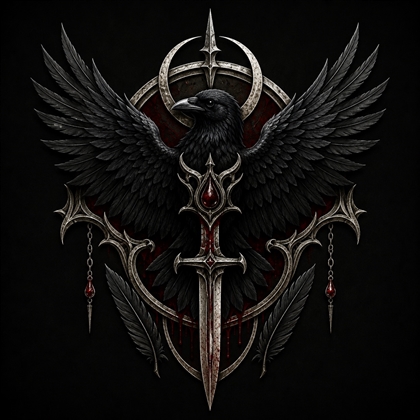
Blood Hunters of the Order of the Raven are solemn sentinels who walk beside death without surrendering themselves to it. They hunt undead creatures, soul thieves, necromancers, and beings that prolong their existence through stolen life or corrupted magic.
Members of the order believe that death is not merely an ending. It is a threshold that must remain guarded. When souls are imprisoned, corpses are made into tools, or the dead are forced to walk again, the natural passage between life and what follows begins to fracture.
Many Raven-bound hunters receive dreams, omens, or intrusive visions connected to approaching death. A circling raven may reveal the site of a future murder. A whispered name may belong to someone not yet dead. Reflections may show corpses where living people stand. These signs are rarely complete, and interpreting them is among the order’s most difficult disciplines.
The order’s hunters combine funerary knowledge with direct martial power. Their rites prevent enemies from recovering, their weapons strike at the unnatural resilience of undead creatures, and spectral wings carry them above the battlefield. At the height of their power, they become living harbingers wrapped in shadow, feathers, and the cold inevitability of the grave.
Some serve the Matron of Ravens or another divine custodian of death. Others act through ancestral tradition, philosophical conviction, or direct experience with the dead. Whatever their faith, all members accept the same responsibility: what has reached its rightful end must not be dragged back through the threshold for the convenience of the living.
Origins in Aetheris
The Order of the Raven has several claimed origins, none universally accepted.
Skraeling traditions hold that the first Raven-bound hunters were chosen by the Matron of Ravens to destroy warriors who escaped the judgment of death through forbidden rites. These hunters carried black feathers marked with silver runes and were said to hear the names of those destined to die.
Other records place the order’s origin in Ozythralis after the Shadowfell incursion. Blood Hunters fighting undead legions discovered that necrotic power could be redirected through carefully prepared rites. These rites did not merely damage undead bodies; they interfered with the spiritual bonds keeping those bodies active.
Mourning traditions in the March of Draeven and Helbrann League contributed battlefield recovery practices, grave protection, and formal methods for identifying the dead. In these regions, Raven hunters often work beside military chaplains, gravekeepers, and investigators.
The Freeholds of Rhonadral produced less formal hunters who pursued soul traffickers, necromantic smugglers, and cursed artifacts. Their methods are practical and independent, though many maintain private memorial books containing the names of those they have released.
The order’s chapters are called Ebon Eyries. An Eyrie may be a temple tower, isolated monastery, graveyard lodge, mountain watchpost, or hidden chamber beneath a major city.
Each Eyrie maintains a Black Ledger containing confirmed undead threats, unresolved hauntings, stolen souls, forbidden resurrection rites, and the names of hunters who died in service.
Philosophy and Doctrine
The Order of the Raven teaches that death has dignity, purpose, and limits.
Its members commonly observe the doctrines below.
Death Is a Passage
Death is not inherently a punishment. It is a natural transition that should not be obstructed through fear, greed, or domination.
The Dead Must Not Be Enslaved
Animating unwilling remains, binding souls, or forcing spirits into service is among the order’s greatest prohibitions.
Omens Require Judgment
A vision of death does not always command intervention. Some deaths must be prevented; others are natural, necessary, or beyond the hunter’s authority to alter.
Names Must Be Remembered
The unnamed dead are vulnerable to exploitation. Whenever possible, hunters identify those they release and preserve their names.
Mercy Does Not Mean Delay
Allowing an undead creature to continue suffering because destruction feels cruel may be a greater cruelty.
The Hunter Is Not Death
No member possesses the authority to kill merely because they believe death inevitable. The order exists to protect the boundary, not to replace moral judgment with fatalism.
The order’s central tension lies in its proximity to death. Hunters who constantly perceive mortality may become compassionate and humble—or emotionally distant, fatalistic, and convinced that all resistance is meaningless.
Visual Identity
Raven-bound hunters favor dark, practical equipment decorated with restrained funerary and avian motifs.
Common colors include:
- Black
- Charcoal gray
- Ash white
- Dull silver
- Deep violet
- Midnight blue
- Desaturated crimson
Armor is frequently engraved with feathers, closed eyes, grave runes, or descending wings. Long coats and mantles may resemble folded plumage without using literal feathered costumes.
Common equipment includes:
- Black feathers sealed in wax
- Funeral coins
- Silver nails
- Memorial books
- Small bells
- Ash vials
- Raven-skull charms
- Chains engraved with names
- Hooded lanterns
- Black candles
- Tokens taken from released spirits
Each member carries a Raven Mark. This may be a black-feather tattoo, a scar resembling a beak, a winged blood drop, or an eye surrounded by dark plumage.
When a Crimson Rite is active, spectral feathers may drift from the weapon. Its shadow may resemble a hooked beak or spread wings, and its strikes may be followed by the distant sound of beating feathers.
Veteran hunters often appear unnaturally still. Ravens may watch them without fear, and nearby flames sometimes dim when they speak the name of the dead.
Role in Aetheris
The Order of the Raven functions as an anti-undead striker, mobile executioner, and spiritual controller.
On the battlefield, its members:
- Suppress enemy healing
- Punish enemies who attack allies
- Detect nearby undead
- Fly through spectral wings
- Frighten enemies when creatures fall
- Pursue wounded or fleeing targets
- Prevent short-term regeneration or return from death
- Exploit weakened, cursed, or undead enemies
Outside combat, Raven hunters frequently serve as:
- Psychopomps
- Grave wardens
- Exorcists
- Hunters of necromancers
- Investigators of unnatural death
- Guardians of tombs
- Recoverers of stolen souls
- Witnesses to final words
- Interpreters of death omens
- Destroyers of cursed relics
- Escorts through haunted territory
Within an adventuring party, the subclass combines reliable weapon pressure with flight, anti-healing effects, and limited protection against death-related threats.
Subclass Integration
Major Polities
March of Draeven
The March formally recognizes several Ebon Eyries. Raven hunters secure battlefields, investigate military hauntings, and prevent fallen soldiers from being raised by enemies.
Helbrann League
Helbranni Eyries protect ancestral crypts, mountain graveyards, and memorial roads. Their hunters are disciplined, austere, and meticulous about identifying the dead.
Concord of Veltrion
The Concord permits Raven hunters to investigate necromancy, possession, and soul theft, though authorities monitor chapters closely due to their secrecy.
Dominion of Kaltheros
Kaltheran hunters protect ancient tombs, volcanic burial vaults, and relics capable of trapping spirits.
Freeholds of Rhonadral
Rhonari Raven hunters commonly operate as independent grave wardens, bounty hunters, and destroyers of necromantic contraband.
Shadowmarch Alliance
Raven hunters are valued throughout lands threatened by Shadowfell influence. Their Eyries often stand near old battlefields and unstable breaches.
Dominion of Xathrin
The Dominion is a sworn enemy of the order. Its soul markets, corpse labor, necromantic weapons, and infernal contracts violate every major Raven doctrine.
Obsidian Hegemony
The Hegemony’s corpse troops and soul-bound weapons make it a frequent target of Raven-bound operations.
Organizations, Guilds, and Orders
Likely allies include:
- Mourning Houses
- Gravekeeper guilds
- Paladin orders
- Clerics of death or judgment
- Witch hunters
- Inquisitors
- Battlefield recovery units
- Relic wardens
- Monster-hunting lodges
- Anti-slavery organizations
- Historians and genealogists
Religious and Philosophical Movements
Many members honor the Matron of Ravens, especially among Skraeling communities and regions influenced by their funerary traditions.
Other hunters follow gods associated with death, memory, judgment, fate, or mercy. Some reject divine authority entirely and treat death as a natural law rather than a sacred mandate.
The order permits these differences provided members reject soul enslavement and respect the rightful passage of the dead.
Rival Factions and Enemies
Common enemies include:
- Necromancers
- Liches
- Vampires
- Soul traffickers
- Dominion of Xathrin slavers
- Obsidian Hegemony corpse-legions
- Fiends that bargain for souls
- Witches that bind spirits
- Undead cults
- Cursed sentient weapons
- Corrupt resurrectionists
- Fallen members known as Carrion Ravens
Subclass Features
Order of the Raven Features
|
Blood Hunter Level |
Feature |
|
3rd |
Emissary of the Raven, Rite of the Deathbound Wing |
|
7th |
Gravepiercer |
|
11th |
Raven’s Wings |
|
15th |
Death’s Herald |
|
18th |
Raven Ascendant |
Optional Subclass Techniques
The following techniques may be offered as Eyrie teachings, prophetic gifts, funerary mutations, or optional Blood Hunter abilities at the Game Master’s discretion.
Raven’s Familiar
Prerequisite: Order of the Raven, 3rd level
You can cast find familiar as a ritual without material components, but the familiar must take the form of a raven.
The familiar is celestial, fey, or undead, chosen when you summon it.
Once you cast the spell through this technique, you cannot do so again until you finish a long rest unless you expend one Raven Die.
Black Feather Witness
Prerequisite: Order of the Raven, 7th level
When you examine a corpse, you can expend one Raven Die to receive a brief image, sound, scent, or emotion from the creature’s final minute of life.
The impression is selected by the Game Master and may be incomplete or distorted.
Carrion Denial
Prerequisite: Order of the Raven, 7th level
When an undead creature within 30 feet regains hit points, you can use your reaction and expend one Raven Die.
Reduce the healing by the die result plus your Hemocraft modifier.
If this reduces the healing to 0, you can move up to 10 feet without provoking opportunity attacks.
Feather Through the Veil
Prerequisite: Order of the Raven, 11th level
While Raven’s Wings are active, you can expend one Raven Die as a bonus action to become partially incorporeal until the end of the turn.
You can move through creatures and nonmagical objects as though they were difficult terrain.
If you end your turn inside an object, you are moved to the nearest unoccupied space and take 1d10 force damage.
Murder’s Warning
Prerequisite: Order of the Raven, 15th level
You cannot be surprised while a raven, raven familiar, or friendly creature bearing one of your black feathers is within 60 feet of you and conscious.
When initiative is rolled, you can exchange positions with your raven familiar if it is within 60 feet and both spaces can accommodate the arriving creature.
Playing This Subclass
The Order of the Raven is designed as an anti-undead striker and mobile spiritual controller.
Its central combat rhythm involves activating Rite of the Deathbound Wing, applying Ravenbound Curse to a priority enemy, and using Raven Dice for protection, mobility, or Severing Strike.
The subclass excels against:
- Undead creatures
- Necromancers
- Regenerating enemies
- Possessing spirits
- Injured targets
- Creatures attempting to escape
- Enemies that rely upon healing
- Encounters in dim light or vertical terrain
Raven Dice form the subclass’s primary resource. They power defensive reactions, investigation, movement, flight, and burst damage.
Raven’s Wings provides sustained flight but consumes a limited resource. It is intended to be useful for both combat and exploration without becoming permanently available before the capstone.
Death’s Herald rewards the fall of hostile creatures but is limited to one use per round. It cannot repeatedly restore resources from a large group of creatures dying simultaneously.
Raven Ascendant delivers strong flight, damage, and survival for one combat. Its Soul Severance ability delays unnatural return rather than permanently invalidating powerful monsters’ defining traits.
Roleplaying This Subclass
Raven hunters are often solemn, patient, and attentive to signs others dismiss.
Common habits include:
- Recording names of the dead
- Leaving black feathers at graves
- Speaking final words aloud
- Watching birds for omens
- Carrying funeral coins
- Refusing to disturb remains unnecessarily
- Sleeping near open windows
- Burning black candles after a hunt
- Listening for voices in wingbeats
- Avoiding promises made beside corpses
- Pausing whenever a raven calls unexpectedly
- Treating dreams as possible warnings
Common character themes include:
- A hunter chosen through prophetic dreams
- A former gravekeeper
- A survivor of undeath or possession
- A servant of the Matron of Ravens
- A skeptic burdened with genuine omens
- A hunter seeking a stolen soul
- A soldier haunted by an unburied battlefield
- A protector of ancestral tombs
- A former necromancer seeking redemption
- A character who has seen the circumstances of their own death
Common narrative tensions include:
- Knowing when a death should be prevented
- Interpreting incomplete omens
- Respecting willing or benevolent undead
- Serving a death deity without becoming fatalistic
- Carrying messages from the dead
- Accepting resurrection under exceptional circumstances
- Distinguishing prophecy from manipulation
- Fearing that every raven is watching on behalf of something greater
Faction and Organization Connections
Likely allies and patrons include:
- Ebon Eyries
- Mourning Houses
- Gravekeeper guilds
- Clerical orders
- Paladin orders
- Inquisitors
- Witch hunters
- Battlefield recovery units
- Relic wardens
- Anti-slavery organizations
- Historians and genealogists
- Communities threatened by undead
Likely enemies include:
- Dominion of Xathrin soul traffickers
- Obsidian Hegemony corpse-legions
- Necromancers
- Liches
- Vampires
- Possessing spirits
- Fiendish bargainers
- Undead cults
- Witches that bind souls
- Carrion Ravens
- Sentient cursed weapons
- Rulers seeking immortality through unwilling sacrifice
Adventure Hooks
- The Raven Without a Shadow. A white raven begins following the party. Every person it visits dies within three days, but none of the deaths appear supernatural.
- The Empty Black Ledger. Names vanish from an Eyrie’s records. Each erased dead person simultaneously returns as an undead creature somewhere in Aetheris.
- The Ascendant Corpse. A revered Raven hunter dies while transformed, but the spectral wings remain and carry the body toward an unknown destination.
- The Queen’s False Voice. Several Eyries receive identical visions commanding the execution of an innocent ruler. The order must determine whether the prophecy is genuine.
- The Unclaimed Soul. A dead child’s spirit refuses every psychopomp and insists that someone else is living within their body.
- The Carrion Parliament. A group of fallen Raven hunters has seized control of a city’s graveyards and claims that undeath is the only protection against an approaching catastrophe.
Notable NPCs
Thora Skeldraven, Wing of the Last Winter
Thora is a Skraeling Blood Hunter devoted to the Matron of Ravens.
She protects frozen burial grounds and hunts undead creatures awakened beneath ancient glaciers.
Thora speaks gently to the dead but has no patience for those who exploit grief. Her spectral wings resemble black feathers rimed with ice.
Matthias Corven, Keeper of the Black Ledger
Matthias oversees an Ebon Eyrie in the March of Draeven.
He is a meticulous historian who can identify thousands of fallen soldiers from fragments of armor, weapons, and bone.
Matthias has recently discovered several names written in the Ledger in his own handwriting, though he has no memory of recording them.
Seraphine Vale, the Carrion Saint
Seraphine was once celebrated for destroying an entire necromantic cult.
She later concluded that undeath could preserve worthy servants until the final battle against darkness. Her followers willingly surrender their lives to become her immortal agents.
Several Eyries have condemned her. Others secretly fear that her prophecies may be correct.
Balance Notes
Intended Role
Primary role: Striker
Secondary roles: Controller, Support, Anti-Undead Specialist
The subclass focuses on healing suppression, mobile attacks, anti-undead pressure, and spiritual protection.
Damage Profile
Sustained damage comes from Crimson Rite and Ravenbound Curse.
Severing Strike provides limited burst damage through Raven Dice.
Harbinger’s Judgment increases critical-hit frequency only against defined targets.
Deathbrand Strikes adds reliable capstone damage once per turn.
Final Messenger provides one area-damage effect during the capstone transformation.
Survivability
The subclass gains survivability through:
- Necrotic damage reduction
- Death-saving-throw support
- Flight
- Reaction movement
- Fear immunity against undead
- Capstone resistances
- A once-per-transformation refusal to fall
It does not gain unrestricted healing, permanent physical resistance, or heavy armor proficiency.
Utility
The subclass provides:
- Spare the dying
- Undead detection
- Spiritual investigation
- Enhanced tracking
- Flight
- Anti-healing effects
- Anti-possession effects
- Anti-teleportation control
- Death saving throw support
- Limited corpse-memory investigation
- Detection of invisible spirits
Resource Economy
Raven Dice equal the hunter’s proficiency bonus and return on a long rest.
They power:
- Defensive reactions
- Ability checks
- Movement
- Flight
- Burst damage
- Optional techniques
Death’s Herald can restore resources but is limited to once per round and requires a hostile creature to fall.
Raven Ascendant restores one Raven Die per turn but lasts only 1 minute and is usable once per long rest.
Comparison to Similar Subclasses
The Order of the Raven shares themes with the Order of the Pale Requiem, Grave Clerics, vengeance-oriented Paladins, and spirit-focused Rangers.
Unlike the Pale Requiem, the Order of the Raven emphasizes prophecy, flight, fear, execution, and the authority of a deathly harbinger. The Pale Requiem is more focused on funerary memory, exorcism, and protecting the dying.
Unlike a Cleric, the Raven hunter does not gain full spellcasting, Turn Undead, or resurrection magic.
Unlike a Paladin, it lacks Divine Smite, Lay on Hands, and a general saving-throw aura.
Its strongest effects depend on weapon attacks, limited Raven Dice, and enemies being undead, cursed, frightened, or wounded.
Summary
The Order of the Raven is a death-bound Blood Hunter tradition devoted to enforcing the rightful boundary between life and death.
Its members serve as psychopomps, undead hunters, prophetic sentinels, and executioners of creatures that refuse their final rest.
Raven Dice fuel spiritual protection, investigation, movement, flight, and burst damage. The Rite of the Deathbound Wing suppresses healing and marks enemies who turn their attacks toward others.
At higher levels, Raven hunters manifest spectral wings, draw power from fallen enemies, and become living harbingers capable of delaying unnatural resurrection long enough to sever its source.
Within Aetheris, the order operates through Ebon Eyries and maintains close ties to gravekeepers, death faiths, military recovery units, and those who oppose soul slavery.
The subclass is best suited to players who enjoy anti-undead combat, flight, prophetic themes, spiritual investigation, execution mechanics, and the image of a black-winged hunter standing at the threshold of death.
“When the raven speaks your name, do not ask whether death is coming. Ask what unfinished thing has called it.”
—Closing warning of the Ebon Eyries
Emissary of the Raven
You become sensitive to death, spiritual disturbance, and the presence of the restless dead.
Action Type: Passive; reaction for Raven’s Warning
Uses: Raven Dice equal to your proficiency bonus per long rest
Duration: Varies by effect
Scaling: Raven Dice become d8s at 11th level and d10s at 18th level
You learn the spare the dying cantrip. It does not count against the number of cantrips you know.
For you:
- Its range is 30 feet.
- It requires no components.
- You can cast it as a bonus action.
- At 11th level, its range increases to 60 feet.
You gain proficiency in Insight and Religion. If you already have proficiency in both skills, you gain expertise in one of them.
Raven Dice
You gain a pool of Raven Dice equal to your proficiency bonus. These dice are d6s.
You regain all expended Raven Dice when you finish a long rest.
Your Raven Dice become d8s at 11th level and d10s at 18th level.
You can expend Raven Dice in the following ways.
Raven’s Warning
When a creature you can see within 30 feet makes a death saving throw or a saving throw against being frightened, possessed, or magically compelled, you can use your reaction and expend one Raven Die.
Add the die to the saving throw.
You can use this feature after seeing the d20 roll but before the outcome is determined.
Black Omen
When you make an Insight, Investigation, Medicine, Perception, or Religion check involving death, undead creatures, funerary rites, or spiritual disturbance, you can expend one Raven Die and add it to the roll.
You can do so after seeing the d20 roll but before the outcome is determined.
Feathered Reprieve
When a creature you can see within 30 feet takes necrotic damage, you can use your reaction and expend one Raven Die.
Reduce the damage by the die result plus your Hemocraft modifier.
Harbinger’s Step
When a hostile creature you can see within 30 feet is reduced to 0 hit points, you can expend one Raven Die to move up to 15 feet without provoking opportunity attacks.
This movement does not require an action.
Rite of the Deathbound Wing
You learn the Rite of the Deathbound Wing as part of your Crimson Rite feature. It does not count against the number of Crimson Rites you know.
Action Type: Part of the bonus action used to activate a Crimson Rite
Uses: At-will, subject to normal Crimson Rite rules
Duration: Until the Crimson Rite ends
Scaling: Healing suppression improves at 11th level
While the rite is active, the weapon’s rite damage is necrotic or radiant damage. You choose the damage type when you activate it.
Once during each of your turns when you hit a creature with a weapon bearing this rite, you can mark it with a Ravenbound Curse until the start of your next turn.
While cursed:
- The creature cannot benefit from temporary hit points.
- Any hit points it regains are reduced by your proficiency bonus.
- It has disadvantage on the first attack roll it makes against a creature other than you.
A creature can bear only one Ravenbound Curse from you at a time.
At 11th level, the reduction to healing equals your proficiency bonus plus your Hemocraft modifier.
If the cursed creature is undead, it cannot regain hit points at all until the curse ends.
Gravepiercer
You can strike through the necromantic protections that preserve unnatural life.
Action Type: Passive; part of a successful weapon attack
Uses: One Raven Die for Severing Strike
Duration: Instantaneous or until the start of your next turn
Scaling: Raven Dice power later subclass features
You gain the following benefits.
Sense the Restless
You know when an undead creature is within 60 feet of you, provided it is not behind total cover and is not protected from divination.
This sense does not reveal its number, identity, or exact location.
As an action, you can focus this sense until the end of your next turn. During that time, you know the direction of each undead creature detected by this feature.
You can focus the sense a number of times equal to your Hemocraft modifier, with a minimum of once. You regain all expended uses when you finish a long rest.
Hunter of the Unquiet
You have advantage on Wisdom (Survival) and Intelligence (Investigation) checks made to locate or track undead creatures, necromancers, or creatures carrying a bound soul.
Gravepiercing Weapons
Your weapon attacks count as magical for the purpose of overcoming resistance and immunity to nonmagical attacks and damage.
When you deal necrotic or radiant damage to an undead creature, you ignore resistance to that damage.
If an undead creature is immune to the chosen damage type, you do not ignore that immunity. Instead, you can change the rite damage of that attack to the other damage type granted by Rite of the Deathbound Wing.
Severing Strike
Once during each of your turns when you hit an undead creature or a creature bearing your Ravenbound Curse, you can expend one Raven Die.
The attack deals additional radiant or necrotic damage equal to two rolls of the Raven Die.
The target must then make a Charisma saving throw against your Hemocraft save DC.
On a failed save, it cannot teleport, become ethereal, possess another creature, or travel to another plane until the start of your next turn.
Raven's Wings
Your bond with death manifests as spectral raven wings.
Action Type: Bonus action
Uses: One Raven Die per activation
Duration: 10 minutes
Scaling: Wings become permanent during Raven Ascendant
As a bonus action, you can expend one Raven Die to manifest spectral wings for 10 minutes.
The wings may resemble black feathers, pale shadow, drifting ash, or translucent bone.
While the wings are present:
- You gain a flying speed equal to your walking speed.
- You can hover.
- You have advantage on Dexterity (Stealth) checks while in dim light or darkness.
- Opportunity attacks against you are made with disadvantage while you are flying.
- You take no falling damage while conscious.
The wings end early if you dismiss them as a bonus action or become incapacitated.
Black-Feather Descent
When you descend at least 10 feet immediately before hitting a creature with a weapon attack, you can apply one of the following effects:
Driving Talon
The target must succeed on a Strength saving throw against your Hemocraft save DC or fall prone.
Passing Shadow
You can move up to 10 feet after the attack without provoking opportunity attacks from the target.
Dreadful Omen
The target has disadvantage on the next saving throw it makes against being frightened before the start of your next turn.
You can use Black-Feather Descent only once during each of your turns.
Death's Herald
The fall of one creature strengthens your authority over those who remain.
Action Type: Reaction
Uses: Once per round; intensified effect by expending Raven Dice
Duration: Until the end of your next turn
Scaling: None
When a hostile creature you can see within 60 feet is reduced to 0 hit points, you can use your reaction to invoke Raven’s Call.
Choose one of the following benefits:
- Regain one expended Raven Die.
- Regain one expended use of Blood Maledict.
- Activate a Crimson Rite on one weapon you are holding without taking the normal damage required to activate it.
- Move up to half your speed without provoking opportunity attacks.
You cannot exceed your normal maximum number of Raven Dice or Blood Maledict uses.
After choosing the benefit, each hostile creature of your choice within 10 feet of the fallen creature must make a Wisdom saving throw against your Hemocraft save DC.
On a failed save, a creature is frightened of you until the end of your next turn.
You can use Raven’s Call only once per round.
Harbinger’s Judgment
Your weapon attacks score a critical hit on a roll of 19 or 20 against:
- Undead creatures;
- Creatures bearing your Ravenbound Curse;
- Frightened creatures; or
- Creatures below half their hit point maximum.
If another feature already allows the attack to score a critical hit on a roll of 19 or 20, the ranges do not combine unless that feature explicitly says otherwise.
Death Knows Its Own
You have advantage on saving throws against necromancy spells and magical effects created by undead creatures.
You also cannot be frightened by undead creatures.
Raven Ascendant
You become a living emissary of final rest.
Action Type: Bonus action
Uses: Once per long rest
Duration: 1 minute
Scaling: Final subclass feature
As a bonus action, you assume your Raven Ascendant form for 1 minute.
The transformation ends early if you are incapacitated or dismiss it as a bonus action.
While transformed, spectral wings spread from your back, a mantle of dark feathers surrounds you, and your voice carries the echo of funeral bells.
You gain the following benefits.
Wings of the Harbinger
You gain a flying speed of 60 feet and can hover.
Moving through another creature’s space does not cost you extra movement, though you cannot end your movement there.
The first time during each of your turns that you pass within 5 feet of a hostile creature, you can force it to make a Wisdom saving throw against your Hemocraft save DC.
On a failed save, it is frightened of you until the start of your next turn.
A creature can be forced to make this saving throw only once during each of your turns.
Mantle of Final Night
You have resistance to necrotic, psychic, and radiant damage.
You are immune to the frightened condition and possession.
You can see invisible undead, disembodied spirits, and creatures on the Ethereal Plane within 30 feet.
Deathbrand Strikes
Once during each of your turns when you hit a creature with a weapon attack, the attack deals additional necrotic or radiant damage equal to 2d8.
If the target is frightened, undead, bearing your Ravenbound Curse, or below half its hit point maximum, the additional damage becomes 4d8.
Soul Severance
When you reduce an undead creature, fiend, or creature carrying a bound soul to 0 hit points with a weapon attack, you can sever its immediate connection to unnatural restoration.
Until the end of your next turn, the creature cannot:
- Regain hit points;
- Possess another creature;
- Enter another body or object;
- Activate a regeneration trait;
- Teleport or travel to another plane; or
- Use a feature that would immediately return it to consciousness.
Soul Severance does not permanently prevent resurrection or reformation. It creates a brief opportunity to destroy a phylactery, sever a tether, complete a ritual, or otherwise prevent the creature’s return.
Final Messenger
The first time during the transformation that you would be reduced to 0 hit points but not killed outright, you can drop to 1 hit point instead.
You then teleport up to 60 feet to an unoccupied space you can see. Your destination must be in dim light or darkness, or within 5 feet of a corpse, grave, memorial, or undead creature.
A raven-shaped eruption of shadow fills your former space.
Each hostile creature of your choice within 15 feet of that space must make a Constitution saving throw against your Hemocraft save DC.
On a failed save, a creature takes 6d10 necrotic or radiant damage, chosen by you, and cannot take reactions until the end of its next turn.
On a successful save, it takes half as much damage and suffers no additional effect.
Unending Flight
At the start of each of your turns, you regain one expended Raven Die.
You cannot have more Raven Dice than your proficiency bonus.
Once you use Raven Ascendant, you cannot use it again until you finish a long rest.
Previous Versions
| Name | Date Modified | Views | Adds | Version | Actions |
|---|---|---|---|---|---|
|
7/24/2026 6:40:23 PM
|
9
|
6
|
1
|
Coming Soon
|
Comments