



 Base Class: Blood Hunter
Blood Hunters of the Order of Ursus bind their altered blood to the primal essence of the bear. Through carefully controlled lycanthropic hemocraft, they assume a powerful hybrid form defined by immense strength, dense muscle, supernatural endurance, and an instinctive need to protect those within their care.
Where other shapechanging orders emphasize pursuit, stealth, or sudden violence, the Order of Ursus teaches its hunters to endure. An Ursus hunter plants themselves between danger and the vulnerable, absorbs punishment that would break lesser warriors, and drags powerful enemies away from those unable to withstand them.
The bear spirit embodies more than physical might. It represents guardianship, patience, survival, healing, and the terrible violence of a protector driven beyond restraint. Ursus hunters are taught that strength exists to shelter others, not to dominate them.
Their transformation remains dangerous. The beast within is territorial, possessive, and slow to forgive a threat. Members must learn to distinguish protection from control and loyalty from ownership. An Ursus hunter who begins deciding every choice for those under their protection risks becoming a jailer rather than a guardian.
At the height of their power, these hunters become living bulwarks. Their claws break armor, their roars halt advancing enemies, and their blood forms a supernatural shelter around nearby allies.
Origins in Aetheris
The Order of Ursus traces its earliest traditions to mountain settlements, northern forests, and isolated communities whose survival depended upon communal protection.
Several Ursarath traditions describe ancient warriors who entered ritual communion with the Bear-Father and returned bearing the strength of great guardian beasts. While the modern Order does not claim ownership of Ursarath religious practices, many of its oldest rites clearly show their influence.
Other traditions emerged among Blood Hunters in the Helbrann League, where werebear guardians protected mountain roads, villages, and winter shelters from monsters and raiders. These hunters contributed the order’s emphasis on endurance, discipline, and standing firm in narrow defensive positions.
Northmen and Skraeling hunters developed related techniques for surviving extreme cold, defending isolated homesteads, and carrying wounded companions through hostile terrain. Mountainborn practitioners added methods of grappling creatures much larger than themselves and resisting forced movement.
In the Freeholds of Rhonadral, Ursus hunters became caravan defenders, private guardians, and protectors of remote settlements. Their loyalty often belongs to a family, crew, or community rather than a government.
The order’s chapters are known as Hearths. Every Hearth protects a defined group or place called its Shelter. A Shelter may be a village, neighborhood, mountain pass, traveling company, extended family, or endangered people.
Hearths are generally communal. Members train, eat, rest, and perform transformation rites together. The order believes isolation encourages an Ursus hunter to become possessive, paranoid, and dangerously convinced that only they can keep others safe.
Philosophy and Doctrine
The Order of Ursus teaches that strength is measured by what survives because of it.
Its members commonly observe the doctrines below.
Stand Between
When danger threatens those unable to withstand it, the hunter takes the exposed position.
Strength Must Shelter
Power used only for personal advancement is incomplete. A guardian’s strength should create safety for others.
Endurance Is Not Invulnerability
Pain, fear, and exhaustion must be acknowledged. Hunters who deny their limitations eventually endanger everyone depending upon them.
Protection Is Not Possession
Those under a hunter’s protection retain the right to make choices, accept risks, and leave the Shelter.
Wrath Must Have an End
Violence used to stop a threat must end when the threat ends. Vengeance pursued beyond necessity feeds the beast rather than the community.
The Hearth Protects the Guardian
No hunter should bear every burden alone. Companions must be allowed to offer aid, advice, and correction.
The order’s central tension lies between guardianship and control. Ursus hunters are encouraged to accept responsibility, but not to deny others freedom in the name of safety.
Visual Identity
Ursus hunters favor heavy, durable equipment capable of surviving close combat, difficult weather, and prolonged travel.
Common materials include:
- Thick leather
- Reinforced hide
- Heavy chain
- Layered scale
- Darkened steel
- Hardened bark
- Fur-lined mantles
- Broad belts
- Reinforced boots
- Large bracers
- Bone, antler, or stone fasteners
Common colors include brown, black, gray, deep green, rust red, dark blue, ivory, and muted gold.
Armor often bears symbols of shelter: roofs, circles, hearth flames, mountains, protective paws, or broad shields. Claw marks commonly point outward, representing violence directed away from the protected community.
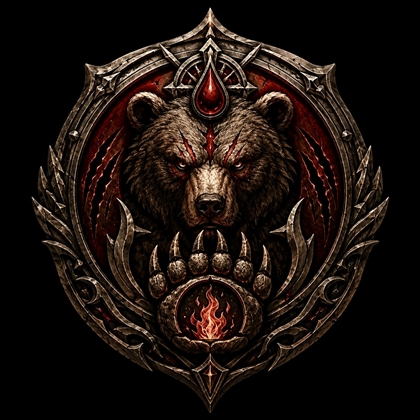
Every member bears an Ursus Mark. This is usually a broad paw print surrounding a blood drop, shield, flame, or smaller figures. It may be tattooed over the heart, branded between the shoulders, or carved along the forearms.
In hybrid form, an Ursus hunter becomes much broader and more heavily built. Thick fur covers the body, the face develops an ursine muzzle, and the hands become immense clawed weapons.
Coat color varies according to ancestry and magical influence. Brown, black, white, silver, red-brown, and blue-gray forms are all recorded.
When a Crimson Rite is active, glowing lines spread through the claws and forearms like molten blood beneath dark stone. Each footstep may briefly leave a luminous paw print.
Role in Aetheris
The Order of Ursus functions as a defender, frontline controller, and durable melee combatant.
On the battlefield, its members:
- Transform into a powerful werebear hybrid
- Gain temporary protection
- Grapple and shove larger enemies
- Resist forced movement
- Intercept attacks against allies
- Reduce incoming damage
- Control nearby space
- Frighten or halt advancing enemies
- Remain standing after devastating injuries
- Carry or extract wounded companions
Outside combat, Ursus hunters frequently serve as:
- Community guardians
- Caravan protectors
- Mountain wardens
- Rescue specialists
- Bodyguards
- Monster hunters
- Winter guides
- Defenders of refugees
- Anti-slavery fighters
- Protectors of sacred sites
- Mediators in isolated communities
- Guardians of vulnerable children or elders
Within an adventuring party, an Ursus hunter is most effective when positioned near allies and dangerous enemies. The subclass rewards remaining engaged rather than repeatedly withdrawing.
Subclass Integration
Major Polities
Helbrann League
The Helbrann League contains several respected Hearths. Ursus hunters defend mountain settlements, passes, tunnels, and winter roads.
Helbranni chapters emphasize discipline and communal accountability. A hunter showing signs of possessiveness or uncontrolled violence is rarely permitted to operate alone.
Volarion Republic
Volarion Ursus hunters often swear protection to individual cantons or communities. Their loyalty to local civic life makes them respected militia leaders and rescue specialists.
Freeholds of Rhonadral
Rhonari hunters frequently protect families, crews, settlements, and caravans. They are independent but take chosen obligations extremely seriously.
Dominion of Kaltheros
Kaltheran Hearths protect volcanic roads, fortress settlements, and communities threatened by subterranean monsters.
March of Draeven
The March employs Ursus hunters as defensive specialists, military rescuers, and guardians of fortified positions. Conflict arises when military commanders treat their protective instincts as unquestioning obedience.
Verdant Confederacy
Confederacy Hearths often work beside Druids, Rangers, Ursarath guardians, and frontier communities. They are particularly respected in regions threatened by corrupted predators.
Dominion of Xathrin
The Dominion considers the order a persistent obstacle to slavery and forced relocation. Ursus hunters frequently defend escaping captives and destroy fortified holding camps.
Obsidian Hegemony
The Hegemony has attempted to reproduce Ursus resilience through forced mutation. Its unstable bear soldiers are regarded by the order as victims as well as threats.
Organizations, Guilds, and Orders
Likely allies include:
- Ursarath communities
- Ranger lodges
- Verdant Thorn Blood Hunters
- Tigris Vigils
- Druid circles
- Rootkeepers
- Frontier militias
- Rescue companies
- Caravan networks
- Anti-slavery organizations
- Monster-hunting companies
- Temple guardians
- Refugee protection groups
Religious and Philosophical Movements
Some Ursus hunters honor the Bear-Father, particularly those who train among or alongside Ursarath communities.
Others follow deities associated with protection, endurance, family, winter, wilderness, or communal duty.
The order itself does not require a specific faith. It teaches that protection can be sacred even when it is not divine.
Members are strongly warned against claiming Ursarath rites or religious authority they have not been granted.
Rival Factions and Enemies
Common enemies include:
- Dominion of Xathrin slavers
- Obsidian Hegemony mutators
- Predatory warlords
- Supernatural traffickers
- Raiders
- Corrupted lycanthropes
- Tyrannical guardians
- Monsters that target isolated settlements
- Cults that demand sacrifice from communities
- Old One mutations
- Rogue Hearths
- Fallen Ursus hunters known as the Iron Maulers
Subclass Features
Order of Ursus Features
|
Blood Hunter Level |
Feature |
|
3rd |
Ursus Transformation, Rite of the Sheltering Claw |
|
7th |
Ursine Might |
|
11th |
Guardian of the Hearth |
|
15th |
Indomitable Presence |
|
18th |
Primal Bulwark |
Optional Subclass Techniques
The following techniques may be offered as specialized Hearth training, lycanthropic adaptations, downtime rewards, or optional Blood Hunter abilities at the Game Master’s discretion.
Winter Coat
Prerequisite: Order of Ursus, 7th level
While transformed, you have resistance to cold damage and suffer no penalties from extreme cold.
You can also sleep comfortably in freezing environments without ordinary shelter.
Burden Bearer
Prerequisite: Order of Ursus, 7th level
Your carrying capacity is doubled.
You can carry a willing or unconscious creature of your size or smaller without reducing your speed.
Carrying a larger creature reduces your speed by only 10 feet rather than halving it, provided the creature does not exceed your carrying capacity.
Crushing Embrace
Prerequisite: Order of Ursus, 11th level
At the start of your turn, you can deal bludgeoning damage equal to one roll of your Guardian Die plus your Strength modifier to one creature you are grappling.
You do not expend the Guardian Die when rolling it for this damage.
You can deal this damage only once during each turn.
Hearth-Blood Recovery
Prerequisite: Order of Ursus, 11th level
When you finish a short rest, choose yourself or one creature that completed the rest within 10 feet of you.
The chosen creature gains temporary hit points equal to your Blood Hunter level plus your Constitution modifier.
Once a creature gains temporary hit points from this technique, it cannot do so again until it finishes a long rest.
Guardian’s Challenge
Prerequisite: Order of Ursus, 15th level
As a bonus action, expend one Guardian Die and choose one creature you can see within 30 feet.
Until the end of your next turn, the creature has disadvantage on attack rolls against creatures other than you.
If it damages one of your allies during this time, you regain the Guardian Die expended on this technique.
Playing This Subclass
The Order of Ursus is designed as the defensive shapechanger among the specialized Blood Hunter orders.
Its central combat rhythm involves transforming, activating Rite of the Sheltering Claw, and positioning between dangerous enemies and vulnerable allies.
The subclass rewards:
- Remaining near allies
- Grappling dangerous creatures
- Controlling narrow passages
- Intercepting attacks
- Reducing incoming damage
- Punishing enemies that ignore you
- Maintaining concentration of enemy attention
- Enduring prolonged melee combat
Guardian Dice form the subclass’s primary resource. They fuel offensive pressure, grappling, damage reduction, attack interception, and repeated protective effects.
Unlike the Order of Tigris, Ursus is not primarily a pouncing attacker. It possesses less burst mobility and fewer offensive control options, but greater durability and stronger ally protection.
Unlike the Order of Pardus, Ursus does not depend upon stealth, darkness, or rapid withdrawal.
Temporary hit points from Bear’s Endurance are limited to once per short or long rest, preventing repeated transformations from refreshing a large defensive buffer.
Hearthguard grants small recurring temporary hit points, but only to creatures that currently have none. This prevents the aura from stacking excessive protection.
Guardian’s Intercession reduces damage rather than transferring the entire attack. Its force-damage cost prevents the Ursus hunter from combining resistance with interception to erase most enemy damage.
Unyielding Guardian at 18th level permits more flexible damage interception but remains limited to once per round and still inflicts irreducible force damage.
Roleplaying This Subclass
Members of the Order of Ursus are often patient, dependable, physically affectionate, and intensely protective.
Common habits include:
- Sitting nearest the door
- Taking the final watch
- Carrying extra food and blankets
- Checking whether companions have eaten
- Refusing to leave wounded allies behind
- Sleeping lightly when others are nearby
- Repairing shelters without being asked
- Remembering small details about companions’ needs
- Becoming visibly tense around threats to children
- Offering practical comfort rather than speeches
- Disliking unnecessary separation
- Remaining calm until violence becomes unavoidable
Common character themes include:
- A guardian who failed to protect a previous community
- A Blood Hunter adopted by an Ursarath family
- A veteran carrying the responsibilities of fallen companions
- A former tyrant learning that protection requires consent
- A caravan defender
- A rescuer altered by lycanthropic hemocraft
- A survivor of Hegemony experiments
- A bodyguard whose charge no longer wants protection
- A hunter seeking members of a destroyed Hearth
- A solitary warrior learning to accept protection from others
Common narrative tensions include:
- Protection versus control
- Responsibility versus exhaustion
- Strength versus vulnerability
- Accepting that companions can choose dangerous paths
- Knowing when a community must defend itself
- Allowing others to share burdens
- Distinguishing anger from justice
- Resisting the belief that only the hunter can keep everyone safe
Faction and Organization Connections
Likely allies and patrons include:
- Ursus Hearths
- Ursarath communities
- Ranger lodges
- Verdant Thorn Blood Hunters
- Tigris Vigils
- Druid circles
- Rootkeepers
- Frontier militias
- Rescue companies
- Caravan networks
- Anti-slavery organizations
- Temple guardians
- Refugee protection groups
Likely enemies include:
- Dominion of Xathrin slavers
- Obsidian Hegemony mutators
- Predatory warlords
- Supernatural traffickers
- Raiders
- Corrupted lycanthropes
- Tyrannical guardians
- Old One mutations
- Rogue Hearths
- The Iron Maulers
- Monsters that target isolated communities
- Rulers who use protection to justify oppression
Adventure Hooks
- The Empty Hearth. Every member of an Ursus chapter vanishes during a winter storm, but their protected village remains surrounded by enormous bear tracks.
- The Sleeping Guardian. A legendary werebear lies dormant beneath a mountain settlement. Recent mining has begun waking it, and no one knows whether it remembers the people it once protected.
- The Iron Mauler. A fallen Ursus hunter has imprisoned an entire community “for its own safety,” sealing every road and forbidding anyone to leave.
- The Stolen Shelter. Xathrin agents use a captured Hearth’s blood rites to create enslaved guardians incapable of disobeying commands.
- The Bear-Father’s Mark. Several unrelated children are born bearing an Ursus Mark. Ursarath priests, Blood Hunters, and political rulers disagree over what the sign means.
- The Guardian That Will Not Die. An Ursus hunter continues defending a ruined settlement decades after its inhabitants disappeared. The hunter refuses to believe they are gone.
Notable NPCs
Hroda Stonepaw, Matron of the First Hearth
Hroda is an Ursarath-trained Blood Hunter who protects several isolated mountain communities in the Helbrann League.
She is warm, observant, and almost impossible to intimidate. Hroda insists that every hunter under her authority spend time performing ordinary labor for the communities they protect.
Her hybrid form bears dark-brown fur marked by a broad white patch over the chest.
Garric Wintermantle, the Last Door
Garric is a Northman Ursus hunter famous for holding a fortress gate while hundreds of civilians escaped.
He survived, but one leg and much of his torso remain permanently transformed.
Garric now trains rescue companies and teaches that survival is a group discipline rather than an individual achievement.
Maura Ironmaw, the Shelter-Tyrant
Maura once defended refugees from slavers and raiders.
After years of sacrifice, she concluded that the people under her protection lacked the judgment to govern themselves. She now controls every aspect of their lives while insisting that none have suffered violence since accepting her rule.
Her territory is peaceful, secure, and nearly impossible to leave.
Balance Notes
Intended Role
Primary role: Defender
Secondary roles: Controller, Durable Striker, Rescue Specialist
The subclass is intended to protect nearby allies, control dangerous melee enemies, and remain functional under sustained pressure.
Damage Profile
Sustained damage comes from Bear Claws and Crimson Rite.
Mauling Fury provides a limited additional attack through Guardian Die expenditure.
Crushing Hold and Rite of the Sheltering Claw add situational damage.
Bulwark’s Wrath adds reliable capstone damage once per turn.
Earthshaking Reprisal provides one area-damage effect during the capstone transformation.
The subclass deals less burst damage than Tigris or Pardus in exchange for greater defense and ally protection.
Survivability
The subclass gains survivability through:
- Temporary hit points
- Nonmagical physical resistance
- Damage reduction
- Improved grappling size
- Forced-movement resistance
- Death refusal
- Fear immunity
- High-level physical resistance
- Guardian Dice recovery during the capstone
Permanent resistance to magical physical attacks is delayed until 18th level.
Before then, magical physical damage can be reduced only through Brace the Impact or similar limited abilities.
Utility
The subclass provides:
- Enhanced perception
- Tracking
- Increased carrying capacity
- Rescue capability
- Grappling and shoving
- Damage interception
- Fear protection
- Death-saving-throw support
- Environmental cold protection
- Defensive positioning
- Cover for nearby allies
Resource Economy
Ursus Transformation has proficiency-bonus uses per long rest.
Guardian Dice equal the hunter’s proficiency bonus and recover on a long rest.
These dice power:
- Additional claw attacks
- Defensive reactions
- Grappling damage
- Damage reduction
- Repeated interception
- Optional techniques
Guardian’s Roar normally recovers on a short or long rest but can be reused by spending two Guardian Dice.
Unbroken Bastion restores one Guardian Die each turn but lasts only 1 minute and is usable once per long rest.
Comparison to Similar Subclasses
The Order of Ursus shares themes with defensive Fighters, ancestral Barbarians, Paladins, and other lycanthropic Blood Hunters.
Unlike a Barbarian, it does not gain Rage, Reckless Attack, or early resistance to all physical weapon damage.
Unlike a Paladin, it lacks healing pools, spellcasting, Divine Smite, and broad saving-throw auras.
Unlike the Order of Tigris, it has less mobility and offensive pressure but stronger protection and damage interception.
Unlike the Order of Pardus, it lacks stealth-based execution and evasive movement.
Its strength lies in positioning, endurance, grappling, protection, and absorbing consequences that would otherwise fall upon allies.
Summary
The Order of Ursus is a defensive Blood Hunter tradition built around controlled werebear transformation.
Its members become powerful ursine hybrids capable of grappling large enemies, resisting forced movement, reducing incoming damage, and sheltering nearby allies.
Guardian Dice fuel the subclass’s attacks, defensive reactions, grappling pressure, and damage interception. Rite of the Sheltering Claw punishes enemies that ignore the hunter and attack protected companions.
At higher levels, Ursus hunters project a defensive aura, refuse to fall, frighten enemies, provide cover, and become living bastions capable of standing between an entire party and destruction.
Within Aetheris, the order operates through communal Hearths that protect settlements, families, roads, refugees, and other vulnerable communities.
The subclass is best suited to players who enjoy transformation, defensive positioning, grappling, ally protection, damage reduction, communal responsibility, and the tension between sheltering others and controlling them.
“A wall is not remembered because it stood untouched. It is remembered because something precious remained standing behind it.”
—Final teaching of the First Hearth
Level 3: Ursus Transformation
You can assume the hybrid form of a supernatural bear.
Action Type: Bonus action
Uses: Proficiency bonus per long rest
Duration: 10 minutes
Scaling: Natural weapons and defensive benefits improve at higher levels
As a bonus action, you transform into your Ursus hybrid form.
The transformation lasts for 10 minutes. It ends early if:
- You are incapacitated.
- You die.
- You dismiss it as a bonus action.
- You assume another form through a class feature or magical effect.
You can transform a number of times equal to your proficiency bonus. You regain all expended uses when you finish a long rest.
Your equipment does not merge into the transformation. Worn armor and carried equipment adjust to accommodate your hybrid form whenever reasonably possible.
While transformed, you gain the following benefits.
Bear Claws
Your claws are natural melee weapons with which you are proficient.
They deal 1d8 slashing damage and possess the versatile property, dealing 1d10 damage when you attack using both hands.
You use Strength for their attack and damage rolls.
Your claws count as one weapon for the purpose of activating and maintaining a Crimson Rite. Activating a rite on your claws affects both hands.
Your claw attacks count as magical for the purpose of overcoming resistance and immunity to nonmagical attacks and damage.
Bear’s Endurance
When you transform, you gain temporary hit points equal to your Blood Hunter level plus your Constitution modifier.
These temporary hit points disappear when the transformation ends.
Once you gain temporary hit points from this feature, you cannot gain them again until you finish a short or long rest.
Additional transformations before then do not restore the temporary hit points.
Ursine Build
You count as one size larger when determining:
- Your carrying capacity;
- The weight you can push, drag, or lift;
- The creatures you can grapple or shove; and
- Whether another creature can forcibly move you.
If you are Small, you count as Medium. If you are Medium, you count as Large.
This feature does not increase the space you occupy or the reach of your attacks.
Keen Senses
You have advantage on Wisdom (Perception) checks relying on hearing or smell.
You also have advantage on Wisdom (Survival) checks made to track a creature that has damaged one of your allies within the past 24 hours.
Grounded Stance
You have advantage on ability checks and saving throws made to resist being knocked prone or moved against your will.
Standing from prone costs you only 5 feet of movement.
Protective Instinct
When a hostile creature enters a space within 5 feet of one of your allies and is also within your reach, you can move 5 feet toward that creature without provoking an opportunity attack from it.
This movement does not require an action, but you can use it only once per round.
Predatory Composure
You have advantage on saving throws against being frightened.
Whenever you begin your turn below half your hit point maximum, the bear spirit’s protective fury intensifies. Until the end of that turn:
- You have advantage on Strength checks.
- You count as one additional size larger for grappling and shoving.
- You cannot willingly take the Dodge action.
This feature never compels you to attack an ally or surrender control of your actions.
Rite of the Sheltering Claw
You learn the Rite of the Sheltering Claw as part of your Crimson Rite feature. It does not count against the number of Crimson Rites you know.
Action Type: Part of the bonus action used to activate a Crimson Rite
Uses: At-will, subject to normal Crimson Rite rules
Duration: Until the Crimson Rite ends
Scaling: Protective effect improves at 11th level
The Rite of the Sheltering Claw can be activated only on a melee weapon or your Bear Claws.
While the rite is active, the weapon’s rite damage is force or thunder damage. You choose the damage type when you activate it.
Once during each of your turns when you hit a hostile creature with a weapon bearing this rite, you can mark it as Threatening until the start of your next turn.
The first time the Threatening creature damages one of your allies before the mark ends, it takes damage equal to one roll of your Hemocraft die.
A creature can take this damage only once from each application of the rite.
At 11th level, the ally damaged by the Threatening creature also gains temporary hit points equal to your Hemocraft modifier, with a minimum of 1.
Level 7: Ursine Might
Your hybrid form develops greater resilience and the strength to dominate close combat.
Action Type: Passive; Guardian Dice expenditure
Uses: Guardian Dice equal to your proficiency bonus per long rest
Duration: Instantaneous or until the start of your next turn
Scaling: Guardian Dice become d8s at 11th level and d10s at 18th level
You gain a pool of Guardian Dice equal to your proficiency bonus. These dice are d6s.
You regain all expended Guardian Dice when you finish a long rest.
Your Guardian Dice become d8s at 11th level and d10s at 18th level.
While transformed, you gain resistance to bludgeoning, piercing, and slashing damage from nonmagical attacks.
You can expend Guardian Dice in the following ways.
Mauling Fury
When you take the Attack action and make at least one attack with your Bear Claws, you can expend one Guardian Die to make one additional claw attack as a bonus action.
On a hit, add the Guardian Die result to the attack’s damage.
Sentinel Instinct
When a creature you can see attacks an ally within 10 feet of you, you can use your reaction and expend one Guardian Die.
Roll the die and subtract the result from the attack roll.
You must use this feature before the attack’s outcome is determined.
If the attack misses, the attacker becomes Threatening under your Rite of the Sheltering Claw until the start of your next turn, even if you did not hit it.
Crushing Hold
When you successfully grapple a creature or hit a creature you are grappling with a claw attack, you can expend one Guardian Die.
The creature takes bludgeoning damage equal to the die result plus your Strength modifier.
Until the start of your next turn, the creature has disadvantage on checks made to escape your grapple.
Brace the Impact
When you take bludgeoning, piercing, or slashing damage, you can use your reaction and expend one Guardian Die.
Reduce the damage by the Guardian Die result plus your Constitution modifier.
If the damage came from a nonmagical attack, also add your proficiency bonus to the reduction.
Relentless Shove
When you successfully shove a creature, you can expend one Guardian Die.
Move the creature an additional number of feet equal to five times the result rolled, to a maximum of 20 additional feet.
Alternatively, if you knocked the creature prone, it cannot stand until the start of your next turn unless it uses an action to do so.
Level 11: Guardian of the Hearth
Your presence becomes a source of protection and resilience for nearby allies.
Action Type: Passive; reaction for Guardian’s Intercession
Uses: Guardian’s Intercession once per short or long rest, with additional uses through Guardian Dice
Duration: Continuous while transformed
Scaling: Guardian Dice become d8s at this level
While transformed, you emanate a 10-foot Hearthguard aura.
You and friendly creatures within the aura gain the following benefits:
- Advantage on saving throws against being frightened;
- Advantage on checks and saving throws made to resist being shoved, knocked prone, or forcibly moved;
- Resistance to environmental cold;
- Advantage on death saving throws; and
- A creature that begins its turn with no temporary hit points gains temporary hit points equal to your Constitution modifier, with a minimum of 1.
A creature can gain temporary hit points from your Hearthguard aura only once during each round.
The temporary hit points disappear when the creature leaves the aura or your transformation ends.
Guardian’s Intercession
When an ally within your Hearthguard aura takes damage, you can use your reaction to move up to 10 feet toward that ally.
This movement does not provoke opportunity attacks.
If you end this movement within 5 feet of the ally, reduce the triggering damage by an amount equal to two rolls of your Guardian Die plus your Constitution modifier.
You then take force damage equal to half the amount by which you reduced the triggering damage.
The force damage dealt to you cannot be reduced or prevented.
Once you use Guardian’s Intercession, you cannot use it again until you finish a short or long rest unless you expend two Guardian Dice to use it again.
Ursine Endurance
When you are reduced to 0 hit points but not killed outright while transformed, you can drop to 1 hit point instead.
You then gain temporary hit points equal to one roll of your Guardian Die plus your Constitution modifier.
Once you use Ursine Endurance, you cannot use it again until you finish a long rest.
Level 15: Indomitable Presence
Your hybrid form becomes an immovable center of protection and primal authority.
Action Type: Bonus action
Uses: Once per short or long rest; additional uses by expending two Guardian Dice
Duration: 1 minute, with repeat saving throws
Scaling: None
While transformed, you can use a bonus action to unleash a Guardian’s Roar.
Each hostile creature of your choice within 30 feet that can hear you must make a Wisdom saving throw against your Hemocraft save DC.
On a failed save, a creature is frightened of you for 1 minute.
While frightened in this way:
- Its speed is reduced by 10 feet.
- It has disadvantage on attack rolls against creatures other than you.
- It cannot take reactions.
- It cannot willingly enter a space within 5 feet of one of your allies unless it is also within your reach.
A frightened creature repeats the saving throw at the end of each of its turns, ending the effect on itself on a success.
A creature that succeeds on the initial saving throw is immune to your Guardian’s Roar until you finish a long rest.
Once you use Guardian’s Roar, you cannot use it again until you finish a short or long rest unless you expend two Guardian Dice to use it again.
Bear’s Resolve
While transformed:
- You are immune to the frightened condition.
- You have advantage on saving throws against being charmed.
- You cannot be moved against your will unless you are incapacitated or choose to be moved.
A creature at least two sizes larger than you can still move you, but it must first succeed on a Strength check against your Hemocraft save DC.
Living Rampart
You provide half cover to friendly creatures of your size or smaller while they are within 5 feet of you, provided you are between the creature and the source of the attack.
You cannot provide this cover while prone, incapacitated, or grappled by a creature larger than you.
Level 18: Primal Bulwark
You have mastered the protective strength, endurance, and terrible wrath of the bear spirit.
Action Type: Passive; bonus action to invoke the Unbroken Bastion
Uses: Unbroken Bastion once per long rest
Duration: 1 minute
Scaling: Final subclass feature
Your Ursus Transformation gains the following permanent improvements.
Mighty Claws
Your Bear Claws deal 2d8 slashing damage, or 2d10 damage when used with both hands.
Your claw attacks score a critical hit on a roll of 19 or 20.
Against a creature you are grappling or a creature that has damaged one of your allies since the end of your last turn, your claw attacks instead score a critical hit on a roll of 18–20.
Mountain’s Strength
When you make a Strength check or Strength saving throw, you can treat a d20 roll of 9 or lower as a 10.
You count as Huge when determining your carrying capacity and the creatures you can grapple or shove.
This does not increase the space you occupy or the reach of your attacks.
Unstoppable Guardian
While transformed:
- You cannot be knocked prone.
- Your speed cannot be reduced below 10 feet unless you are incapacitated.
- You have advantage on saving throws against being paralyzed, restrained, or stunned.
- You can grapple creatures up to two sizes larger than you.
You are not automatically immune to grappling or restraint, preserving the ability of exceptionally powerful creatures to control you.
Unbroken Bastion
As a bonus action while transformed, you become an Unbroken Bastion for 1 minute.
The effect ends early if your transformation ends or you become incapacitated.
While the Unbroken Bastion lasts, you gain the following benefits.
Apex Resilience
You have resistance to bludgeoning, piercing, and slashing damage.
You also have resistance to cold, force, and thunder damage.
Shelter of the Great Bear
Your Hearthguard aura expands to 30 feet.
At the start of each of your turns, choose a number of allies within the aura up to your Constitution modifier, with a minimum of one.
Each chosen ally gains temporary hit points equal to one roll of your Guardian Die plus your Constitution modifier.
A creature cannot gain these temporary hit points again until the start of your next turn.
Unyielding Guardian
When an ally within your Hearthguard aura takes damage, you can use your reaction to take some or all of the damage in the ally’s place.
Choose any amount of the triggering damage, up to your Blood Hunter level plus twice your Constitution modifier.
The ally’s damage is reduced by the chosen amount, and you take force damage equal to that amount.
This force damage cannot be reduced or prevented.
You can use Unyielding Guardian only once during each round.
Crushing Retaliation
The first time during each round that you take damage through Guardian’s Intercession or Unyielding Guardian, choose one hostile creature within your reach.
You can make one claw attack against that creature without using an action.
Bulwark’s Wrath
Once during each of your turns when you hit a creature with a claw or melee weapon attack, the attack deals an additional 2d8 force or thunder damage.
If the creature damaged one of your allies since the end of your last turn, the additional damage becomes 4d8.
Unending Guardianship
At the start of each of your turns, you regain one expended Guardian Die.
You cannot have more Guardian Dice than your proficiency bonus.
Earthshaking Reprisal
Once during the Unbroken Bastion, when you or an ally within your Hearthguard aura is reduced to half their hit point maximum or fewer, you can strike the ground without using an action.
Each hostile creature of your choice within 20 feet must make a Strength saving throw against your Hemocraft save DC.
On a failed save, a creature takes 6d10 thunder damage, falls prone, and is pushed up to 10 feet away from you.
On a successful save, it takes half as much damage and is neither knocked prone nor pushed.
Once you use Unbroken Bastion, you cannot use it again until you finish a long rest.
Previous Versions
| Name | Date Modified | Views | Adds | Version | Actions |
|---|---|---|---|---|---|
|
7/24/2026 7:43:56 PM
|
5
|
3
|
1
|
Coming Soon
|
Comments