



 Base Class: Paladin
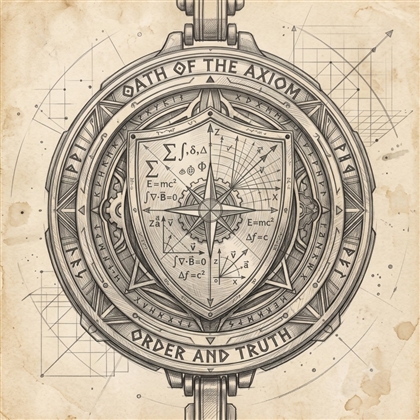
Paladins of the Oath of the Axiom do not swear to gods, kings, or abstract concepts of justice. They swear a commitment to universal constants, mathematics, and the laws of physics. Power is derived from strict empirical logic and absolute willpower.
Tenets of the Axiom:
- Empirical Truth: Reject the illusion of destiny. Rely only on what can be measured, observed, and mathematically proven.
- Broken Oath I: Acting on blind faith, superstition, or a prophetic vision without seeking empirical validation.
- Broken Oath II: Spreading, endorsing, or codifying a falsehood or mathematical error to manipulate others or protect oneself.
- Economy of Motion: Emotion and vanity are physical liabilities. Every strike, movement, and word must serve a calculated, strictly necessary purpose.
- Broken Oath III: Exposing oneself or allies to unnecessary risk out of personal pride, anger, or the desire for glory.
- Broken Oath IV: Spontaneous slaughter or cruelty driven purely by emotional malice rather than a calculated tactical objective.
- Calculated Reputation: A demoralized enemy is statistically easier to kill. Maintain a fearsome reputation as a practical tool to reduce battlefield resistance.
- Broken Oath V: Intentionally displaying weakness, cowardice, or groveling before a hostile force, compromising tactical authority.
- Broken Oath VI: Allowing a defeated foe to spread word of the Paladin's mercy or inconsistency, thereby diminishing their calculated deterrent.
- Risk Assessment: Identify the highest probability threat immediately. Isolate it, disable it, and eliminate it without hesitation or mercy.
- Broken Oath VII: Hesitating to eliminate a confirmed, high-probability threat due to personal affection or sentimentality.
- Broken Oath VIII: Wasting resources or compromising a mission to focus on a low-probability, tertiary threat out of personal bias.
History:
The origins of the Oath trace back to the aftermath of the Time of Troubles (1358 DR) and the subsequent devastation of the Spellplague (1385 DR) in Faerûn. When the gods were cast down to walk Toril and Mystra's assassination shattered the Weave, magic went wild and kingdoms collapsed under divine whim. Witnessing this chaos, a faction of sentinel-scholars from Candlekeep and the order of Silverymoon rejected the fickle worship of deities. They asserted that magic and the Weave were not divine gifts, but a natural, physical energy field governed by immutable laws of conservation, geometry, and frequency. Retreating to the isolated observatories of the Sunset Mountains, they formulated the Axiomatic Theorems—proving that Toril's physical constants, not the whims of the Seldarine or the Faerûnian pantheon, dictate structural reality. Today, paladins of this Oath serve as empirical wardens across the Sword Coast, stabilizing spell scars and policing anomalies caused by divine interference.
Level 3: Oath of the Axiom Spells
You gain oath spells at the paladin levels listed.
-
3rd Level: Shield, Longstrider
-
5th Level: Misty Step, Blur
-
9th Level: Haste, Slow
-
13th Level: Dimension Door, Otiluke's Resilient Sphere
-
17th Level: Wall of Force, Telekinesis
Level 3: Channel Divinity: Axiom Options
You gain the following two Channel Divinity options.
Diagnosed Weakness. You use a Bonus Action to analyze the mechanical flaws of one creature you can see within 30 feet. You instantly learn the target's current Armor Class, damage immunities, resistances, and vulnerabilities. For the next minute, your weapon attacks against that creature score a critical hit on a roll of 19 or 20, and your attacks ignore half and three-quarters cover. Can be used once per short rest.
While this feature is active, you can choose to have your weapon attacks against the target deal Force damage instead of their normal damage type. If the target drops to 0 hit points before this effect ends, you can use your Reaction to immediately transfer this analysis to a new creature you can see within 30 feet.
Calculated Momentum. You use a Bonus Action to instruct your allies on the most efficient paths of movement. You can distribute temporary hit points equal to 2 times your Paladin level + your Charisma modifier among creatures of your choice within 30 feet. For the duration of combat any creature that gained these temporary hit points has their walking speed increased by 10 feet. Can be used once per short rest.
Level 7: Aura of Calculus
Your hyper-vigilant risk assessment creates a zone of absolute tactical awareness and statistical normalization. You and friendly creatures within 10 feet of you can never be Surprised. Additionally, you and any ally within the aura can add your Charisma modifier (minimum of +1) to Initiative rolls.
Furthermore, once per round, when you or a friendly creature within the aura makes a saving throw and rolls a 9 or lower on the d20, they can choose to treat the roll as a 10 instead.
At 18th level, the range of this aura increases to 30 feet.
Level 3: Axiomatic Force
You have learned to draw your power from the absolute physical and mechanical constants of the multiverse rather than divine entities. Whenever you cast a Paladin Smite spell (such as Divine Smite), you can choose to change its damage type to Force instead of Radiant.
Level 15: Vector Deflection
You master the geometry of trajectories. When you or a creature you can see within 30 feet is targeted by an attack, you can use your Reaction to add or subtract your Charisma modifier (minimum of +1) from the attack roll, potentially causing it to miss.
You can use this Reaction a number of times equal to your Charisma modifier (minimum of once). You regain all expended uses when you finish a Long Rest.
Level 20: Paradigm of Logic
You achieve a state of perfect, unfeeling efficiency. As a Bonus Action, you enter this state for the rest of the encounter. While in this state, you gain the following benefits:
-
You are immune to the Charmed, Frightened, and Stunned conditions.
-
When you take the Attack action, you can make one additional attack as part of that action.
-
If your weapon attack hits, you can choose to forego rolling the weapon's base damage dice and instead deal the maximum possible number on those dice.
Once you use this feature, you can’t use it again until you finish a Long Rest.
Previous Versions
| Name | Date Modified | Views | Adds | Version | Actions |
|---|---|---|---|---|---|
|
7/28/2026 11:25:46 AM
|
12
|
1
|
1.0
|
Coming Soon
|
|
|
7/28/2026 1:12:29 PM
|
12
|
1
|
1.3
|
Coming Soon
|
|
|
7/28/2026 1:37:27 PM
|
13
|
1
|
1.4
|
Coming Soon
|
Comments