



 Base Class: Warlock
Xyrrath, the Thousand-Legged Hunger
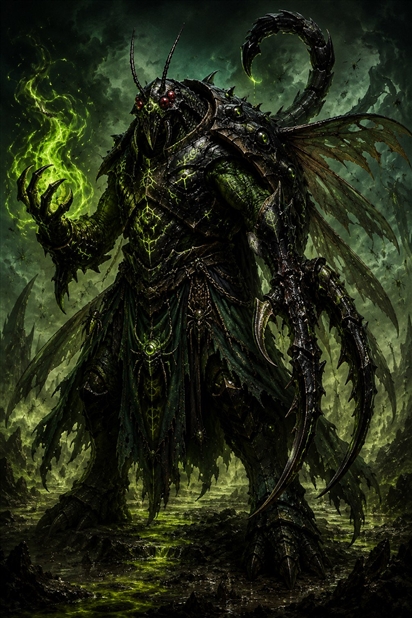
Xyrrath does not lend power—it changes those who enter its service. Warlocks of the Brood gradually become living extensions of their patron, developing chitinous armor, compound eyes, antennae, claws, venomous stingers, wings, and other insect-like mutations.
The Brood of Xyrrath focuses on permanent physical transformation and adaptation. As your bond with Xyrrath deepens, your body becomes increasingly insectoid, granting you supernatural abilities while making it more difficult to pass as an ordinary humanoid.
Your pact also takes on the nature of the Brood. Weapons can manifest as living insects, familiars become specialized members of Xyrrath's swarm, and forbidden knowledge can be recorded within a living codex of chitin, wings, and shifting insects.
The Gifts Have a Price
The physical transformations granted by Xyrrath are permanent. Chitin, claws, antennae, eyes, wings, stingers, and other mutations remain part of your body even if your pact is broken.
These mutations can affect how others perceive you. Some creatures may fear or distrust your increasingly unnatural appearance, while others may find your monstrous form deeply intimidating.
As your power grows, Xyrrath's influence becomes increasingly visible until the boundary between warlock and insect begins to disappear.
The Brood does not simply give you power. It transforms you into something capable of wielding it.
BROOD SPELLS
Xyrrath grants you access to magic associated with insects, venom, transformation, and the consuming nature of the Brood.
The following spells are associated with the Brood of Xyrrath:
Infestation
Spider Climb
Web
Enlarge/Reduce
Fly
Stinking Cloud
Giant Insect
Cloudkill
Insect Plague
THE BROOD OF XYRRATH
There are patrons who desire worship. There are patrons who desire obedience.
Xyrrath desires transformation.
Known by whispered names such as the Mother of the Brood, the Hunger Beneath the Chitin, and the Queen of Crawling Things, Xyrrath is an ancient and alien intelligence whose influence manifests through insects, venom, mutation, consumption, and adaptation.
Whether Xyrrath is truly a single entity is uncertain. Some occult scholars describe her as an immense insectoid horror dwelling somewhere beyond the known planes. Others claim that Xyrrath is not an individual creature at all, but a consciousness shared across an endless supernatural swarm.
A more disturbing theory suggests that every creature touched by Xyrrath eventually becomes part of her—and that the entity called Xyrrath is simply the collective hunger of everything the Brood has ever consumed.
THE CALL OF THE BROOD
Xyrrath rarely approaches mortals through conversation.
She communicates through instinct.
A prospective warlock might begin dreaming of endless tunnels filled with the sound of millions of wings. Insects may gather around them without attacking. Spiders construct strange symbols in their webs. Beetles appear where none should survive. A wounded character might awaken to discover tiny creatures surrounding the injury as though examining it.
Then comes the hunger.
Not necessarily hunger for food, but an overwhelming desire to survive, adapt, learn, hunt, and become something stronger.
Xyrrath offers power to those willing to change.
The pact is rarely written and almost never spoken.
The warlock simply accepts the Brood.
THE BROOD
Those who serve Xyrrath call themselves many things: Broodbound, Chosen of the Swarm, Children of Xyrrath, or simply the Brood.
They are not necessarily allies.
Xyrrath values adaptation above loyalty. Two members of the Brood might cooperate, compete, hunt one another, or never realize that they serve the same patron.
What unites them is transformation.
As a warlock's connection to Xyrrath deepens, their body begins displaying increasingly unnatural characteristics. Chitin may grow beneath the skin. Eyes may become glossy or segmented. Fingers may develop small hooks. Venom glands may form beneath the tongue. Additional joints may appear where none existed before.
Some changes are subtle.
Others are impossible to hide.
These mutations are not punishments.
To Xyrrath, they are improvements.
XYRRATH'S GIFT
The first lesson of the Brood is simple:
Survival belongs to those who can change.
Warlocks of Xyrrath develop insect-like adaptations that alter their bodies and grant abilities inspired by the countless creatures of the Brood.
One warlock might develop the climbing ability of a spider. Another might gain the extraordinary senses of a predatory insect. Another might develop powerful legs, hardened chitin, or stranger adaptations.
No two members of the Brood need look alike.
Each transformation represents Xyrrath reshaping her servant into something better suited to survive.
XYRRATH'S PACT
Xyrrath's influence also changes the nature of a warlock's Pact Boon.
Those who follow the Pact of the Blade become Predators, hunters who feed Xyrrath's hunger through violence and bloodshed.
Those who follow the Pact of the Chain become Broodkeepers. Their familiars are drawn into Xyrrath's supernatural ecosystem, becoming strange members of the Brood capable of assuming insect-like forms.
Those who follow the Pact of the Tome become Brood Scholars. Their books transform into living Brood Codices formed from chitin, translucent wings, shed exoskeletons, membranes, and crawling creatures that rearrange themselves into forbidden writing.
Each path represents a different aspect of Xyrrath:
The Predator hunts.
The Broodkeeper commands.
The Brood Scholar understands.
THE BROOD STIRS
As Xyrrath's influence grows, transformation becomes increasingly difficult to separate from the warlock's natural body.
Chitin spreads.
Organs adapt.
The body learns to survive environments that once threatened it.
Acid, freezing cold, flame, lightning, and poison can become merely another problem for the Brood to overcome.
At this stage, some warlocks begin wondering where their own body ends and Xyrrath's design begins.
XYRRATH'S STINGER
Eventually, the Broodbound develops one of Xyrrath's most unmistakable gifts: a permanent venomous stinger.
The weapon is not carried.
It is grown.
Through it, the warlock can deliver supernatural venoms produced by their transformed body. These toxins can poison prey, paralyze victims, drain life, or plunge creatures into unnatural sleep.
With every transformation, the distinction between warlock and Brood becomes smaller.
BECOME THE HUNGER
The most powerful servants of Xyrrath eventually discover the truth hidden within every gift their patron has granted them.
The mutations were never separate abilities.
They were pieces of a single form.
For a brief and terrifying moment, the warlock can allow those pieces to become whole.
Chitin spreads across the body. Wings tear free and unfold. Additional limbs emerge. Venom courses through newly formed organs. Supernatural insects gather around their transformed master while wounds begin knitting themselves closed through Xyrrath's unnatural vitality.
The warlock becomes an Avatar of the Brood.
They become faster, harder to kill, and horrifyingly efficient at hunting prey.
For that brief moment, the warlock does not merely command the Brood.
They are the Brood.
They Become the Hunger.
THE PRICE OF TRANSFORMATION
Xyrrath's gifts carry an unusual price.
They do not always disappear.
Even when supernatural abilities fade, traces of transformation may remain behind. Chitin might remain beneath the skin. An additional eye may never completely close. Strange clicking noises might accompany speech. Insects may instinctively recognize the warlock as something familiar.
These changes need not provide mechanical benefits unless a subclass feature says otherwise.
They are marks of the pact.
A record written upon the body.
Some Broodbound hide these mutations.
Others display them proudly.
And some eventually stop remembering why they ever considered their original form preferable.
THE WILL OF XYRRATH
Xyrrath does not judge creatures as good or evil.
She understands only adaptation and extinction.
Survive, and you have proven yourself worthy of further evolution.
Fail, and your remains will nourish something stronger.
A warlock of Xyrrath therefore need not be cruel or monstrous. Some use their transformations to protect others, believing that terrible power can serve a noble purpose. Others embrace the philosophy of the Brood completely and view every conflict as a contest determining which creature deserves to survive.
Whatever path they choose, one question eventually follows every servant of Xyrrath:
Are you controlling the transformation...
or is Xyrrath simply waiting for you to become what you were always meant to be?
Xyrrath's Gift
When you choose Xyrrath as your patron at 3rd level, its influence permanently alters your body.
Chitinous Carapace. While you aren't wearing armor, your Armor Class equals 13 + your Dexterity modifier. You can use a Shield while benefiting from this feature. Your carapace is a permanent physical alteration and can't be voluntarily dismissed.
Insect Adaptations. Choose one of the following adaptations:
Spider Climber. You gain a Climb Speed equal to your Speed. You can climb difficult surfaces, including ceilings, without making an ability check.
Compound Eyes. You gain Darkvision out to 60 feet. If you already have Darkvision, its range increases by 60 feet. You have Advantage on Wisdom (Perception) checks that rely on sight.
Leaping Legs. Your jump distance is tripled, and you don't need a running start to make a Long Jump or High Jump.
Predatory Claws. Your claws are Natural Weapons that deal 1d6 Slashing damage. You can use Strength or Dexterity for their attack and damage rolls.
Burrowing Mandibles. You gain proficiency in Athletics. You have Advantage on Strength checks made to break, tear, or force open objects.
Sensitive Antennae. You have Advantage on Wisdom (Perception) checks that rely on hearing or smell. You can sense the presence of creatures within 10 feet of you, even if you can't see them, unless the creature is behind Total Cover.
Reinforced Chitin. Your Chitinous Carapace AC becomes 14 + your Dexterity modifier.
The physical changes caused by your chosen adaptations are permanent manifestations of Xyrrath's influence.
Compound Eyes
Your eyes permanently become multifaceted and insect-like.
You gain Darkvision out to 60 feet. If you already have Darkvision, its range increases by 60 feet.
You have Advantage on Wisdom (Perception) checks that rely on sight.
Leaping Legs
Your legs permanently become longer, stronger, and more insect-like, developing powerful joints built for sudden leaps.
Your jump distance is tripled, and you don't need a running start to make a Long Jump or High Jump.
Spider Climber
Your body develops insect-like climbing adaptations, such as hooked claws, gripping pads, or tiny bristles.
You gain a Climb Speed equal to your Speed. You can climb difficult surfaces, including ceilings, without needing to make an ability check.
Level 3: Voice of the Brood
Xyrrath allows you to communicate with the creatures of the Brood.
You can communicate telepathically with Beasts and Monstrosities that have an insect-like form while they are within 60 feet of you.
You can also communicate simple concepts with ordinary insects. When communicating with insects, you can understand them regardless of whether they normally possess a language.
You can cast Speak with Animals without expending a spell slot. Once you cast the spell using this feature, you can't do so again until you finish a Long Rest.
Level 3: Xyrrath's Pact
Your pact with Xyrrath alters the form of your chosen Pact Invocation.
If you possess Pact of the Blade, Pact of the Chain, or Pact of the Tome, Xyrrath transforms that pact into a living manifestation of the Brood.
The Predator — Pact of the Blade. Your Pact weapon becomes a living insect capable of transforming into your chosen weapon and feeding upon the vitality of your enemies.
The Broodkeeper — Pact of the Chain. Your familiar becomes a supernatural member of Xyrrath's Brood and can develop specialized insect adaptations.
The Brood Scholar — Pact of the Tome. Your Book of Shadows becomes a living Brood Codex containing insect magic and forbidden knowledge.
These features modify the corresponding Pact Invocation. They do not grant the Pact Invocation itself.
The Brood Scholar
Pact of the Tome — The Brood Scholar
If you have Pact of the Tome, your Book of Shadows transforms into a living Brood Codex.
Its pages are formed from chitin, translucent wings, shed exoskeletons, and thin membranes. Tiny supernatural insects crawl across its pages and rearrange themselves to form its writing.
Forbidden Brood Knowledge. You gain proficiency in Nature. If you already have proficiency in Nature, you instead gain Expertise in Nature.
After studying a creature you can see for 1 minute, you can learn one of the following pieces of information about it:
• One damage Resistance it possesses.
• One damage Immunity it possesses.
• One damage Vulnerability it possesses.
• Whether it has the Poisoned condition.
• Whether it is suffering from a disease.
You can use Forbidden Brood Knowledge a number of times equal to your Proficiency Bonus, and you regain all expended uses when you finish a Long Rest.
The Brood Codex also grants access to supernatural magic associated with insects, transformation, poison, decay, and Xyrrath's Brood.
The Broodkeeper
Pact of the Chain — The Broodkeeper
If you have the Pact of the Chain invocation, your familiar becomes a supernatural member of Xyrrath's Brood.
Your familiar can appear as a Spider, Scorpion, Wasp, Moth, Beetle, Fly, Ant, or Locust.
Whenever you finish a Long Rest, you can choose one Brood Form for your familiar. The chosen form remains until you finish another Long Rest.
Brood Forms
Spider. Your familiar gains a Climb Speed equal to its Speed and can climb difficult surfaces, including ceilings, without making an ability check.
Fly. Your familiar gains a Flying Speed equal to its Speed.
Moth. Your familiar gains Darkvision out to 120 feet.
Wasp. Your familiar's Speed increases by 10 feet.
Beetle. Your familiar gains Resistance to Bludgeoning damage.
Scorpion. Your familiar's attacks can deal additional Poison damage.
Ant. Your familiar has Advantage on Strength checks.
Locust. Your familiar doesn't provoke Opportunity Attacks when it moves on its turn.
The Predator
When you summon your Pact weapon, it can appear as a supernatural insect from Xyrrath's Brood that transforms into the weapon you choose.
The insect's appearance reflects the weapon's form. A mantis might unfold into a sword, a centipede might become a whip, a beetle might form a maul, or a scorpion might become a spear.
The weapon otherwise functions normally as your Pact weapon.
Brood Feeding. Once per turn when you hit a creature with your Pact weapon, you can cause the Brood to drain its vitality.
The attack deals an additional 1d6 Necrotic damage, and you regain Hit Points equal to your Proficiency Bonus.
You can use Brood Feeding a number of times equal to your Charisma modifier (minimum of once). You regain all expended uses when you finish a Long Rest.
Level 6: The Brood Stirs
Xyrrath's influence within your body grows stronger, causing your insect-like mutations to evolve.
Additional Adaptation. You gain one additional Insect Adaptation from the options available through Xyrrath's Gift.
Brood Resilience. Whenever you finish a Long Rest, choose one of the following damage types: Acid, Cold, Fire, Lightning, or Poison.
You gain Resistance to the chosen damage type until you finish your next Long Rest.
The physical changes associated with this feature are manifestations of Xyrrath's growing influence and may permanently alter the appearance of your chitin, skin, or other insect-like features.
Acid Resilience
Your chitin changes to withstand corrosive substances.
You gain Resistance to Acid damage until you choose a different Brood Resilience after finishing a Long Rest.
Cold Resilience
Your chitin thickens and changes to withstand supernatural cold.
You gain Resistance to Cold damage until you choose a different Brood Resilience after finishing a Long Rest.
Fire Resilience
Your chitin hardens and changes to withstand supernatural heat and flame.
You gain Resistance to Fire damage until you choose a different Brood Resilience after finishing a Long Rest.
Lightning Resilience
Your chitin develops conductive patterns that disperse supernatural electrical energy.
You gain Resistance to Lightning damage until you choose a different Brood Resilience after finishing a Long Rest.
Poison Resilience
Your body adapts to the toxins and venoms of Xyrrath's Brood.
You gain Resistance to Poison damage until you choose a different Brood Resilience after finishing a Long Rest.
Xyrrath's Stinger
A permanent stinger grows from your body as Xyrrath's influence further transforms you.
Stinger. Your stinger is a Natural Weapon with a reach of 5 feet. On a hit, it deals 1d8 Piercing damage plus your Dexterity modifier.
Xyrrath Venom. Whenever you finish a Long Rest, choose one Xyrrath Venom: Poison Venom, Paralytic Venom, Necrotic Venom, or Somnolent Venom.
Your chosen venom remains active until you finish another Long Rest.
Poison Venom. When you hit a creature with your Stinger, it must make a Constitution saving throw against your Warlock spell save DC. On a failed save, the creature takes 2d8 Poison damage and has the Poisoned condition until the start of your next turn. On a successful save, it takes half as much damage and isn't Poisoned.
Paralytic Venom. When you hit a creature with your Stinger, it must make a Constitution saving throw against your Warlock spell save DC. On a failed save, the creature takes 2d6 Poison damage and has the Stunned condition until the start of your next turn. On a successful save, it takes half as much damage and isn't Stunned. Once you use this venom, you can't use it again until you finish a Long Rest.
Necrotic Venom. When you hit a creature with your Stinger, it must make a Constitution saving throw against your Warlock spell save DC. On a failed save, the creature takes 2d8 Necrotic damage, and you regain Hit Points equal to the Necrotic damage dealt. On a successful save, it takes half as much damage and you regain no Hit Points.
Somnolent Venom. When you hit a creature with your Stinger, it must make a Constitution saving throw against your Warlock spell save DC. On a failed save, the creature takes 2d6 Poison damage and falls Unconscious for up to 1 minute. The creature wakes if it takes damage or another creature uses an action to wake it. The creature can repeat the saving throw at the end of each of its turns, ending the effect on itself on a success. Once you use this venom, you can't use it again until you finish a Long Rest.
Necrotic Venom
When you hit a creature with your Stinger, you can inject it with Xyrrath's Necrotic Venom.
The creature must make a Constitution saving throw against your Warlock spell save DC.
On a failed save, the creature takes 2d8 Necrotic damage, and you regain Hit Points equal to the Necrotic damage dealt.
On a successful save, the creature takes half as much Necrotic damage, and you regain no Hit Points.
This venom remains your chosen Xyrrath Venom until you finish a Long Rest and choose another venom.
Paralytic Venom
When you hit a creature with your Stinger, you can inject it with Xyrrath's Paralytic Venom.
The creature must make a Constitution saving throw against your Warlock spell save DC.
On a failed save, the creature takes 2d6 Poison damage and has the Stunned condition until the start of your next turn.
On a successful save, the creature takes half as much Poison damage and isn't Stunned.
Once you use Paralytic Venom, you can't use it again until you finish a Long Rest.
This venom remains your chosen Xyrrath Venom until you finish a Long Rest and choose another venom.
Poison Venom
When you hit a creature with your Stinger, you can inject it with Xyrrath's Poison Venom.
The creature must make a Constitution saving throw against your Warlock spell save DC.
On a failed save, the creature takes 2d8 Poison damage and has the Poisoned condition until the start of your next turn.
On a successful save, the creature takes half as much Poison damage and doesn't gain the Poisoned condition.
This venom remains your chosen Xyrrath Venom until you finish a Long Rest and choose another venom.
Somnolent Venom
When you hit a creature with your Stinger, you can inject it with Xyrrath's Somnolent Venom.
The creature must make a Constitution saving throw against your Warlock spell save DC.
On a failed save, the creature takes 2d6 Poison damage and falls Unconscious for up to 1 minute.
The creature wakes immediately if it takes damage or if another creature uses an action to wake it.
The creature can repeat the saving throw at the end of each of its turns, ending the effect on itself on a successful save.
On a successful initial save, the creature takes half as much Poison damage and doesn't fall Unconscious.
Once you use Somnolent Venom, you can't use it again until you finish a Long Rest.
Level 14: Become the Hunger
As a Bonus Action, you allow Xyrrath's transformation to overtake you, becoming an Avatar of the Brood for 1 minute.
Chitinous Ascension. Your Armor Class becomes 17 + your Dexterity modifier unless your Armor Class is already higher.
Brood Wings. You gain a Flying Speed of 60 feet.
Extra Limbs. Whenever you take the Attack action, you can make one additional attack as part of that action.
Xyrrath's Hunger. Once per turn when you deal damage to a creature, you regain Hit Points equal to your Charisma modifier.
Brood Swarm. At the start of each of your turns, supernatural insects swarm around you. Each creature of your choice within 10 feet of you takes 2d6 Poison damage.
Perfect Venom. Whenever you finish a Long Rest, you can choose two Xyrrath Venoms instead of one. Once during this transformation, when you hit a creature with your Stinger, you can apply both of your chosen venoms to that attack.
Unnatural Presence. You have Advantage on Charisma (Intimidation) checks and Disadvantage on Charisma (Persuasion) checks against creatures unfamiliar with Xyrrath's Brood.
When the transformation ends, the supernatural benefits granted by this feature end, but the physical changes caused by Xyrrath remain permanently visible on your body.
Once you use Become the Hunger, you can't use it again until you finish a Long Rest.
Comments