



 Base Class: Blood Hunter
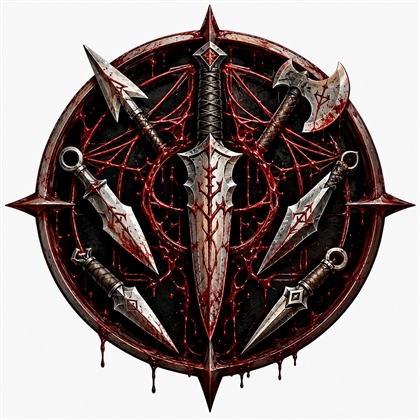
Members of the Order of the Crimson Cast believe there is something uniquely intimate about the thrown weapon.
An arrow belongs to the bow.
A bullet belongs to the firearm.
A spell belongs to the caster.
But a knife thrown by hand carries the hunter's own motion with it.
For the Crimson Cast, that connection can be made literal.
Before battle, members trace tiny blood-runes along the handles, blades, hafts, or points of their weapons. When those weapons leave the hand, the hunter's hemocraft remains attached to them through threads of supernatural vitality.
To ordinary eyes, a dagger simply spins through the air.
A Crimson Cast hunter sees something else:
a thin crimson filament stretching between hand and blade.
Through that connection, they learn to:
- recall thrown weapons;
- maintain Crimson Rites upon them;
- redirect missed attacks;
- mark enemies through wounds;
- throw around cover;
- attack several creatures in rapid succession;
- and eventually fill the battlefield with orbiting blood-bound weapons.
Many Crimson Cast hunters carry far more weapons than they seem to need.
That is intentional.
Their belts, harnesses, sleeves, boots, and armor may hold:
- knives;
- darts;
- hatchets;
- spikes;
- discs;
- needles;
- and specialized throwing blades.
A veteran of the Order may appear unarmed—
until they move.
Origins
The exact origin of the Order varies by region.
Some traditions trace it to hunters who lacked access to silvered bows or expensive ammunition and instead learned to empower reusable blades.
Others claim the techniques originated among monster hunters fighting creatures too dangerous to approach but too resilient for ordinary arrows.
The practical advantage soon became obvious.
A Blood Hunter using conventional ranged weapons has an ammunition problem.
A Crimson Cast hunter can throw the same enchanted dagger repeatedly.
More importantly, the weapon remains theirs.
The blood remembers it.
Philosophy of the Order
The Crimson Cast teaches four principles.
The Hand Defines the Weapon
A weapon need not be large to be deadly.
Precision matters more than size.
A dagger placed correctly can accomplish what an axe swung poorly cannot.
Distance Is Survival
Blood Hunters already sacrifice their own vitality.
There is no virtue in unnecessarily offering the enemy the rest.
Crimson Cast hunters prefer to dictate engagement distance.
Never Throw Without Knowing the Return
This is both literal and philosophical.
A thrown weapon should have:
- a retrieval plan;
- a second target;
- a tactical purpose;
- or a reason worth losing it.
The same philosophy applies to hemocraft.
Every sacrifice should accomplish something.
Blood Remembers
This is the Order's central mystical doctrine.
Blood establishes connection.
A Crimson Rite placed upon a weapon does not cease to recognize its wielder simply because the weapon leaves their hand.
The Order learns to exploit that bond.
Visual Identity
Crimson Cast hunters frequently wear light or medium armor designed to leave the arms and shoulders free.
Typical equipment includes:
- diagonal knife harnesses;
- forearm sheaths;
- thigh-mounted blades;
- throwing-axe loops;
- bandoliers of darts;
- concealed sleeve knives;
- reinforced throwing gloves;
- blood-rune wrappings;
- and small sharpening stones.
Their weapons often bear channels etched specifically to hold the hunter's blood.
When a Crimson Rite is active, those channels may glow with:
- flame;
- frost;
- lightning;
- shadow;
- radiant light;
- or whichever energy the Rite produces.
During advanced techniques, faint crimson threads may briefly become visible between the hunter's fingers and their airborne weapons.
Order of the Crimson Cast Features
|
Blood Hunter Level |
Feature |
|
3rd |
Bloodbound Arsenal, Crimson Recall |
|
7th |
Sanguine Ricochet |
|
11th |
Rite of the Piercing Mark |
|
15th |
Scarlet Pursuit |
|
18th |
Tempest of a Hundred Cuts |
Optional Crimson Cast Techniques
These can serve as advanced Order teachings, feats, Blood Hunter techniques, or campaign rewards.
Double Cast
Action Type: Part of an attack
Uses: Proficiency Bonus per Long Rest
When you attack with a Light thrown weapon, draw and throw a second Light thrown weapon at the same target.
The second attack deals weapon damage but does not add your ability modifier unless another feature permits it.
Bloodpin
Action Type: Triggered on hit
Uses: Proficiency Bonus per Long Rest
When you hit a Large or smaller creature with a thrown piercing weapon, force it to make a Strength saving throw against your Hemocraft save DC.
On a failure, its Speed becomes 0 until the beginning of your next turn as the blood-bound weapon pins clothing, armor, flesh, or shadow to nearby terrain.
The effect requires an appropriate nearby surface.
Crimson Disarm
Action Type: Triggered on hit
Uses: Once per Short or Long Rest
When you hit a creature with a qualifying thrown weapon, it must make a Strength saving throw.
On a failure, one object it is holding falls into an adjacent space.
The object cannot be something secured with both hands in a way the Game Master considers impossible to dislodge.
Redline Cast
Action Type: Bonus Action
Uses: Once per Short or Long Rest
Until the end of your current turn, double the normal range of your thrown weapons.
This does not increase Long Range.
Splintered Rite
Action Type: Bonus Action
Uses: Proficiency Bonus per Long Rest
Choose up to three qualifying nonmagical thrown weapons you are touching.
For 1 minute, each is treated as though bearing the same Crimson Rite currently active on one of your Bloodbound Arsenal weapons.
This does not require additional activation damage.
Only one use of Splintered Rite may be active at a time.
Playing the Order of the Crimson Cast
The subclass is designed around constant motion rather than standing at extreme range.
The ideal combat distance is generally somewhere between melee and conventional archery range.
A Crimson Cast hunter:
- activates a Crimson Rite on a favorite thrown weapon;
- marks dangerous prey;
- throws and recalls the same weapon;
- uses Sanguine Ricochet against clustered enemies;
- follows moving prey with Pursuing Cast;
- uses mobility to stay outside direct melee;
- eventually unleashes Tempest of a Hundred Cuts.
The result should feel less like an archer and more like a supernatural knife-fighter whose battlefield happens to extend dozens of feet around them.
Weapon Choices
Different weapons create different visual styles without fundamentally changing the subclass.
Daggers and Throwing Knives
The classic Crimson Cast style.
Fast, precise, concealable, and ideal for hunters who value finesse.
Darts
Favored by extremely precise hunters.
Some Crimson Cast members carry dozens in rigid forearm cases.
Handaxes
A heavier style associated with brutal impact and monster hunting.
Returning blood-bound axes can create a distinctive circular fighting rhythm.
Light Hammers
Often favored against:
- skeletons;
- constructs;
- armored enemies;
- or creatures vulnerable to blunt trauma.
Javelins and Spears
Used by hunters who prefer greater range and heavier weapons.
They often resemble supernatural harpooners.
Chakrams and Throwing Discs
Particularly dramatic with Crimson Recall and Sanguine Ricochet.
Some regional branches of the Order specialize almost entirely in these weapons.
Crimson Cast and Magical Weapons
A magical thrown weapon is particularly valuable to this subclass because Crimson Recall allows one weapon to be reused repeatedly.
This creates a deliberate distinction from ammunition-based ranged builds.
A Crimson Cast hunter might possess only one truly exceptional weapon:
a legendary knife,
a soul-stealing handaxe,
a radiant chakram,
or a blood-stained spear.
That weapon can become almost inseparable from the character.
Roleplaying the Order
Crimson Cast hunters often develop distinctive physical habits.
They may:
- constantly rotate knives through their fingers;
- judge distance without consciously thinking about it;
- dislike sitting with their throwing arm against a wall;
- sharpen weapons during conversations;
- instinctively count exits;
- place objects according to how easily they could be thrown;
- or become extremely particular about weapon balance.
Some give every knife a name.
Others deliberately refuse to name any weapon because a tool should remain replaceable.
Veterans often possess tiny scars across:
- fingers;
- palms;
- forearms;
- and wrists
from years of blood-rune activation and blade handling.
Order Philosophy and Blood
The Order has an unusual attitude toward hemocraft.
They regard blood not merely as fuel.
They regard it as connection.
A Blood Curse works because blood recognizes life.
A Crimson Rite works because blood binds hunter and weapon.
A Piercing Mark works because once a creature has been touched by the hunter's blood-bound steel, the distance between hunter and prey becomes metaphysically smaller.
Some senior Crimson Cast philosophers describe this principle as:
The Red Thread.
They believe all living things are connected by countless invisible relationships.
Hemocraft simply makes one of those relationships visible enough to pull.
Faction Connections
Crimson Cast hunters can appear almost anywhere in Aetheris.
They fit particularly naturally among:
- monster-hunting orders;
- assassins who specialize in supernatural creatures;
- wilderness hunters;
- pirate hunters;
- naval marines;
- urban Blood Hunter cells;
- dueling traditions;
- caravan protectors;
- and adventuring companies.
A maritime Crimson Cast hunter using knives or harpoon-like javelins would fit particularly well aboard Aurvalian, Stormvaarder, or Shōrin vessels.
Adventure Hooks
The Returning Knife
A Blood Hunter is murdered.
Their signature throwing knife disappears from the evidence room every night.
Every morning it is found beside the corpse.
The Hundredth Blade
According to Order tradition, a legendary Crimson Cast master made one hundred identical knives.
Ninety-nine have been recovered.
The hundredth is supposedly still embedded in the creature that killed them.
The creature is still alive.
Severed Thread
Several Crimson Cast hunters suddenly lose the ability to recall their weapons.
Their blood magic functions normally in every other respect.
Something is interfering specifically with the connection between blood and steel.
The Knife Knows Him
A recovered magical dagger immediately returns to the hand of one particular adventurer whenever thrown.
The adventurer has never seen it before.
The weapon's last owner disappeared thirty years ago.
Red Rain
A battlefield is discovered containing hundreds of dead monsters.
Each has been killed by the same dagger.
The dagger is nowhere to be found.
Notable NPCs
Serika Nine-Blades
Class: Blood Hunter — Order of the Crimson Cast
Role: Master Instructor
Serika carries nine daggers.
She insists this is excessive.
Her students have never seen her use more than one.
Nobody knows why she carries the other eight.
Garran Red-Axe
Class: Fighter / Blood Hunter
Role: Monster hunter
Garran specializes in paired handaxes.
Rather than catching them conventionally when they return, he allows them to orbit his forearms briefly before seizing them again.
He claims this offers a tactical advantage.
Most observers suspect he simply thinks it looks impressive.
Both can be true.
Velis Needlehand
Class: Blood Hunter — Order of the Crimson Cast
Role: Urban hunter
Velis fights almost exclusively with darts small enough to hide beneath formal clothing.
She has developed such precise control over her Crimson Recall that she can apparently throw one beneath a table, around a chair, and into someone's hand without spilling their wine.
She refuses to demonstrate this after drinking.
Balance Notes
Intended Role
Primary: Ranged Striker
Secondary: Skirmisher / Controller
Damage Profile
The subclass receives controlled additional damage through:
- Crimson Rite;
- Horizon-like once-per-turn Piercing Mark damage;
- ricochet attacks;
- reactive attacks;
- and the 18th-level additional attack.
It deliberately avoids adding a Hemocraft Die to every attack, which would scale too aggressively with Extra Attack and other Blood Hunter damage riders.
Range
Thrown weapons remain shorter-ranged than bows and firearms for most of the character's career.
The subclass compensates with:
- increased normal range;
- Crimson Recall;
- cover manipulation;
- mobility;
- and pursuit.
This preserves the thrown-weapon identity rather than turning daggers into reskinned longbows.
Resource Economy
Primary resources are:
- Crimson Rite;
- Blood Maledict;
- Sanguine Ricochet uses;
- Piercing Mark uses;
- Scarlet Pursuit reactions;
- and Tempest of a Hundred Cuts.
The subclass therefore remains strongly tied to existing Blood Hunter resources without requiring an entirely separate point system.
Comparison to an Archery Blood Hunter
An archery-focused Blood Hunter remains superior at very long-range engagement.
The Crimson Cast is superior at:
- medium-range mobility;
- weapon recovery;
- attacking around cover;
- pursuit;
- multi-target ricochets;
- and operating effectively when enemies close the distance.
Comparison to a Melee Blood Hunter
A melee Blood Hunter generally gains easier access to:
- Opportunity Attacks;
- close-range control;
- and larger weapon damage dice.
The Crimson Cast instead gains:
- safer positioning;
- pursuit;
- ranged application of Crimson Rites;
- and unusual weapon trajectories.
Summary
The Order of the Crimson Cast transforms the Blood Hunter into a dedicated hemocraft throwing-weapon specialist.
Its progression is deliberately straightforward:
At 3rd level, blood-bound thrown weapons retain their Crimson Rites and return to the hunter through Crimson Recall.
At 7th level, Sanguine Ricochet allows those weapons to strike multiple enemies and bend around defenses.
At 11th level, Rite of the Piercing Mark embeds hemocraft directly into prey, improving tracking, damage, and weapon recall.
At 15th level, Scarlet Pursuit makes escaping the hunter increasingly difficult.
At 18th level, Tempest of a Hundred Cuts transforms the Blood Hunter into the center of a whirling storm of returning blood-bound steel.
The subclass's defining principle is ultimately simple:
An ordinary warrior throws a knife and loses possession of it.
A Crimson Cast hunter throws a knife—
and the blood refuses to let it go.
Bloodbound Arsenal
You learn to extend your Crimson Rites through thrown weapons without losing their supernatural connection.
Action Type: Passive
Uses: At-will
Duration: Permanent
Scaling: Improved by later subclass features
A weapon qualifies for your Bloodbound Arsenal if it possesses the Thrown property or is specifically designed to function as a thrown weapon.
Examples include:
- dagger;
- dart;
- handaxe;
- javelin;
- light hammer;
- spear;
- trident;
- throwing knife;
- chakram;
- shuriken;
- weighted spike;
- or similar weapons approved by the Game Master.
Crimson Throw
When you activate a Crimson Rite on a qualifying thrown weapon, the Rite remains active on that weapon after you throw it.
The Rite does not end merely because:
- the weapon leaves your hand;
- strikes another creature;
- misses;
- or lands elsewhere.
You still follow all normal Crimson Rite rules.
Quick Cast
Drawing a qualifying thrown weapon can be done as part of the attack you make with it.
You therefore do not need to spend a separate object interaction to draw each weapon used with your Attack action.
Hemocraft Aim
You may use your Dexterity for attack and damage rolls with any qualifying thrown weapon, even if the weapon would normally use Strength.
Blood Hunter's Range
The normal range of qualifying thrown weapons you wield increases by 20 feet.
For example:
- a dagger with range 20/60 becomes 40/60;
- a handaxe with range 20/60 becomes 40/60;
- a javelin with range 30/120 becomes 50/120.
The weapon's long range does not change.
Crimson Recall
Your blood connection allows a thrown weapon to return to you.
Action Type: No Action / Bonus Action
Uses: At-will
Duration: Instantaneous
Scaling: Improved at 11th level
Immediately after you make a ranged attack using a weapon currently bearing one of your Crimson Rites, you may cause that weapon to fly back to your hand.
The weapon must be within 60 feet of you.
It returns after the attack resolves.
You must have a free hand to catch it.
If you do not, it falls harmlessly in your space.
Returning Around Obstacles
The weapon can curve around creatures and small obstacles while returning, but it cannot:
- pass through solid walls;
- cross magical barriers preventing objects from passing;
- or travel between planes.
At 11th level, Crimson Recall's range becomes 120 feet.
Bloodbound Weapon Appearance
Crimson Recall does not necessarily look like telekinesis.
Different hunters manifest it differently.
The weapon might:
- reverse its spin;
- whip around in an impossible arc;
- dissolve briefly into bloody mist;
- snap backward along a red thread;
- or vanish from the wound and reappear in the hunter's palm.
These differences are cosmetic.
Sanguine Ricochet
You learn to redirect a thrown weapon through your blood connection while it remains in flight.
Action Type: Triggered when you make a thrown weapon attack
Uses: Proficiency Bonus per Long Rest
Duration: Instantaneous
Scaling: Improved interaction at 15th level
When you hit a creature with a qualifying thrown weapon bearing your Crimson Rite, you may cause the weapon to ricochet toward another creature.
Choose a second creature you can see within 20 feet of the first target.
Make a new ranged weapon attack against the second target using the same weapon.
On a hit, the second creature takes the weapon's normal damage and your Crimson Rite damage.
You do not add an ability modifier to the weapon's damage against the second target unless that modifier is negative.
Afterward, the weapon may return through Crimson Recall.
You can use Sanguine Ricochet only once on each turn.
You may use it a number of times equal to your Proficiency Bonus and regain all expended uses when you finish a Long Rest.
Banked Cast
Your blood-bound weapons can also follow unnatural trajectories.
When attacking with a qualifying thrown weapon bearing your Crimson Rite, you may ignore Half Cover.
If the target has Three-Quarters Cover, treat it as Half Cover instead.
This benefit requires no resource.
Rite of the Piercing Mark
Your thrown weapons can implant a fragment of hemocraft into the creature they strike.
Action Type: Triggered on hit
Uses: Proficiency Bonus per Long Rest
Duration: 1 minute
Scaling: Improved by Scarlet Pursuit
When you hit a creature with a qualifying thrown weapon bearing your Crimson Rite, you may brand the creature with a Piercing Mark.
The mark lasts for 1 minute.
A creature can bear only one of your Piercing Marks at a time.
While marked, you gain the following benefits.
Blood-Sense
You always know the marked creature's direction while it is within 300 feet of you and on the same plane of existence.
You do not know its exact distance.
Exposed Opening
The first time on each of your turns that you hit the marked creature with a thrown weapon, it takes additional damage equal to one roll of your Hemocraft Die.
The damage type matches your active Crimson Rite.
No Concealment in Blood
The marked creature cannot gain the benefits of Half Cover or Three-Quarters Cover against your qualifying thrown weapon attacks.
Crimson Recall Through Flesh
If one of your Crimson-Rite weapons is embedded in or being carried by the marked creature, Crimson Recall can pull the weapon free and return it to your hand.
Doing so deals additional damage to the creature equal to one roll of your Hemocraft Die.
A creature can take this recall damage only once per turn.
Hemocraft Tracking
You have Advantage on Wisdom (Survival) checks made to track a creature bearing your Piercing Mark.
You regain all uses of Rite of the Piercing Mark after a Long Rest.
Scarlet Pursuit
Once your blood has marked prey, distance becomes increasingly meaningless.
Action Type: Passive / Reaction
Uses: Reaction — Proficiency Bonus per Long Rest
Duration: Instantaneous
Scaling: None
Your thrown weapon mastery improves in several ways.
Blood Finds Blood
The normal range of your qualifying thrown weapons increases by another 20 feet.
This stacks with Blood Hunter's Range.
Your attacks against a creature bearing your Piercing Mark do not suffer Disadvantage merely for being made at Long Range.
Pursuing Cast
When a creature bearing your Piercing Mark moves 10 feet or more while within the long range of one of your qualifying thrown weapons, you may use your Reaction to make one thrown weapon attack against it.
On a hit, the creature takes normal weapon and Crimson Rite damage.
Hamstringing Strike
When Pursuing Cast hits, reduce the target's Speed by 10 feet until the end of its current turn.
If the attack also dealt your Piercing Mark bonus damage, reduce the target's Speed by 20 feet instead.
Recall and Recast
When you use Crimson Recall after making a thrown weapon attack, you may immediately draw or catch the weapon in a position ready for another cast.
The next thrown weapon attack you make with that weapon before the end of your next turn ignores Three-Quarters Cover.
Scarlet Pursuit Uses
You may use Pursuing Cast a number of times equal to your Proficiency Bonus.
You regain all expended uses after a Long Rest.
Tempest of a Hundred Cuts
You attain the supreme technique of the Crimson Cast, suspending multiple blood-bound weapons around yourself before releasing them in a storm of impossible trajectories.
Action Type: Bonus Action
Uses: Once per Long Rest
Duration: 1 minute
Scaling: Subclass capstone
As a Bonus Action, activate Tempest of a Hundred Cuts.
For 1 minute, spectral blood-lines appear around your arms and hands while thrown weapons orbit you, return instantly, and change direction in midair.
You gain the following benefits.
Bloodstorm Arsenal
Whenever you make a thrown weapon attack using a qualifying weapon, the weapon returns to your hand immediately after the attack.
This requires no action and functions regardless of distance, provided the weapon remains on the same plane of existence.
Endless Cast
You may magically replicate a temporary hemocraft version of any nonmagical qualifying thrown weapon you are holding.
These copies:
- appear in your hand when needed;
- carry your active Crimson Rite;
- vanish immediately after resolving the attack;
- cannot be sold, given away, or retained.
You therefore cannot run out of ordinary thrown weapons during the Tempest.
This feature does not duplicate unique magical weapons.
Crimson Cascade
Once on each of your turns when you take the Attack action and attack with qualifying thrown weapons, you may make one additional thrown weapon attack as part of that action.
Perfect Ricochet
Your Sanguine Ricochet:
- does not expend a use during the Tempest;
- may target a creature within 30 feet of the original target;
- and adds your ability modifier to the ricocheted weapon's damage normally.
You may still activate Sanguine Ricochet only once per turn.
Blood Has No Corners
Your thrown weapon attacks ignore:
- Half Cover;
- Three-Quarters Cover.
You may also curve your attacks around ordinary obstacles, provided you have personally seen the target during the current turn.
Total Cover still prevents an attack unless there is a plausible open path the weapon can follow.
Scarlet Execution
Once during each of your turns, when you hit a creature bearing your Piercing Mark, you may maximize one Hemocraft Die rolled as part of that attack instead of rolling it.
For example, a d10 Hemocraft Die contributes 10.
Storm of Steel
Once during the Tempest, you may replace one attack with a massive release of blood-bound weapons.
Choose any number of creatures you can see within 60 feet, up to your Proficiency Bonus.
Make one thrown weapon attack against each target.
Each hit deals:
- normal weapon damage;
- Crimson Rite damage.
Piercing Mark bonus damage can apply only once during this Storm of Steel.
After resolving the attacks, every weapon returns to you.
Once Storm of Steel has been used, it cannot be used again during that activation.
After Tempest of a Hundred Cuts ends, you cannot activate it again until you finish a Long Rest.
Comments