



 Base Class: Fighter
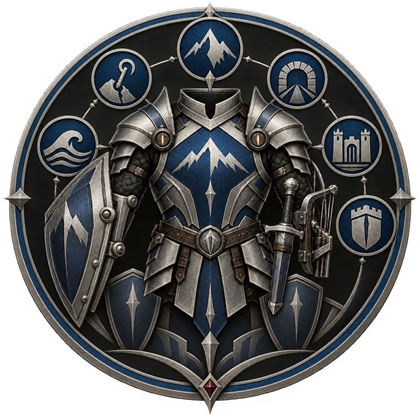
Stonecrest Armigers are elite armored fighters trained to operate in environments where conventional heavy infantry becomes dangerously inflexible. Their armor is not a single static suit. It is a fitted system of interchangeable plates, articulated joints, sealed padding, climbing anchors, flotation chambers, weapon braces, and specialized field attachments.
An Armiger prepares for a battlefield in the same way an artificer prepares a device. Before entering a mountain pass, the fighter adjusts weight distribution and fits climbing anchors. Before descending underground, they shorten protruding plates, shield vulnerable joints, and attach low-light lenses. Naval operations require sealed fittings, release catches, and buoyancy systems. Fortress defense demands locking greaves, recoil braces, and overlapping armor intended to protect companions standing behind the Armiger.
The tradition is closely associated with Steinwehr Arms & Harness, the Stonechain Guard, and Stonecrest Bastion. Steinwehr fits the armor, Stonecrest teaches its use, and the Stonechain Guard proves its value under battlefield conditions.
Stonecrest Armigers are not merely difficult to kill. They are trained to become the stable point around which a formation can recover. They brace against charges, shelter companions, advance under missile fire, and remain functional in terrain that would immobilize ordinary heavy infantry.
Origins in Aetheris
The Stonecrest tradition developed from the practical problems faced by Helbranni canton militias. The League’s defenders were expected to fight in alpine passes, deep tunnels, fortified settlements, lake vessels, river craft, and dense cities. Armor designed for one environment frequently became a liability in another.
Early attempts to solve the problem relied upon separate suits of armor. This proved expensive, logistically difficult, and dangerous when troops were deployed with the wrong equipment. Steinwehr harness-makers instead developed a standardized armor foundation that could accept different fittings without compromising its protective structure.
The first Armiger companies were stationed at Stonecrest Bastion, where soldiers trained in rotating environments: steep slopes, flooded chambers, narrow galleries, simulated ship decks, collapsing streets, and fortified gates. Training emphasized that equipment alone could not solve the problem. The warrior needed to understand how armor interacted with balance, fatigue, terrain, and the bodies of nearby companions.
The Stonechain Guard adopted the system for officers and heavy infantry expected to serve across canton borders. Chasmwatch later commissioned tunnel configurations, while Silberkeel shipwrights helped develop naval fittings.
The tradition has since spread to wealthy adventuring companies, High Tribunal escorts, caravan guards, and foreign soldiers capable of acquiring genuine Steinwehr work.
Philosophy and Doctrine
Stonecrest Armigers follow five practical doctrines:
- Fit the defense to the danger.
- Mobility is part of protection.
- Armor that saves only its wearer is incomplete.
- Every fastening is a potential failure.
- The line holds where the Armiger stands.
Armigers reject the belief that the heaviest possible armor is automatically the safest. A plate that catches on a tunnel wall, a shield that destabilizes a climber, or a sealed boot that drags a soldier beneath the water can kill as surely as an enemy weapon.
The tradition values preparation but warns against excessive specialization. Battles rarely occur under the conditions described in advance. Armigers must be capable of changing weapons, shedding damaged components, and altering their stance without abandoning the protective role their allies depend upon.
Armiger doctrine also emphasizes responsibility. Heavy armor creates authority on a battlefield because frightened soldiers naturally gather behind it. A warrior who accepts that position must not withdraw without warning or use sheltered companions merely as support for personal glory.
Visual Identity
Stonecrest Armigers wear fitted medium or heavy armor built around a recognizable Steinwehr harness. Although individual suits vary, common features include:
- Overlapping plates with reinforced but flexible joints.
- Broad shoulder defenses shaped to deflect falling debris.
- Quick-release straps marked in red.
- Shield hooks and modular weapon brackets.
- Retractable climbing spikes.
- Sealed gorgets and protective tunnel visors.
- Detachable greaves, flotation panels, and recoil braces.
- Runic load indicators showing damaged sections.
- Canton marks mounted separately from the armor’s maker seal.
The armor is typically gunmetal, darkened steel, slate-grey, or muted silver. Canton colors appear on cloth panels, shield edges, cords, or enamel plates rather than across the entire suit.
An Armiger’s supernatural abilities remain subtle. Plates shift fractions of an inch before impact, locking braces descend into the ground, and pale geometric reinforcement lines spread across the armor when it shelters another creature.
Role in Aetheris
Stonecrest Armigers serve as:
- Heavy infantry.
- Fortress defenders.
- Chasmwatch breachers.
- Mountain-pass guardians.
- Armored naval troops.
- Caravan escorts.
- High Tribunal guards.
- Disaster-response soldiers.
- Officers responsible for defensive formations.
- Adventurers operating across multiple environments.
In an adventuring party, the Stonecrest Armiger is a mobile defender. The subclass can use heavy armor without surrendering exploration utility, adapt to different environments, protect creatures standing nearby, and switch efficiently between shield, melee, and ranged configurations.
Subclass Integration
Major Polities
The Helbrann League considers the Stonecrest Armiger a model of its citizen-soldier ideal: well-equipped, adaptable, defensive, and accountable to the community being protected.
The Concord of Veltrion values Armigers in fortified settlements exposed to Shadowfell threats. The Freeholds of Rhonadral employ them along mountain roads and in defended trade houses.
The Kingdom of Aurvalis admires their armor but often finds its severe functionality visually austere. Aurvalian armorers have created more decorative adaptations, some of which Steinwehr considers structurally questionable.
The Volarion Republic respects the tradition’s technical discipline and favors its urban and naval configurations.
The Obsidian Hegemony seeks captured harnesses for its elite troops. Steinwehr incorporates maker locks and concealed failure marks intended to make unauthorized reproduction difficult.
Organizations and Guilds
- Steinwehr Arms & Harness: Principal manufacturer of Armiger armor.
- Stonecrest Bastion: Primary training center.
- Stonechain Guard: Largest military user of the tradition.
- Chasmwatch Directorate: Employs tunnel and breaching specialists.
- Silberkeel Cantonal Yard: Contributes naval fittings.
- Sturmhammerwerke: Develops recoil braces and firearm-compatible armor.
- Brannt & Toller Quietworks: Provides compact weapons for tunnel configurations.
- Stonechain Engineers: Cooperates on fortress bracing and structural rescue.
- High Tribunal: Employs Armigers as secure escorts.
Religious and Philosophical Movements
Stonecrest training is primarily secular, though Armigers often respect religious traditions of guardianship, endurance, and civic responsibility. Some suits bear small devotional plates beneath the breastplate, placed close to the heart but hidden from public view.
Rivals and Enemies
Armigers oppose siege troops, tunnel predators, giants, saboteurs, and enemies who target noncombatants or break defensive lines through fear.
Their professional rivals include traditional heavy cavalry, artificer-piloted armor, and officers who regard adaptability as an excuse for failing to master a single style of warfare.
Subclass Features
Stonecrest Armiger Features
|
Fighter Level |
Features |
|
3rd |
Armiger Training, Bonded Field Harness, Theater Configuration |
|
7th |
Brace for Impact, Shelter the Line |
|
10th |
Rapid Refit, Advanced Configurations |
|
15th |
Integrated Arsenal |
|
18th |
Immovable Center |
Optional Subclass Techniques
These techniques can represent unusual Steinwehr fittings, specialist Stonecrest instruction, or rewards issued by particular military organizations.
Chasmward Seal
While using Tunnel Configuration, you have Advantage on saving throws against Poison and against effects created by Aberrations. Your harness can hold enough filtered air for you to breathe normally for 10 minutes.
Avalanche Release
When a Large or larger creature hits you with a melee attack, you can use your Reaction to deliberately release part of the impact through your armor. Move up to 10 feet without provoking Opportunity Attacks and reduce the damage by your Constitution modifier.
Rescue Harness
Your Bonded Field Harness includes a folding sling and reinforced carrying frame. You can carry a willing or unconscious creature of your size or smaller without reducing your Speed.
Proofed Recoil Brace
You ignore the Heavy property’s minimum ability-score requirement, if one exists, when firing ranged weapons. Being Prone does not impose Disadvantage on your ranged weapon attacks.
Quick-Seal Plates
When you take Acid, Cold, Fire, Lightning, or Thunder damage, you can use your Reaction to gain resistance to that instance of damage. Doing so disables your current Theater Configurations until the beginning of your next turn.
Playing This Subclass
The Stonecrest Armiger is a defender designed to retain mobility and utility while wearing heavy armor. Its core decision is choosing the correct Theater Configurations for the expected environment.
At lower levels, the Armiger specializes in one environment at a time. At 10th level, two configurations can operate together, allowing combinations such as:
- Mountain and Fortress: Alpine pass defender.
- Tunnel and Fortress: Chasmwatch line-holder.
- Naval and Ranged Posture: Armored marine.
- Urban and Close Posture: Street and interior enforcer.
- Mountain and Naval: Cliffside or amphibious rescue specialist.
Brace for Impact and Shelter the Line establish the subclass’s protective role. The Armiger is most effective when positioned between an enemy and more vulnerable allies.
Integrated Arsenal allows the fighter to transition between melee, ranged, and shield combat without wasting turns. Immovable Center transforms the Armiger into a temporary defensive formation around which the rest of the party can fight.
Strengths
- Excellent Armor Class and physical durability.
- Strong protection for nearby allies.
- Heavy-armor mobility across unusual terrain.
- Flexible environmental configurations.
- Efficient weapon and shield switching.
- Effective control through Opportunity Attacks.
- Valuable rescue and exploration capabilities.
Weaknesses
- Many protective features require close positioning.
- Less personal damage than an offense-focused Fighter.
- Configuration choices may be ineffective if intelligence about the mission is wrong.
- Limited defense against mental effects.
- Immovable Center restricts movement around an Anchor Point.
- Heavy dependence on armor and equipment.
- Flying or distant enemies can bypass the Armiger’s protected line.
Roleplaying This Subclass
Stonecrest Armigers tend to be meticulous about equipment and positioning. They notice poorly fitted armor, unbalanced packs, unsecured straps, narrow exits, unstable floors, and companions standing in exposed locations.
Common personality traits include:
- Checking everyone’s equipment before departure.
- Refusing to dismiss minor discomfort in armor.
- Standing between strangers and a potential threat.
- Remaining calm during structural collapse or battlefield confusion.
- Treating retreat as a maneuver rather than a disgrace.
- Maintaining detailed records of equipment failure.
- Distrusting decorative modifications that compromise function.
- Feeling responsible whenever someone is injured behind their position.
Armigers may struggle with overprotectiveness. Companions can come to resent being treated as pieces in a formation, especially when personal relationships blur the line between care and control.
The most experienced Armigers learn that protecting someone does not mean denying them danger, agency, or sacrifice. The fighter’s task is to provide a stable choice—not make every choice for them.
Faction and Organization Connections
A Stonecrest Armiger might be:
- A Stonechain Guard veteran.
- A graduate of Stonecrest Bastion.
- A Steinwehr field tester.
- A Chasmwatch heavy infantry specialist.
- A Silberkeel armored marine.
- A High Tribunal escort.
- A mountain rescue soldier.
- A canton militia officer.
- A caravan defender protecting dangerous trade routes.
- An adventurer testing an experimental modular harness.
- A former soldier whose armor saved them while the rest of their formation was lost.
Armigers work especially well beside Stonechain Wardwrights. The Wardwright creates the defensive position; the Armiger becomes its mobile center. They also complement Quietworks Specialists, Watchfire clerics, and Living Avalanche barbarians.
Adventure Hooks
- The Empty Harness. A sealed suit of Stonecrest armor returns from a missing Chasmwatch patrol with no wearer inside and no sign that its quick-release fittings were used.
- The False Steinwehr Mark. Armiger armor bearing counterfeit maker seals is failing during battle. Evidence suggests that genuine Steinwehr components were used in the forgeries.
- The Fifth Configuration. A dead master left plans for an undocumented configuration designed for warfare in a place where gravity and direction no longer behave normally.
- The Broken Line. A respected Armiger is accused of abandoning a defensive position. The soldier claims remaining would have allowed an officer to sacrifice an entire refugee column.
- The Hegemony Harness. Obsidian Hegemony troops appear wearing corrupted copies of Stonecrest armor fitted with restraints that prevent their soldiers from retreating.
- Stonecrest Under Siege. Someone within Stonecrest Bastion has altered the training grounds so that safety mechanisms become lethal during the final Armiger examination.
Notable NPCs
Captain Gerhardt Steinmark
A human Stonechain Guard officer who has served in all five recognized theaters. Gerhardt is respected for refusing promotions that would remove him from active field inspection. He believes several recent equipment failures were deliberate tests conducted without the soldiers’ knowledge.
Hilda Brassfast
A dwarven Steinwehr master fitter responsible for many Chasmwatch harnesses. Hilda remembers the measurements and injury history of every soldier she has fitted. She has permanently banned three officers from her workshop for ordering troops to exchange armor without proper refitting.
Marek Vollen
A Helbranni armored marine stationed near Chasmfall Bay. Marek developed an experimental configuration for underwater boarding actions. His latest recovered armor shows deep scoring from something that attempted to open the suit from the inside.
Balance Notes
Intended Role: Defender and adaptable front-line controller.
Damage Profile: Moderate. Integrated Arsenal adds flexible Bonus Action attacks at high level, but most earlier features emphasize survival and ally protection rather than increased damage.
Survivability: High while wearing the Bonded Field Harness. Brace for Impact, environmental configurations, and Immovable Center provide strong physical defense without granting universal resistance at low levels.
Utility: Excellent for environmental movement, rescue operations, equipment maintenance, and campaigns involving varied terrain.
Resource Economy: Theater Configurations normally require rest preparation. Rapid Refit permits limited in-combat changes. Brace for Impact has proficiency-bonus uses, while Immovable Center is limited to once per Long Rest.
Comparison: The Stonecrest Armiger occupies a different niche from the Stonechain Wardwright. The Wardwright creates external fortifications and magical defensive networks; the Armiger turns a personal suit of armor into a mobile defensive platform. Compared with offensive Fighter subclasses, it sacrifices burst damage for adaptability, ally protection, and control of nearby space.
Summary
The Stonecrest Armiger is Helbrann’s premier armored field specialist. Trained by Stonecrest Bastion and equipped through Steinwehr Arms & Harness, the Armiger adapts a bonded suit of armor for mountain, tunnel, naval, urban, or fortress combat.
Its configurations eliminate many traditional weaknesses of heavy armor. Its defensive techniques allow it to absorb attacks, shelter companions, and hold a formation together. At higher levels, the Armiger can change configurations during battle, transition seamlessly between shield, melee, and ranged weapons, and become an immovable center around which allies rally.
The subclass embodies a distinctly Helbranni principle: the finest armor is not the suit that bears the greatest weight, but the one properly fitted to the danger and the people it must protect.
“Check the seal. Set the brace. Stand behind me. When the line moves, we move together.”
Armiger Training
Action Type: Passive
Uses: At will
Duration: Permanent
You gain proficiency with heavy armor. If you already possess this proficiency, you instead gain proficiency in Athletics or Investigation.
You gain proficiency with smith’s tools or leatherworker’s tools. If you already have both proficiencies, choose one of them; your proficiency bonus is doubled for ability checks you make using that tool.
You can use smith’s tools or leatherworker’s tools to perform maintenance on armor during a Short Rest. At the end of that rest, choose one suit of armor maintained in this way. Until its wearer finishes a Long Rest, the first Critical Hit scored against the wearer becomes a normal hit.
Once a suit of armor gains this benefit, it cannot do so again until it has received maintenance during another Short or Long Rest.
Proficiency - Leatherworker's Tools
You gain proficiency in Leatherworker's Tools
Proficiency - Smith's Tools
You are proficient with Smith's Tools
Bonded Field Harness
Action Type: One-hour fitting process; passive while worn
Uses: One bonded suit at a time
Duration: Until replaced
You can spend 1 hour using smith’s tools or leatherworker’s tools to bond with one suit of medium or heavy armor. This work can be performed during a Short or Long Rest.
The armor becomes your Bonded Field Harness and gains the following benefits while you wear it:
- You ignore any Strength requirement imposed by the armor.
- The armor’s weight does not count against your carrying capacity.
- You can don or doff it as an Action.
- Sleeping in it does not interfere with resting.
- Magical effects cannot remove it from you against your will.
- You have Advantage on saving throws against effects that would damage, destroy, or magically alter the armor.
- You can draw or stow a shield as part of the same object interaction used to draw or stow a weapon.
- You can replace a damaged strap, buckle, joint, or minor plate during a Short Rest without requiring replacement materials.
If you bond with another suit of armor, the previous bond ends.
Your Bonded Field Harness is not inherently magical. If the armor is already magical, bonding with it does not interfere with its properties or attunement requirements.
Theater Configuration
Action Type: Configuration during a Short or Long Rest
Uses: At will during rest
Duration: Until changed
When you finish a Short or Long Rest while wearing or working on your Bonded Field Harness, choose one Theater Configuration.
You retain that configuration until you select another.
Mountain Configuration
The armor gains climbing hooks, articulated weight distribution, ice spikes, and secured load straps.
You gain the following benefits:
- You ignore Difficult Terrain caused by nonmagical snow, ice, rubble, scree, or steep slopes.
- Climbing does not cost you additional movement if the surface provides handholds or footholds.
- You have Advantage on saving throws and ability checks made to avoid falling or being knocked Prone.
- You reduce falling damage by an amount equal to five times your Fighter level.
- You are acclimated to high altitude and extreme cold.
Tunnel Configuration
Protruding plates retract, joints become more flexible, and the helmet gains protected low-light fittings.
You gain the following benefits:
- You gain Darkvision to a range of 60 feet. If you already have Darkvision, its range increases by 30 feet.
- You suffer no penalties for squeezing through a space one size smaller than you.
- Other creatures do not provide Half Cover against your attacks while within 30 feet.
- You have Advantage on saving throws against falling debris, cave-ins, and inhaled substances.
- You can determine the approximate direction of a moving creature touching the same stone floor or wall within 10 feet, provided it is not behind more than 5 feet of solid stone.
Naval Configuration
Sealed joints, emergency releases, buoyancy fittings, and deck-gripping boots prepare the harness for aquatic operations.
You gain the following benefits:
- You gain a Swimming Speed equal to your Speed.
- You can hold your breath for a number of minutes equal to five times your Constitution modifier, with a minimum of 5 minutes.
- Standing from Prone costs you only 5 feet of movement.
- You have Advantage on checks and saving throws made to maintain your balance.
- You do not have Disadvantage on weapon attacks solely because you are underwater or standing upon an unstable deck.
- You can doff the armor as a Bonus Action while underwater.
Urban Configuration
The armor’s profile is narrowed, footfalls are dampened, and its plates are arranged for stairs, alleys, crowds, and interior fighting.
You gain the following benefits:
- Your Bonded Field Harness does not impose Disadvantage on Dexterity (Stealth) checks.
- Moving through a nonhostile creature’s space does not cost you additional movement.
- You have Advantage on checks made to detect concealed weapons, ambush positions, false doors, and structural escape routes.
- Opportunity Attacks against you are made with Disadvantage while you are within 5 feet of a wall, doorway, vehicle, or other creature.
- You can move through the space of a hostile creature one size larger than you, treating its space as Difficult Terrain.
Fortress Configuration
Locking greaves, shield braces, and reinforced forward plates prepare you to hold a fixed position.
You gain the following benefits:
- You have Advantage on saving throws and ability checks made to avoid being pushed, pulled, or knocked Prone.
- While wielding a shield, you count as one size larger when determining whether a creature can move through your space.
- If you move no more than half your Speed during your turn, you gain a +1 bonus to Armor Class until the beginning of your next turn.
- A friendly creature directly behind you relative to an attacker gains Half Cover from that attacker.
- You deal double damage to unattended objects, gates, siege equipment, and barricades with melee weapon attacks.
Mountain Configuration
The armor gains climbing hooks, articulated weight distribution, ice spikes, and secured load straps.
You gain the following benefits:
- You ignore Difficult Terrain caused by nonmagical snow, ice, rubble, scree, or steep slopes.
- Climbing does not cost you additional movement if the surface provides handholds or footholds.
- You have Advantage on saving throws and ability checks made to avoid falling or being knocked Prone.
- You reduce falling damage by an amount equal to five times your Fighter level.
- You are acclimated to high altitude and extreme cold.
Naval Configuration
Sealed joints, emergency releases, buoyancy fittings, and deck-gripping boots prepare the harness for aquatic operations.
You gain the following benefits:
- You gain a Swimming Speed equal to your Speed.
- You can hold your breath for a number of minutes equal to five times your Constitution modifier, with a minimum of 5 minutes.
- Standing from Prone costs you only 5 feet of movement.
- You have Advantage on checks and saving throws made to maintain your balance.
- You do not have Disadvantage on weapon attacks solely because you are underwater or standing upon an unstable deck.
- You can doff the armor as a Bonus Action while underwater.
Tunnel Configuration
Protruding plates retract, joints become more flexible, and the helmet gains protected low-light fittings.
You gain the following benefits:
- You gain Darkvision to a range of 60 feet. If you already have Darkvision, its range increases by 30 feet.
- You suffer no penalties for squeezing through a space one size smaller than you.
- Other creatures do not provide Half Cover against your attacks while within 30 feet.
- You have Advantage on saving throws against falling debris, cave-ins, and inhaled substances.
- You can determine the approximate direction of a moving creature touching the same stone floor or wall within 10 feet, provided it is not behind more than 5 feet of solid stone.
Urban Configuration
The armor’s profile is narrowed, footfalls are dampened, and its plates are arranged for stairs, alleys, crowds, and interior fighting.
You gain the following benefits:
- Your Bonded Field Harness does not impose Disadvantage on Dexterity (Stealth) checks.
- Moving through a nonhostile creature’s space does not cost you additional movement.
- You have Advantage on checks made to detect concealed weapons, ambush positions, false doors, and structural escape routes.
- Opportunity Attacks against you are made with Disadvantage while you are within 5 feet of a wall, doorway, vehicle, or other creature.
- You can move through the space of a hostile creature one size larger than you, treating its space as Difficult Terrain.
Brace for Impact
Action Type: Reaction
Uses: Proficiency Bonus per Long Rest
Duration: Instantaneous
When you or a creature you can see within 5 feet takes damage, you can use your Reaction to brace your harness against the impact.
Reduce the triggering damage by:
1d10 + your Constitution modifier + your Fighter level
If you protect another creature, you can move into an unoccupied space adjacent to it immediately before reducing the damage, provided that space is within 10 feet of you. This movement does not provoke Opportunity Attacks.
After reducing the damage, choose one of the following additional effects:
Anchor. The protected creature cannot be moved or knocked Prone by the triggering effect.
Deflect. If the triggering damage came from an attack, you can move the protected creature 5 feet without provoking Opportunity Attacks.
Distribute. You take half of the remaining damage in place of the protected creature. Your resistances and immunities can apply to this transferred damage.
Endure. The protected creature gains Temporary Hit Points equal to your Constitution modifier at the end of the triggering effect.
You regain all expended uses when you finish a Long Rest. If you roll Initiative with no uses remaining, you regain one use.
Shelter the Line
Action Type: Passive
Uses: At will
Duration: Permanent
Your armored position protects creatures using you as cover.
A friendly creature of your size or smaller gains Half Cover while it is within 5 feet of you and you are positioned between it and the source of an attack or harmful effect.
If the creature already has Half Cover from another source, your protection instead grants it Three-Quarters Cover.
When a creature benefiting from this feature makes a Dexterity saving throw, it can use your Dexterity saving throw result in place of its own if your result is higher and you are affected by the same effect.
If you succeed on the saving throw and the protected creature fails, you can use Brace for Impact on that creature without expending a use of the feature. Once you provide this free use, you cannot do so again until you finish a Short or Long Rest.
Rapid Refit
Action Type: Bonus Action
Uses: Proficiency Bonus per Long Rest
Duration: Until changed
You can reconfigure your Bonded Field Harness during battle.
As a Bonus Action, replace your current Theater Configuration with another configuration. You can describe this as shifting plates, releasing counterweights, deploying hooks, sealing joints, or activating fitted mechanisms.
You can also use this Bonus Action to repair damaged armor. When you do so, you regain Hit Points equal to 1d10 + your Fighter level.
Rapid Refit does not function if you are not wearing your Bonded Field Harness.
You regain all expended uses when you finish a Long Rest.
In addition, you can select two configurations whenever you finish a Short or Long Rest. Both configurations remain active simultaneously. When you use Rapid Refit, you replace either or both active configurations.
Advanced Configurations
Each Theater Configuration gains an additional benefit.
Mountain: High-Line Advance
You gain a Climbing Speed equal to your Speed. While climbing, you can leave one hand free for a weapon or shield provided the surface offers sufficient support.
Tunnel: Close-Gallery Fighting
You do not have Disadvantage on ranged attacks because a hostile creature is within 5 feet. Hostile creatures within 5 feet cannot gain Advantage on attack rolls against you solely because they are unseen.
Naval: Storm-Deck Stability
You gain resistance to Cold damage. In addition, currents, waves, and nonmagical wind cannot move you against your will unless you choose to be moved.
Urban: Crowd Interposition
When a hostile creature moves through a space within your reach, you can make an Opportunity Attack against it even if it has not left your reach. On a hit, its Speed becomes 0 for the remainder of the turn.
You can make this special Opportunity Attack only once per round.
Fortress: Locked Position
If you move no more than 5 feet during your turn, you gain resistance to Bludgeoning, Piercing, and Slashing damage dealt by Opportunity Attacks and attacks made as Reactions until the beginning of your next turn.
Your Fortress Configuration’s Armor Class bonus also applies when you move no more than 5 feet rather than no more than half your Speed.
Mountain: High-Line Advance
You gain a Climbing Speed equal to your Speed. While climbing, you can leave one hand free for a weapon or shield provided the surface offers sufficient support.
Naval: Storm-Deck Stability
You gain resistance to Cold damage. In addition, currents, waves, and nonmagical wind cannot move you against your will unless you choose to be moved.
Tunnel: Close-Gallery Fighting
You do not have Disadvantage on ranged attacks because a hostile creature is within 5 feet. Hostile creatures within 5 feet cannot gain Advantage on attack rolls against you solely because they are unseen.
Urban: Crowd Interposition
When a hostile creature moves through a space within your reach, you can make an Opportunity Attack against it even if it has not left your reach. On a hit, its Speed becomes 0 for the remainder of the turn.
You can make this special Opportunity Attack only once per round.
Integrated Arsenal
Action Type: Passive and Bonus Action
Uses: At will; special Bonus Action once per turn
Duration: Permanent
Your harness becomes a complete weapon-management system.
You can carry and rapidly employ multiple weapons without compromising your defense:
- You can draw, stow, or exchange any number of weapons and shields as part of the Attack action.
- Reloading a weapon no longer requires a free hand if the ammunition is stored in your harness.
- You ignore the Loading property of ranged weapons.
- Being within 5 feet of a hostile creature does not impose Disadvantage on your ranged attacks.
- You can use a shield as a melee weapon with which you are proficient. It deals 1d6 Bludgeoning damage and possesses the Push mastery property.
- Equipping or stowing a shield does not alter the Armor Class bonus granted by that shield until the end of your current turn.
Once on each of your turns after making an attack, you can use a Bonus Action to adopt one of the following arsenal postures:
Close Posture
Make one melee weapon attack against a creature within your reach. On a hit, the target cannot make Opportunity Attacks until the beginning of its next turn.
Shield Posture
Raise or deploy your shield. You and one friendly creature within 5 feet gain a +2 bonus to Armor Class against the next attack made against each of you before the beginning of your next turn.
You must be wielding a shield to use this posture.
Ranged Posture
Move up to 10 feet without provoking Opportunity Attacks and make one ranged weapon attack. You can reload the weapon as part of this attack.
You can use only one arsenal posture during the same turn. Once you use a posture, you cannot use another until the beginning of your next turn.
Immovable Center
Action Type: Bonus Action
Uses: Once per Long Rest
Duration: 1 minute
You activate every reinforcement system in your Bonded Field Harness and become the immovable center of a defensive formation.
For 1 minute, you gain the following benefits:
- All five Theater Configurations and their Advanced Configuration benefits are active simultaneously.
- You gain resistance to Bludgeoning, Piercing, and Slashing damage.
- You cannot be moved, knocked Prone, Grappled, or Restrained against your will.
- Your reach increases by 5 feet for Opportunity Attacks.
- A creature provokes an Opportunity Attack from you when it enters your reach.
- When you hit a creature with an Opportunity Attack, its Speed becomes 0 for the remainder of the turn.
- You can take one additional Reaction during each round. This Reaction can be used only for Brace for Impact or an Opportunity Attack.
- Friendly creatures of your choice within 10 feet gain Half Cover.
- Friendly creatures within 10 feet have Advantage on saving throws and ability checks made to avoid being moved or knocked Prone.
- You regain one expended use of Brace for Impact at the beginning of each of your turns.
When you activate Immovable Center, choose the point where you stand as your Anchor Point. You can move up to 10 feet from that point without ending the feature. If you willingly move farther away, Immovable Center ends.
If you are moved from the Anchor Point against your will, you can return to the nearest unoccupied space within 10 feet of it immediately after the effect resolves.
Once you use Immovable Center, you cannot use it again until you finish a Long Rest.
Comments