



 Base Class: Paladin
Paladins who swear the Oath of the Bound Gate dedicate themselves to the protection of thresholds.
Some thresholds are made of stone and iron.
Others exist between prisoner and captor, witness and persecutor, refugee and pursuer, citizen and state, sanctuary and violence, lawful authority and tyranny.
The oath originated with the Order of the Bound Gate in the March of Draeven, whose paladins guard city gates, courts, witnesses, refugees, lawful custody, civic sanctuaries, border crossings, and other places where authority determines who may pass and who must remain.
These paladins do not believe obedience is inherently virtuous. Neither do they believe individual conscience automatically supersedes law.
Instead, they hold that authority creates obligation.
A gate closed against an invading army protects.
A gate closed against innocents seeking sanctuary may condemn them.
A prisoner lawfully detained must remain in custody—but must also arrive alive to answer before the law.
The task of a Bound Gate paladin is therefore not merely to stand before the gate.
It is to understand why the gate must open or close—and then hold that decision against anyone who would violate it.
Mechanically, the Oath of the Bound Gate is a defensive Paladin subclass specializing in:
- protecting allies;
- controlling movement;
- defending chokepoints;
- preventing forced movement;
- resisting charms and coercion;
- safeguarding prisoners and witnesses;
- establishing temporary sanctuaries;
- punishing enemies who attempt to cross defended boundaries.
Tenets of the Bound Gate
Members of the Order traditionally express their oath through the Seven Obligations of the Gate.
Know Why It Opens
Passage granted without judgment can be as dangerous as passage denied without cause. Understand what you permit before you permit it.
Know Why It Closes
Never deny passage merely because you possess the power to do so. A barrier exists for a purpose.
Custody Answers to Law
A captive entrusted to you is neither prey nor property. Protect prisoners from escape, abuse, execution, and disappearance until lawful judgment is rendered.
Sanctuary Is Not Convenience
Once protection has been lawfully granted, do not surrender those beneath your shield merely because defending them becomes difficult.
A Witness Is Not a Possession
Those placed under your protection remain persons with dignity and rights. Authority over another creates responsibility toward them.
Authority Must Answer
Power must be witnessed, recorded, reviewable, and accountable. No title places its bearer beyond obligation.
When Law Becomes a Cage, Remember the Shield
Law exists to preserve ordered society, not to provide respectable language for domination. When obedience itself would betray the obligations you have sworn to defend, you must be prepared to stand at the gate and refuse.
Oath Spells
When you reach a Paladin level specified in the Oath of the Bound Gate Spells table, you thereafter always have the listed spells prepared.
These spells don't count against the number of spells you can prepare.
|
Paladin Level |
Spells |
|
3rd |
Command, Sanctuary |
|
5th |
Arcane Lock, Zone of Truth |
|
9th |
Counterspell, Magic Circle |
|
13th |
Death Ward, Mordenkainen's Private Sanctum |
|
17th |
Hold Monster, Wall of Force |
These spells reflect the oath's emphasis on protected space, lawful restraint, secure custody, truth, resistance to hostile magic, and the creation of boundaries that cannot easily be violated.
Playing an Oath of the Bound Gate Paladin
The Oath of the Bound Gate is designed primarily as a defensive battlefield-control Paladin.
It is strongest when the battlefield contains meaningful geography.
A Bound Gate paladin excels at:
- doors;
- bridges;
- stairways;
- alleys;
- ship gangways;
- castle breaches;
- narrow passages;
- ritual chambers;
- evacuation routes;
- defensive formations.
The subclass becomes particularly effective when the party must protect something rather than merely kill an enemy.
Examples include:
- defending civilians;
- protecting an NPC;
- holding a ritual site;
- escorting a prisoner;
- preventing an enemy's escape;
- defending a wounded ally;
- controlling an entrance;
- covering a retreat.
The subclass deliberately possesses fewer direct offensive enhancements than many Paladin oaths. Its strength lies instead in determining where combat happens and who is permitted to reach whom.
Combat Doctrine
Bound Gate paladins are traditionally taught three questions before any engagement:
Who must pass?
Who must not?
What ground cannot be surrendered?
A paladin who can answer those questions already understands the shape of the coming battle.
Holding the Line
Use Warden of Passage and Aura of the Held Line to occupy the point through which enemies must travel.
Creating Sanctuary
Use Stand at the Threshold when the party needs to protect a position, civilian group, wounded character, prisoner, or objective.
Breaking Coercion
Use Authority Held in Trust when an ally is magically or physically deprived of agency.
Protecting the Vulnerable
At higher levels, Sanctuary Must Hold allows the paladin to absorb the consequences of attacks directed at characters who cannot afford to withstand them.
Becoming the Objective
At 20th level, The Gate That Cannot Be Broken effectively turns the paladin into a mobile fortified position around which the party can organize its defense.
Roleplaying the Oath
The most interesting Bound Gate paladins are not characters who blindly follow laws.
Nor are they characters who casually disregard laws whenever they disagree with them.
Their oath exists in the difficult space between those extremes.
A Bound Gate paladin may obey an order they personally dislike because the authority issuing it is legitimate and the order itself lawful.
The same paladin may later place themselves physically between that authority and an innocent person when the institution exceeds its rightful power.
Such decisions should carry weight.
Members of the Order are expected to explain their actions afterward.
A Bound Gate paladin who says:
“I followed my conscience.”
has not necessarily satisfied the oath.
They should also be capable of answering:
- What authority was involved?
- What obligation did that authority possess?
- What harm would obedience have caused?
- What alternatives existed?
- Why did the oath require intervention?
- Would you accept formal review of your decision?
The oath demands judgment and accountability for that judgment.
The Refusal Hearing
One of the most important traditions associated with this oath is the Refusal Hearing.
When a sworn paladin deliberately refuses a lawful command because they believe obedience would violate their higher obligations, their actions are formally examined.
The hearing asks not merely:
“Did you disobey?”
It asks:
“Was your refusal required by the obligations you swore to uphold?”
A paladin may therefore face disciplinary review even after doing something heroic.
Conversely, obedience is not automatically a defense when an order was manifestly corrupt.
This tradition makes the Oath of the Bound Gate particularly suitable for campaigns involving complicated institutions rather than simple struggles between obvious heroes and villains.
Appearance and Visual Identity
Paladins of this oath commonly wear:
- matte blackened plate;
- silver edging along armor seams;
- rectangular gate-line engraving;
- deep crimson oath cords;
- heavy charcoal or black cloaks;
- broad defensive shields.
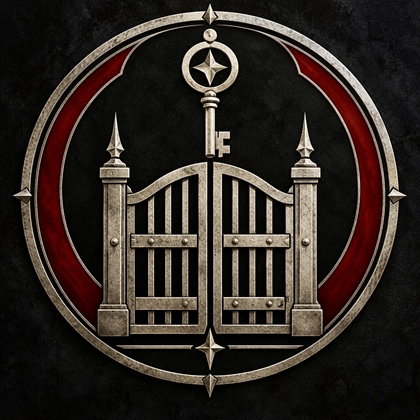
Their traditional shield bears a closed silver gate beneath a suspended silver key upon a black field.
The gate represents the protected threshold.
The key represents authority held in trust.
A crimson oath cord is traditionally tied to the left shoulder of ceremonial armor.
The overall appearance should be severe and disciplined rather than extravagant.
Divine Magic
Bound Gate divine magic tends to manifest as architecture rather than spectacle.
Common manifestations include:
- silver lines appearing across floors;
- translucent rectangular barriers;
- luminous threshold markings;
- glowing inscriptions;
- spectral keys;
- silver runes spreading across shields;
- brief outlines of enormous gates.
Even powerful divine effects are normally quiet and controlled.
A Bound Gate paladin does not typically erupt in celestial flame.
Instead, a silver line appears across the ground.
And something discovers that it cannot cross.
Bound Gate Paladins in Aetheris
The oath is most strongly associated with the Order of the Bound Gate in the March of Draeven.
Members commonly serve at:
- city gates;
- courts;
- prisons;
- sanctuaries;
- border crossings;
- harbors;
- witness halls;
- military checkpoints.
Their training extends beyond conventional martial instruction into Draevenite law, rules of evidence, custody procedure, sanctuary doctrine, court protocol, witness protection, riot control, magical restraint, shield fighting, and protected escort duty.
A paladin of the Bound Gate is expected to understand not merely how to stop someone.
They are expected to understand under what authority they do so.
Relationships with the Order
Courts
Bound Gate paladins commonly protect judges, witnesses, courtrooms, and lawful custody.
Their relationship with courts becomes considerably more complicated when the integrity of the court itself is questioned.
Crimson Rangers
The two organizations naturally complement one another.
Rangers secure dangerous territory and wilderness routes.
Bound Gate paladins protect formal crossings, civilian passage, custody, and fortified thresholds.
The Wraiths
Relations are politically sensitive.
Some members deeply respect the Wraiths' service to the March.
Others are troubled by the concentration of secret authority without ordinary mechanisms of public accountability.
Grey Ledger
The Grey Ledger is particularly offensive to the oath because forged warrants, false identities, corrupted ownership records, and manipulated evidence attack the very structures through which lawful authority becomes accountable.
Smugglers
Bound Gate paladins are trained to distinguish between different forms of unlawful passage.
A merchant smuggling untaxed cargo, a refugee crossing an illegal border, an escaped political prisoner, and a trafficker transporting chained captives have all violated or circumvented some form of lawful passage.
They have not necessarily committed equivalent acts.
The oath demands judgment rather than mechanical enforcement.
Character Concepts
The Oath of the Bound Gate works especially well for:
The Court Guardian
A former court officer who watched lawful procedure nearly become a weapon in the hands of corrupt officials.
The Refugee's Shield
Someone once granted sanctuary by the Order who eventually returned to take the oath themselves.
The Border Warden
A veteran accustomed to deciding who may cross dangerous frontiers during war, famine, plague, or political unrest.
The Harbor Oathwarden
A maritime paladin specializing in extraditions, prisoner transfers, refugees, smugglers, and jurisdictional disputes.
The Refused Key
A paladin whose career was transformed after refusing a lawful command and surviving the resulting Refusal Hearing.
The Witnessed Sword
A disciplined martial guardian who believes that every weapon wielded under public authority should be answerable for how it is used.
Potential Character Hooks
The Warrant You Refused
Years ago, you refused to surrender someone despite a valid warrant.
You were eventually vindicated.
You still wonder whether you were right.
The Person Behind the Gate
Someone once stood between you and people who wanted you dead.
You remember the sound of their shield striking the floor as they said:
“You do not pass.”
Now you carry that shield.
The Missing Witness
Someone entrusted to your protection disappeared.
You have never discovered whether they escaped, were abducted, or were betrayed from within the Order.
The Broken Lock
One of your ancestors or mentors lies within the memorial crypt known as the Broken Lock.
Official histories call them a hero.
Restricted records suggest the truth may be considerably more complicated.
The Seventh Obligation
You believe deeply in the most controversial teaching of your order:
“When law becomes a cage, the oath is to the shield.”
You are still trying to understand exactly where that line lies.
Subclass Summary
|
Paladin Level |
Feature |
|
3rd |
Oath Spells, Channel Divinity: Stand at the Threshold, Channel Divinity: Authority Held in Trust, Warden of Passage |
|
7th |
Aura of the Held Line |
|
15th |
Sanctuary Must Hold, The Shield Answers |
|
20th |
The Gate That Cannot Be Broken |
Design Identity
The Oath of the Bound Gate is the Paladin oath of the defended threshold.
Where other paladins pursue enemies, the Bound Gate makes enemies come through them.
Where others destroy threats, the Bound Gate creates places where threatened people can survive.
Where others invoke divine authority, the Bound Gate insists that authority itself carries obligations.
Its defining fantasy is simple:
A gate stands behind the paladin.
People are sheltering beyond it.
Something terrible approaches.
The paladin plants their shield upon the threshold.
Silver lines ignite across the stone.
And they say:
“No further.”
“A gate may open.
A gate may close.
Neither act is righteous merely because we command it.
Know whom you protect. Know whom you bar. Know why.
Then stand.”
Oath Spells
When you reach a Paladin level specified in the Oath of the Bound Gate Spells table, you thereafter always have the listed spells prepared.
These spells don't count against the number of spells you can prepare.
|
Paladin Level |
Spells |
|
3rd |
Command, Sanctuary |
|
5th |
Arcane Lock, Zone of Truth |
|
9th |
Counterspell, Magic Circle |
|
13th |
Death Ward, Mordenkainen's Private Sanctum |
|
17th |
Hold Monster, Wall of Force |
These spells reflect the oath's emphasis on protected space, lawful restraint, secure custody, truth, resistance to hostile magic, and the creation of boundaries that cannot easily be violated.
Bound Gate Features
At 3rd level, your oath teaches you to make the distinction between protection and imprisonment tangible upon the battlefield.
You gain the following features.
Channel Divinity
You gain the following two Channel Divinity options.
Stand at the Threshold
As a Bonus Action, you present your Holy Symbol and designate a point on the ground that you can see within 30 feet of yourself.
A 15-foot-radius protected threshold centered on that point appears for 1 minute. The boundary is visible as faint silver geometric lines resembling the outline of gates, locks, and written oaths.
When you create the threshold, choose any number of creatures you can see to be Protected Creatures.
While you are within the threshold:
- the area is Difficult Terrain for hostile creatures;
- Protected Creatures ignore that Difficult Terrain;
- Protected Creatures have Advantage on saving throws against being pushed, pulled, knocked Prone, or teleported against their will;
- a hostile creature that enters the threshold for the first time on a turn or starts its turn there must make a Wisdom saving throw against your spell save DC.
On a failed save, the creature's Speed becomes 0 until the beginning of its next turn.
On a successful save, its Speed isn't reduced by this feature during that turn.
The threshold ends early if you are Incapacitated or if you end your turn more than 30 feet from its center.
The boundary is not a physical wall. Creatures can cross it, but doing so against the will of its defender is deliberately difficult.
Authority Held in Trust
When a creature you can see within 30 feet of yourself is Charmed, Frightened, Grappled, or Restrained, you can use your Reaction and expend one use of your Channel Divinity to invoke the higher obligations of your oath.
The creature can immediately repeat one saving throw against an effect causing the Charmed, Frightened, or Restrained condition, with Advantage.
If the condition resulted from a grapple rather than a saving throw, the creature can immediately attempt to escape that grapple with Advantage without using an action.
If the creature succeeds, it can immediately move up to half its Speed without provoking Opportunity Attacks.
In addition, until the start of your next turn, the creature has Resistance to all damage from the creature or effect from which you freed it.
This movement cannot pass through a space the creature could not normally enter.
Warden of Passage
Your training prepares you for combat around doors, bridges, corridors, gangways, gates, stairways, and other constrained spaces.
Whenever you hit a creature with an Opportunity Attack, that creature's Speed becomes 0 for the rest of the current turn.
In addition, creatures provoke Opportunity Attacks from you even when they take the Disengage action before leaving your reach.
A creature that teleports does not provoke this attack.
This feature reflects a central principle of Bound Gate martial training:
Passage through defended ground is never assumed.
Aura of the Held Line
Your oath transforms the ground around you into a place where your allies are exceptionally difficult to dislodge.
You emanate a 10-foot Emanation while you aren't Incapacitated.
You and allies within the aura gain the following benefits:
Unbroken Footing
A creature has Advantage on saving throws and ability checks made to avoid being:
- Grappled;
- knocked Prone;
- pushed;
- pulled;
- moved against its will.
No Forced Passage
A creature cannot be teleported against its will while within the aura.
Protected Withdrawal
Opportunity Attacks against your allies within the aura are made with Disadvantage.
At 18th level, the range of this aura increases to 30 feet.
Sanctuary Must Hold
You have learned that protection means little if it lasts only until the enemy becomes determined.
When a creature you can see within 30 feet of yourself takes damage, you can use your Reaction to interpose your oath between the creature and the attack.
Reduce the triggering damage by:
2d10 + your Charisma modifier + your Paladin level.
If this reduces the damage to 0, the protected creature can immediately move up to half its Speed without provoking Opportunity Attacks.
You can then choose to move up to half your Speed toward the creature without provoking Opportunity Attacks.
If you end this movement within 5 feet of the protected creature, you may occupy any unoccupied space adjacent to it.
You can use this Reaction a number of times equal to your Charisma modifier (minimum of once), and you regain all expended uses when you finish a Long Rest.
The Shield Answers
In addition, whenever you use Sanctuary Must Hold, the attacker becomes Marked by the Gate until the end of your next turn.
The first time the marked creature willingly moves closer to the creature you protected before the mark ends, it takes Radiant damage equal to:
2d8 + your Charisma modifier.
A creature can take this damage only once from each use of Sanctuary Must Hold.
The Gate That Cannot Be Broken
At 20th level, you can become the living embodiment of the oath—the final threshold between those under your protection and whatever seeks to reach them.
As a Bonus Action, you assume the Aspect of the Bound Gate for 1 minute.
For the duration, silver lines of divine script spread across your armor, shield, and the ground around you. Behind you appears the translucent outline of an immense closed gate, while a luminous silver key hangs above your head.
You gain the following benefits.
The Uncrossed Threshold
You emanate a 30-foot Emanation.
The area is Difficult Terrain for enemies of your choice.
Whenever an enemy enters the aura for the first time on a turn or starts its turn there, you can force it to make a Wisdom saving throw against your spell save DC.
On a failed save, its Speed becomes 0 until the beginning of its next turn.
A creature that succeeds on this saving throw is immune to this particular effect until the beginning of its next turn.
Sanctuary Without Breach
You and allies within your aura have Resistance to Bludgeoning, Piercing, and Slashing damage.
In addition, creatures of your choice within the aura can't be:
- Charmed;
- Frightened;
- moved against their will;
- teleported against their will.
If a protected creature is already Charmed or Frightened when it enters the aura, that condition is suppressed while it remains there.
No Passage Without Judgment
Whenever a hostile creature within your aura attempts to teleport or use magical movement that would cause it to leave the aura, you can use your Reaction to force it to make a Charisma saving throw against your spell save DC.
On a failed save, the movement or teleportation fails, and any action, Bonus Action, or Reaction used to attempt it is wasted.
On a successful save, the creature moves normally.
Stand Behind Me
Once during each of your turns, when you hit a creature with a weapon attack, you can designate one ally you can see within your aura.
That ally gains Temporary Hit Points equal to:
your Charisma modifier + your Proficiency Bonus.
The creature can also immediately move up to 10 feet without provoking Opportunity Attacks.
Once you use The Gate That Cannot Be Broken, you can't use it again until you finish a Long Rest.
Comments