



 Base Class: Cleric
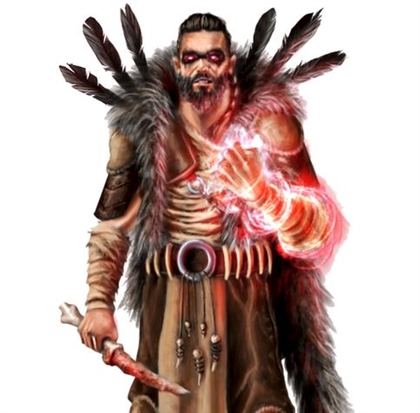
Those few who would find it in them to become Shamans feel the pull of nature. Without regard for their own well-being do they follow their own path. Their crafts are the direct result of deity worship and their personal devotion, placing their bodies in the hands of the Gods who in turn empower them with divine magic. This knowledge of spells is not innate, nor does it come easy, and the investiture of spells is a process both rapturous and baleful. A gift of the gods, the trees, the water, the stone, the sun, the moon, beast and man are not to be treated lightly, and many have succumbed in their quest for this power. The ancient, primitive craft of shamanism rewards those who are true of character and commit themselves to the spiritual journey.
Shamanic Domain Spells
| Cleric Level | Spells |
|---|---|
|
1st |
|
|
3rd |
|
|
5th |
|
|
7th |
|
|
9th |
Shamanic Character Traits:
Adventure:
Most Shamans are a reclusive breed, and therefore have little need to adventure. They do, however, live out a nomadic existence, as their spiritual journey often takes a lifetime. The most accomplished Shamans who stand the test of time and nature return to their tribes as an old man, to relegate their wisdom to the young. Before this time, however, Shamans travel the world high and low, and adventure on account of personal intuition. They may join a party that they feel allows them to commit to the Journey.
Characteristics:
Even when in a party, shamans tend to distance themselves from other members in order to contemplate their life-long quandary in silence and isolation. When others talk and drink together, he observes the stars, the winds, and the movement of animals, the waves of the water, the sway of the grass, the weave of life itself. Shamans, despite the auspicious nature of their craft, are often powerful of build, as their craft requires them to be exceptionally healthy. This health, they say, is required for the Journey. When the party enters a conformation of civilized society, the shaman usually takes the rear in contemplative silence.
Alignment:
At one side, the shaman's life is one of commitment, devotion and sacrifice. At the other, he requires the conviction to maintain personal standards, the intuition to read omens in all facets of nature and the inclination to follow his own personal Journey. They then must possess either ethical extreme in equal measure in order to gain his superhuman link with life itself.
Religion:
Wise shamans know more than anybody else that life itself is one large journey, and they devote all of their life to what they call 'The Journey'. This Journey is to understand, but they know that understanding is much more than seeing. This Journey never ends, and it takes a lifetime for most shamans to understand this and what is truly important, to learn the ways of the Four Winds and to understand what is truly worth protecting. They do not value material wealth, but they do not look down upon taking what is rightfully theirs, if all expenses are incurred in favor of means that allow them to better pursue the Journey. The most important thing, however, that for all intents and purposes he regards life and nature as sacred. Although some Shamans make their journey at the behest of a deity, a devotion is not always necessary. Shamans can treat nature itself as a deity. Though no living creature can impart divine spells, nature itself, being such a massive formation of spiritual energy, can.
Background:
In almost any case, a Shaman's background can be traced to a tribe or otherwise primitive society. Societies that bring forth shamans do not have a written alphabet.
Races:
Iconic as they are to primitive societies, very few members of a race known to have a sophisticated civilization ever become shamans. Dwarves, Elves, Gnomes and Halflings (other than Ghostwise tribes) very rarely become shamans. Humans and half-elves that hail from primitive lands however regularly become shamans. Shamans are however really prominent character choices between the creatures known for their savagery. Goblins, Half-Orcs, Kobolds, Orcs, Ogres, Minotaurs, Trolls and other such creatures often become shamans.
Other Classes:
If there is any class that Shamans are likely to get along with well, it's the Druid as they very often share the same personal conviction towards nature and things assorted. As they share the Barbarian's more primitive origins as well as their illiteracy, shamans are favorable towards them as well. To most other classes however, the shaman is reasonably straight-forward. They do not share the intellectual upbringing of Wizards, nor do they understand the need for deception and sophistry that marks the specialization of Rogues.
Role:
The shaman is not very adept at combat, but depends on his great health in order to last the fight. He gladly protects those that are more frail, and is at the forefront not to deliver killing strokes, but to heal and support the front with buffing and calling.
Steward of Nature
At 1st level, you learn one druid cantrip of your choice. You also gain proficiency in one of the following skills of your choice: Animal Handling, Nature, or Survival.
Way of the Land
You gain proficiency with the Herbalism Kit, and learn the Druidcraft cantrip.
Channel Divinity: Totem Spirit
Starting at 2nd level, you can use your Channel Divinity to summon the avatar of your totem spirit to the material plane.
As an action, you present your holy symbol and invoke the true name of your totem spirit. The avatar appears as a translucent, non-copropreal statuette in a space that is a 5-foot cube you can see within 60 feet. Though it cannot be touched or interacted with, all living things within 10 feet of the totem feel its effects -- each spirit having a unique impact on the world around it. The totem lasts for 1d4 rounds, plus an additional round for every four cleric levels (rounded down).
At 2nd level, choose two of the following totem spirits. Choose additional totems at the 6th, 12th, and 17th levels.
Aberrant Totem
Whenever you or a creature you can see moves into the totem's aura for the first time on a turn or starts its turn there, it must make a Wisdom saving throw. On a failed save, the creature becomes frightened of the totem for 1 minute. If a creature is frightened in this manner, its speed is reduced to 0 while in the aura, and that creature takes psychic damage equal to half your cleric level if it starts its turn there. The frightened creature can repeat this saving throw at the end of each of its turns, ending the effect on itself on a success.
Bestial Totem
You and friendly creatures within the totem's aura gain a bonus +1 to all attack rolls, and can use their reaction to gain a bonus +2 AC until the end of the round.
Celestial Totem
Whenever you or a creature you can see moves into the totem's aura for the first time on a turn or starts its turn there, you can cause the spirit to restore 1d6 hit points to that creature (no action required). The totem can’t heal constructs or undead. The spirit can heal a number of times equal to 2 + your spellcasting ability modifier (minimum of three). After healing that number of times, the totem disappears.
Elemental Totem
Whenever a creature deals damage to you or a friendly creature within the totem's aura, you can use your reaction to force the attacker to make a Constitution saving throw. On a failed save, the attacker takes magical damage equal to the damage amount and type it just dealt. On a successful save, it takes half as much damage.
Fey Totem
Each object in the totem's aura is outlined in colored light (your choice). Any creature in the area when the spell is cast is also outlined in light if it fails a Dexterity saving throw. For the duration, objects and affected creatures shed dim light in a 10-foot radius. Any attack roll against an affected creature or object has advantage if the attacker can see it, and the affected creature or object can't benefit from being invisible.
Shadow Totem
Dim light spreads from the totem to fill it's entire aura. This effect spreads around corners. You and any friendly creature within the aura become blurred, shifting and wavering to all who can see you. For the duration, any creature has disadvantage on attack rolls against you and your blurred allies. An attacker is immune to this effect if it doesn't rely on sight, as with blindsight, or can see through illusions, as with truesight.
Undead Totem
Each undead within the totem's aura must make a Wisdom saving throw. If the creature fails its saving throw, the creature is instantly destroyed if its challenge rating is at or below a certain threshold, as shown in the Destroy Undead table. Otherwise, it is turned for 1 minute or until it takes any damage.
A turned creature must spend its turns trying to move as far away from you as it can, and it can’t willingly move to a space within 30 feet of you. It also can’t take reactions. For its action, it can use only the Dash action or try to escape from an effect that prevents it from moving. If there’s nowhere to move, the creature can use the Dodge action.
Destroy Undead Table
|
Cleric Level |
Destroys Undead of CR ... |
|---|---|
|
5th |
1/2 or lower |
|
8th |
1 or lower |
|
11th |
2 or lower |
|
14th |
3 or lower |
|
17th |
4 or lower |
Spiritual Strike
At 6th level, you gain the ability to channel the planar elements of your totem spirits into your weapons. Once on each of your turns while you have a totem spirit active, when you hit a creature with a weapon attack, you can cause the attack to deal an extra 1d8 of a type corresponding to that totem to the target. When you reach 14th level, the extra damage increases to 2d8.
- Bestial Totem: Acid Damage
- Celestial Totem: Radiant Damage
- Fiendish Totem: Necrotic Damage
- Aberrant Totem: Psychic Damage
- Fey Totem: Thunder Damage
- Shadow Totem: Force Damage
- Undead Totem: Poison Damage
- Elemental Totem: Fire, Cold, or Lightning Damage (your choice)
If more than one totem is active, you may choose one or the other to represent the damage type dealt.
Calling Prowess
Starting at 8th level, your will to channel the spirits has grown significantly in potency and variety. Your Channel Divinity: Totem Spirit gains the following features:
- You may summon two totem spirits at once. They cannot occupy the same space, but their auras can overlap.
- Your totems now last for 1d6 rounds, plus an additional round for every four cleric levels (rounded down).
- You may summon your totem spirit as a bonus action instead of an action.
- The radius of your totem spirit's aura is increased by five feet (15 total).
Shamanic Mastery
At 17th level, you gain the ability to bring your totem creatures fully into the material plane to fight for your cause. The totems will not move or take action, unless commanded to. When a totem spirit moves, its aura will move with it.
Each totem spirit becomes a creature with a stat block based on the list below as if they were cast as 8th level spells:
- Bestial Totem: [Tooltip Not Found]
- Celestial Totem: [Tooltip Not Found]
- Fiendish Totem: [Tooltip Not Found]
- Aberrant Totem: [Tooltip Not Found]
- Fey Totem: [Tooltip Not Found]
- Shadow Totem: [Tooltip Not Found]
- Undead Totem: [Tooltip Not Found]
- Elemental Totem: [Tooltip Not Found]
While your totem spirit is in its material form, you can take a bonus action on your turn to verbally command what each of those creatures will do on its next turn. If a totem spirit is reduced to zero hit points, it vanishes -- as does its aura.
-
View User Profile
-
Send Message
Posted Sep 29, 2021Ya same just hope my DM allows it
-
View User Profile
-
Send Message
Posted Jul 20, 2021This was something I was looking for, and I was looking for a long time