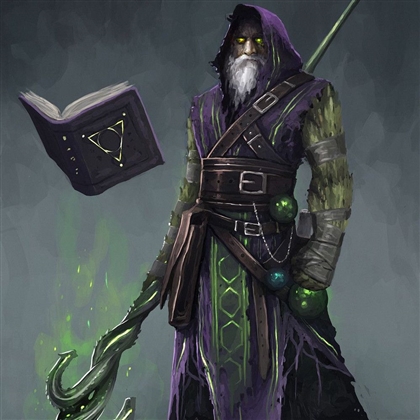
Base Class: Wizard
Inspired by Gandalf and Saruman’s Orthanc tower fight, the Telekinesian Wizard can move or strike objects and creatures from a distance by channeling their mind-over-matter magical powers through their telekinesian staff.
*Read the following after reading the 2nd-level subclass feature: Starting at 4th level, whenever you reach a level that grants the Ability Score Improvement feature, you can acquire one of the following subclass-specific feats (instead of gaining a feat or Ability Score Improvement):
- If you cast the Booming Blade and/or Green Flame Blade spells, you can do so through your telekinesian staff as well as from its reach.
- If you use a Smite (e.g. Divine Smite), you can do so through your telekinesian staff as well as from its reach.
Telekinetic Fighting
Starting at 2nd level, you are proficient with the Telekinisian Staff, which has become a channel through which you can telekinetically make melee weapon attacks from a distance. This staff's telekinetic reach increases at higher levels. A quarterstaff has the properties of a telekinesian staff only while being wielded by a Telekinesian Wizard. This staff can also act as a spellcasting focus.
The following are the abilities and rules regarding your use of a Telekinesian Staff:
- Telekinesian Staff Properties: 1d6 Magical Bludgeoning damage, Versatile (d8), Simple, Melee, Special (Telekinetic Reach = 20 ft).
- When you make an attack with this staff, you use your Intelligence modifier (instead of Strength) for the attack and damage rolls.
- You can make a telekinesian staff attack as a bonus action. However, you don’t use your Intelligence modifier for the damage roll.
- If the last visible creature that you hit moves out of your staff’s reach, it provokes a telekinesian staff opportunity attack from you.
- When a target is prone, you have advantage on your telekinesian staff attacks against it.
- The reach of your telekinesian staff increases by an additional 5 feet at the following levels: 3, 5, 7, 9, 11, 13, 15, and 17.
Telekinetic Displacement
Starting at 6th level, once per turn, when you hit a creature or object with a telekinesian staff attack, you can displace (push) it to a space up to 10 feet in any direction (even up). If the target you hit is Huge or larger, it is only moved 5 feet.
When you move a creature through the occupied space of another creature of the same size or smaller, both creatures must make a DC 13 Dexterity saving throw; a failing creature is knocked prone. The smaller of the creatures (in size) has disadvantage on the saving throw.
If you move a creature towards another creature that is larger in size, only the displaced creature makes the saving throw. In this case, whether the displaced creature succeeds or fails the saving throw, it ends up in the nearest unoccupied space to the larger creature.
You also gain the use of the mage hand cantrip (if you don’t already have it), and the range of your mage hand is now equal to the reach of your staff.
Telekinesian Dual Wielding
Starting at 10th level, you can wield two telekinesian staffs at the same time; doing so grants you the following benefits:
- Whenever you take the Attack action on your turn, you can make two telekinesian staff attacks, instead of one.
- The distance at which you can displace a creature or object (through your Telekinetic Displacement feature) doubles.
- Whenever you critically hit a creature with one of your telekinesian staff attacks, the target must succeed on a Strength saving throw or be knocked prone. The DC equals 8 + your proficiency bonus + your Intelligence modifier.
- You can still use the somatic component of spells while dual wielding telekinesian staffs.
Telekinetic Aid
Starting at 14th level, when you hit a creature with your staff on your turn, you can use the Help action as a bonus action.
Furthermore, as an action, you can end one of the following conditions on a creature you can see (other than yourself) within your telekinesian reach: charmed, frightened, incapacitated, paralyzed, and stunned. You can use this feature a number of times equal to your intelligence modifier, between long rests.