



 Base Class: Warlock
Binder of Souls
The beings that serve as patrons for warlocks are mighty inhabitants of other planes of existence—not gods, but almost godlike in their power. Various patrons give their warlocks access to different powers and invocations, and expect significant favors in return. The Binder takes this one step further and reaches out to multiple ancient, and often forgotten, beings from other planes, binding with them through bargains in exchange for their service.
Beyond Reality
Binders learn to cast their minds into the Void between planes, and to search the abyss there for beings that will answer their call. These beings – called vestiges – are remnants of powerful beings residing in the nothingness outside of reality, which is born from the last echoes of the world's creation, and from energies that leak out of the planes. Pact Magic scholars seek out these vestiges and pass down legends of their origin. They learn of their personalities, abilities, and motivations, all of which vary wildly, from the reasonable, to deeply inscrutable. Because vestiges are devoid of all sensation in the Void, they crave any small taste of reality, and will answer the call of any binder powerful enough to draw them forth. Binders, so named for their willingness to share their own souls with these exiled spirits, can merge a portion of their soul with a vestige in exchange for some of the power the vestige commanded in life.
A Bargain Sealed
In order to obtain the services of a vestige, a binder must strike a deal with that vestige, and use their magic to make the terms of the agreement totally binding. This is known as a pact. Knowing this, the vestiges will often seek to outwit the binder, adding loopholes and ambiguity into the terms of the bargain, making every deal a grave risk for the binder.
(Your dungeon master may use this as an opportunity to play to the vestige's strengths and nature. Any binder that hasn't thought through their bargain may find themselves serving the vestige instead).
Subclass Features
In addition to the class features from the Warlock, the Binder gains the following:
Soul Binding Ritual
Through special methods known only to binders, you can contact a vestige and make a pact with it. Starting at 1st level, you can make a pact with one 1st level vestige. At higher levels, you can form and maintain pacts with multiple vestiges simultaneously, as shown in the Bound Vestiges column of the Binder Table, although you must complete the ritual with each one separately. Vestiges are bound to your soul by a pact, and cannot be targeted by any means. A vestige may only be expelled by the Expel Vestige class feature described below.
Although vestiges were once beings of light and darkness, like all creatures of the planes, their long existence in a strange state beyond normal reality has twisted them into enigmatic and amoral entities. However, their nature does not dictate the alignments of those who bind to them. A fearsome and violent vestige can lend its powers to a good binder, who uses them to make peace with enemies. Conversely, a sweet-faced and kind vestige might grant an evil binder the power to wreak havoc. In some cases, the same vestige might make separate but simultaneous pacts with two binders that oppose one another.
Vestiges are not easily described as good, evil, lawful, or chaotic, but their unfathomable mindsets and strange appearance often disturb lawful and good creatures. Thus, most binders tend to be neutral, chaotic neutral, neutral evil, or chaotic evil.
The Ritual Process
Contacting Vestiges - To contact a vestige, you must draw its unique seal visibly on a surface, making the image at least 5 feet across. Drawing a seal requires the ability to mark a surface with a specific material and 1 minute of concentration (as if concentrating on a spell). A vestige may have special requirements for contact, included in its entry.
Summoning Vestiges - Once the seal is drawn, you can use your action to perform a ritual and touch the seal, calling out to a vestige using both its name and its title. An illusory image of the vestige appears in the seal's space, ignoring everyone but you. If you fail to address it before the end of your next turn, it disappears. The vestige speaks in whatever language you used to call it. You cannot summon a vestige already bound to you. Vestiges have special requirements; a vestige will not appear if the conditions are not met.
Binding Vestiges - To make a pact with the summoned vestige, you must first agree on the bargain. Once negotiations are over, the binding process ends and you make a binding check (1d20 + your proficiency bonus + your Charisma modifier). This process requires at least 1 minute to perform, but could take up to an hour depending on negotiations with the vestige. You can choose to make a rushed binding check as an action at disadvantage, accepting the vestiges conditions without negotiating. The DC for this check is determined by the level of the vestige you are attempting to bind, as shown in the Binder Table at the end of this description, plus modifiers for longer pacts.
The Bargain/Pact - Bargaining begins with the Binder stating the desired length of the pact and making an offer in return for the services of the vestige. The vestige will then make a counter-offer. Each vestige has unique desires; the higher the level of vestige and the longer the length of the pact, the more they will want from you. Many binders research their vestiges prior to contacting them with an agreeable bargain in mind. The default length of a bargain/pact is until the binders next long rest. The maximum length of a pact that can be agreed is 21 long rests.
Because a Binder must always stand a chance of being able to pass their Binding Check, the maximum pact length a Binder can attempt is equal to: 20 + your proficiency bonus + your Charisma modifier - Vestige's DC you are trying to bind with.
Binding DC Modifiers - There are no modifers for a pact lasting until the binders next long rest. For every additional long rest the Binding DC increases by +1.
Failing to agree a pact - Should bargaining fail, the vestige will leave. A binder will be unable to attempt another Soul Binding Ritual for the number of days equal to the vestiges level, plus, the next binding check will be made at disadvantage. Before the vestige leaves, a binder can attempt to force the agreement and bind the vestige to them choosing to make a rushed binding. This will incur a binding check made at disadvantage, with the pact conditions being those the vestige last stated.
Vestigial Influence - If you succeed on your binding check, the vestige has no control over your actions and does not influence your personality. If the binding check is a failure, the vestige influences your personality and your actions, and you must adhere to its requirements to the best of your ability. If you can not or will not adhere to the requirements of a vestige, you receive disadvantage on all actions that go against its influence. If you are influenced by more than one vestige, you must act according to all their influences. The influence lasts for 1 day per level of the vestige, after which time you can attempt to expel the vestige (provided you are high enough level). Effects do not stack but run in tandem with eachother. Should you fail a binding check and become influenced and then fail a second binding, become influenced by another vestige, both vestiges will exert control over the binder for their own length of time. They may even compete against eachother, with the binder soul being torn apart.
Vestigial Manifestation - As long as you are bound to a vestige, you manifest a specific physical sign of its presence, as given in its entry. This sign is real, not an illusory or shapechanging effect. If you are bound to more than one vestige, you bear the physical sign of binding for each one.
You can choose not to exhibit the physical sign that accompanies a pact with a vestige only when you succeed on your binding check. You can suppress or reveal the sign as a bonus action. A binder that fails their binding check will exhibit physical signs for as long as the vestige remains.
Vestigial Power - Whether the binding check succeeds or fails, you successfully make a pact with the vestige, and you gain the features granted by it. When the pact ends you lose access to all of the features granted by the vestige.
Vestigial Ability - Charisma is your spellcasting ability for all spells and features granted to you by your vestiges. Use your Charisma score whenever a spell refers to your spellcasting ability. In addition, use your Charisma modifier when setting the saving throw DC for a spell or feature granted to you by one of your vestiges.
Conditions - You cannot bind the same vestige at the same time. Vestiges have special requirements and won't appear in a summoning if those requirements are not met. The minimum length of a pact is until the binders next long rest, so if a length is not stated then this is the default. The binding DC is increased by 1 for each additional long rest agreed in the bargain.
(A binder may need to spend some time researching vestiges as they may not have access to all of them instantly. The seal of a vestige is particularly valuable as is the method of summoning. Check with your dungeon master as these could be an enticing quest reward; a page found in a forgotten tomb or in a book owned by another)
Expel Vestige
You unlock this feature at 2nd level. You have discovered how to allow vestiges to come and go as you please. You can use your action to expel a vestige to which you are bound, making a binding check against the chosen vestige's binding DC. If you fail, the vestige remains. If you succeed on the binding check, you expel the vestige immediately. You can summon a different one to replace the vestige through Soul Binding, but only after a long rest. Once you have attempted to expelled a vestige, you must finish a long rest before expelling another.
Vestiges react poorly to your use of this ability. Pass or fail, you have disadvantage on your next binding check with ANY vestige. Additionally, you also have disadvantage on your binding check with the vestige you expelled, regardless of the amount of time passed.
Exploit Vestige
Starting at 6th level you can exploit the power of one of your bound vestiges to augment one of your spells with Metamagic. As a reaction, when you cast a spell, you can convert one of your vestige’s abilities into one of the Metamagic effects below.
You can forego only one ability at a time in this manner and this can only be done once per day. At 12th level this becomes twice per day and at 18th level this becomes 3 times per day. Once you have done so, you lose access to that vestige's ability until you finish a long rest.
Be wary; vestiges react poorly to your use of this ability; you suffer disadvantage on your next binding check with the vestige regardless of the amount of time passed.
Careful Spell - When you cast a spell that forces other creatures to make a saving throw, you can protect some of those creatures from the spell’s full force. To do so, you choose a number of those creatures up to your Charisma modifier (minimum of one creature). A chosen creature automatically succeeds on its saving throw against the spell.
Distant Spell - When you cast a spell that has a range of 5 feet or greater, you can double the range of the spell.
When you cast a spell that has a range of touch, you can make the range of the spell 30 feet.
Extended Spell - When you cast a spell that has a duration of 1 minute or longer, you can double its duration, to a maximum duration of 24 hours.
Heightened Spell - When you cast a spell that forces a creature to make a saving throw to resist its effects, you can give one target of the spell disadvantage on its first saving throw made against the spell.
Quickened Spell - When you cast a spell that has a casting time of 1 action, you can change the casting time to 1 bonus action for this casting.
Subtle Spell - When you cast a spell, you can cast it without any somatic or verbal components.
Siphon Vestige
Starting at 10th level you can exploit one of your bound vestiges for magical power. As a bonus action you can convert a vestige you currently have bound into a single spell slot. The spell slot is equal to the level of the vestige on the Binders Table. Once you have done so, you lose access to that vestige's powers until you finish a long rest.
You can do this once per day at 10th level, twice at 14th level, and 3 times per day at 18th level, providing you have enough vestiges bound).
Be wary; vestiges react poorly to your use of this ability; you suffer disadvantage on your next binding check with the vestige regardless of the amount of time passed.
Soul Guardian
As you attain higher binder levels, the vestige guards its time with you even more jealously, granting you protection from additional effects that would harm your soul and life energy for as long as the pact lasts.
Vestigial Awareness - Starting at 14th level, your vestiges enhance your perception. While you are bound to at least one vestige, you have advantage on Wisdom (Perception) checks that rely on sight, and you cannot be surprised.
Vestigial Mastery - Upon reaching 16th level, you have become trusted and respected among vestiges. Your attunement to vestiges grant you supernatural vitality. You no longer suffer the frailty of old age, you cannot be aged magically, and your hit point maximum cannot be reduced.
Vestigial Bravery – Once you reach 18th level your mind has become steeled by your experience of binding vestiges. You are immune to fear effects
Vestigial Guardian - When you reach 20th level, your bound vestiges completely protect your mind. While you are bound to at least one vestige, once per day you can choose to automatically succeed on an Intelligence, Wisdom, or Charisma saving throw against a spell or similar effect. You must finish a long rest before doing so again.
Boundless Binding
You unlock this feature when you attain 20th level (due to homebrew creation rules this feature is discovered at level 14). The seals of the vestiges you have bound with (since discovering this feature) are burned into your mind, a conduit for contact allowing you to bind vestiges at will. Using your action, you can utter the name and title of a vestige, instantly summoning the chosen vestige and binding it to you. When you bind a vestige with this feature, the saving throw DC of its granted features increases by 1, and you automatically fail on your binding check to make a pact with it, subjecting you to its influence. Due to the speed of the binding, the pact automatically ends when you finish a long rest, and you can't expel the chosen vestige by any means.
You can form any, or all, of your pacts in this way, but you will be subjected to the influence of each vestige you bind with this feature until you complete a long rest.
Additionally, you gain a +1 bonus to your attack and damage rolls for each vestige you have bound with this feature, and any attack you make is considered magical for the purpose of overcoming resistance and immunity to nonmagical attacks and damage. These benefits fade when the pact(s) ends.
Table: The Binder
| Level | Features | Vestige Level | Bound Vestiges |
| 1st | Soul Binding Ritual (1 vestige) | 1st | 1 |
| 2nd | Expel Vestige | 1st | 1 |
| 3rd | 2nd | 1 | |
| 4th | 2nd | 1 | |
| 5th | Soul Binding (2 vestiges) | 3rd | 2 |
| 6th | Exploit Vestige | 3rd | 2 |
| 7th | 4th | 2 | |
| 8th | 4th | 2 | |
| 9th | 5th | 2 | |
| 10th | Siphon Vestige | 5th | 2 |
| 11th | Soul Binding (3 vestiges) | 6th | 3 |
| 12th | 6th | 3 | |
| 13th | 6th | 3 | |
| 14th | Soul Guardian (Vestigial Awareness), Boundless Binding Awareness | 7th | 3 |
| 15th | 7th | 3 | |
| 16th | Soul Guardian (Vestigial Mastery) | 7th | 3 |
| 17th | Soul Binding (4 vestiges) | 8th | 4 |
| 18th | Soul Guardian (Vestigial Bravery) | 8th | 4 |
| 19th | 8th | 4 | |
| 20th | Soul Guardian (Vestigal Guardian), Boundless Binding Ability Unlocked | 8th | 4 |
Expanded Spell List
The Binder lets you choose from an expanded list of spell, which are added to the warlock spell list for you.
Expanded Spells
| Spell Level | Spells |
|---|---|
|
1st |
|
|
2nd |
|
|
3rd |
|
|
4th |
|
|
5th |
Soul Binding Ritual
Through special methods known only to binders, you can contact a vestige and make a pact with it. Starting at 1st level, you can make a pact with one 1st level vestige. At higher levels, you can form and maintain pacts with multiple vestiges simultaneously, as shown in the Bound Vestiges column of the Binder Table, although you must complete the ritual with each one separately. Vestiges are bound to your soul by a pact and cannot be targeted by any means. A vestige may only be expelled by the Expel Vestige class feature described below.
Although vestiges were once beings of light and darkness, like all creatures of the planes, their long existence in a strange state beyond normal reality has twisted them into enigmatic and amoral entities. However, their nature does not dictate the alignments of those who bind to them. A fearsome and violent vestige can lend its powers to a good binder, who uses them to make peace with enemies. Conversely, a sweet-faced and kind vestige might grant an evil binder the power to wreak havoc. In some cases, the same vestige might make separate but simultaneous pacts with two binders that oppose one another.
Vestiges are not easily described as good, evil, lawful, or chaotic, but their unfathomable mindsets and strange appearance often disturb lawful and good creatures. Thus, most binders tend to be neutral, chaotic neutral, neutral evil, or chaotic evil.
The Ritual Process
Contacting Vestiges - To contact a vestige, you must draw its unique seal visibly on a surface, making the image at least 5 feet across. Drawing a seal requires the ability to mark a surface with a specific material and 1 minute of concentration (as if concentrating on a spell). A vestige may have special requirements for contact, included in its entry.
Summoning Vestiges - Once the seal is drawn, you can use your action to perform a ritual and touch the seal, calling out to a vestige using both its name and its title. An illusory image of the vestige appears in the seal's space, ignoring everyone but you. If you fail to address it before the end of your next turn, it disappears. The vestige speaks in whatever language you used to call it.
Binding Vestiges - To make a pact with the summoned vestige, you must first agree on the bargain. Once negotiations are over, the binding process ends and you make a binding check (1d20 + your proficiency bonus + your Charisma modifier). This process requires at least 1 minute to perform, but could take up to an hour depending on negotiations with the vestige. You can choose to make a rushed binding check as an action at disadvantage, accepting the vestiges conditions without negotiating. The DC for this check is determined by the level of the vestige you are attempting to bind, as shown in the Binder Table at the end of this description, and the length of the pact.
The Bargain/Pact - Bargaining begins with you stating the desired length of the pact and making an offer in return for the services of the vestige. The vestige will then make a counter-offer. Each vestige has unique desires; the higher the level of vestige and the longer the length of the pact, the more they will want from you. Many binders research their vestiges prior to contacting them with an agreeable bargain in mind.
Pact Length and Binding DC: A standard pact is until the binder’s next long rest. A binder can negotiate a longer pact, but for every long rest above 1, the DC of the vestige increases by +1. Your maximum pact length cannot exceed the maximum you are capable of rolling on your binding check (20 + your proficiency bonus + your Charisma modifier - Vestige DC).
Example 1: A level 5 Warlock (+3 proficiency bonus and charisma of 17 gives a +3 bonus) attempts to bind a level 1 vestige (DC10). The maximum binding check he can achieve is 26 (20+3+3), less the Vestige DC of 10 and he can attempt to bind the vestige for a maximum of 16 long rests. The final Binding DC for this vestige will be DC26.
Example 2: A level 17 Warlock (+6 proficiency bonus and a 20 Charisma give a +5 bonus) has a maximum achievable binding check of 31 (20+6+5). The maximum he can bind a level 1 vestige (DC10) is for 21 long rests, a level 3 vestige (DC14) for 15 long rests and a level 8 vestige (DC24) for 7 long rests.
Failing to agree a pact - Should bargaining fail, the vestige will leave. A binder will be unable to attempt another Soul Binding Ritual for the number of days equal to the vestiges level, plus, the next binding check will be made at disadvantage. Before the vestige leaves, a binder can attempt to force the agreement and bind the vestige to them choosing to make a rushed binding. This will incur a binding check made at disadvantage, with the pact conditions being those the vestige last stated.
Vestigial Influence - If you succeed on your binding check, the vestige has no control over your actions and does not influence your personality. If the binding check is a failure, the vestige influences your personality and your actions, and you must adhere to its requirements to the best of your ability. If you can not or will not adhere to the requirements of a vestige, you receive disadvantage on all actions that go against its influence. If you are influenced by more than one vestige, you must act according to all their influences. The influence lasts for 1 day per level of the vestige, after which time you can attempt to expel the vestige (provided you are high enough level). Effects do not stack but run in tandem with eachother. Should you fail a binding check and become influenced and then fail a second binding, become influenced by another vestige, both vestiges will exert control over the binder for their own length of time. They may even compete against eachother, with the binders soul being torn apart.
Vestigial Manifestation - As long as you are bound to a vestige, you manifest a specific physical sign of its presence, as given in its entry. This sign is real, not an illusory or shapechanging effect. If you are bound to more than one vestige, you bear the physical sign of binding for each one.
Vestigial Sign: You can choose not to exhibit the physical sign that accompanies a pact with a vestige only when you succeed on your binding check. You can suppress or reveal the sign as a bonus action. A binder that fails their binding check will exhibit physical signs for as long as the vestige remains.
Vestigial Power - Whether the binding check succeeds or fails, you successfully make a pact with the vestige, and you gain the features granted by it. When the pact ends you lose access to all of the features granted by the vestige.
Vestigial Ability - Charisma is your spellcasting ability for all spells and features granted to you by your vestiges. Use your Charisma score whenever a spell refers to your spellcasting ability. In addition, use your Charisma modifier when setting the saving throw DC for a spell or feature granted to you by one of your vestiges.
Vestige Saving Throw DC = 8 + your Proficiency bonus + your Charisma modifier
Spell Attack Modifier = your proficiency bonus + your Charisma modifier
Binder Table
| Level | Vestige Level | Bound Vestiges |
| 1st | 1st | 1 |
| 2nd | 1st | 1 |
| 3rd | 2nd | 1 |
| 4th | 2nd | 1 |
| 5th | 3rd | 2 |
| 6th | 3rd | 2 |
| 7th | 4th | 2 |
| 8th | 4th | 2 |
| 9th | 5th | 2 |
| 10th | 5th | 2 |
| 11th | 6th | 3 |
| 12th | 6th | 3 |
| 13th | 6th | 3 |
| 14th | 7th | 3 |
| 15th | 7th | 3 |
| 16th | 7th | 3 |
| 17th | 8th | 4 |
| 18th | 8th | 4 |
| 19th | 8th | 4 |
| 20th | 8th | 4 |
Bound Vestiges
The Ritual Process
Contacting Vestiges - To contact a vestige, you must draw its unique seal visibly on a surface, making the image at least 5 feet across. Drawing a seal requires the ability to mark a surface with a specific material and 1 minute of concentration (as if concentrating on a spell). A vestige may have special requirements for contact, included in its entry.
Summoning Vestiges - Once the seal is drawn, you can use your action to perform a ritual and touch the seal, calling out to a vestige using both its name and its title. An illusory image of the vestige appears in the seal's space, ignoring everyone but you. If you fail to address it before the end of your next turn, it disappears. The vestige speaks in whatever language you used to call it. You cannot summon a vestige already bound to you. Vestiges have special requirements; a vestige will not appear if the conditions are not met.
Binding Vestiges - To make a pact with the summoned vestige, you must first agree on the bargain. Once negotiations are over, the binding process ends and you make a binding check (1d20 + your proficiency bonus + your Charisma modifier). This process requires at least 1 minute to perform, but could take up to an hour depending on negotiations with the vestige. You can choose to make a rushed binding check as an action at disadvantage, accepting the vestiges conditions without negotiating. The DC for this check is determined by the level of the vestige you are attempting to bind, as shown in the Binder Table at the end of this description, plus modifiers for longer pacts.
The Bargain/Pact - Bargaining begins with you stating the desired length of the pact and making an offer in return for the services of the vestige. The vestige will then make a counter-offer. Each vestige has unique desires; the higher the level of vestige and the longer the length of the pact, the more they will want from you. Many binders research their vestiges prior to contacting them with an agreeable bargain in mind. The default length of a bargain/pact is until the binders next long rest.
Binding DC Modifiers - There are no modifers for a pact lasting until the binders next long rest. For every additional long rest the Binding DC increases by +1.
Maximum Pact Length - A Binder must always be able to succeed on their Binding Check. Therefore, maximum pact length cannot exceed: 20 + Binder's Proficiency Modifier + Binder's Charisma Modifier - Vestige's DC. Furthermore, a pact can never exceed 21 long rests.
Failing to agree a pact - Should bargaining fail, the vestige will leave. A binder will be unable to attempt another Soul Binding Ritual for the number of days equal to the vestiges level, plus, the next binding check will be made at disadvantage. Before the vestige leaves, a binder can attempt to force the agreement and bind the vestige to them choosing to make a rushed binding. This will incur a binding check made at disadvantage, with the pact conditions being those the vestige last stated.
Conditions - You cannot bind the same vestige at the same time. Vestiges have special requirements and won't appear in a summoning if those requirements are not met. The minimum length of a pact is until the binders next long rest, so if a length is not stated then this is the default. The binding DC is increased by 1 for each additional long rest agreed in the bargain.
(A binder may need to spend some time researching vestiges as they may not have access to all of them instantly. The seal of a vestige is particularly valuable as is the method of summoning. Check with your dungeon master as these could be an enticing quest reward; a page found in a forgotten tomb or in a book owned by another).
Vestigial Influence - If you succeed on your binding check, the vestige has no control over your actions and does not influence your personality. If the binding check is a failure, the vestige influences your personality and your actions, and you must adhere to its requirements to the best of your ability. If you can not or will not adhere to the requirements of a vestige, you receive disadvantage on all actions that go against its influence. If you are influenced by more than one vestige, you must act according to all their influences. The influence lasts for 1 day per level of the vestige, after which time you can attempt to expel the vestige (provided you are high enough level). Effects do not stack but run in tandem with eachother. Should you fail a binding check and become influenced and then fail a second binding, become influenced by another vestige, both vestiges will exert control over the binder for their own length of time. They may even compete against eachother, with the binder soul being torn apart.
Vestigial Manifestation - As long as you are bound to a vestige, you manifest a specific physical sign of its presence, as given in its entry. This sign is real, not an illusory or shapechanging effect. If you are bound to more than one vestige, you bear the physical sign of binding for each one.
You can choose not to exhibit the physical sign that accompanies a pact with a vestige only when you succeed on your binding check. You can suppress or reveal the sign as a bonus action. A binder that fails their binding check will exhibit physical signs for as long as the vestige remains.
Vestigial Power - Whether the binding check succeeds or fails, you successfully make a pact with the vestige, and you gain the features granted by it. When the pact ends you lose access to all of the features granted by the vestige.
Vestigial Ability - Charisma is your spellcasting ability for all spells and features granted to you by your vestiges. Use your Charisma score whenever a spell refers to your spellcasting ability. In addition, use your Charisma modifier when setting the saving throw DC for a spell or feature granted to you by one of your vestiges.
Vestige Saving Throw DC = 8 + your Proficiency bonus + your Charisma modifier
Spell Attack Modifier = your proficiency bonus + your Charisma modifier
Abysm, The Schismed
8th Level Vestige. DC24.
Abysm, the Schismed, is a living vestige of a psionic mythal. As a vestige, Abysm gives its host access to several psionic effects.
Restrictions: The seal must be drawn using the sap from a remorhaz. Sap made from a creature is a time-consuming process. The freshly killed creature (or limbs if the creature is large) must be hung to dry so the blood can be collected beneath. Once fully drained and dried, the flesh and bones must be burned to ash and then mixed with the blood. This liquid is then boiled down to half of its volume over a low heat for 2 days, continually stirring the mixture. It is then strained to remove any clumps and reduced once again to half its size using the same process. After a week, 300 pounds of creature will produce one vial of animal sap that can be used as ink.
Influence: Your speech pattern becomes disconnected, as if many voices are trying to speak through you. Your mannerisms also change from moment to moment: masculine to feminine, regal to shy, and confident to passive.
Manifestation: Crystals grow from the seal into a prismatic tree that suddenly cracks and shatters into dust. The dust swirls into a shimmering, rainbow-laden cyclone that forms an indistinct face. A discordant voice speaks to the binder, saying, "We, Abysm."
Legend: Little is known about the origin of the vestige that is Abysm, but some have learned that a strange group of psionic users once visited the great city of Myth Drannor on Faerûn. These visitors wished to learn more about mythals and spent much time in research while in the great elven city. Scholars theorize that they then created a psionic mythal around a secret city of psychics and called it Abysm.
Imagine a city of psions, all interconnected by their psicrystals and a great mythal of psionic energy. Now imagine all of them dying overnight. No one knows what disaster visited the city, but it killed every living thing. Some believe that due to the inhabitants' direct connection to the mythal by way of their psicrystals, their souls did not depart as they should have. Instead they got caught in the weave of psionic energies, and the resulting combination of energies was simply too much for the crystals to hold - all psicrystals shattered at once and gave birth to the vestige that is Abysm.
Some researchers and lore-seekers say that Abysm has only recently became sane enough to maintain a safe binding for more than a few seconds. Many old tales relate how binders found themselves being nearly driven insane just by contacting it, but now it does respond and answer the call of those who seek it.
Sign: Your fingernails and toenails become crystal
Granted Features
While bound to Abysm, you gain powers that various city inhabitants had at some point in their lifetimes.
Psionic Boon: While bound to Abysm, all spells you cast are done psionically; You require no verbal or somatic components. You only require material components if they have a gold cost.
Overpowered: You gain enhanced stats when you bind with Abysm and you gain advantage on death saving throws.
Mindlink: You can forge a telepathic link with a number of creatures equal to your charisma modifier. You are able to communicate with them over long distances.
Conversion: You gain resistance against psychic, acid, cold, fire, lightning, and thunder damage, absorbing half of the damage dealt. You can use your reaction to expend this energy into blinding light or into a ray that targets enemies within range.
Aeraldoth, The Volunteer
7th Level Vestige. DC22.
Aeraldoth was a djinn vizier of the Grand Caliph. He volunteered to be imprisoned by Martek for a thousand years in order to do battle with Khalitharius upon his release.
Restrictions: The seal must be drawn using desert sand and an empty bottle placed in its centre.
Influence: Aeraldoth cannot abide evil doing. While under his influence you will attempt to stop anyone from committing any premeditated evil acts, you will be honourable in all things and be the first to volunteer for any quest or mission with a good outcome.
Manifestation: The sound of howling wind grows from within the sign as the sands start to rise, forming a whirlwind, starting wide at the edges of the sign, and closing in on the bottle while growing taller. Just before the whirlwind closes, it explodes, sand flying outwards, and in its centre stands a blue figure, 30 feet tall, black hair pulled back into a ponytail, wearing a blue robe from the waist down and a golden sash about his waist. He looks down at you and slowly shrinks down to your size, then acknowledges you with a greeting and a nod of his head.
Legend: Martek; a wizard known as the Grand Vizier of Raurin was legendary in his power, and particularly known for his prophecy that the efreet Khalitharius would break free of his binding. Shortly after capturing Khalitharius, Martek penned a prophecy that the efreet would be released in a thousand years. He teleported to the Citadel of Ice and Steel in the Elemental Plane of Air, where, in an audience with the Caliph of all djinn, he convinced his Vizier, Aeraldoth, to allow himself to be bound for a thousand years to do battle with the efreet once the latter was released.
While imprisoned, Aeraldoth spent a thousand years preparing himself for the battle, though he could not win. Aeraldoth's prison was a bottle; he could not be released without a magical word, as removing the stopper did nothing. The word was hidden as a combination of the contents of the sign on the palm of Princess Shadalah and the Amulet of the Oasis of the White Palm. The bottle could not be taken further than a hundred feet from its location, either, for it would teleport back: it was found beneath a statue of Set in the City of Phoenix. After Khalitharius was released, his cry for release was mentally audible up until adventurers were able to break his imprisonment.
Aeraldoth was released only weeks after Khalitharius. He battled the efreet all across the Raurin until Martek was resurrected and became able to step in, quickly defeating the exhausted efreet.
Whether the efreet was slain or banished, scholars cannot say, but Khalitharius was defeated, Martek survived, and of Aeraldoth? Binder scholars now know he became a vestige.
Sign: Your skin turns blue, and your feet appear to be transformed into columns of swirling air.
Granted Features
Aeraldoth grants you some his abilities as a djinn for the use of combating evil.
Cloud Walk: While showing his sign your feet seem transformed into columns of swirling air. You do not leave tracks of any sort and walk an inch above the ground. This also means that you do not trigger any traps that require the victim to step down onto them applying pressure. You are able to walk on water as long as the water is calm.
Feather Fall: Using a reaction you can cast feather fall on yourself.
Chain lightning: Using an action you create a bolt of lightning that arcs toward a target of your choice that you can see within range. Three bolts then leap from that target to as many as three other targets, each of which must be within 30 feet of the first target. A target can be a creature or an object and can be targeted by only one of the bolts.
A target must make a Dexterity saving throw. The target takes 10d8 lightning damage on a failed save, or half as much damage on a successful one.
Create Whirlwind: Using an action you can create a 5-foot-radius, 30-foot-tall cylinder of swirling air that magically forms on a point you can see within 120 feet. The whirlwind lasts as long as you maintain concentration (as if concentrating on a spell). Any creature but you that enters the whirlwind must succeed on a DC 18 Strength saving throw or be restrained by it. You can move the whirlwind up to 60 feet as an action, and creatures restrained by the whirlwind move with it. The whirlwind ends if you loses sight of it.
A creature can use its action to free a creature restrained by the whirlwind, including itself, by succeeding on a DC 18 Strength check. If the check succeeds, the creature is no longer restrained and moves to the nearest space outside the whirlwind.
Elemental Language: You are able to speak Primordial
Djinni Resistance: You are resistant to Lightning and Thunder
Agares, The Betrayed
3rd Level Vestige. DC14.
Agares died at the hands of his allies for a wrong he did not commit. As a vestige, not only does he give binders the ability to weaken foes and knock them prone, but he also makes his summoner fearless and able to speak any tongue.
Restrictions: The seal must be drawn using stones, outdoors on flat unworked earth. Agares particularly despises two other vestiges: Aeraldoth and Otiax. If you have hosted one of these spirits within the last 24 hours, Agares refuses to answer your call. Similarly, these spirits will not answer your call if you are already bound to Agares.
Influence: Agares’s loyalty in life and his anger at the betrayal perpetrated by his lieutenants has become a hatred of falsehood. When influenced by Agares, you speak forthrightly and with confidence. You cannot use the Deception skill, and when asked a direct question, you must answer truthfully and directly.
Manifestation: The ground trembles briefly as the head of a great brown crocodile bursts from beneath Agares’s seal. The crocodile’s maw opens upward, unleashing a hooded black hawk that spreads its wings, forcing the jaws farther apart with the mere brush of its feathers. Two large, catlike eyes gleam on the hawk’s breast. When Agares speaks, the hawk’s beak moves, but the sound comes from the crocodile’s rumbling throat.
Legend: In life, Agares ruled over vast armies on the Elemental Plane of Earth. He was the most powerful general the plane had yet seen and second in authority only to his genie emperor, a dao of great influence. Even though Agares was unalterably loyal, he nevertheless gave his emperor reason to fear betrayal. Agares became obsessed with a djinni commander who had thwarted his conquests on several occasions. His desire to meet this favored foe on the field of battle blinded him to other tactical options and deafened him to rumors that his esteem for his enemy had deepened into love. When at last Agares entrapped the djinni’s forces, he girded himself for personal combat and set out to answer a challenge to duel his adversary. The summons was a trap laid by Agares’s lieutenants, however; his allies slew him within sight of his greatest enemy.
Sign: You gain a wracking cough that spews dust and small stones from your mouth. This coughing prevents you from casting any spells that have verbal components. While bound to Agares, you can resist the urge to cough for a number of rounds equal your Constitution score. Thereafter, you cough for a round and then can try to resist the urge again.
Granted Features
Agares gives you the power to exalt yourself and your allies, to make the earth tremble beneath your feet, to render foes weak, and to speak the truth to all peoples.
Elemental Companion: You can use your action to summon an earth elemental to accompany you and fight for you.
Earth Stomp: As an action, you can stomp on the ground, causing every creature within range of you that is either standing or climbing on a surface connected with the ground succeed on a Dexterity saving throw or fall prone. You and your summoned earth elemental are never affected by the use of this feature.
At One With The Earth: As long as your feet touch the ground, you gain a +2 to Strength or Dexterity and +2 Armour Class.
Petrify Immunity: You have immunity to the petrified condition.
True Speech: You can speak, understand, read, and write all languages spoken by creatures within 30 feet of you. To use an unfamiliar language, you must hear it spoken and see the speaker. Once you have used it, you can continue to do so for as long as your pact with Agares lasts. When speaking or writing in a language with which you are not familiar, you cannot lie.
Amon, The Void
1st Level Vestige. DC10.
Although Amon once ruled as a deity of light and justice, his long existence as a vestige has twisted him into a monster consumed by wrath. He grants those who summon him his sight, his fiery breath, and his powerful ram's charge.
Restrictions: The seal must be drawn outdoors in chalk during daylight. Amon particularly despises four other vestiges: Nabarius, Geryon, Bel, and Chupoclops. If you have hosted one of these spirits within the last 24 hours, Amon refuses to answer your call. Similarly, these spirits will not answer your call if you are already bound to Amon.
Influence: Amon’s influence makes you surly and irritable. In addition, since Amon despises living deities of fire, sun, and law, he forces you to resist even beneficial spells cast by those devoted to such powers. You must make a saving throw to resist such a spell if one is allowed; failure allows you to gain the benefit.
Manifestation: Amon manifests in a burst of black smoke, howling foul curses at his summoner. He possesses a black wolf’s body with a ram’s head and a serpent for a tail. His mouth is filled with sharp teeth, and fire escapes it when he speaks.
Legend: Scholars claim that Amon is what remains of the personality of a god who died of neglect millennia ago. Once worshiped by thousands, Amon eventually lost his faithful to more responsive deities. His will was strong enough, though, to resist eternal sleep on the Astral Plane. Since his demise, his half-existence as a vestige seems to have dramatically changed his appearance and personality. Once a calm and wise protector, a god of light and law, Amon is now a foul tempered and hateful spirit.
Sign: You grow a ram’s curling horns.
Granted Features
Amon grants you his sight and his breath, as well as the deadly use of his horns.
Darkvision: You gain darkvision out to 60 feet.
Fire Breath: You can use your action to breathe fire. Each creature in range must make a Dexterity saving throw.
Ram's Horns: While showing Amon's sign, you can use the ram’s horns as a melee weapon that deals 1d8 bludgeoning damage. You are proficienct with your ram's horns, and you use your Strength for its attack and damage rolls.
Additionally, if you spend half of your movement traveling in a straight line towards an enemy and make an attack with your ram's horns, you deal an extra 1d8 points of damage on a successful hit.
Amyr, The Queen of Avarice
2nd Level Vestige. DC12.
Once a monarch of dwarves, Amyr allowed her greed to bring an end to her empire. As a vestige, she gives her host the ability to wear armor without impedance, to set objects and creatures alight with a touch, to resist the effects of fire, and to shatter objects with heavy blows.
Restrictions: The seal must be drawn using chalk and a gold bar worth 200 gold pieces must be placed in the centre.
Influence: Under Amyr’s influence, you become stingy and greedy, begrudging every coin or item of value that you or your group must give to another. At the same time, she requires that you give a coin (silver, gold, or platinum - your choice) to every dwarf you see.
Manifestation: Amyr arises from the gold bar within the seal. She has two great worms for legs and three heads—one a lion’s, one a female dwarf’s, and one a bull’s. Her powerfully muscled torso strains beneath the finery of an empress, and her fingers glitter with more than a dozen jeweled rings. In one hand she holds a red-hot, star-shaped branding iron, and with the other, she holds shut the lion head’s mouth. Aym speaks through her dwarf head, since both animal heads are incapable of speech. She prefers to keep the lion muzzled because if she doesn’t, it roars and causes the bull’s head to low in terror, making it impossible for her to hear.
Legend: Dwarven legends depict Amyr as the greediest dwarf queen who ever lived. Modern-day dwarves still spit at the mention of her name. Not long after Moradin first forged the dwarves, Amyr arose as a great leader among them. Greed brought her to power, and greed consumed her while she ruled. Dwarves mined furiously in response to Amyr’s constant demand for more gems and precious metals, and her people became virtual slaves to their work. As onerous as Amyr’s rule was, however, all this mining greatly expanded the dwarves’ territory, and many dwarven clans grew quite wealthy. Jealous of the dwarves’ wealth and smarting from their conquests, a great horde of orcs, giants, and goblinoids banded into an army to assault Amyr’s kingdom. The dwarves fought bravely, but because their forces were stretched so thin across Amyr’s empire, they could not respond quickly enough to the horde’s concentrated assault on their capital. Legend has it that when the fires of the burning city reached her, Amyr stood among a hundred wagons laden with gold that her servants had loaded in preparation for her flight. But so engrossed was she in counting the coins to make certain she didn’t lose a copper that she didn’t notice the danger until the fires began to melt the coins in her grasp. Rather than repenting her greed at the point of her death, Amyr cursed Moradin for not protecting her, and in return, Moradin cursed her.
Sign: While you host Amyr, you bear a star shaped brand on the palm of your left hand or on your forehead, which you choose at the time you make the pact.
Granted Features
Amyr grants you powers that reflect her dwarven heritage and the ruin she brought to her kingdom.
Heavy Armor Proficiency: You gain proficiency with heavy armor.
Dwarven Step: You can move at normal speed while wearing heavy armor and ignore the Strength requirements to wear it.
Fire Resistance: You gain resistance to fire damage.
Sundering Strike: You have advantage on your attack rolls against objects and constructs.
Ruinous Attack: Your melee attacks deal double damage to objects and constructs. If your binder level is at least 10th, your melee attacks count as magical for the purpose of overcoming resistance and immunity to nonmagical attacks and damage.
Halo of Fire: You can shroud yourself in a wreath of flame. If a hostile creature within 5 feet of you that hits you with a melee attack, they take fire damage. This feature resets after a long rest.
Flame Weapon: You deal additional fire damage to targets by using your reaction. This feature resets after a long rest.
Andromalius, The Repentant Rogue
4th Level Vestige. DC14.
Once the favorite of the god Olidammara, Andromalius now exists as a vestige. His granted abilities help his summoners beat rogues, thieves and assassins at their own game.
Restrictions: The seal must be drawn using a piece of coal. You must obtain two different nonmagical items similar to those that Andromalius holds in his hands when he manifests and place them within the confines of his seal when you summon him. These items vanish as soon as Andromalius appears.
Andromalius particularly despises two other vestiges: Marchosias and Kenddar. If you have hosted one of these spirits within the last 24 hours, Andromalius refuses to answer your call. Similarly, these spirits will not answer your call if you are already bound to Andromalius.
Influence: When influenced by Andromalius, you become a devious mischief-maker who delights in causing small calamities—especially misunderstandings between friends and incidents of mistaken identity. However, Andromalius cannot now abide acts of theft, so he forbids you to steal from a creature, take an item from a dead body, or remove someone else’s possession from a location without permission so long as you are under the jurisdiction of an authority whose laws expressly forbid such activities. By the same logic, you cannot take possession of any object that you know to be stolen.
Manifestation: Andromalius appears as a middle-aged but lithe human male in the garb of a jester. Each of his arms splits at the elbow into a dozen forearms, and he holds a small object in each of his twenty-four hands. Though his costume and overall appearance change from one manifestation to another, the specific collection of objects never does—a fact that has sparked a long-standing debate among binder scholars. The items are: a belt purse, a silver key, a gold ring, a pair of dice, a copper coin, a dagger, an apple, an arm bone, a scroll, a comb, a whistle, a fish hook, a mirror, an egg, a potion, a dead spider, an oak leaf, a human skull, a lock, a closed black book, a bell, a dove, a set of lock picks, and a mouse. When Andromalius returns whence he came, he juggles these illusory items and then tosses one to his summoner. Some scholars claim that the item thrown indicates a future event, but that the specific meaning depends on which other objects are held in the hands of that same arm.
Legend: Once the herald of Olidammara, Andromalius forswore theft and mischief on his deathbed, repenting all the actions he had taken on behalf of his god during his life. By this means, he hoped to steal his soul from his deity, thus accomplishing his greatest theft and prank in history, and proving himself the most worthy of his god’s favor. At first angered by Andromalius’s betrayal, Olidammara quickly realized the irony of the moment and burst into laughter. Yet the god’s good humor was short-lived, because he realized that to accept Andromalius’s soul would be to prevent the theft and ruin the joke. Since Olidammara was loath to let such a clever servant to go to the realm of some other god, he repaid his servant’s honor a hundredfold—he stole Andromalius’s soul from the cosmos, making it a vestige. Whether Andromalius deemed this result an honor or not remains unclear.
Sign: You gain an extra digit on each limb. This appendage prevents you from wearing normal gloves or gauntlets, but magic gloves and gauntlets reshape to fit you.
Granted Features
The abilities that Andromalius grants help you catch thieves and return stolen goods, discover wickedness and underhanded dealings, and punish wrongdoers.
Jester’s Mirth: As an action, you can cause an opponent to break into uncontrollable laughter. This feature functions like the Tasha’s hideous laughter spell, and you must concentrate on its effect.
Locate Item: You can sense the direction of any well known or clearly visualized object that lies within range of your location. You must take a minute to focus on the object first and then you will sense its direction. This feature lasts for up to 10 minutes providing you maintain concentration throughout. If you lose concentration you have to use this feature again. If you wish to find a specific object, this feature works only if you have seen the object firsthand and can accurately visualize its peculiarities, otherwise, the direction of the nearest object of the same type is revealed. You can sense the direction of only one item each time you use this feature. This feature does not reveal the direction to a disguised object, such as a secret door, unless you can clearly visualize its disguised form, nor does it tell you the distance to the object.
See the Unseen: You see invisible creatures and objects as if they were visible, and you can see into the Ethereal Plane. Ethereal creatures and objects appear ghostly and translucent. You can activate this feature as a bonus action.
Sense Trickery: You have advantage on Wisdom (Insight) checks, on Wisdom (Perception) checks, and on Intelligence (Investigation) checks made to discern a disguise. In addition, you automatically notice when a creature uses sleight of hand to take something from you.
Sneak Attack: You can deal extra damage to one creature you hit with an attack if you have advantage on the attack roll. You don’t need advantage on the attack roll the target is flanked. This feature doesn't work if you have disadvantage on the attack roll. The attack must use a melee or a ranged weapon. If you get a sneak attack bonus from another source, the bonuses to damage stack.
Ashardalon, The Pyre Of The Three
8th Level Vestige. DC24.
A seeker of pure power and wealth, the fiendish red dragon Ashardalon was among the toughest creatures of his era. Having escaped death more than once, he grants binders some of his powers as a dragon and fiend, as well as a portion of his great resilience.
Restrictions: The seal must be drawn using dragon sap. Sap made from a creature is a time-consuming process. The freshly killed creature (or limbs if the creature is large) must be hung to dry so the blood can be collected beneath. Once fully drained and dried, the flesh and bones must be burned to ash and then mixed with the blood. This liquid is then boiled down to half of its volume over a low heat for 2 days, continually stirring the mixture. It is then strained to remove any clumps and reduced once again to half its size using the same process. After a week, 300 pounds of creature will produce one vial of animal sap that can be used as ink.
Influence: You greatly hunger for vengeance against those who harm or slight you. Ashardalon requires you to accept any opportunity to strike a foe who damages or insults you in preference over any other target.
Manifestation: Ashardalon tears open the ground with his long black talons and hauls his massive body up from a flaming pit. The red dragon is wreathed in flames and has a burning hole where his heart should be. He bellows in anger before turning to the binder and demanding to know why he has been disturbed.
Legend: At the dawn of time, the three progenitor dragons created the universe during the Age of Dragons. This age came to and end with the murder of Siberys, the Dragon Above, at the claws and fangs of Khyber, the Dragon Below. Moving to contain Khyber, Eberron, the Dragon Between, folded the wicked dragon in her coils, and became the world we know today. But Khyber stirred in her bonds, and spawned the terrible demons and their Overlords, heralding the Age of Demons.
Dragons tell the legend that at the kindling of this terrible age, they were created by the blood of slain Siberys falling upon the soil of Eberron, creating their kind from two of the mighty Progenitor Wyrms. But for Ashardalon, this was not enough. With the Draconic Prophecy rediscovered, the dragons had begun to fight back against their demonic oppressors and rise from their primitive state. Ashardalon posed as one of the dragon's greatest heroes, crusading against fiend and Overlord and manipulating the Prophecy to dragonkind's advantage. But it was all a ruse, subtly shifting fortunes and selecting courses of events to bring him to one certain moment in time.
An Overlord, it's identity now unknown, was bowed and broken before him, outmaneuvered by two millennia of Ashardalon's plotting of Prophetic events. Instead of slaying the fiend or binding it, Ashardalon tore his own draconic heart out of his chest with a claw and enacted a dark ritual, drawing the Overlord into the void where his heart was just moments before. But this was no merger of beings, as with Kyuss and Katashka eons later. Rather, the great red wyrm assumed all of the Overlord's strength and power, without losing his self. Finally, Ashardalon was complete, a being made up of all three Progenitor Wyrms.
Proclaiming himself the new god of dragonkind, Ashardalon cut a swath of destruction across the face of Eberron, hoarding and rampaging with an unholy fervor. Even Dol Dorn, Sovereign of Strength and Steel, could not whether Ashardalon's wrath. Finally, it is said that the remote, distant gods of the dragons were forced to act and seal Ashardalon away for eternity. Others say that once his initial madness abated, Ashardalon left the cosmos of his own accord to create a new universe in his image, using the power of the Three.
Sign: A patch of skin over your heart is marked by a deep-hued crimson sigil of a curled red dragon.
Granted Features
Ashardalon grants you some of the vast power he collected during his life as a dragon and a fiendish creature.
Fiend’s Heart: You share some of the defensive benefits of the fiend once bound to Ashardalon’s body. This effect grants you resistance to non-magical damage and grants you immunity to fire damage.
Ashardalon’s Presence: You can use your action to strike fear into the hearts of your foes. This feature functions like the fear spell, and you must maintain concentration on its effect. When you use this feature, the vestige’s sign shows through any armor or clothing you wear for 1 round, burning like a fiery brand (though it doesn’t actually deal damage or start a fire). You cannot use this feature if you do not show Ashardalon's sign.
Ashardalon’s Greed: You have advantage on Intelligence (Investigation) and Wisdom (Perception) checks to find items. You can also use a bonus action to locate objects near you, as the locate object spell, and you must concentrate on its effect.
Ashardalon's Insight: You can identify the properties and command words of a magic item, as the identify spell, requiring 1 minute of study and concentration.
Ashardalon’s Vigor: Ashardalon grants you some of the vast resilience he enjoyed in life. When you form a pact with Ashardalon, you gain a bonus to your constitution and advantage on constitution saving throws.
Astaroth, The Fallen Angel
4th Level Vestige. DC16.
An angel cast down from the heavens for reasons unknown, Astaroth has helped mortals since writings began. When eventually he was slain by his own worshippers, not even the Outer Planes would house his soul. He has been a vestige ever since.
Restrictions: The seal must be drawn in charcoal, in front of a hearth, with a lit fire.
Astaroth particularly despises two other vestiges: Bel and Skellige. If you have hosted one of these spirits within the last 24 hours, Astaroth refuses to answer your call. Similarly, these spirits will not answer your call if you are already bound to Astaroth.
Influence: Astaroth's influence renders you incapable of taking responsibility for your own actions. You cannot admit any fault, acknowledge any mistake, or make reparations or apologies for any wrong, no matter the consequences or the evidence against you.
Manifestation: Accompanied by the sound of flapping wings and cawing crows, Astaroth manifests as a hideously scarred angel. His limp, almost burnt wings are tattered and filthy charcoal in patches, his features are drawn and gaunt with burn marks covering his body and his eyes are yellowed. He carries a viper in his burnt right hand and wears a tarnished crown upon his brow. A horrific stench of burnt decaying meat accompanies him, almost, but not quite enough, to sicken everyone nearby.
Legend: Scholars know little of Astaroth before his fall, save that he favored constant interference and assistance when it came to mortals, rather than leaving them to develop on their own. Some tales claim that he was responsible for teaching humanoids such techniques as metalworking and even alchemy.
According to ancient writings, Astaroth himself maintains that this was why he fell, cast from Heaven for the "crime" of aiding the mortal races in their development of civilization. Most theologians, however, remain convinced that the angel was exiled for greater crimes. Legends range from an attempt to usurp the position of some heavenly god, to an effort to raise an entire mortal race to celestial status, to an attempt to turn all mortals away from worship of the gods so that he might be free to influence them as he saw fit. Astaroth admitted to no such defiance, however, and swore to the day of his disappearance that his fall was unjust.
For centuries Astaroth roamed many worlds, mortal and spiritual alike. To the celestials, he was an outcast — another prideful fallen angel who could not even admit to his errors, let alone atone for them. Yet because he refused to embrace damnation, he found no allies among the fiends either. Eventually he settled among mortals. He watched over them as a guardian and mentor to start, but slowly his obsession with "protecting" the mortals grew uncontrollable. Astaroth became a dictator, restricting even the day-to-day behavior of his subjects to keep them "safe." The fallen angel was finally slain by an uprising within the populace, but none of the Outer Planes would grant his soul any respite. Eventually, with no afterlife to call his own, stripped even of his physical existence, Astaroth simply went — elsewhere.
Sign: Your skin takes on a charred, burnt, crusty appearance in places; dry and leathery as if you were burned horrifically and are now recovering, and in other places it is shiny and wet; almost moist, with blisters, as if you have just been freshly burnt, and, you emit a foul, burnt flesh odor. While this odor is not strong enough to impede or distract an opponent, it does attract attention.
Granted Features
Astaroth guided mortals, and he still grants abilities based in knowledge and education. As a fallen angel, and then a vestige, his magics have grown ever grimmer and more distasteful; he also grants powers based on directly controlling and offending others.
Breath of Astaroth: You can exhale a 60-foot cone of foul-smelling gas. Creatures within the cone must make a Constitution saving throw or be incapacitated for 1d4 rounds. Creatures immune to poison or disease are immune to this effect.
Word of Astaroth: You can use your action to make a suggestion, as the spell, except you need not maintain concentration. At any given time, you may affect a total number of creatures equal to your Charisma modifier (minimum 1) with this feature.
Angelic Lore: Astaroth constantly whispers the secrets of reality in the back of your mind, allowing you to draw on his own nigh-infinite knowledge. You may make a special knowledge check with a bonus equal to your binder level to see if you know some relevant information about local notable people, legendary items, or noteworthy places. DC 10 for common knowledge, known by at least a substantial minority of the local population. DC 15 for uncommon knowledge, known by only a few peoples' legends. DC 20 for obscure knowledge that is known by few, and is hard to come by. DC 25 for extremely obscure knowledge, known by very few, possibly forgotten by most who once knew it, or possibly known only by those who don’t understand the significance of the knowledge.
A successful knowledge check will not reveal the powers of a magic item but may give a hint as to its general function.
Honeyed Tongue: You have advantage on Charisma (Persuasion), Charisma (Deception), and Charisma (Intimidate) checks.
Balam, The Bitter Angel
5th Level Vestige. DC18.
Once a being of extreme goodness, Balam became a wrathful vestige after taking on an impossible task that ended in failure. She grants her summoners the ability to foresee future difficulties and the intellect to interpret what they see, as well as skill with light arms and a stare that chills flesh.
Restrictions: The seal must be drawn using holy water, poured over flat rock or stone.
Influence: Balam’s influence causes you to distrust clerics, paladins, and other devotees of deities. You disagree with any plan of action they may put forward if you are in a aprty with them and refuse to stand or sit beside them. Whenever you enter a temple or some other holy or unholy site, Balam requires that you spit on the floor and utter an invective about the place in a loud voice.
Manifestation: Balam is a horror to behold. Her body is that of a great purple serpent, and her head consists of the top halves of three horned humanoid heads arranged evenly around a shared gaping maw. This mouth is a tooth-studded chute that extends deep into her body, and her six horns point forward around it. Balam speaks in a grinding moan, exhaling hot, stinking breath with each word. The fangs in her chute-mouth move in waves with the shuddering of her throat, and the eyes of her three heads glow blue when she becomes excited or angry.
Legend: Binder scholars claim that Balam is all that remains of the soul of a powerful solar. Exactly how she came to exist in her current state remains a mystery, but sources of planar lore state that several good gods tasked her with eliminating the practice of sacrificing sentient beings in the worship of deities. Since such sacrifices are part and parcel of evil rituals, the task amounted to wiping out the worship of evil gods altogether—a task well beyond what even the good deities could manage. Needless to say, Balam failed in her assignment, and some believe that her foes actually sacrificed her in praise of a dark god.
Sign: Your voice gains a peculiar quality, becoming both hollow and guttural.
Granted Features
Balam grants you the power to predict future events. She also teaches cunning and finesse, and gives you the ability to freeze foes with a glance.
Balam’s Cunning: You can reroll one attack, saving throw, or ability check you have just made (no action required). You must accept the result of the reroll, even if it is worse than the original.
Prescience: You get a glimpse of the future a moment before it happens. This knowledge manifests as a +2 bonus on initiative checks, Dexterity saving throws, and your Armor Class.
Weapon Finesse: You gain proficiency will all Martial weapons that have the Finesse property (basic rules).
Balam's Defence: You gain an ability similar to the Feat: Defensive Duelist.
Icy Glare: At the start of your turn, each opponent within 30 feet of you that can see you must succeed on a Wisdom saving throw or take 1d6 points of cold damage. Opponents can avert or close their eyes to protect themselves. You can use your action to focus your gaze on a target creature, forcing them to make a Wisdom saving throw. You can choose not to affect specific creatures within range of the gaze attack, such as your allies, if desired.
Bel, The Pretender
3rd Level Vestige. DC14.
Once a great archdevil who ruled the first layer of hell, Bel was supplanted by Zariel. Bel was a master tactician, preferring to fight from afar and never went into battle without minions to command. His granted abilities reflect his prowess on the battlefield.
Restrictions: The seal must be drawn using a lump of coal with a drop of the binder’s blood in the centre. Bel particularly despises three other vestiges: Ka-ven Drahl, Balan, and Amon. If you have hosted one of these spirits within the last 24 hours, Bel refuses to answer your call. Similarly, these spirits will not answer your call if you are already bound to Bel.
Influence: You become calculating and calm when a problem presents itself, using every tactical advantage available and only engaging in battle on your own terms. You will be over-analytical of situations, offering complex suggestions involving ambushes, double-crosses, feints and countermoves, but never making the first move yourself, rather waiting for others to be the first to move. When in battle, you will remain at the back, summoning minions to fight for you and using ranged attacks, only engaging in melee with your claws, as a last resort.
Manifestation: Smoke begins to curl from the seal on the ground and the drop of blood bursts into flame, growing larger as a red, clawed hands grab the edges of the seal, seemingly pulling Bel up from hell itself. Bel appears to resemble a pit-fiend, appearing as a 12‑foot tall, crimson-scaled colossus with massive, bat-like wings, clawed extremities, and fangs that drip a green, smoking venom. His voice is deep and gravelly.
Legend: Bel's bond with his fellow archdevils wasn't particularly strong, owing to the circumstances of his rise to power. He was often referred to as "The Pretender” since his rebellion against his original lord was public knowledge. Neither Mephistopheles, Baalzebul, or their respective faction leaders could look past his blatant treachery, but none cared enough to make a move against him.
With no allies among his peers, Bel was forced to find them among other beings. In certain infernal courts, Tiamat was mockingly referred to as Bel's "scaly watchdog" since she guarded, albeit poorly, the portal between Avernus and Dis, but the relationship between the two was more complex. Despite Tiamat being too prideful to acknowledge allies, the two had reached some sort of agreement, one that increased the number of abishai in Bel's armies.
Bel's relationship with Zariel was likely his worst, as the two hated each other with a burning passion. They could barely stand being near one another and both invented distractions to avoid each other, such as Zariel assigning him the busywork of weapons production. Despite Asmodeus decreeing that Zariel was to accept Bel as an advisor, Bel did not try to curb her reckless behaviour, instead encouraging it. Believing that Asmodeus now favoured Zariel, he tried using indirect tactics to tarnish Zariel's reputation, such as trying to compel her to overextend herself and face a humiliating defeat, or otherwise hindering her plans to make her appear inept.
Eventually¸ Asmodeus claimed that Bel's tactics were inadequate in defending Avernus from demonic incursions and reinstated Zariel as its archduke, relegating Bel to a supporting, advisory role. Binders do not know how Bel ended up a vestige; some say through Zariel’s actions and others say voluntarily, but one thing they do know - Bel's story is one of the greatest inspirational tales in the Nine Hells and every devil wants to do what he did. Originally a mindless lemure, Bel climbed the ranks of the diabolical hierarchy, earning his place through strength, skill, and skullduggery until he became a full-fledged pit fiend.
Sign: Your skin turns crimson, and horns grow from your head, outward from above each of your temples. You hand and feet become clawed and your incisors grow pointed, overlapping the opposite lip.
Granted Features
As a superior tactician, Bel grants you insight to guess at the enemies next move, he also grants you the ability to summon minions, pillars of fire and to savagely attack with your claws.
Master Tactician: You gain the Bel's insight
Bel's Claws: Provided you are showing Bel's signs, you can use your claws to attack. You are proficient in claw attacks and they deal 2d4 + CHA modifier.
Pillar of Fire: You create a pillar of fire on any solid surface within range. The pillar has a 10’ radius and can from 5’ up to 20’ high, at your discretion. The pillar is opaque and lasts until the end of your turn. When the pillar appears, each creature within its area must make a Dexterity saving throw. On a failed save, a creature takes fire damage determined by your level, or half as much damage on a successful save. The pillar will ignite any cloth or wood causing it to burn.
Summon Minions: Using your action you invoke Bel’s name and summon lesser demons from the chaos of the abyss. The number of demons that appear are based on the binder’s level and the bargain you made with Bel.
Points Pool: The original Pact Length determines the number of points available. The Binder gets a pool of 1 point per pact length to max of 30.
The binder can choose the number of demons and their size based on points in the pool and the available demons unlocked as per their level below.
Demon Table:
| Binder Level | Demon | Points to summon | Demon | Points to summon |
| 5 | Lemure | 1 | Dretch | 2 |
| 10 | Hellhound | 5 | Bearded Devil | 6 |
| 15 | Barbed Devil | 10 | ||
| 20 | Chained Devil | 15 |
The Binder chooses the unoccupied spaces they appear, within range. The demons that are summon appear out of the ground where the binder chooses them to appear.
A summoned demon disappears when it drops to 0 hit points or after 10 minutes.
The demons are hostile to all creatures, including your allies, but not the Binder, providing they are exhibiting Bel’s signs, and Bel has not been subject to Exploit Vestige or Siphon Vestige.
The binder gets to roll initiative for the summoned demons as a group, which has its own turns. The demons pursue and attack the nearest non-demons to the best of their ability (run by the DM).
Blume Arnesen, The Iron Maiden
1st Level Vestige. DC10.
Blume Arnesen remained a mystery for ages, but binder scholars now believe her to have been a human ascetic from a far away land who lived more than two thousand years ago. As a vestige, she grants her summoners the power to move objects at a distance, to strike with the skill of a monk, to fall as lightly as a feather, and to run like the wind
Restrictions: The seal must drawn in the soil under a clear sky and an iron gauntlet placed in the centre. Blume particularly despises three other vestiges: Chupoclops, Marchosias, and Ipos. If you have hosted one of these spirits within the last 24 hours, Blume Arnesen refuses to answer your call. Similarly, these spirits will not answer your call if you are already bound to Blume Arnesen.
Influence: Blume Arnesen's influence makes you think that others doubt your abilities and competence. Despite what anyone says, you feel the constant need to prove your worth. In addition, Blume Arnesen requires that you consume neither food nor beverages, including potions, for the entire time you remain bound to her.
Manifestation: When Blume Arnesen manifests, the ground quakes, and a rusted iron sarcophagus erupts from the earth within her seal, shedding dirt and flakes of rust as it grates upward. The metal visage of a human woman is discernible on the lid. The metal bindings holding the lid closed burst in clouds of corroded metal, and the sarcophagus creaks open, releasing a tumble of human bones and noisome black liquid. Blume Arnesen does not speak to her summoner, but the visage on the lid smiles or frowns during the pact-making process.
Legend: Many binder scholars credit Blume Arnesen with laying the foundation for orders of monks, and indeed, her philosophies and abilities bear a strong resemblance to the training that monks now receive. In life, Blume Arnesen was a charismatic guru who taught that enlightenment comes from denial—first of the needs of the flesh, then of the perceived limits of reality, and lastly of the rules of reality. Her frequent demonstrations of power served to illustrate the validity of her ideas to others. She leapt from cliffs without harm, lifted boulders with her thoughts, and lived for months without eating or drinking. Although Blume Arnesen gathered many followers, not one of her disciples could manage her great feats. Some began to question her methods.
To prove the veracity of her teachings, Blume Arnesen secluded herself in an iron coffin, telling her students to bury her and dig her up only when they received a sign from her. Years passed, and no sign came. One by one, her followers lost faith and deserted her. At last only one remained. Disillusioned, he dug up the rusted sarcophagus, only to find it empty. He tracked down his fellow disciples to tell them of the miracle, but none believed him. Blume Arnesen and her nameless disciple would have been lost to obscurity, but her lone faithful follower inscribed his story on the walls of a cavern. The recent discovery of this inscription explains the strange powers and appearance of Blume Arnesen.
Sign: The flesh of your face settles into a frown or a smile (a frown if you succeeded on your binding check, or a smile if you did not) and retains that general expression regardless of your actual feelings. This alteration to your visage does not affect your Charisma, Charisma-based skill checks, or others’ ability to make Insight checks against you.
Granted Features
Blume Arnesen gives you the power to fall any distance without harm, lift objects without touching them, and run like the wind.
Magic Attacks: Your melee attacks count as magical for the purpose of overcoming resistance and immunity to nonmagical attacks and damage.
Feather Fall: You fall as though you were under the influence of a feather fall spell. You can suppress or activate this feature as an action, or as a reaction if you start to fall.
Iron Fists: Using your action and your bonus action you are able to make 2 unarmed strikes with your fists on a single target. You can use DEX instead of STR for its attack and damage rolls. You roll a 1d6 in place of the normal damage. The damage die of your unarmed strike increases to 2d6 at 7th level, to 3d6 at 14th level, and to 4d6 at 20th level.
Sprint: Your movement speed increases by 10 feet.
Far Hand: As a bonus action, you can lift and move an unattended object to which you have line of effect, as long as it is within 10 feet per binder level you possess. The force manipulating the object is considered Medium in size, and it has a Strength score equal to 10 + one-half your binder level. During the bonus action, you can move the object up to 5 feet per binder level. The force cannot lift the object more than 5 feet off the ground. In any round during which you do not use a bonus action to manipulate the object, you lose control of it. You can never move an object outside the range of this feature, and you lose control of the object if you move too far away from it or if a creature touches it. You can move only one object at a time in this fashion.
Ethereal Shove: As an action, you can use the telekinetic force of your Far Hand to push a creature, as long as it is within range. The hand deals force damage and has a Strength score equal to 10 + one-half your binder level. The push initiates a shove. You use the hand’s Strength modifier for the Strength (Athletics) check, and add your proficiency bonus, even if you lack proficiency with that skill. If the shove is successful, the target either moves in the direction you indicate, equal to half the binder's level in feet, or it falls prone.
Buer, The Huntress
5th Level Vestige. DC18.
Buer grants binders superior healing as well as powers against poisons and diseases.
Restrictions: The seal must be drawn on the ground using honey, under an open sky in the middle of a forest.
Influence: Under Buer’s influence, you are plagued by momentary memory lapses. For an instant, you might forget even a piece of information as familiar as the name of a friend or family member. Furthermore, since Buer abhors the needless death of living creatures other than animals and vermin, the first melee attack you make against such a foe must be for nonlethal damage. In addition, Buer requires that you not make any coup de grace attacks.
Manifestation: With a great roar and a flash of light, Buer appears on the farthest edge of the sign. Buer’s form is that of a five-branched star, or wheel, composed of satyr legs. She has two faces, one positioned on each side of her wheel-shaped body at the center point where the five legs meet. One face is that of a green hag, and the other is a raging, leonine visage with an unruly mane and beard. Buer constantly moves within her seal, rolling from foot to foot as she traverses its circumference. She always keeps her raging face outward, but she speaks from her green hag face in a friendly manner with a gentle voice. When her body rolls in such a way that her hag face cannot see her summoner, Buer grows frustrated and begins yelling curses at her body.
Legend: Buer tells many different stories about how she came to be a vestige, so her true origins remain obscure. In various popular versions of the tales, she is a beautiful elf maiden who fell to evil satyrs, a virtuous human ranger killed by a chimera, or a green hag slain by a lammasu. It’s likely that Buer herself cannot remember who she was in life or what brought her to her current state, and the stories she tells are cobbled together from the shreds of her memory that remain. Regardless of what her true form once was, most binders believe that she possessed great skill as a hunter and healer in life.
Sign: Your feet turn into satyr’s hooves, giving you a curious tip-toeing gait. These hooves prevent you from wearing normal boots or shoes, but magic footwear reshapes to fit you.
Granted Features
Buer grants you healing powers, the ability to ignore toxins and ailments, and skills that help you navigate the natural world.
Healing Touch: As a bonus action, you can touch a creature (including yourself) to restore hit points equal to your Charisma modifier.
Healing Gift: As an action, you can touch a creature (including yourself) to restore a number of hit points equal to 1d8 per 5 binder levels.
Purify: As an action, you can touch a creature and cure them of any non-magical disease or poison.
Fast Healing: When you suffer any damage, you can use your reaction to immediately activate your fast healing feature. This feature lasts for one hour or until you are fully healed; which ever comes first. You regain 1 hit point +1 per 5 binder levels.
Buer’s Knowledge: You gain advantage on Wisdom (Medicine), Wisdom (Nature), and Wisdom (Survival) checks.
Buer's Healing: You gain features similar to the Feat: Healer. You are an able physician, allowing you to mend wounds quickly and get your allies back in the fight. You gain the following benefits:
- When you use a healer’s kit to stabilize a dying creature, that creature also regains 1 hit point.
- As an action, you can spend one use of a healer’s kit to tend to a creature and restore 1d6 + 4 hit points to it, plus additional hit points equal to the creature’s maximum number of Hit Dice. The creature can’t regain hit points from this feature again until it finishes a long rest.
Buer’s Purity: You have immunity to disease and poison, and making a pact with Buer removes any existing disease and neutralizes any poison that afflicts you.
Track: You have advantage on Wisdom (Perception) and Intelligence (Investigation) checks made to notice tracks.
Chupoclops, The Harbinger of Forever
6th Level Vestige. DC20.
A great monster believed to be a harbinger of the apocalypse, Chupoclops became a vestige when slain by mortals. Chupoclops grants its summoner a poisoned bite and unnatural senses, plus the ability to pounce on foes, to exist ethereally, and to make enemies despair.
Restrictions: The seal must be drawn using spider venom.
Influence: While under the influence of Chupoclops, you can’t help but be pessimistic. At best, you are quietly resigned to your own failure, and at worst, you spread your doubts to others, trying to convince them of the hopelessness of their goals. In addition, Chupoclops requires that you voluntarily fail all saving throws against fear effects or any effect that imposes a morale penalty.
Manifestation: Chupoclops appears over its seal in the form of a Colossal phase spider. However, only the part of its body directly over its seal is visible at any given time. In most cases, Chupoclops first appears as a massive spider leg striking out of nowhere into the center of the seal. Then it shifts its body, slowly bringing its face into view and down to the level of its summoner. Glaring over its oddly tusked arachnid visage from eight all-too-human eyes, Chupoclops rumbles an ominous growl to begin the process of pact making.
Legend: Chupoclops once stood tall in the company of Fenris, Dendar the Night Serpent, and other supposed harbingers of the end of existence. A titanic spider like creature, Chupoclops stalked the Ethereal Plane, devouring ghosts and giving birth to mortals’ nightmares. Legend has it that the gods trapped the monstrous Chupoclops in the realm of ghosts to prevent it from devouring hope, but it was destined to escape and sate its hunger during the end times. Because Chupoclops was a terror to both the living and the undead, several powerful individuals eventually joined forces to fight it. Three were great heroes, and four were powerful villains. Four of these seven-one of the heroes and three of the villains— were ghosts; the rest were living. This group set out to murder Chupoclops and thus accomplish what deities could not. The furious battle lasted for seven days, and each day ended with the death of one member of the group that had come to kill the great monster. On the last day, the last hero struck down Chupoclops with her dying blow. Chupoclops, never a creature defined by the normal rules of the universe, became a vestige after its death. Binder scholars claim that adventurers still encounter its enormous corpse in the misty Ethereal Plane. Now that the monster can no longer destroy hope, some say it will exist forever, and thus, so will the world.
Sign: Your lower jaw increases in size, and two long, sharply pointed tusks grow upward from it.
Granted Features
Chupoclops gives you the power to linger on the Ethereal Plane, sense the living and undead, demoralize foes, and poison enemies.
Poison Bite: You gain a bite attack that deals piercing bite damage and poison damage. You are proficient with your bite. You use your Dexterity modifier for the attack and damage rolls. You cannot use this feature if you do not show Chupoclops’s sign.
Pounce: You can use a bonus action to make an attack with your poison bite on each of your turns.
Aura of Despair: Every hostile creature within 10 feet of you has a –2 penalty on attack rolls, ability checks, saving throws, and weapon damage rolls. You can suppress or activate this feature as an action.
Ethereal Watcher: As a bonus action, you can become ethereal. Providing you take no action or movement you can remain on the Ethereal Plane for a number of hours equal to your Binder Level. While on the Ethereal Plane you can perceive the Plane you originated from and cannot be perceived yourself from your originating Plane unless through magic.
Soulsense: You notice and locate living creatures within range as if you possessed blindsight. You also sense the strength and type of their life forces automatically, determining if they are undamaged, dying, or wounded.
Ghost Touch: Your weapons count as magical for the purpose of overcoming resistance and immunity to nonmagical attacks and damage against incorporeal creatures.
Delver Gnarl, The Tortured One
3rd Level Vestige. DC14.
Once a human binder, Delver Gnarl now grants powers just as other vestiges do. He gives his summoners mental fortitude, a frightening moan, protections against madness, and the ability to share injuries with others.
Restrictions: The seal must be drawn using a length of rope, dusted in the ash of any reptile creature and a tooth must be placed in the centre of the seal.
Delver Gnarl particularly despises two other vestiges: Zceryll and Abysm. If you have hosted one of these spirits within the last 24 hours, Delver Gnarl refuses to answer your call. Similarly, these spirits will not answer your call if you are already bound to Delver Gnarl.
Influence: You shift quickly from distraction to extreme focus and back again. Sometimes you stare blankly off into space, and at other times you gaze intently at the person or task at hand. Since Delver Gnarl dislikes any task that requires more than 1 round of concentration (such as some spellcasting, concentration on an effect, or any action that requires a Concentration check), he requires that you undertake no such activities while under his influence.
Manifestation: Delver Gnarl's frightful apparition floats in the air above his seal, with arms and legs hanging limply. Teeth and fangs of all kinds stud his entire body, replacing even his eyes. What skin is visible between the teeth appears to be the moist, pink flesh of gums. Delver Gnarl's mouth is a bloody ruin that clearly lacks teeth, and when he opens it to speak, only a moan issues forth. Some binders believe that his vestige form is a punishment inflicted by the other vestiges, but others insist that he appears as he does because of his everlasting obsession with the teeth that bear his name.
Legend: Bards tell two stories of Delver Gnarl, both linked to the magic items that carry his name—the teeth of Delver Gnarl. Some say that because Delver Gnarl was antiquity’s most powerful cleric, his followers treated his teeth as holy relics after his death and they somehow gained magical powers through this veneration. Others insist that Delver Gnarl was a cleric of little consequence who discovered some magic dragon teeth in the ruins of a red dragon’s lair. In this version of the story, the teeth were named after Delver Gnarl because he became a terror in the region where he acquired them. Binder scholars know a different story—that Delver Gnarl was a cleric, one of mediocre power, who forsook his deity to pursue the power of pact magic. The fabled teeth of Delver Gnarl, to which all the legends attribute miraculous powers, were neither his own nor those of the dragon he battled. They were the teeth of beings that became vestiges after death, and they could grant abilities similar to those that the vestiges themselves imparted. Pact magic treatises relate that Delver Gnarl pulled out his own teeth and replaced them with those of the vestiges, but that using them all drove him mad. What happened thereafter is a matter of debate, but the texts maintain that Delver Gnarl eventually died, and the teeth were lost, divided up among the squabbling followers he had managed to gain and then spread across the world. Today, Delver Gnarl exists as a vestige in his own right—perhaps brought to that state through his close association with so many others.
Sign: Several teeth grow from your scalp in two rows from front to back like dragons teeth. Though they are small enough to be hidden by a large quantity of hair or a hat, a touch reveals them immediately.
Granted Features
Delver Gnarl armours your mind and blends his madness with your sanity, lending you some of his selfish powers.
Mad Soul: Binding to Delver Gnarl grants you advantage on Wisdom saving throws to resist magical effects.
Maddening Moan: You can emit a frightful moan as an action. Every creature of your choice within 30 feet of you must succeed on a Wisdom saving throw or be incapacitated for 1 round. A creature that can't hear you automatically succeeds on this saving throw.
Mental Defense: When bound to Delver Gnarl, your mind is fortified against illusions. You gain advantage on intelligence checks involving illusions and illusion magic.
Unwilling Mind: As a reaction, when you take damage in melee, you can force a creature within range to share half the damage you take. They get a wisdom saving throw to resist.
Desharis, The Urban Fey
1st Level Vestige. DC10.
Desharis was the first fey born in a city. He grants his summoners the ability to conduct themselves as someone who has lived there their entire life.
Restrictions: The sign must be drawn using salt with a pair of worn boots placed in the centre. If you have gone more than a day without binding Desharis, you may only draw his seal in a village or larger city. Attempts to do so elsewhere fail outright. You can, however, "carry" Desharis into the wild; this is why you may continue to summon him, even outside the urban environment, if you have not allowed more than a day to lapse since you last did so. Desharis particularly despises four other vestiges: Zagan, Kenddar, Balam, and Haures. If you have hosted one of these spirits within the last 24 hours, Desharis refuses to answer your call. Similarly, these spirits will not answer your call if you are already bound to Desharis.
Influence: Under Desharis's influence, you cannot stand to be alone, and the more people you have around you, the better. You never voluntarily accept any task that requires you to be alone, and you argue vigorously against options that would split the party. If you have the opportunity to socialize with large groups of people (such as entering a boisterous tavern), you must take it unless doing so is overtly harmful, or you have reason to suspect the individuals are hostile to you.
Manifestation: Desharis appears with the sound of a hundred distant voices talking and shouting, though specific words remain completely unintelligible. A veritable mob of individuals appears as from a great distance, as though the air above his seal had become a window to some other place. As the mob approaches, these bare silhouettes meld together even as they take on greater details, eventually combining to form a single humanoid shape standing 10 feet in height. Though the silhouettes look human, Desharis himself appears made of equal amounts of stone, wood, metal, and glass.
Legend: According to ancient myths, the earliest true community was a human village called Desh, or "shelter" in the old tongue. Here the people dwelt together for protection against predators, and they first constructed structures rather than use existing shelters for protection against the elements.
This legend itself is neither uncommon nor unknown today. What few realize, however, is how swiftly the natural and magical worlds adapt to changes within. Desh was not merely the first community, but it also birthed the first urban fey, a distant ancestor of what would become the mighty zeitgeist.
Desharis knew nothing of his own origins. He knew only that of his two conflicting urges — one to protect the sanctity of the natural world, the other to defend Desh and the people therein — the latter was by far the stronger. Invisibly, he worked to stave off attacks from predators; to keep the village free of plague; and to aid its inhabitants when other humanoids attempted to raid Desh for its supplies. While the people of Desh thanked the gods and spirits for their fortune, however, they never knew of Desharis himself. The other fey of the world, horrified at the notion of a spreading society that might supplant the natural order, counted Desharis a traitor. They worked to thwart his efforts and even destroy him. Though he was, in effect, the very embodiment of community, Desharis was ever alone.
Desharis grew bitter at the disdain of the other fey, and some suggest that he inspired the spread of civilization as vengeance against them. Whatever the case, Desharis spread as the notion of community did, growing ever more diffuse, ever larger. Though he gained in size and influence, he gained nothing in the way of power; smaller villages added nothing to his abilities, and larger communities frequently birthed their own urban fey. Eventually, the spirit of community was too diffuse and spread out to exist as a being at all — and yet, as the embodiment of civilization, now a permanent part of the world, he could not entirely fade away.
Sign: While hosting Desharis, your eyes turn to glass. Anyone meeting your gaze sees the movement of multiple silhouettes behind them, as though looking through a window at a busy street.
Granted Features
Desharis grants abilities that reflect a city life, plus provides a few that show his anger at the fey and other creatures of nature.
Spirit of the City: If you spend at least one day in a new city, walking from one end to the other end, absorbing the atmosphere and culture you are able to use this feature. If you spend an entire evening walking around you are also able to discern the various darker contacts in a city by observing them; thieves, ruffians etc. After your "spirit walk" you are able to recite the general layout of the city, including the names of streets, shops, districts or quarters and their locations, the state of politics in the city and the mood of the populace. You can only recall this information while bound to Desharis.
While Desharis is still bound to you, you also gain advantage on any persuasion, deception or insight checks made when speaking to any local person of the city face-to-face, as you are easily able to adopt local mannerisms and customs, being more accepted as a "local"; a native to the city.
Language of the City: After your "spirit walk" of the city, you are now able to understand and speak with any local language, just by having heard it while passing.
City-Dweller: A city-dweller knows how to move through a crowd rapidly. While hosting Desharis, you are able to move at your normal rate when moving through a creature's space, including through the space of a hostile creature. You do not provoke an opportunity attack with the feature.
Infinite Doors: Once per day, you can pass through an exterior doorway (one that leads from inside a building to outside), and appear through another exterior doorway within 1 mile. The two doors must both be set in buildings made of similar materials; for instance, you could pass from a wooden building to another wooden building, or a stone building to another stone building. You can either select a specific door with which you are familiar as the destination, or simply declare that you are appearing through the closest appropriate door to a given distance. (If no appropriate portal exists within range or in the direction you wish to travel, the effect does not function.)
Smite Natural Soul: You may attempt to smite a beast, elemental, or fey with a single melee attack, dealing additional radiant damage. If you accidentally smite a creature that is not one of the above types, the attack gains no additional benefits from this feature.
Eligor, The Dragon's Slayer
7th Level Vestige. DC22.
A champion both against and for evil dragons, Eligor grants martial prowess both in and out of the saddle, as well as supernatural strength.
Restrictions: The seal must be drawn using the bone or claw of a dragon to scratch the seal onto the chosen surface. Finally, using the bone or claw to slice into your flesh, a fresh drop of the binders blood must fall into the centre to complete the seal.
Influence: You feel pity for all outcasts, particularly half-elves and half-orcs, and you make every effort to befriend any such beings you meet. Because Eligor desires revenge on the deities who abandoned him, he requires that you attack a human, elf, or dragon foe in preference to all others whenever you enter combat.
Manifestation: Eligor clatters out of nothingness on a winged, half-horse/half-dragon monstrosity. Both rider and mount are heavily armored, and in fact Eligor’s form is entirely obscured by ornate, shining plate armor and a grand helm. He carries a lance in one hand and holds a banner in the other. With each manifestation, Eligor’s banner and mount change color, cycling through the five different colors of chromatic dragons. Although Eligor rides what might well be an evil creature, he always greets his summoner warmly and treats him with respect.
Legend: Supposedly, Eligor was a great half-elf dragonslayer before he was condemned to a vestige’s existence by the actions of Tiamat. Believers of this legend claim that after Eligor’s death, Tiamat sent her draconic minions against the followers of both the human and the elven deities, demanding that they release his soul to her. Despite Eligor’s great service to both races, the deities gave up his soul to stave off the dragon attacks against their living followers. Only one deity argued against this profound injustice. The race and gender of this lone voice of reason differ with the teller, and not even binder scholars agree on whether the deity was human or elf, or even male or female. Whoever it was, this god set off alone to face Tiamat and wrest Eligor’s soul from her grasp. Upon arrival, however, the deity found Eligor in the service of Tiamat rather than in bondage. Unbeknownst to the other gods, Tiamat had raised him from death to be her champion and enforcer, using his abandonment by the other gods to win his loyalty. Eligor and the nameless deity fought, and Eligor lost his life yet again. This time, no deity laid claim to his soul, since doing so had already caused enough trouble.
Sign: One of your hands becomes thickly scaled. The color of the scales matches the color of Eligor’s mount at the time of his summoning. Your eyes change color to match.
Granted Features
In his first life, Eligor was a skilled horseman, and in his second, he served the primary deity of Chromatic dragons. Thus, the powers he grants tend to reflect those associations.
Eligor’s Skill in the Saddle: While mounted, you can use your bonus action to spur your mount to take the Dash action. If your mount spends at least half of its movement travelling in a straight line before you make a melee attack, that attack deals double damage.
Chromatic Strike: You can use your reaction to charge attacks with acid, cold, electricity, or fire. Your melee attacks deal an extra 1d8 poits of damage + 1d8 per 5 binder levels of the chosen energy type. You choose which damage type each time you hit with a melee attack. You can elect to use your reaction once the strike is successful.
Eligor’s Strength: Your Strength score increases by 4, to a maximum of 20.
Eligor's Resilience: You gain a +5 bonus to your Armor Class.
Heavy Armor Proficiency: You gain proficiency with heavy armor.
Focalor, The Prince of Tears
2nd Level Vestige. DC12.
Focalor has power over storms and seas. He gives those who bind him the power to drown souls in sadness and sink ships in an ocean of tears.
Restrictions: The seal must be drawn using sea water and tear drops poured into the centre.
Influence: While influenced by Focalor, you feel some of his inestimable grief and act morose, rarely smiling or finding cause to laugh. Whenever you kill a creature, Focalor demands that as soon as you have a peaceful moment, you take a round to say a few words of sorrow and regret for the life cut short by your actions. When you encounter any freestanding body of water (river, lake or ocean), Focalor demands you seize the opportunity and go for a swim.
Manifestation: Focalor manifests slowly, appearing first as a single tear that drops from thin air to strike the ground. Next his weeping eyes appear, and gradually his whole body becomes visible. Focalor resembles a thin, bearded, middle-aged human male with feathered wings and brown cloven hooves. He wears no clothes, but he cloaks his body in the griffon wings that grow from his back and shudder with each of his wracking sobs.
Legend: Accounts of Focalor’s origins vary widely. Some claim he was once a demon, and others say he was an angel— likely a planetar. The constantly crying spirit has never uttered a coherent word, so binder scholars must look elsewhere to solve the mystery of how he came to be a vestige. All agree, however, that Focalor was an immortal creature that died of grief, and his immense anguish kept him from being absorbed into his home plane. The cause of his sadness, however, is as unclear as his origin.
Sign: While you serve as host to Focalor, your eyes constantly weep, regardless of your mood or thoughts.
Granted Features
Focalor gives you the ability to breathe water, to control water, to blind enemies with a puff of your breath, and to cause creatures to be stricken with grief in your presence.
Aura of Sadness: When you activate this feature as an action, you emit an aura of depression and anguish that overtakes even the strongest-willed creatures. Every creature within range of you (including friendly) is overcome with grief, which manifests as a –2 penalty on attack rolls, saving throws, and ability checks for as long as it remains within range of you. This effect remains in place for an hour, or until you use an action to dismiss it.
Focalor’s Breath: As a bonus action, you can exhale toward a single living target within 30 feet. That target is blinded until the start of your next turn unless it succeeds on a Constitution saving throw.
Control Water: As an action, you can control any freestanding water inside an area you choose that is a cube up to 100 feet on a side. Provided you maintain concentration, this feature lasts for up to ten minutes.
Water Breathing: You can breathe both water and air easily.
Geryon, The Deposed Demon Lord
6th Level Vestige. DC20.
Once a devil of great power, Geryon now exists only as a vestige. He gives binders powers associated with his eyes, as well as the ability to fly at a moment’s notice.
Restrictions: The seal must be made using acid to burn the seal into a flat surface of rock or stone and then washed over with alchemist's fire.
Influence: While influenced by Geryon, you become overly trusting of and loyal to those you see as allies, even in the face of outright treachery. Because he values trust, if you make an Insight check or use any ability to read thoughts or detect lies, you rebel against Geryon’s influence and incur the normal penalties.
Manifestation: As soon as the Alchemists Fire ignites, Geryon arrives in a flash of sickly green light. A strange conglomeration of forms, his body resembles three ogre mages standing with their backs to each other and melded into one being. He has three legs, each with two feet, and three arms, each with two hands. Three brutish faces gaze out from equidistant points on a single head, which sits upon a neck jutting upward from three shoulders. One face has a furrowed brow and looks angry, another appears agitated, with wildly rolling eyes, and the third seems thoughtful, often staring into the distance as though thinking of something else.
Legend: Most scholars of the dark arts know of Geryon. As one of the legendary Lords of the Nine, he ruled Stygia, the frozen fifth layer of Hell. During a great upheaval known as the Reckoning, Geryon secretly supported the greatest of the arch devils, Asmodeus, against his rivals. When the armies of the opposing lords met to decide who would take Asmodeus’s power, Geryon blew his horn. At his signal, the armies turned against their leaders, the usurpers were thrown down, and Asmodeus reestablished his right to rule all Baator. Knowing he had taught the usurpers a lesson they would not soon forget, Asmodeus returned them to power. Rather than reward Geryon, however, he inexplicably gave his lone supporter’s power and position to another. Geryon’s fate after losing his position is unclear, but some binder scholars maintain that Asmodeus held one more betrayal in store for him. The story goes that Geryon, bewildered and stunned, lost all hope for the future. He began to question the purpose of his actions and, in a moment of weakness, even the point of his own existence. It was then that Asmodeus struck. The ruler of the Nine Hells had always hungered for the souls of those who had lost their faith, and Geryon’s powerful soul made a fine meal.
Sign: Two extra pairs of devilish eyes with green lids and yellow, catlike irises open on your head. Located at the level of your own eyes and equidistant from them, these bloodshot orbs grant you the ability to see all around yourself. Your own eyes take on the same appearance as the new ones.
Granted Features
Geryon gives you his eyes and his baleful gaze, as well as the ability to fly.
Acidic Gaze: At the start of your turn, each opponent within 30 feet of you that can see you must succeed on a Wisdom saving throw or take 1d6 points of acid damage. Creatures can avert or close their eyes to protect themselves. You can use your action to focus your gaze on a target creature, forcing them to make a Wisdom saving throw.
Swift Flight: You can use a bonus action to gain a fly speed of 60 feet for a number of turns equal to your charisma modifier.
Devil's Helper: Using an action, you can summon a Chain Devil to fight for you. The Chain Devil is loyal to you and will obey your commands, provided you use your bonus action to issue commands to it. Only one Chain Devil can be summoned to your side at a time. The Chain Devil will remain by your side for a number of turns equal to your Binder Level and then disappear, or if banished, or if it reaches 0 hit points.
All-Around Vision: Your extra eyes allow you to look in any direction, granting you advantage on Wisdom (Perception) and Intelligence (Investigation) checks. When confronted by a creature with a gaze attack, however, you cannot avert your eyes, though you can still close them. You cannot use this feature if you do not show Geryon’s sign.
See in Darkness: You gain darkvision to 90 feet and blindsight to 15 feet. You cannot use this feature if you do not show Geryon’s sign.
Haagenti, The Mother of Minotaurs
1st Level Vestige. DC10.
Haagenti tricked the god of frost giants and paid a terrible price for that deed. She girds her summoners for battle and gives them the power to confuse foes.
Restrictions: The seal must be made using a rope of Giants hair and you must be either Large or able to speak Giant. Haagenti particularly despises four other vestiges: Blume Arnesen, Regis Rumblebelly, Ipos, and Kenddar. If you have hosted one of these spirits within the last 24 hours, Haagenti refuses to answer your call. Similarly, these spirits will not answer your call if you are already bound to Haagenti.
Influence: You feel ashamed and occasionally bashful in the presence of beautiful creatures. In addition, Haagenti requires that you give deference to any creature you perceive as more attractive or charismatic than yourself. This deference might take the form of a bow, a salute, opening a door for the creature in question, not speaking until spoken to, or any other gesture that acknowledges the creature as superior to you. In any case, you must constantly treat any such creature with respect or suffer the penalty for defying Haagenti’s influence. Finally, whenever you see a frost giant, you cower in fear for 2 turns, unable to do anything but moan.
Manifestation: When Haagenti is summoned, a huge icicle thrusts up from the ground within the confines of her seal. Haagenti’s blurry white form can be seen moving within the ice for a moment, then she spreads her arms and shatters her icy prison. Although she appears with her back to her summoner, her form is clearly that of a winged minotaur. Haagenti waves her ice shield and battle axe to disperse the cold mist around her, then turns to face her summoner, revealing her bull-like face and icicle beard. Her frost-rimed fur is pure white, and her horns appear to be made of ice. Her powerfully muscled form doesn’t appear female, but her smooth voice sounds quite feminine. Sign: You possess the same features as you always did, but they somehow make you more ugly than before. Others easily recognize you, but small differences make you less appealing to look upon. In addition, your bulk expands until you weigh half again as much as you did before.
Legend: The tale of how minotaurs originated changes according to the culture and race of the teller, but frost giants blame Haagenti. Thrym, their primary deity, had tried to force a goddess of the humans to marry him and failed when her brother disguised himself as Thrym’s bride and disrupted the ceremony. The angry and humiliated god consoled himself with dalliances among his giant worshipers. Haagenti, a hill giant sorceress, learned of his liaisons and used a spell to transform herself into a beautiful frost giant so that she might bear Thrym’s powerful half-god children. Her ploy succeeded, and a year later she gave birth to twin sons. Once the children of his dalliances had grown old enough, Thrym set out to visit and test them all. He fought each child to see who was the strongest and bravest, intending to invite the most fit to join him in Jotunheim. When he sought out Haagenti, he found her herding cattle in the warm lowlands and became enraged when he saw her true form. But when he raised his axe to fell her, two horribly ugly giants leapt to her defense.
Thrym realized to his disgust that they were his sons. Thrym would have destroyed them at that moment, but he suddenly realized that Haagenti had taught him a valuable lesson. His failed attempt at marriage had been fouled by a beautiful form created through trickery, and now he had fallen victim to the same ruse again. Rather than kill Haagenti and her children, Thrym cursed them to resemble the cattle with which they wallowed, turning them into minotaurs. Then he left, vowing to teach his frost giant worshipers to distrust all beauty. How Haagenti became a vestige is unclear, but binder lore holds that her guilt at ruining beauty for the frost giants was so great that she could not bear to exist in any place that held beauty of any kind. Since every place in the planes seems beautiful to some being, she could find no eternal home anywhere. Haagenti refuses to speak on the subject and becomes angry when questioned about her past.
Granted Features
Haagenti grants you some of Thrym’s skill with arms and armor, plus her own aversion to transformation and the ability to inflict a state of confusion upon others.
Confusing Touch: You can confuse by touch. The target of your touch must succeed on a Wisdom saving throw or become confused (as if through the confusion spell).
Immunity to Transformation: No mortal magic can permanently affect your form while you are bound to Haagenti. Effects such as polymorph or petrification might force you into a new shape, but you can immediately resume your normal form as a reaction. You remain affected by such effects only when you choose to do so.
Shield Proficiency: You gain proficiency with shields.
Weapon Proficiency: You gain proficiency with battleaxes, greataxes, and handaxes, and you have a +1 bonus to attack and damage rolls with these weapons.
Halphax, The Angel In The Angle
8th Level Vestige. DC24.
Gnomes rarely earn a reputation for their military might, but Halphax is one of the few exceptions to that rule. He grants his summoners the ability to raise a fortress and imprison foes, as well as the hardness of stone.
Restrictions: The seal must be drawn using the sap of a basilisk in a city that is surrounded by walls, with the seal itself being carved into stone, either into the floor of a building/structure or over pavingstones. Sap made from a creature is a time-consuming process. The freshly killed creature (or limbs if the creature is large) must be hung to dry so the blood can be collected beneath. Once fully drained and dried, the flesh and bones must be burned to ash and then mixed with the blood. This liquid is then boiled down to half of its volume over a low heat for 2 days, continually stirring the mixture. It is then strained to remove any clumps and reduced once again to half its size using the same process. After a week, 300 pounds of creature will produce one vial of animal sap that can be used as ink.
Influence: In his time as a vestige, Halphax seems to have lost all memory of his life as well as any feeling of guilt or shame for his actions. Thus, when you are under his influence, you lose any normal sense of shame or embarrassment. However, if someone threatens a hostage you care about—be it a creature or an item—Halphax requires that you accede to the hostage taker’s demands.
Manifestation: When Halphax manifests, the corner in which he was summoned appears to warp, growing deeper and extending to what appears to be an infinite distance beyond the limits of the structure. In that distance, a figure appears, and suddenly the distance closes, bringing Halphax into his seal. Halphax always takes the form of a gnome wearing leather breeches and a vest, both of which are covered in pockets and loops for holding tools and items. The tools of an engineer hang from his belt, and he usually appears in a posture of boredom, hands in his pockets. Halphax’s most striking feature is that he seems to have no flesh and bone beneath his clothes—only broken bits of stone and masonry. The shattered features of bas-reliefs and gargoyles make up his face. Once the bargain is struck and Halphax is bound, the chiseled seal disappears, repairing itself.
Legend: An engineer of inestimable excellence, Halphax made great advances in architecture of all kinds. His influence can be seen in the solid architecture of the dwarves, the beauty of elven buildings, the comfort of gnome dwellings, and the practicality of halfling homes. His greatest passion, however, was the architecture of military fortifications and the art of defense. Halphax’s walls still encircle towns, and most of the castles he designed are still standing today, even though more than a thousand years have passed since he last sketched a floor plan. Unfortunately for him, the great architect’s professionalism became his downfall. In Halphax’s time, gnomes were as populous as humans. They lived in grand cities that rivaled those of the elves, and they welcomed all civilized races into these metropolises to live and trade. The hobgoblins were the first of the goblinoids to rise out of tribalism and find welcome in the gnome city states.
They quickly took to gnome society, learning as much as they could and using their strong backs and hale bodies to earn places for themselves in the military and manual labor trades. Then, in an act known to gnomes as the Great Betrayal, the hobgoblins turned against their benefactors in a series of well-coordinated attacks. The victorious goblinoids turned each gnome city into a prison, using the fortifications meant to keep enemies out to trap the gnomes within. To ensure that they overlooked no means of escape, they captured and enslaved the gnomes who had designed them. Through a combination of threats and rewards, they forced the gnomes to make these prisons even more effective. Many gnome architects chose to die rather than help the hobgoblins, and others secretly used their positions to help their kinfolk escape the city. But when the hobgoblins threatened the life of Halphax’s wife, the great architect put all his effort into creating the most impregnable prison possible. Legend holds that no gnome ever escaped Halphax’s city, and it was the last goblinoid holding to fall in the war that followed the Great Betrayal.
When at last the goblinoids were defeated, the prison city that Halphax had built was found empty of all gnomes but him. The hobgoblins had killed them all except Halphax and his wife. She could not bear to be the cause of so much tragedy, however, and took her own life. When the gnomes attempted to apprehend Halphax and hold him responsible for his deeds, the architect vanished into his city. The allied armies tore the city down to its foundations in their attempts to find him, but he was never seen again.
Sign: Your body takes on the appearance of cracked stone.
Granted Features
Halphax grants you great knowledge of mechanical arts as well as the power to imprison foes, build towers, and gird your body with the hardness of stone.
Imprison: You can imprison a foe deep in the earth with only a touch. As an action, a creature you touch must make a Constitution saving throw or be imprisoned for a number of rounds equal to your binder level. You cannot imprison a creature while you already have another imprisoned from the use of this feature.
Iron Wall: As an action, you can cause a flat, vertical iron wall to spring into being. It functions as a wall of stone spell, except that it is made of iron, rather than stone, it disappears after 1 minute, and you don't need to maintain concentration on this feature.
Secure Shelter: As an action, you can bring a sturdy stone building into being at any point on the ground within 60 feet of you, as long as the space can accommodate its dimensions.
You conjure a two-story tower with a 20 foot diameter made entirely of stone. The floor is level, clean, and dry. In all respects the tower resembles a normal tower, with a sturdy door, two shuttered windows, a small fireplace, and arrow slits on the upper floor. The tower is furnished and decorated however you like, and it contains sufficient food to serve a three-course meal for up to 10 people each day. Furnishings, food, and other objects created by this feature crumble to dust if removed from the tower, reappearing within the tower moments later.
It is impervious to normal projectiles (but not the sort cast by siege engines or giants). The door, shutters, and even chimney are secure against intrusion, the former two being arcane locked and the latter secured by an iron grate at the top and a narrow flue. In addition, these three areas are protected by an alarm spell. Finally, an unseen servant is conjured to provide service to you for the duration of the tower.
After 7 days or when you use this feature again, the tower harmlessly crumbles and sinks back into the ground, leaving any creatures or foreign objects that were inside it safely on the ground. Using this feature on the same spot once every 7 days for a year makes the tower permanent.
Halphax’s Knowledge: You have advantage on Intelligence checks relating to siege weapons and mechanical devices.
Damage Reduction: You gain resistance to bludgeoning, slashing and piercing damage you take from non-magical weapons
Haures, The Dreaming Duke
7th Level Vestige. DC22.
Haures grants his summoners the power to create illusions, protect their thoughts, and move through objects like a ghost.
Restrictions: The seal must be drawn using rope that is made from the hair of a tiger and dyed with the blood of a rakshasa.
Influence: When influenced by Haures, you become an eccentric, often speaking to yourself and to imaginary friends. In addition, Haures requires that if you encounter and disbelieve an illusion not of your own making, you must not voluntarily enter its area.
Manifestation: Haures initially manifests as a ghostly tiger stalking out of thin air, but his appearance rapidly changes to that of a handsome and well-dressed middle-aged man who appears alive and healthy. A moment later, that form decays before his summoner’s eyes, rotting into a zombielike state, then fading into ghostly incorporeality and changing again, this time into a skeletal tiger wearing a shining crown and purple robe. This tiger form soon loses its crown and robe but gains ghostly flesh, becoming a ghostly tiger to begin the cycle of change all over again. Haures seems cognizant of his summoner only while he is in living human form, and he speaks only in those brief moments.
Legend: Human history associates the name Haures with a powerful lord who terrorized his people. From the time he took the throne until his death, he kept his subjects at work building his castle, adding constantly to its grandeur and might. Workers at the castle would return with strange tales of building a room and then rebuilding it the next day because no sign remained of their previous day’s work. Then those who told such stories began to vanish in the castle, never to be heard from again. Although the castle grew with the additions made to it for the first few years, the constant construction seemed to have no effect on its size in later years.
When at last Haures died, his subjects rejoiced and attacked the castle, hoping to loot and set fire to the palatial structure. The mob of peasants found the castle empty, devoid even of its furnishings. Confused and frightened, they left, and the castle and the surrounding lands soon gained a reputation for being haunted. Binder scholars believe they know the answer to the mystery of Haures’s disappearance and the strange construction of the castle. According to their legends, Haures was not a human at all, but a powerful rakshasa sorcerer in disguise. Much of the construction he demanded took place on the Ethereal Plane because Haures planned to continue his existence there as a ghost. He wanted his afterlife to be as much like his mortal life as possible, so he had his subjects build a nearly exact duplicate of his castle on the Ethereal Plane and cloaked their work sites in illusions to hide the truth.
In the last months of his life, Haures brought many living and undead servants to his foggy realm, as well as all the comforts to which he had become accustomed. For some time after his demise, Haures spent time on both the Material and Ethereal Planes. As a ghost, he would cloak the decaying castle on the Material Plane in bright illusions so that he could throw lavish parties for the travelers attracted to its warm glow. Then he would end the party suddenly, leaving his guests alone in the chilly ruins of his castle and delighting in their terror. As the years passed, fewer folk dared enter his home, and Haures began to throw illusory parties for himself to alleviate his boredom. As his sanity deteriorated, he became unable to distinguish between the Material and the Ethereal Planes, and even between his illusions and his own imagined experiences. At some point, Haures lost all sense of the difference between reality and dreams, illusion and imagination, and even life and undeath. This complete dissolution of these barriers propelled him into existence as a vestige.
Sign: While you are bound to Haures, your palms are where the backs of your hands should be, just as they are on a rakshasa. If you flip over your hands so that the backs are up, your thumbs end up on the wrong sides of your hands. This rearrangement has no effect on your Dexterity, spellcasting, ability to wield objects, or use of skills.
Granted Features
Haures shields your mind with his madness, allows you to move like a ghost, gives you the power to fool the senses, and grants you the ability to kill others with their deepest fears.
Major Image: You can use your action to create an illusion at will, as though you had cast major image. A creature can attempt a Wisdom saving throw to realize the illusion is false. You can never create more than one major image at a time, and you can dismiss or renew the effect as an action.
Phantasmal Killer: You can use your action to conjure an image of a creature's worst fears. This feature functions like the phantasmal killer spell, but you must still concentrate on its effect. You can target a single creature within range.
Incorporeal Movement: You can activate or deactivate this feature using an action. When activated you gain a +2 bonus to your armor class. Wen moving, you become nearly incorporeal and can ignore the effects of difficult terrain. You can even move through an enemy’s space, but not through walls or other solid barriers. Furthermore, any opportunity attacks directed at you while you move are made at disadvantage. This feature lasts for an hour or until deactivated.
Inaccessible Mind: You can activate or deactivate this feature using an action. You are protected from any effort to detect, influence, or read your emotions or thoughts, and you have immunity to any mind-affecting spells and abilities. This feature lasts for an hour or until deactivated.
Ipos, The Prince of Fools
6th Level Vestige. DC20.
Binders call Ipos the Prince of Fools because of the crown he wears and the sad legend of his transformation into a vestige. He grants his summoners cold iron claws with which to rend foes, the power to see creatures and objects as they are, and a fraction of his charisma.
Restrictions: The seal must be made on empty earth using molten iron to draw it and a birds nest placed in the centre.
Influence: You think highly of your intellect and show contempt toward those who question your assumptions or conclusions. If you encounter a creature that shows interest in a topic about which you have knowledge, Ipos requires that you truthfully edify that individual.
Manifestation: Ipos steps forward onto his seal as though reappearing from invisibility. Some pact magic texts say that he has the head of a vulture or a goose, but those writers must have been unfamiliar with the bald ibis. Ipos clearly has that bird’s long, downward-curving beak and mottled, featherless head. Atop his warty scalp, he wears a crown of black iron, and a many-layered gray cloak hides most of his form. Ipos’s overly long arms end in gray-furred and clawed members that are more like the paws of a lion than the hands of a man. In one paw, he holds a gnarled iron cane that he uses more often to strike the ground in emphasis than as an aid in walking. He keeps his other paw hidden in one of the long sleeves of his robes, but from time to time, an observer can see him extending its long, black claws. Despite his rusting crown and tattered cloak, Ipos presents an imposing figure, and his hissing voice and baleful glare add considerably to his menace
Legend: As a mortal scholar of deities and the planes, Ipos discovered vestiges and the process of binding long before their rediscovery in the current age. Although binder lore gives conflicting accounts of Ipos’s race and nation of origin, the legends agree that he was a mighty spellcaster with the power to travel the planes in his pursuit of knowledge. Although he was interested in all subjects, Ipos had a particular passion for discovering the nature of the planes, magic, and the gods. Through his study of these topics, Ipos sought to discover the planar order—the set of fundamental laws within which the multiverse operated. Ipos did a magnificent job with his research, and his discoveries have been passed down through the generations. Yet he left such an incomplete vision of reality that later scholars and explorers had to expand upon his body of work. In the midst of his investigations, Ipos stumbled across vestiges and drowned in the depth of this knowledge. He could not conceive of beings that did not exist in some place, or that could not be reached via the planes or by deities. He became obsessed with finding the plane upon which the vestiges resided. He dropped the study of all other topics and threw himself into the task of finding a way to the realm of the vestiges. No one knows what happened after he made this mission his focus, but the fact that he now exists as a vestige lends credence to the idea that he discovered what he sought.
Sign: You grow 2-inch long, black, claw-like nails that are as hard as iron.
Granted Features
Ipos grants you his discerning sight and commanding presence, as well as claws of cold iron with which to rend the veil of ignorance.
Flash of Insight: As a bonus action, you gain true sight for 1 round.
Cold Iron Claws: When showing Ipos's sign, you can make one claw attack per hand that deals slashing damage. You are proficient with your claws. You use your Dexterity modifier for its attack and damage rolls. Your claw attacks count as magical for the purpose of overcoming resistance and immunity to nonmagical attacks and damage, and they are considered light weapons for the purpose of two-weapon fighting. You cannot use this feature if you do not show Ipos’s sign.
Rend: When you hit one creature with two claw attacks in one turn, the target takes an additional 3d8 magical slashing damage.
Ipos’s Influence: Your affiliation with Ipos gives you increased abilities and skills.
Planar Resistance: Using your action you can gift yourself with resistance from one of the natural effects of a specific plane. These effects include extremes in temperature, lack of air, poisonous fumes, emanations of positive or negative energy, or any other attributes of the plane itself.
Ka-ven Drahl, The Sacrificed One
4th Level Vestige. DC16.
Ka-ven Drahl, a powerful half-elven high priest of a lost Order (Order of the Oesung) who sacrificed herself to ensure the sacred trees survived the collapse of her order. As a vestige she grants abilities similar to those used by her order.
Restrictions: The seal must be made with the sticks of a tree and a holy symbol of the Order must be placed in the centre. She won’t appear if the binder is already bound to, or has been bound in the last 24 hours to, Kenddar Besagh, Balam, Geryon, Vanus, or Zceryll. Similarly, these spirits will not answer your call if you are already bound to Ka-ven Drahl.
Influence: While influenced by Ka-ven Drahl, you speak in clipped, high notes, are polite and always willing to help those in need. If you come across the sick or dying you will stop and offer a prayer and your aid. During combat you exhibit all the signs of a confident warrior, charging into battle to support any allies currently fighting, standing by their side as a protector and ally.
Manifestation: When you place the holy symbol in the center of her sign, golden mist begins to pour out of it taking the form of a white, ten-foot high Oesung tree with naked branches. Her face appears in the bark of the tree and slowly protrudes as she steps out of the tree to stand in front of you.
Legend: Only scholars now know the name of Ka-ven Drahl and what became of the order of the Oesung. Named after the sacred trees which were planted by the Old Gods to commune with mortals and to fast travel across the continents, the order became popular with warriors in service of the old Gods. Ka-ven Drahl was their greatest warrior priestess who was gifted with the powers of the Oesung by the Old Goddess Fauna, goddess of Earth, Nature, Plants and Animals. She fought to close many rifts after the breaking and invaded Sarth, returning with a relic of immense power. It is said she could commune directly with the goddess after that.
In retaliation, demons poured through newly created rifts to destroy her and her order. To stop the Demons destroying any more sacred trees, she pleaded with Fauna to use her essence to grant the remaining trees immunity to magic not conjured from the weave. Her sacrifice saved the sacred trees and for a time the demons stopped coming. And while peace reigned, her order diminished, until it was only present in the pages of history.
Sign: Your skin becomes the colour and texture of the Oesung tree; white streaky bark, which covers you from head to toe.
Granted Abilities
You gain several abilities from Ka-ven Drahl that mirror her character and Order.
Shield Mastery: You gain proficiency with shields and the fighter style Protection
Protection: When a creature you can see attacks a target other than you that is within 5 feet of you, you can use your reaction to impose disadvantage on the attack roll. You must be wielding a shield.
Self-Sacrifice: While standing within 5 feet of an ally who gets hit with a melee weapon, you can use your reaction to switch places with them, taking the hit and all the damage that they would have taken from the hit.
Barkskin: When bound to Ka-ven Drahl your skins hardens like the bark of a tree, increasing your AC
Speak with Animals and Plants: You have the ability to speak with plants and animals
Cure Light Wounds: By touching one creature you are ale to cure them the same way a cure light wounds spell works.
Transport via Tree: While bound to Ka-ven Drahl, knowledge of the teleportation ability of the Order becomes yours. Using this ability, you can open a portal from one sacred tree to another, provided you have physically touched both trees in the past. The portal remains open for 1 round allowing anyone of medium size or smaller to pass through and step directly out in front of the other connected tree. (At your DMs discretion: if any sacred trees exist they will be few, or the Binder must first carved the Orders Sign into a specific tree in order to connect them)
Kenddar Besagh, The Treacherous One
4th Level Vestige. DC16.
Kenddar Besagh allows his summoners to see without being seen, to pass through surroundings without leaving any sign, to vanish from sight, and to poison their enemies.
Restrictions: The seal must be drawn in ink, a doves feather and a crow's feather must be placed in the centre. Kenddar Besagh particularly despises Ka-ven Drahl. If you have hosted her within the last 24 hours, or are currently bound to her, Kenddar Besagh refuses to answer your call. Similarly, Ka-ven Drahl will not answer your call if you are already bound to Kenddar Besagh.
Influence: While influenced by Kenddar Besagh, you fall in love too easily. A kind word or a friendly gesture can cause you to devote yourself entirely to another person. Should that person reject your affection, your broken heart mends the moment another attractive person shows you some kindness. In addition, if you have access to poison, Kenddar Besagh requires that you employ it against your foes at every opportunity.
Manifestation: Kenddar Besagh begins his manifestation with a furious fluttering of white doves. The creatures explode out of thin air, then fly away from each other and fade from view, revealing a handsome male elf clad in black. Kenddar Besagh has pale skin, black eyes, and black feathers for hair. His smile reveals black teeth, and when he speaks, his black tongue licks the air like a snake’s. Kenddar Besagh wears a noble’s finery in funerary black, and a cloak made of raven heads and feathers hangs from his shoulders. The heads start up a raucous cry whenever he moves too much, so he remains largely still, making only small gestures with his black-gloved hands. Kenddar Besagh’s hoarse voice croaks and cracks when he speaks, a quality that annoys him greatly.
Legend: Only elves who know their history well are familiar with the story of Kenddar Besagh, a lesser scion of an ancient elven kingdom’s ruling family. Kenddar Besagh joined a druidic order under pressure from his elders, who hoped that enforced dedication to nature would teach him greater respect for their traditions and the elven way of life. After a contentious start, the plan seemed to work. Kenddar, always the black sheep of the family, soon became a model member of the elven nobility. His trademark, a white dove’s feather, could be found at sites where good deeds had been done, although no one ever saw him perform them. This impression was all part of Kenddar's act.
While studying the druidic traditions, he met another elf druid—a female who won his heart with guile and promises of power. Together they hatched a plan to make Kenddar Besagh heir to the throne. While his white feathers turned up wherever good events were occurring, black feathers began to appear on the murdered corpses of royalty. Elf diviners soon discovered that Kenddar Besagh was at the root of their troubles, and the traitorous elf was forced to flee. Kenddar Besagh flew to his lover’s hideaway among the trees, intending to warn her and flee with her. But when she heard his story, she flew into a rage, mocking him for his stupidity and his overtures of affection. To wound him even more deeply, she revealed her true form—that of a drow. When the elf authorities found Kenddar Besagh, he lay on the ground, dead not from magic or physical harm, but from the breaking of his heart and the loss of his soul.
Sign: Your teeth and tongue turn black.
Granted Features
Kenddar Besagh grants you the ability to spy without detection, to disappear, to ward off poison, and to strike vicious blows against vulnerable foes.
Bird’s Eye Viewing: At will, you can use a bonus action to summon a bird to aid your powers of observation. (You determine its appearance, but you use the statistics for a raven regardless of the creature’s form.) The bird appears perched on your shoulder. You have complete control over its actions, and you can see what it sees and hear what it hears as long as it is on the same plane. Use the bird’s skill checks to determine the results of its actions and observations (for example, Perception, Stealth, Performance), but use your skill bonuses to derive information from its observations (for example, Arcana, Insight, or History). You can have only one bird summoned at a time. It disappears when its hit points drop to 0, you summon another, you dismiss it (a bonus action), or you end your pact with Kenddar Besagh.
Invisibility: As an action, you can make yourself invisible, as if through the invisibility spell, and you must maintain concentration on its effect. Making an attack ends the invisibility (as normal), and the effect lasts a number of rounds equal to your binder level. You can invoke this feature as a bonus action at 11th level. This feature begins recharging when you return to visibility.
Sudden Strike: Once per turn when you hit with an attack roll, you deal an extra 1d6 points of damage if you had advantage on the attack. You don't need advantage on the attack roll if another enemy of the target is within 5 feet of it, that enemy isn't incapacitated, and you don't have disadvantage on the attack roll. For every five binder levels you posses, your sudden strike damage increases by an additional 1d6 points, to a maximum of 4d6 additional damage at 20th level. The extra damage from sudden strike stacks with that from sneak attack whenever both would apply to the same target.
Poison Resistance: You gain resistance to poison damage.
Large Luigi, The Exiled
7th Level Vestige. DC22.
Large Luigi was a unique beholder rumoured to have ascended the Spindle on H’Catha to obtain the ultimate knowledge. He was outcast from his kind when he returned.
Restrictions: The seal must be drawn inside of a tavern, using chalk. A pint of beer and a glass of wine must be placed in the centre of the seal in order for Luigi to appear.
Influence: While under the influence of Luigi, his jovial and boisterous personality takes precedence. You become a connoisseur of all things alcohol and are an adept bartender. You also have a thirst for knowledge; at any opportunity to learn something new you will choose that option before any other. You also only ever request payment in the form of a story or a song.
Manifestation: The sounds of tavern music and laughing conversation can be heard from all around you. From the ground, slowly rising, appear 10 eyes, followed by the stalks they are attached to and then, with a pop, the rest of Luigi appears; a large beholder wearing an apron tied around his body below his mouth. One of the eye stalks swivel to look down at the drinks. A white ray springs forth and first the beer is levitated and poured into Luigi's mouth, the glass drops and smashes to the ground. Then the glass of wine levitates toward his mouth as he downs that and smashes the glass on the ground. With a mirthful laugh he looks down at the binder and smiles. He has a jovial, high pitched voice and is overly polite.
Legend: Luigi used to live on H'Catha, the beholder discworld at the far reaches of Realmspace. While many have attempted the challenge, Luigi was one of the few of his kind to successfully reach the summit of the Spindle, a 1,000-mile (1,600 kilometer) effort, interacting with each of the hundreds of "mind-readying stations" along the way. It was said that anyone to succeed, as Luigi did, would have his or her mind filled with all knowledge collected since the creation of the phlogiston. It was revealed to Luigi that the true purpose of the beholder race was to learn and to teach others.
In any case, Luigi's entire outlook—and even some of his inherent magical powers—were changed. Luigi was reborn. Leaving behind the old version of himself, he returned to the surface as a new beholder. He was immediately rejected by his kin and was forced to flee for his own life.
He managed to find a human tradesman and convinced the crew to take him on. Eventually, he found his way to the Rock of Bral, where he purchased his own tavern, the Laughing Beholder, and became a famous citizen of the city.
After many years a visitor arrived at the Laughing Beholder. It was the old version of Luigi that he had left behind. The 2 beholders sat opposite each other, enthralled for months, they say, while the new version tried to convince the old of the real reason for beholders to exist. Eventually the new version of Luigi prevailed and the old faded away into the realm where vestiges are found.
Sign: You grow 10 2-inch long stalks on your head, ending with an eye resembling those of a beholder, each a different colour. The stalks can be covered with a large hood, but a helmet cannot be worn while showing Luigi’s sign.
Granted Features
Luigi grants features to his binders that mimic his spells.
Spindle Knowledge: While bound to Luigi you gain advantage on Arcana, History, Religion and Nature (intelligence) checks
Charm Ray: The targeted creature must succeed on a DC 16 Wisdom saving throw or be charmed by the binder for 1 hour, or until the binder harms the creature.
Paralyzing Ray: The targeted creature must succeed on a DC 16 Constitution saving throw or be paralyzed for 1 minute. The target can repeat the saving throw at the end of each of its turns, ending the effect on itself on a success.
Fear Ray: The targeted creature must succeed on a DC 16 Wisdom saving throw or be frightened for 1 minute. The target can repeat the saving throw at the end of each of its turns, ending the effect on itself on a success.
Slowing Ray: The targeted creature must succeed on a DC 16 Dexterity saving throw. On a failed save, the target’s speed is halved for 1 minute. In addition, the creature can’t take reactions, and it can take either an action or a bonus action on its turn, not both. The creature can repeat the saving throw at the end of each of its turns, ending the effect on itself on a success.
Enervation Ray: The targeted creature must make a DC 16 Constitution saving throw, taking 36 (8d8) necrotic damage on a failed save, or half as much damage on a successful one.
Telekinetic Ray: If the target is a creature, it must succeed on a DC 16 Strength saving throw or the binder moves it up to 30 feet in any direction. It is restrained by the ray’s telekinetic grip until the start of the binder’s next turn or until the binder is incapacitated.
Sleep Ray: The targeted creature must succeed on a DC 16 Wisdom saving throw or fall asleep and remain unconscious for 1 minute. The target awakens if it takes damage, or another creature takes an action to wake it. This ray has no effect on constructs and undead.
Petrification Ray: The targeted creature must make a DC 16 Dexterity saving throw. On a failed save, the creature begins to turn to stone and is restrained. It must repeat the saving throw at the end of its next turn. On a success, the effect ends. On a failure, the creature is petrified for 1 hour or until it is freed by a greater restoration spell or dispel magic spell.
Disintegration Ray: If the target is a creature, it must succeed on a DC 16 Dexterity saving throw or take 45 (10d8) force damage. If this damage reduces the creature to 0 hit points, its body becomes a pile of fine gray dust. If the target is a Large or smaller nonmagical object or creation of magical force, it is disintegrated without a saving throw. If the target is a Huge or larger object or creation of magical force, this ray disintegrates a 10-foot cube of it.
Truth Ray: The targeted creature must succeed on a DC 16 Charisma saving throw. On a failed save, a creature can't speak a deliberate lie for 1 hour. You know whether the targeted creature succeeds or fails on its saving throw.
Leraje, The Green Herald
1st Level Vestige. DC10.
Once a favored servant of the primary deity of the elves, Leraje allowed her pride to become her downfall. Leraje gives her summoners the ability to bring a bow to hand at will, to fire it with accuracy, and to damage a foe’s sense of self with it. In addition, she gives her hosts keen vision in darkness and skill at hiding.
Restrictions: The seal must be drawn using the strings from a bow or horsehair and you must break an arrow crafted by an elf while calling out Leraje’s name and title. Leraje hates Amon for some unknown reason and will not answer your call if you are already bound to him. Additionally she particularly despises three other vestiges: Kenddar, Lolth, and Zagan. If you have hosted one of these spirits within the last 24 hours, Leraje refuses to answer your call. Similarly, these spirits will not answer your call if you are already bound to Leraje.
Influence: While influenced by Leraje, you become quiet and unassuming. Leraje still feels considerable guilt about the actions that led her to become a vestige, so she requires that you not attack any elf or creature of fae blood, including half-elves and members of the various elf subraces, such as drow.
Manifestation: Leraje appears before her summoner as though she had always been there, but camouflaged so well that she could not be seen. First her dull eyes open, then her yellowed teeth come into view out of seeming nothingness, revealed in a sly smile. As Leraje moves, her body takes shape against the background, and her clothes and skin change color to reveal her as an elf archer dressed in beautifully decorated green leather armor. Although she was clearly beautiful at some point, the ravages of some toxin or disease have made her hair limp, yellowed her eyes and teeth, and made her skin pockmarked and sallow.
Legend: Tales of Leraje’s prowess with a bow exist to this day, although her feats are now ascribed to deities and other great heroes, and most elves think her legend is heresy. Pact magic treatises maintain that Corellon Larethian called upon Leraje to be his first herald among mortals. She taught the elves how to make and use bows, though none could ever come close to matching her prowess. Legend holds that she killed Thessala, goddess of hydras, by shooting a single arrow through all one thousand of her heads, thereby causing her children, the hydras, to be dull and crude throughout eternity. One day, Leraje helped Corellon save Lolth, who had not yet fallen from grace, from an ambush set by Gruumsh.
Lolth praised Leraje for her skills, claiming that not even Corellon could fire an arrow as fast or as accurately as his herald. Leraje beamed under the compliment, and a bemused Corellon challenged her to an archery duel to settle the matter. When Leraje agreed, Corellon declared their target: her heart. Corellon expected his servant to realize the error of her pride and yield the contest, but Leraje instead brought up her bow, aimed an arrow at Corellon, and pulled back the string. Surprised, he raised his own bow and fired at her. Leraje released her bowstring at that same moment, aiming not at the god but at the arrow that sped toward her heart. Leraje’s arrow met that of her deity in midair and ricocheted back, piercing her heart before Corellon’s arrowhead even touched her chest. As punishment for wasting her life for the sake of her stubborn pride, Corellon cast Leraje’s soul from heaven and earth.
Sign: You look pale, sickly and diseased, and your skin becomes sallow and pockmarked.
Granted Features
You gain supernatural powers related to Leraje’s skills in life, as well as the ability to fire arrows that strike multiple foes.
Stealth Bonus: You have advantage on Dexterity (Stealth) checks.
Improved Darkvision: You gain the ability to see with darkvision up to a distance of 120 feet.
Perception Bonus: You gain advantage when making Wisdom (Perception) checks. This cancels out the disadvantage for checks in dim light
Ranged Weapon Mastery: While bound to Leraje, you gain a +1 bonus to ranged attack rolls.
Precise Shot: You are not subject to disadvantage when making a ranged attack at long range.
Ricochet: As part of your action, when you make a successful ranged attack, you can choose to use the ricochet abillity to strike an adjacent target providing it is within 10 feet of the original target. You use the single attack roll and apply that result to the Armor Class of both targets. Any hit you score deals damage to the target normally. Extra damage from features such as sneak attack or smite applies only to the original target.
Lolth, The Spider Queen
6th Level Vestige. DC20.
An elven goddess, turned Demon Queen, Lolth suddenly became silent, starting an event know as "Silence of Lolth". She became completely inactive and no longer granted spells or communed with her followers during the Silence of Lolth. She had taken the time to prepared herself for a transformation. Before her return, she manifested a part of herself into a vestige. A by product of her transformation that would live on eternally.
Restrictions: The seal must be drawn using poison liquid on flat rock or stone that is underground, such as a natural cave floor or in a basement or cellar providing it is underground and the floor is made of stone or rock. Lolth particularly despises Tenebrous and Aeraldoth. If you have hosted one of these spirits within the last 24 hours, Lolth refuses to answer your call. Similarly, these spirits will not answer your call if you are already bound to Lolth.
Influence: Under the influence of you enjoy sowing chaos amongst your friends; subtle words here and there, items that are moved when needed and misinformation that causes confusion.
Manifestation: Lolth appears, falling from the roof of the cave or building you are in, to land on all her limbs in the centre of the seal. Her torso slowly rises from her abdomen, standing proudly upright as she looks down at you. Her voice is deep but melodic.
Legend: Lolth was formerly Araushnee, the lesser elven goddess of destiny and artisans. She was Corellon Larethian's consort, and the main goddess of the dark elves. They had twins together, the elder Vhaeraun, the younger Eilistraee. At some point, Araushnee grew ambitious and started to plot against Corellon. After many failed attempts, a trial was called in, Vhaeraun and Eilistraee became members in exile of the Seldarine—in the case of Eilistraee willingly, as she had foreseen that the dark elves would have needed her light and hope in the future—while Araushnee was made into a tanar'ri and sentenced to banishment. Furious for her defeat, she attempted one last time at her lover's life, by turning into a spider monster and attacking him. Despite all, the Protector still loved her and could not bring to finish her off, letting her escape. After her exile, Araushnee took the name "Lolth". She conquered the 66th layer of the Abyss, the Demonweb Pits, for herself. She was then known as the Queen of Spiders and the Queen of the Demonweb Pits, and bcame the most influential goddess of the drow.
Sign: The coloration of your skin becomes darker, allowing you to more easily fade into the shadows, and your hair becomes dark silver in colour. A faint emblem of a spider appears, covering your entire body, both front and back; the spiders body covers your torso, and two spider limbs extend down each of your arms and legs to the knee and elbow joints, with the head and mandibles covering the back of your head, wrapping around the base of your jaw.
Granted Features
Lolth grants you the abilities of the Drow as well as being Lolth-touched and power over spiders.
Sunlight Sensitivity: You have disadvantage on attack rolls and on Wisdom (Perception) checks that rely on sight when you, the target of your attack, or whatever you are trying to perceive is in direct sunlight.
Superior Darkvision: Your darkvision has a radius of 120 feet.
Drow Magic: You can cast dancing lights, faerie fire and the darkness spell.
Drow Weapon Training: You have proficiency with rapiers, shortswords, and hand crossbows.
Lolth's Shadow: You gain proficiency and advantage to stealth
Lolth-Touched: Lolth-touched are fearless and immune to frightened as well as poison.
Lolth's Environment: You can cast the spell web and are not affected by any web effects while you show Lolth's sign.
Fear Aura: While you are showing Lolth's sign, you can use your action to emit a wave of fear and create an aura about you that lasts for as many rounds as your binder level. The aura stretches out to 10 feet from you. Enemies caught in the wave, and any who come within 10 feet, must succeed on a Wisdom saving throw. Those who fail are frightened of you. Foes remain frightened for a number of turns equal to one-half your binder level(round down). Creatures that fail the save must roll again if they again come within 10 feet after the duration expires, but not before. A creature that succeeds on a saving throw against this feature need not make another save for 24 hours.
Spider Form: Using an action you can transform yourself into a Phase Spider as per polymorph spell, keeping all phase spider stats until changing back or reaching 0 hit points at which point you change back to your form before phasing.
Lolth's Summoning: Using your action you can summon a number of Giant Spiders equal to your Charisma Modifier. You can use your reaction to issue them commands which they will obey and you can use a bonus action to briefly glimpse through the eyes of any one of them each turn.
Marchosias, The King of Killers
7th Level Vestige. DC22.
A legendary assassin in life, Marchosias now grants his summoners his supernatural charm, plus the ability to kill or paralyze with one startling attack and to disappear in a puff of smoke.
Restrictions: The seal must be drawn outside under a clear sky using logs. Wood and kindling must cover the seal to create a pyre in the shape of the seal. It should be doused in oil and then lit so the blaze reaches the open sky.
Influence: Marchosias’s influence makes you debonair and sly, as though you have some trick up your sleeve and the knowledge of it makes you confident. In addition, Marchosias requires that you use the death attack he grants you against any foe you catch unawares.
Manifestation: Marchosias appears with a bloodcurdling scream in an explosion of fire and black smoke. Though much of the smoke curls away, some remains and slowly coalesces to form a human figure. Marchosias appears as a king with body and raiment composed of swirling smoke and cinders. He wears a crown of fire, beneath which gleam two glowing, hot coals where his eyes should be. Marchosias wields a scepter of flames, and a sword of hot ash is belted to his hip. For a moment, he seems exhausted by the rigors of his arrival, standing with his shoulders slumped and his head bowed. After a moment, he raises his gaze to his summoner and stands straight and tall, adopting an imperious posture.
Legend: Marchosias seems to have appeared as a vestige quite recently—in fact, only a short time before Delver Gnarl did. In life, Marchosias was a human who brought death to others. His favorite targets were other assassins and murderers, but this choice of foes had nothing to do with morals. Despicably evil, Marchosias was obsessed with improving his skill as a killer, and ending the lives of other professional slayers seemed the best challenge he could undertake. When at last Marchosias met his death, his soul traveled to the Nine Hells. The devils gleefully accepted his powerful spirit, but others there took note of his arrival and were not pleased.
The spirits of hundreds of thugs, slaughterers, executioners, and assassins banded together and rebelled against their devilish captors— intending not to escape or take control, but to attack Marchosias. Although the devils were loath to allow such lawlessness, they let the souls of the damned fight it out, thinking to step in and punish all the spirits when the battle was over. Marchosias fought well, but he could not prevail against so many foes at once, and he fell under the onslaught. When the devils pulled back the attackers, nothing was left—Marchosias’s soul had been torn to pieces.
Sign: While you are bound to Marchosias, the pupils of your eyes glow with a red-orange light. Anyone looking at your face can make a DC 12 Perception check each round to notice this effect. This light is not strong enough to illuminate the area, and it does not make you any easier to see in the dark, but it can be disturbing to look upon.
Granted Features
Marchosias gives you an assassin’s skill at killing, plus the ability to assume gaseous form and the power to charm foes.
Smoke Form: You can assume the form of a smoke cloud for up to one hour. You can activate or deactivate this feature as an action.
Death Attack: If you study a target for 3 rounds and then make an attack with a melee weapon that successfully deals damage, the attack either paralyzes or kills the target (your choice) in addition to dealing normal sneak attack damage. While studying the victim, you can undertake other actions so long as you concentrate on the target (as if concentrating on a spell). If the victim of such an attack fails on a Constitution saving throw against the kill effect, they instantly die. If they fail on the paralysis effect, they are paralyzed for a number of rounds equal to half your binder level(round down). If the victim’s saving throw succeeds, the attack is just a normal sneak attack. Once you have completed the 3 rounds of study, you must make the death attack within the next 3 rounds. If you attempt a death attack and fail (the victim succeeds on the save), or if you do not launch the attack within 3 rounds of completing the study, 3 new rounds of study are required before you can attempt another death attack.
Fiery Retribution: You can use your reaction to deal extra 3d6 points of fire damage when you strike a creature. This damage can be dealt through a normal attack, sneak attack, sudden strike, or similar feature.
Silent and Sure: You have advantage on Dexterity (Stealth) and Dexterity (Sleight of Hand) checks.
Naberius, The Grinning Hound
2nd Level Vestige. DC12.
A cunning and mysterious vestige, Naberius can make his summoners adept with all manner of arts and sciences, disguise them, and make them cogent speakers.
Restrictions: The seal must be drawn using chalk and fur from a canine must be placed in the centre. Naberius values knowledge, industry, and the willingness to deceive. He manifests only for a summoner with proficiency in Arcana, History, or Religion.
Influence: While you are influenced by Naberius, you love the sound of your own voice and are constantly pleased by your cleverness. Whenever you are presented with a pulpit, a stage, a talking stick, or any other place or object designed to give a speaker the floor, Naberius requires that you immediately seize the opportunity to speak. Any topic will do, but since Naberius resents others taking control of the discourse, he requires that you either shout them down or mock them. Your speech must last a number of rounds equal to your binder level to satisfy Naberius.
Manifestation: Naberius’s manifestation begins with a great squawking and flutter of feathers. Moments later, a black crane flies in an agitated fashion over the seal, then crashes down atop it, apparently dead. Naberius then stalks forward out of invisibility as a three-headed hound to feast upon the crane. He speaks hoarsely from whichever dog head isn’t eating at the moment. Despite his terrible appearance and raucous voice, Naberius somehow manages to seem amiable and eloquent.
Legend: Though Naberius’s origin remains mysterious, binder scholars know that his name and form have changed many times over the centuries. Ancient pact magic texts refer to a spirit matching Naberius’s powers as Naberus, Kaberon, Cerbere, and Serberius. One of these spirits appeared as a noble, bird-headed man, another as a dog with a crane’s head, another as a wolf with fifty heads and a tail of three entwined snakes, and the fourth as a heap of bodies surrounded by a cloud of flies.
A few fiendish sages have suggested that Naberius might be an aspect of the three-headed, doglike creature that guards the gates to the Underworld on the third layer of Hades, but that creature is thought to be simpleminded and has never been known to speak. Naberius never admits to having had older forms or names, and questions about his origin get only a sly smile in reply.
Sign: Your voice deepens and acquires a gravelly, growling tone. Your ears grow larger and hairy, resembling those of a canine.
Granted Features
Naberius grants you the power to wear any face, extended endurance, disease prevention, use skills of which you have no knowledge, and talk your way through danger.
Disguise Self: You can alter the appearance of your form as an action. This feature functions like the disguise self spell.
High Metabolism: You have advantage on saving throws against diseases.
Improved Endurance: You gain advantage on checks against exhaustion.
Naberius’s Skills: At the time you make your pact, you can choose several proficencies for the duration of your pact.
Silver Tongue: You have advantage on Charisma (Deception) and Charisma (Persuasion) checks.
Orthos, Sovereign Of The Howling Dark
8th Level Vestige. DC24.
Ancient and unknowable, Orthos gives its summoners the power to sense what they cannot see, to fool the sight of others, and to turn their breath into wind that can speak or scour flesh from bones.
Restrictions: In honour of the creator races, Orthos's seal must be drawn using the combined sap of the Sarrukh (a naga or yuan-ti), Batrachi (a doppelganger or an aboleth), Aearee (a harpy or a dragon), Fey (a dryad or a satyr), and Human. Sap made from a creature is a time-consuming process. The freshly killed creature (or limbs if the creature is large) must be hung to dry so the blood can be collected beneath. Once fully drained and dried, the flesh and bones must be burned to ash and then mixed with the blood. This liquid is then boiled down to half of its volume over a low heat for 2 days, continually stirring the mixture. It is then strained to remove any clumps and reduced once again to half its size using the same process. After a week, 300 pounds of creature will produce one vial of animal sap that can be used as ink.
Influence: While influenced by Orthos, you are averse to darkened areas and loud noises. Although you can endure such conditions, they give you a sense of panic and make you short of breath. Orthos requires that you always carry an active light source with a brightness at least equal to that of a candle, and that you not cover it or allow it to be darkened for more than 1 round. Additionally, Orthos requires that you speak only in a whisper.
Manifestation: When Orthos begins to manifest, a breeze seems to pass over the summoner, but it ruffles nothing except the summoner’s hair and clothes. The breeze intensifies, becoming a cold wind, and a low whistle emanates from the vicinity of Orthos’s seal. Directly over it appears a black speck—a mote of shadow like a blind spot in the observer’s vision. The whistle becomes a moan that slowly rises in pitch and volume, eventually transforming into a howl as the darkness spirals outward, opening like the pupil of some great cat’s eye with an explosive rush of wind. The howling grows so loud that it pains the ear while the seemingly nonexistent wind buffets the summoner. Then it stops. In the sudden silence, an unseen, unheard, yet palpable presence slides out of the black aperture and hovers heavily over the seal. Though not detectable by any sense, Orthos is eerily extant, and its presence can be felt by even the dumbest of beasts. The vestige says nothing; its summoner can only plead her case and hope that Orthos does not impose its influence.
Legend: Orthos might well be the original vestige—the first being to break the boundaries and see past the window of reality to the nothingness beyond. Pact magic texts always mention this entity, and persistent explorers can find its seal represented in art or architecture on most planes, as well as in the ruins of many ancient civilizations. Binder scholars have a thousand theories about Orthos’s origins, but none is more than mere supposition. All agree that Orthos is inestimably old, and it has long since shed whatever form and persona it might once have had, becoming an alien and distant being. In deference to its great age and the hallmark of its appearance, binder scholars have dubbed Orthos the Sovereign of the Howling Dark.
Sign: You always seem to be buffeted by a breeze that no one else can feel, even when you’re indoors. The eerie wind makes no noise, but it tousles your hair and belongings, frequently changing direction.
Granted Features
Orthos gives you blindsight, displacement, and a breath weapon that you can use either as a weapon or to deliver messages.
Displacement: You can surround yourself with a light-bending glamer that makes it difficult for others to surmise your true location. You gain all of the benefits of having three-quarters cover unless the attacker can locate you by some means other than sight. A true seeing effect allows the user to determine your position, but see invisibility has no effect. This effect lasts for a number of rounds equal to your binder level.
Whirlwind Breath: As an action, you can exhale a scouring blast of wind in a 60-foot cone. Your whirlwind breath deals 1d6 points of force damage per binder level. Every creature in the area must make a Dexterity saving throw to halve the damage, or be knocked prone and moved 1d4×10 feet away from you (or just outside the cone, whichever is a shorter distance) on a failed save.
Whispering Wind: At will as an action, you can send a message on the wind as though using the message spell, except where noted here. You only need to know the approximate location of the target, and the range is 20 miles.
Blindsight: You gain blindsight out to 30 feet.
Otiax, The Key
5th Level Vestige. DC18.
The alien Otiax gives its summoners the power to open what is closed, to walk among the clouds, and to strike foes with fog that lands like a hammer.
Restrictions: The seal must be drawn using the ink from a giant octopus, with a new lock from a door or a padlock placed in the centre of the seal.
Influence: Otiax’s motives remain a mystery, but its influence is clear. When confronted with unopened doors or gates, you become agitated and nervous. This emotional state lasts until the door or gate is opened, or until you can no longer see it. Furthermore, Otiax cannot abide a lock remaining secured. Thus, whenever you see a key, Otiax requires that you use it to open the corresponding lock.
Manifestation: When Otiax manifests, the lock on in the centre of the seal shatters and in its place rises a locked golden gate that remains within the seal. Blue fog curls out in wispy tendrils from between the bars, obscuring what lies beyond. After a moment of silence, some unseen force crashes against the barrier. Then the gate shakes and rattles loudly, as though some creature is desperate to open it. Ragged breathing becomes audible, and the fog swirls around some indistinct yet terrible form. At last the raging stops, and the azure vapor passes through the gate. The sound of the tumblers turning in the lock becomes audible, then the gate creaks open.
Legend: Otiax is a bit of a conundrum because it seems to have originated outside the known cosmology of the planes. A few sources of pact magic lore refer to some plane or place called the Far Realm, but most offer no explanation of Otiax’s past. Some even posit that Otiax is somehow the key to reaching the Far Realm, but that supposition has more to do with Otiax’s appearance than with any real evidence of its nature. Because Otiax never speaks, it can shed no light on the issue. Binding with it is more a matter of instinct and will than of deliberation.
Sign: While bound to Otiax, you are surrounded by thin wisps of light blue fog even in the strongest wind, and your limbs, just below the skin, become covered in small round suckers similar to those of an octopus.
Granted Features
Otiax opens doors for you, lets you batter opponents with wind, and cloaks you in a protective fog that can actually lash out at foes.
Knock: As an action, you can unlock a single lock that you can touch. This feature grants you no protection from any traps that might be associated with the lock.
Open Portal: At will as a bonus action, you can open (but not close) a door, chest, box, window, bag, pouch, bottle, barrel, or other container as though using the knock spell. This feature has a range of 10 feet per binder level you possess.
Combat Reflexes: Once per turn, you can make an opportunity attack when a creature moves out of your reach (no action required). You may still make an opportunity attack using your reaction if another creature moves out of your reach, but you cannot make two opportunity attacks against the same creature.
Wall Climb: While you are showing Otiax's sign, you gain the ability to climb sheer walls and ceilings. Your climbing speed is 30' and you must use all 4 of your limbs to begin your climb. You may cast spells using somantic components when stationary, but combat is not possible in this state. Any hit you suffer requires you to make a Constitution saving throw or lose suction and fall to the ground.
Concealing Mist: You can whip the mist that constantly surrounds you into a concealing screen that grants you half cover. You cannot use this cover to hide. You can suppress or activate this feature as an action. A severe wind (either natural or magical, such as a gust of wind spell) suppresses your concealing mist. You cannot use this feature if you do not show Otiax’s sign.
Air Blast: You can focus the air around you into a concentrated blast that batters opponents. You can use your air blast as a melee spell attack against a creature up to 10 feet away. This attack deals 2d6 points of bludgeoning damage. If you can make more than one attack in a turn, such as through the Extra Attack class feature, you can replace any number of those attacks with an air blast. You can also make opportunity attacks with your air blast. You cannot use this feature if you do not show Otiax’s sign.
Paimon, The Dancer
3rd Level Vestige. DC14.
Paimon whirls into reality with grace and style. He gives his summoners the ability to see combat as a dance and makes them masters of its steps and hidden meter.
Restrictions: The seal must be made using the scraps of iron blades. Paimon particularly despises three other vestiges: Tenebrous, Haures, and Large Luigi. If you have hosted one of these spirits within the last 24 hours, Paimon refuses to answer your call. Similarly, these spirits will not answer your call if you are already bound to Paimon.
Influence: Paimon’s influence makes you lascivious and bold. In addition, Paimon requires that you dance (moving at half speed) whenever you hear music.
Manifestation: Paimon appears in a whirl, his form spinning like a top on an arm that ends in a metal blade instead of a forearm and hand. He turns counterclockwise so rapidly that his summoner can make little sense of what he sees. Paimon quickly switches the arm on which he spins with a hop, and then he switches to a leg, which also ends in a blade rather than an ankle and foot. With each switch, Paimon slows, until at last he stands on one leg before his summoner, balancing within the seal on its dagger like point. Paimon’s almost featureless gray body has a dancer’s physique. His face is stretched to disfigurement around the right side of his head, and no ears are visible. Paimon speaks in a garbled voice from his twisted mouth while hopping from appendage to appendage, making small turns as though he is impatient to be whirling again.
Legend: Most binders know the Dancer’s tragic story, although none can be certain of its origin. An infamous Lothario, Paimon delighted in seducing noblewomen with his dancing and besting their suitors with his swordplay. He eventually crossed paths and swords with a particularly jealous and cruel fellow, sometimes identified as a human and other times as an elf. After Paimon had humiliated this nobleman in front of his peers on several occasions, the fellow enlisted some other aggrieved suitors to capture Paimon and cut off his sword hand. Paimon was not so easily defeated. When he recovered, he returned to court wearing a bejeweled golden hand that he could replace with a rapier blade. Exhibiting tremendous aplomb, Paimon again set his rivals on their heels, and he even fought and defeated the man who had wronged him. Paimon spared his adversary’s life only because he was interrupted by a request to dance by the object of both their affections. In response to this further humiliation, Paimon’s foe again had him captured, but this time the man’s thirst for revenge was insatiable. He and his cohorts cut off all of Paimon’s limbs and replaced them with sword blades, jeering at him all the while and daring him to return to court again. Then they left Paimon to die while they celebrated their victory.
At the next royal ball, Paimon’s foe and his coconspirators smirked at every mention of their enemy’s name and winked at one another when others wondered aloud where the charming rake might be. Then a dark figure appeared among the dancers. Impossibly tall and shrouded head to foot in dark, diaphanous cloth, the wraith like figure began to spin. Disturbed by its appearance, the other dancers moved away. When one of them spotted naked steel beneath the whirling cloth, the nobles began to flee the hall. Enraged that his party had been interrupted, Paimon’s enemy went up to the figure and tore away the cloth. For a moment, the tortured figure of Paimon stood before them with bloody blades for legs and arms. Someone screamed at the sight, and Paimon faded to nothing. Thinking they had seen the ghost of Paimon, the men immediately went to find their foe’s body and give it a proper burial, but it was gone. Instead, they found a trail of blood and the marks of sword thrusts in the ground. Apparently Paimon was alive but gone—banished by the scream of a woman.
Sign: One side of your mouth becomes wider than the other, as though it were being stretched or pulled. That side of your mouth has a tendency to remain slightly open, causing you to drool. Scars form on your wrists, shoulders and thighs, exactly at the place where Paimon had his limbs removed.
Granted Features
Paimon gives you the ability to dance in and out of combat, and to make whirling attacks against multiple foes.
Paimon’s Blades: You gain proficiency with rapiers, scimitars, and shortswords. Additionally, you gain a +1 bonus to attack and damage rolls made with those weapons.
Paimon’s Dexterity: Your Dexterity score increases by 4 to a maximum of 20.
Paimon’s Skills: You gain proficiency with the Dexterity (Acrobatics) skill. In addition, you gain advantage on Dexterity (Acrobatics) checks and Charisma (Performance) checks.
Uncanny Dodge: When an attacker that you can see hits you with an attack, you can use your reaction to halve the attack’s damage against you.
Dance of Death: Using your action, you can move your full movement, striking out at each enemy (only once) within range of your melee weapon until the end of your movement. This move provokes opportunity attacks as normal. Make a separate attack rolls for each target.
Whirlwind Attack: Using your action and half your movement, you spin in place, making one separate attack on each enemy within range of your melee weapon. Make a separate attack roll for each target.
Piergeiron, The Paladinson
3rd Level Vestige. DC14.
A great paladin in life, an even greater Lord, but a man always living in his father's shadow. Piergeiron is an enigma as a vestige. He gives binders prowess in battle and in the saddle.
Restrictions: The seal must be made on "holy ground" with melted candle wax and a vial of holy water poured into the centre. Holy ground must be a place of worship; a church, a temple, etc. Piergeiron particularly despises six other vestiges: Kenddar, Agares, Eligor, Machosias, Lolth, and Ashardalon. If you have hosted one of these spirits within the last 24 hours, Piergeiron refuses to answer your call. Similarly, these spirits will not answer your call if you are already bound to Piergeiron.
Influence: Piergeiron does not speak very often, understanding the tact of silence, but when he does, he speaks very slowly, weighing every word. He prefers diplomacy to battle and will always attempt to negotiate before acting. But when the action does happen, he will summon his stead and charge at the biggest threat to him and his companions.
Manifestation: Piergeiron appears in a bright flash of white light. He is a tall, muscular, and strikingly handsome human man of middeling age, with a firm jaw, and dark eyes. His hair is curly slightly greying at the temples, adding to the man's regal aura. He wears a set of full plate mail armor, with a shining shield in one hand, decorated with a warhammer and golden scales atop its head. In his other hand he holds a longsword that emits a feint blue glow. He gazes upon you smiling and speaks with a slow, deep tone.
Legend: One of the Open Lords of Waterdeep, Piergeiron was always in his father’s shadow; Athar, "the Shining Knight", who was famed for slaying the great red wyrm Kistarianth the Red. After creating a name for himself with heroic deeds, Piergeiron eventually rose to be Lord of Waterdeep. He held office for 60 years, warding off assassination attempts and even dopplegangers infiltrating his court. But after losing his wife Shaleen, he grew cold and bitter and past resentments and his father’s shadow took root. That is, until he met Eidola of Neverwinter; a splitting image of his long-lost love Shaleen. Due to be married, his wedding was interrupted by a cloud of darkness, when a group of summoned basal golems abducted the bride to be and disappeared with her into the faraway Utter East. Piergeiron fell mysteriously ill afterwards. Although he still held office for 8 years, he suffered the illness throughout, until eventually succumbing to it. Even more mysteriously, his body disappeared. Some binders claim that after Shaleen died, Piergeiron struck a deal with the dopplegangers, to replace him in office and bind his soul to Shaleen as a vestige, but none bound to him can ever get him to reveal anything about Shareen or becoming a vestige.
Sign: You are surround by feint radiant light that shines about a foot out from you causing you to appear angelic. In darkness this glow shines out to 5 feet. During the day, feint rays of light also shine down on you from above.
Granted Features
Piergeiron lends you some of the skills he had in life, making you a strong combatant with or without a mount.
Summon Steed: As an action, you can summon Dreadnought, his warhorse, complete with barding, a saddle and lance. This feature functions like the find steed spell, except where noted here. The steed disappears if it is killed, you use your action to dismiss it, or your pact with Piergeiron ends. Once you have summoned your steed, you must finish a short rest before summoning it again.
Smite: You can use your action to smite a creature, making a weapon attack as part of this action. You use your charisma to make this attack and if successful, you add the weapons damage to the smite damage.
Sow Discord: Piergeiron grants you the ability to sow discord among your enemies. As an action, you can force an enemy to attack a randomly determined ally within reach on his next action, and he must do so as his next attack. The target must be within 5 feet per two binder levels you possess, and a successful Wisdom saving throw negates the effect. The affected foe must strike for lethal damage with a primary attack and use whatever melee weapon is in hand (or an unarmed strike or natural attack if no weapon is at the ready). If no ally is within the foe’s reach, this feature has no effect.
Sure Blows: You score a critical hit on a roll of 19 or 20 on the d20. If you would already score a critical hit on a roll of 19 or 20 on the d20, then you score a critical hit on a roll of 18, 19, or 20 on the d20 instead.
Saddle Sure: You can't be knocked off your mount, even if you fall unconscious or are otherwise incapacitated.
Weapon Proficiency: You gain proficiency with greatswords, lances, longswords, and rapiers.
Regis Rumblebelly, The Forgotten
5th Level Vestige. DC18.
Regis; the halfling legend that died after being trapped between two planes of existence. His soul was taken and then reincarnated, but what remained behind formed the vestige we know today.
Restrictions: The seal must be drawn using salt and a gem worth at least 200gp placed in its centre, which is consumed once Regis manifests.
Influence: Regis enjoys nothing so much as comfortable living and good conversation. He abhors violence and does his best to avoid it. In situations where tasks were assigned of varying threat, Regis attempted to take the least dangerous option. After a battle was done, he believed in principle that the bodies of the fallen enemies must be searched. While under the influence of Regis, you prefer comfortable living to roughing it; comfort is priceless so you will always purchase the most expensive, affordable items to ensure comfort when you travel or reside at inns. You cannot stand silence and will always speak to fill the gaps. Violence is always a last resort for you; you would prefer to pursuade your foes otherwise and any tasks volunteered for will be the least dangerous. When you do engage in battle, you will always prefer ranged options over melee, only engaging in the latter when set upon, and you will set to searching the bodies only once the battle is done.
Manifestation: Regis bursts out of the gem as it explodes upwards. He appears as a chubby, 3' tall halfling, with curly brown hair, with his left hand missing the tip of the pinky finger and missing the entire index finger; only a stump. Regis typically wears a fine red shirt, brown vest, and breeches and a blue beret on his head and a ruby gem hanging around his neck. If the binder is alone, Regis speaks with confidence in a clear voice, standing to his fullest height. If the binder is in company, Regis appears nervous, calculating and speaks a lot slower as if choosing his words carefully.
Legend: According to halfling legend, Regis was a reluctant member of a famous band of adventurers who would often put them in peril despite his best efforts to help. After his death, he was reincarnated and strove to right the wrongs of his former life.
The stories describe Regis as a skillful rogue and overly lucky halfling. He could be quite subtle and equally crafty, though he was by no means cruel in any way. He grew wise over the course of his many misadventures and gained an ability to see things his friends often missed. Stories tell of the time he stole a magical pendant from his first master only for an assassin to chase him across the known world, when he fell from the battlements in Shallows, survived, only to then charm a worg-riding orc that attacked him into assisting him, he was steward of Mithral Hall and councilman of Ten Towns. This was all before his death in between the planes of existance where his soul was captured and, after some time, reincarnated.
After reincarnation, Regis set about honing his martial and roguish skills. He reached great heights in the underworld and obtained many grand treasures. Amongst them were the lich Ebensoul's dagger; a weapon capable of creating a barrier of snakes for protection, a ring capable of hiding him from heat detection and a magical beret of disguise.
After marrying the crime lord's daughter, Regis all but disappeared into the pages of history and was forgotten. Some say he gave up the life of crime and became a family man, others say he rose to take over the city and rule it with his wife. All we have are the stories told by halfling and those written down. As binders, we know that his vestige holds only those memories of his life up to his death. Everything thereafter appears to have been left out.
Sign: Your hair becomes a chestnut brown colour, thick and curly, hanging down to your shoulders. If you are bald, you immediately begin growing a curly head of chestnut brown hair.
Granted Features
Regis grants you the features synonomis with his life as a roughish character, including being lucky and an effective adventurer.
Persuasive: You gain advantage on Charisma (Persuasion) checks
Regis's Guile: You gain features similar to the Feat: Lucky, and you gain various bonuses when dealing with traps;
- You have advantage on Wisdom (Perception) and Intelligence (Investigation) checks made to detect the presence of secret doors.
- You have advantage on saving throws made to avoid or resist traps.
- You have resistance to the damage dealt by traps.
Regis's Fortitude: You are immune to the conditions "unconscious" and "incapacitated". This includes any effect that render the victim in these conditions, including Paralyzed, Petrified, Stunned.
Brave: You have advantage on saving throws against being frightened.
Shax, The Sea Sister
6th Level Vestige. DC20.
Another giant among the vestiges, Shax gives her summoners the ability to swim like fish, to laugh off lightning, to wriggle free of any bonds, and to strike foes like a thunderbolt.
Restrictions: The seal must be drawn using rope made from giants hair. The bone of a giant placed in the centre and a vial of water that has been struck by lightning poured over the bone.
Influence: While under Shax’s influence, you become possessive and stingy, particularly about territory—be it actual land or simply a room in an inn. In addition, her influence requires you to demand compensation for any service rendered and to tax any use of your territory. However, you can accept nearly any item of value—be it material goods or a service—as payment.
Manifestation: Shax first appears as a semitransparent female storm giant standing 20 feet tall. Her drenched, violet-skinned body is clad in a gold breastplate and black tunic, both of which drip seawater on the ground. After she manifests, Shax smiles, and her head inclines as though acknowledging her summoner, but it continues to dip until it tumbles off her neck. The body vanishes even as the falling head becomes more solid. It strikes the ground upside down with a wet thump, its face turned away from her summoner. For a moment the head just sits there, but then the wet black hair coalesces into thick cords hat press against the earth, lifting it up. Walking on her hair tentacles in a spiderlike manner, Shax turns around to face Her summoner, glaring balefully with her yellow eyes. In a shrill voice, Shax demands to know who has summoned her
Legend: Shax once ruled over storm giants as a goddess of the sea. She was born to Annam, the greatest of all giant gods, without his knowledge. Because he was prone to blind spots in his omniscience, Annam could not hear the giants’ prayers when they mentioned Shax, nor could he see her many cruelties to them. He realized that some problem might exist only when the storm giants started battling the other giant kinds, claiming their caves, clouds, hills, frosty mountains, and volcanic peaks as storm giant territory. When Annam asked them why they had attacked their fellow giants, the storm giants pointed to the sea. Annam’s blind spot still prevented him from perceiving Shax, so he sent his son Thrym to take care of the problem.
Thrym, god of the frost giants, was eager to stop storm giant incursions into his followers’ lands, so he picked up his axe and leapt into the sea. There he met his sister Shax for the first time. Thrym found her both beautiful and terrible. He offered to wed her if she would call the storm giants to return to the sea. Shax would have none of it, though, so the two fought. In the end Thrym won, beheading Shax with a clean blow of his axe, but not before she had scratched off some pieces of his flesh with her nails. The strength of Shax’s spirit gave her the power to resist the pull of the Astral Plane, that graveyard of the gods, so she became a vestige. As for Thrym, he yet lives, but the pieces of his cold body that his sister removed have become icebergs that float in the sea as constant reminders of the storm giants’ debt to him.
Sign: A scar appears around the circumference of your neck, as though your head had been lopped off and then returned to your body to heal, and behind your ears small gills appear.
Granted Features
Shax grants you the swimming skill of a fish and the ability to strike foes with sonic force and electricity. She also gives you immunity to electricity and allows you to move freely despite restraints.
Water Adept: So long as you are showing Shax's sign, you gain a swim speed equal to your movement speed. You can move through water at your swim speed without making Athletics checks, and you have advantage on Strength (Athletics) checks made to perform special actions or avoid hazards while swimming. You are also able to breath water.
Freedom of Movement: As a bonus action, you can give yourself the ability to ignore restraints. This feature functions like the freedom of movement spell, except that it only lasts 1 round.
Storm Strike: As a bonus action, you can charge a melee attack with electricity and sonic power. Your next melee attack deals an extra 1d6 points of lightning damage and 1d6 points of thunder damage.
Immunity to Electricity: You gain immunity to lightning damage.
Skellig, The Covetous
2nd Level Vestige. DC12.
Once a servant of the old gods, Skellig now grants his summoners with heavenly armor, resistance to damage, the ability to draw arrows from thin air, and to cause wounds that do not heal.
Restrictions: The seal must be drawn using iron filings, iron power or bits of iron. To summon Skellig, you must have stolen something and made neither reparations nor apology for that act. This item must be placed in the centre of the seal.
Influence: Skellig’s influence makes you headstrong and recalcitrant. Once you make up your mind about a particular issue, very little can change your thoughts on the matter. In addition, whenever you don armor, employ a shield, or wear any other item that improves your AC, Skellig requires that you not remove that protection for any reason.
Manifestation: The first sign of Skellig’s manifestation is an arrow streaking out of thin air to strike something unseen above his seal. Then a dozen more arrows whistle into the seal, each one landing with a metallic ping. Trickles of blood spout into the air where the arrows hang, and as more strike home, the blood gradually outlines a heavily armored form that seems too broad and powerfully built to be human. Skellig’s features are obscured by his plate armor and helm, as well as the rivulets of blood and the many arrows that pepper his body. When Skellig speaks, he spits out bitter words with a gravelly voice that seems heavy with resentment.
Legend: Skellig lived before recorded history. His story contains about as much myth as it does fact, since the barrier between truth and fiction eroded long before the current age. According to the legend, Skellig served Hextor and Heironeous, sons of Ophelia, before the two half-brothers came to blows. The gods were charged with guarding their mother’s arms and armor while she met with her lovers. Both Hextor and Heironeous were awed and tempted by their mother’s implements of war, but neither son dared disobey his mother. Seeing their desires written clearly upon their faces, however, Skellig devised a means to steal the items or his masters. Relying on their trust in him, Skellig tricked Hextor and Heironeous into letting him guard their mother’s armory. But once his gaze fell on the goddess’s armor, Skellig could not resist donning it. Just touching the metal made him drunk with power. After putting it on, he knew he could never take it off, so he fled the godly realms with the divine armor.
Hextor and Heironeous soon noticed that their servant and the armor were missing. When they looked for Skellig, they found him at war on the Material Plane. Since no energy or mortal weapon could pierce the goddess’s armor, Skellig had decided to set about carving out a kingdom for himself. Shocked at his betrayal and horrified by their own failure to perform their duties, Hextor and Heironeous appeared before Skellig and ordered him to relinquish their mother’s armor. Their former servant responded by attacking, and although he could not harm them, neither could they harm him. Heironeous flew into the sky and tore thunderbolts from the clouds to hurl at Skellig, but Hextor, realizing that they needed deific weapons to defeat the armor, fled back to his mother’s armory. There, he found a bow and grabbed a handful of arrows, then returned to find Heironeous still hurling lightning with little effect. Hextor barely had the strength to draw his mother’s bow, but draw it he did. With each arrow he fired, a dozen missiles streaked down to strike Skellig.
Though the arrows had little power behind them, they did pierce the armor, and as Skellig raged at the injustice the two gods had done him, he slowly bled to death from dozens of small wounds. When at last Skellig lay dead, Hextor and Heironeous removed the armor and debated what to do next. Not only had they failed to guard their mother’s armory, but Hextor had also stolen her bow and arrows. It was Hextor who suggested that they hide Skellig and replace the items, leaving their mother none the wiser. Heironeous didn’t like the plan, but he wanted to protect his half-brother. After all, Hextor’s theft had solved a problem for which Heironeous was partly responsible and prevented Skellig from wreaking still more havoc in the mortal lands. Together, the two gods hid Skellig’s essence in a place even they could not reach. Heironeous has regretted this decision ever since.
Sign: A piece of an arrow appears under your skin somewhere on your body. It looks as though your skin has healed over a broken-off arrow that had previously wounded you. The arrow deals no damage, but at times it causes you some discomfort. If removed, it disintegrates immediately, and another appears somewhere else on your body.
Granted Features
Skellig grants you abilities associated with his death and the command of allies’ positions.
Heavenly Armour: When summoned, Skellig grants the binder invisible armour that increases their armour class by their charisma modifier. The armour does not weigh anything nor does it restrict movement in any way. It also grants resistence to damage from attacks by non-piercing weapons. The armor disappears when your pact with Skellig ends.
Longbow Proficiency: You gain proficiency in Longbow and do not suffer disadvantage when firing at range.
Ophelia's Longbow: Using a bonus action you can call forth a magical longbow that appears in your hands. You can use another bonus action to make it disappear. This bow never requires arrows. As soon as you draw the bow an arrow manifests in the firing position. Any arrows fired from this bow are consider magical and inflict necrotic damage scaled with your level.
Sleight of Hand: You gain proficiency in sleight of hand.
Tenebrous, That Which Was
5th Level Vestige. DC18.
Tenebrous, once a powerful demon prince, offers dominion over darkness and death.
Restrictions: The seal must be drawn in the binders blood causeing the binder to lose 2hp when drawing the seal.
Influence: While influenced by Tenebrous, you are filled with a sense of detachment and an aching feeling of loss and abandonment. Tenebrous requires that you never be the first to act in combat. If your initiative check result is the highest, you must delay until someone else takes a turn.
Manifestation: Upon completion of the rite to summon Tenebrous, the summoner’s shadow shifts to fall across the seal. Even if the rite occurs in complete darkness, the shadow is visible as a darker spot in the blackness. Once the shadow crosses into the seal, an inky humanoid form—impossibly gaunt, holding its limbs at disjointed angles—rises from it. The voice of Tenebrous is a whisper in the wind, almost impossible to hear, yet laden with unmistakable meaning.
Legend: The great demon lord Orcus has long sought divinity. Some years ago, for a brief period, he actually attained it. Slain and resurrected by a surge of negative energy, the corpulent demon arose as the gaunt Tenebrous, a god of darkness and undeath. For a time he traveled the planes in this form, slaying other gods in his quest to gain more power. His ultimate goal was to reincarnate himself yet again because he wished to be a god as Orcus, not Tenebrous. Some say he was thwarted by a band of mortal heroes, but whatever the cause, his grand plan failed. Orcus did indeed rise again, but as the demon prince he once was, not as a god. True divinity can never fade completely. The tatters of godly power that Orcus shed remained intact. Less than a god but still divine, this bit of essence drifted in the void between planes until it once more coalesced into a bitter sentience. Thus, Tenebrous yet exists as a pale reflection of what he once was, a shadow of a shadow.
Sign: You seem to be standing in shadow even on the brightest day. Furthermore, your own shadow never extends more than a few feet from your body, even if the ambient light suggests that it should be much longer. This effect does not grant you concealment.
Granted Features
Tenebrous grants you power over undead and shadows. He gives you the ability to chill your foes.
Turn Undead: You can turn undead as a cleric does. You regain all expended uses when you finish a long rest.
Touch of the Void: As a bonus action, you can charge a melee attack or melee weapon or weapon attack with cold energy. This effect lasts 1 round or until the weapon is used next.
Deeper Darkness: Using an action you can activate this feature which covers you and the surrounding area in magical darkness for 20 feet, extending to 40 feet at higher levels. You are immune to the darkness but other creatures are not.
Vessel of Emptiness: Using a bonus action, you become a vessel of emptiness for a number of turns equal to your Charisma Modifier. Once activated, your skin becomes shrunken and gaunt and your eyes glaze over with darkness, all of your hair, if you have any, lifts from your body as if static and your body becomes semi-corporeal. Anything you are wearing or carrying is not affected. As a vessel you are able to teleport up to 60 feet away at higher levels and avoid damage.
Eyes of Darkness: You gain darkvision to a range of 60 feet and blindsight to 10 feet.
Thren Ironshod, The First Centaur
2nd Level Vestige. DC12.
Thren, a foolhardy wizard who became the first centaur after making a deal with a Djinn. His granted abilities provide binders with access to several qualities that reflect his deal.
Restrictions: The seal must be made in horsehair and part of a horse hoof placed in the centre. Thren won't appear for anyone proficient in Stealth or Slight of Hand.
Influence: You are foolhardy and believe anything a creature tells you, without doubt. You are unable to use insight or perception checks when talking to creatures. You do not get hungry or tired while bound to Thren, but you do suffer negative effects if you do not eat or sleep for the duration that the vestige is bound. If faced with a need to do research, Thren insists that you seek out anything regarding Titania as well, which can often double or even triple the time you spend seeking information (DM's discretion; finding out where the local rowdies ran off to after a tavern fight might not give Thren grounds to require research into his own past, for example).
Manifestation: The ground begins to shake as the rumbling and neighing of charging horses fills the air. Smoke rises from within the seal and then a centaur bursts forth, standing proudly in the centre, several feet above the air. He wears full chainmail barding and a open-faced helm with red ribbons streaming out the top. In one hand he carries a javelin and a shield in the other. He looks down at the binder and speaks with a deep, but clear voice.
Legend: As a young wizard, Thren had a chance meeting with Titania, Queen of the Fae Realm. Smitten but only able to spend a short amout of time with her, he devoted himself to finding his way back to her. After years of study and searching, he discovered a Djinn who promised to send Thren to Titania guaranteeing she would fall in love with him, in exchange for a piece of his soul. Once agreed, the Djinn transformed him into a magical beast; half horse, half man; a centaur, so that the fea queen would love him. The bards say that Thren arrived at her side and as soon as she laid eyes on him and fell in love, his soul broke in two; half bound to the Djinn and the other half to Titania. But binders tell a different ending. Seeing through the Djinn's magic, Titania told Thren that she could not be with him as he was not of the fae. Thren called on the Djinn again to make it so, in exchange for the rest of his soul. And so the Djinn took was was left of him and departed. The deal was done as Thren was already with her; part of him was already bound to Titania. Tricked again, Thren's soulless body died. Titania then used a part of Thren's bound to her to create the centaurs to honour him, and the rest, she made a vestige so he would always be with her in spirit.
Sign: You grow a long brown mane from the neck all the way down your back and your feet grow horses hooves. You cannot wear boots.
Granted Features
While bound to Thren, you gain powers that mirror his centaur form.
Centaur's Flight: Your base speed becomes 50'
Centaur's Constitution: You gain advantage on constitution saving throws
Thren's Javelin: Using a bonus action you can call forth a magical javelin that uses your charmisa modifier. If you are not proficient in it you gain proficiency. You can use the javelin as a melee weapon, or ranged. You can use your reaction to activate the javelin, which then becomes a bolt of lightning, dealing lightning damage in a 5' wide line. Once activated, whether you attack with it or thrown it, the javelin disappears at the end of your turn.
Charge Attack: If you move at least 30 feet straight toward a target and then successfully hit it with a melee attack, you deal extra damage, based on your level.
Charged Strike: If you are using Thren's Javelin, on a successul charge attack, you can use your reaction to activate the javelin dealing piercing damage from the javelin, lightning damage, and charge damage. The javelin disappears after.
Zagan, The Lord of Snakes
4th Level Vestige. DC16.
On the cusp of deification, Zagan lost all he had worked for. As a vestige, he offers his summoners a snake’s sense of smell, the power to cause an enemy flee his presence, the ability to immobilize an opponent, and more effective combat abilities against snakes and their ilk.
Restrictions: The seal must be drawn using shed snake skin, with the fangs of a snake in the centre of the seal. Zagan hates Ashardalon. If you have hosted Ashardalon within the last 24 hours, Zagan refuses to answer your call. Similarly, Ashardalon will not answer your call if you are already bound to Zagan.
Influence: While influenced by Zagan, you become domineering and aggressive. Zagan requires that you immediately slay any snake or snakelike being you meet, and deface any representations of snakes or snakelike beings other than Zagan that you find.
Manifestation: When Zagan begins to manifest, several snakes appear in a heap in his seal. The snakes then slither apart and rise upright along the lines of the seal. Then the crown of a head appears, with baleful eyes glowering. An ogre-like head slowly reveals itself, and after another moment, shoulders and arms appear, to which the snakes are attached. Zagan then uses his powerful arms to pull the rest of his body from the ground, revealing a long, serpentine form instead of legs. He reaches toward his summoner hungrily, his mouth gaping open in a feral grin, but the snakes on his body turn toward him and hiss, causing him to flinch backward. The brooding Zagan then addresses his summoner while calming the snakes. Binder scholars say that the snakes on his body are his most loyal lieutenants, who were killed on the night of Zagan’s murder and dragged with his soul into a vestige’s existence.
Legend: When dwarves had yet to tunnel into their mountains and elves first walked beneath the boughs of trees, Zagan ruled over thousands. A lord in a great yuan-ti empire, he had power over hundreds of his own kind, who in turn controlled the lives of thousands of humanoid slaves. Zagan built himself up as a god to these slaves, using the yuan-ti as his emissaries to communicate with the uneducated masses over which he held sway. Over time, Zagan’s power became so great that he actually aspired to become a god. He sought and finally discovered the means to his goal: a grand ceremony wherein he and his yuan-ti would gather together all his worshipers and slay them.
At the appointed hour on the appointed night, Zagan collected all his people for a celebration of his glory. He could feel their worship empowering him, and with each passing minute he gained strength and felt his awareness widening. Then Zagan rang the gong that signaled the attack, and he and his yuan-ti servants fell upon the slaves, slaying them with wild abandon. At first Zagan thought it glorious, but then he felt his new powers begin to wane. With each life he crushed, he felt a bit more mortal. Zagan attempted to call off the ceremony, but in the chaos of the slaughter, the other yuan-ti could not hear him. Suddenly, a sword pierced Zagan’s chest from behind. As he looked down at the bloody blade, a sibilant voice whispered in his ear, “The World Serpent wishes you well.” A cleric among his own people had tricked Zagan into ruining his chances at godhood on the very eve of his apotheosis. At a point somewhere between godhood and mortality, Zagan passed on into the void.
Sign: You gain a lisp and can’t help but speak in a sibilant/hissing manner.
Granted Features
Zagan grants you a snake’s ability to detect creatures by scent, the ability to grapple and constrict as a snake, increased combat ability against snakes and their cousins, and the power to cause your foes to avoid your mere presence.
Aversion: As an action, you can create a compulsion effect targeting any creature within 30 feet. The target must succeed on a Wisdom saving throw or gain an aversion to you, snakes, and yuan-ti for 1d4 rounds. An affected creature must stay at least 20 feet away from you or any snake or yuan-ti, alive or dead; if already within 20 feet, the target moves away. Any subject unable to move away or attacked by you, a snake, or a yuan-ti is overcome with revulsion. This revulsion reduces the creature’s Dexterity score by 4 points until the effect wears off or the creature is no longer within 20 feet of you. When you use this power, a ghostly image of Zagan manifests around your body and speaks your command with you before vanishing.
Constrict: You gain a giant constrictor’s ability to crush the life from its prey. You deal additional damage for every 5 binder levels with a successful grapple check.
Snake Bane: Zagan’s hatred for snakes, yuan-ti, and all snakelike creatures gives you improved combat prowess against their kind. You deal an extra 2d6 points of damage on melee attacks against snakes, snakelike creatures (such as nagas or yuan-ti), or creatures with a poison attack. This damage also applies when you make a grapple check to deal damage against a snake or snakelike enemy, in addition to dealing your constrict damage.
Improved Grapple: You gain advantage on Strength (Athletics) checks made to grapple a foe. In addition, you are considered to be of Large size for the purpose of making grapple checks.
Scent: You have advantage on Wisdom (Perception) checks involving smell.
Zceryll, The Star Spawn
8th Level Vestige. DC24.
Zceryll was a mortal sorceress who communed with alien powers from the far realm. She became obsessed with immortality, seeking out the alien beings in the hopes of learning their eternal secrets. When she died, she became a hideously twisted vestige, forever seeking to re-enter the Realms via numerous artifacts she dispersed across the world. Zceryll grants you the ability to transform your body and mind into an alien form, granting you telepathy, resistance to effects related to insanity, the ability to summon alien creatures, and the power to unleash bolts of pure madness.
Restrictions: The seal must be drawn in the ground using the sap of a mind flayer under a clear starry sky on a mountain top. Sap made from a creature is a time-consuming process. The freshly killed creature (or limbs if the creature is large) must be hung to dry so the blood can be collected beneath. Once fully drained and dried, the flesh and bones must be burned to ash and then mixed with the blood. This liquid is then boiled down to half of its volume over a low heat for 2 days, continually stirring the mixture. It is then strained to remove any clumps and reduced once again to half its size using the same process. After a week, 300 pounds of creature will produce one vial of animal sap that can be used as ink.
Influence: Never admit that you need help or that you are weaker than anyone else. Treat those that are weaker than you with scorn and contempt, especially the young and arcane spellcasters.
Manifestation: The area in and around the seal fills with thousands of tiny circular mirrors. A beautiful human woman is reflected in all of the mirrors, yet something is off about her features. After a few seconds, a scream is carried on the air and the image of the woman changes into a hideous mass of writhing tentacles. The mirrors then shatter, covering the floor with beautiful but alien patterns of glass that hurt the mind and cause the nose, mouth, eyes, and orifices to bleed black blood.
Legend: Thousands of years ago, an alienist sorceress known as Zceryll learned bizarre powers in a fight to defend herself against oppression. She was promised untold power by strange, alien beings known as star-spawn from beyond the world. All she had to do was to create portals to summon them.
Zceryll created the portals and summoned the star spawn to her aid. She fought back against her oppressors, finding a newfound purpose in her life. She traveled the world, creating many portals for her masters and items of her own devising.
Zceryll was unaware of the slow corruptive effect the star spawn had on her. By the time she realized something was wrong, it was too late to change. Eventually, her body became so suffused with alien power that she became one of them. When her life came to an end, she was a twisted and bitter old hag. She felt she had accomplished nothing and became obsessed with youth. When her time was up, her soul vanished into the far realms, and she became a vestige.
As a vestige, Zceryll, now a phantom twisted alien entity, seeks to exert as much influence over the Realms as possible. She has whispered clues to those who bind her in an effort to guide them to the location of artifacts and items she created, such as the bone scepter of Zceryll (in the Well of Dragons), the star-spawn scepter, the aberrant spheres, the black blood kaleidoscope, and the rod of Taupanga.
Sign: Your eyes appear as circular mirrors. In your peripheral vision, all other living creatures appear twisted, covered in tentacles, extra eyes, and vestigial organs.
Granted Features
While bound to Zceryll, your body and mind become alien, allowing you to channel the power of the star spawn in a variety of ways.
Bolts of Madness: You can use your action to fire a ray that paralyzes a creature. You must succeed on a ranged spell attack.
Monstrous Spirits: You can use your action to summon one spirit of your choice from the Aberrant, Bestial, Celestial, Construct, Elemental, Fey, Fiendish, Shadow and Undead spirits. You require no material components to summon the spirit, you do not need to maintain concentration on this feature, and the spirit disappears after 10 rounds, or if it reaches 0 hit points, or when you use this feature again.
Alien form: While bound to Zceryll, you gain the following features from your alien form.
- Resistance: You have resistance to acid and lightning damage.
- Damage Resistance: Bludgeoning, slashing and piercing damage you take from non-magical weapons
- Spell Resistance: You have advantage against the effects of spells, and foes suffer disadvantage to hit you with spell attack rolls.
Telepathy: You gain telepathy with a range of 100 feet. You can communicate telepathically with other creatures within range that can speak at least one language, although you need not share a language. It is possible to address multiple creatures at once telepathically, although maintaining a telepathic conversation with more than one creature at a time is just as difficult as simultaneously speaking and listening to multiple people at the same time.
You can detect and pinpoint beings with an Intelligence score of 1 or higher within range of your telepathy. This works much like blindsight-you know the exact space that each creature is in, but you do not see the creature, and the creature still has total cover unless the you can see it by some other means. You also perceive several observable characteristics about each creature detected, including the being's type and Intelligence score (no action required).
Alien Mind: Your mind is alien and does not work like that of a normal mortal. You are immune to being charmed, frightened and to psychic effects, including spells such as suggestion or geas.
Expel Vestige
Starting at 2nd level, you have discovered how to allow vestiges to come and go as you please. You can use your action to expel a vestige to which you are bound, making a binding check against the chosen vestige's binding DC. If you fail, the vestige remains. If you succeed on the binding check, you expel the vestige immediately. You can summon a different one to replace the vestige through Soul Binding, but only after a long rest. Once you have attempted to expelled a vestige, you must finish a long rest before expelling another.
Vestiges react poorly to your use of this ability. Pass or fail, you have disadvantage on your next binding check with ANY vesitage. Additionally, you also have disadvantage on your binding check with the vestige you expelled, regardless of the amount of time passed.
Exploit Vestige
Starting at 6th level you can exploit the power of one of your bound vestiges to augment one of your spells with Metamagic. As a reaction, when you cast a spell, you can convert one of your vestige’s abilities into one of the Metamagic effects below.
You can forego only one ability at a time in this manner and this can only be done once per day. At 12th level this becomes twice per day and at 18th level this becomes 3 times per day. Once you have done so, you lose access to that vestige's ability until you finish a long rest.
Be wary; vestiges react poorly to your use of this ability; you suffer disadvantage on your next binding check with them regardless of time passed.
Careful Spell - When you cast a spell that forces other creatures to make a saving throw, you can protect some of those creatures from the spell’s full force. To do so, you choose a number of those creatures up to your Charisma modifier (minimum of one creature). A chosen creature automatically succeeds on its saving throw against the spell.
Distant Spell - When you cast a spell that has a range of 5 feet or greater, you can double the range of the spell.
When you cast a spell that has a range of touch, you can make the range of the spell 30 feet.
Extended Spell - When you cast a spell that has a duration of 1 minute or longer, you can double its duration, to a maximum duration of 24 hours.
Heightened Spell - When you cast a spell that forces a creature to make a saving throw to resist its effects, you can give one target of the spell disadvantage on its first saving throw made against the spell.
Quickened Spell - When you cast a spell that has a casting time of 1 action, you can change the casting time to 1 bonus action for this casting.
Subtle Spell - When you cast a spell, you can cast it without any somatic or verbal components.
Siphon Vestige
Starting at 10th level you can exploit one of your bound vestiges for magical power. As a bonus action you can convert a vestige you currently have bound into a single spell slot. The spell slot is equal to the level of the vestige on the Binders Table. Once you have done so, you lose access to that vestige's powers until you finish a long rest.
You can do this once per day at 10th level, twice at 14th level and 3 times at 18th level.
Be wary; vestiges react poorly to your use of this ability; you suffer disadvantage on your binding check with this vestige regardless of time passed.
Soul Guardian
As you attain higher binder levels, the vestige guards its time with you even more jealously, granting you protection from additional effects that would harm your soul and life energy for as long as the pact lasts.
Vestigial Awareness - Starting at 14th level, your vestiges enhance your perception. While you are bound to at least one vestige, you have advantage on Wisdom (Perception) checks that rely on sight, and you cannot be surprised.
Vestigial Mastery - Upon reaching 16th level, you have become trusted and respected among vestiges. Your attunement to vestiges grant you supernatural vitality. You no longer suffer the frailty of old age, you cannot be aged magically, and your hit point maximum cannot be reduced.
Vestigial Bravery – Once you reach 18th level your mind has become steeled by your experience of binding vestiges. You are immune to fear effects
Vestigial Guardian - When you reach 20th level, your bound vestiges completely protect your mind. While you are bound to at least one vestige, once per day you can choose to automatically succeed on an Intelligence, Wisdom, or Charisma saving throw against a spell or similar effect. You must finish a long rest before doing so again.
Boundless Binding
At 14th level you have understood that there is more knowledge required to achieve limitless bindings. Only when you attain 20th level is this ability unlocked.
Over the next few levels, the seals of the vestiges that you bind with will become burned into your mind; a conduit for contact allowing you to bind vestiges at will.
On attaining 20th level, you are able to use your action to utter the name and title of a vestige you have bound since gaining this knowledge, instantly summoning the chosen vestige and binding it to you without the need for a bargain. When you bind a vestige with this feature, the saving throw DC of its granted features increases by 1, and you automatically fail on your binding check to make a pact with it, subjecting you to its influence. Due to the speed of the binding, the pact also automatically ends when you finish a long rest. You can't expel the chosen vestige by any means.
You can form any, or all, of your pacts in this way, to a maximum of 4, but you will be subjected to the influence of each vestige you bind with this feature until you complete a long rest.
Additionally, you gain a +1 bonus to your attack and damage rolls for each vestige you have bound with this feature, and any attack you make is considered magical for the purpose of overcoming resistance and immunity to nonmagical attacks and damage. These benefits fade when the pact(s) ends.
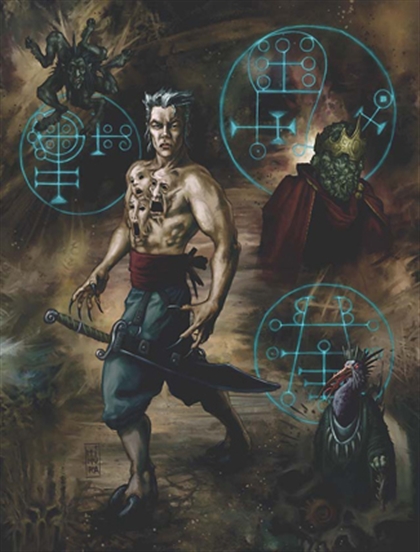
-
View User Profile
-
Send Message
Posted Mar 6, 2023oh, i see. thanks. ill definitely be trying this out at my next game then.
-
View User Profile
-
Send Message
Posted Mar 6, 2023Detailed reply below but everything is account for on your character sheet when the vestige is active
-
View User Profile
-
Send Message
Posted Mar 6, 2023Yes, the subclasses description doesn't list all the damage outputs. There are more detailed descriptions on your DnD Beyond character sheet once you have the vestige activated. Just click on the vestige ability and the side window brings up the details. Plus I have added all the correct damage amounts through the code, so when you have the vestige activated your DnDBeyond character sheet it will automatically have the correct damage listed as an action or attack etc.
Thren Ironshod is one example where I haven't listed the exact damage in the description and it is all added on your Dnd Beyond character sheet under:
Your character sheet will also add the relevant weapon proficiency or skill bestowed by relevant vestiges if the description says you gain them, so you won't need to calculate any penalties or bonuses.
Your binding check roll is also listed under Other for ease of use.
-
View User Profile
-
Send Message
Posted Mar 4, 2023I really like this subclass alot. i would say an issue with it is that many of the vestiges have abilities that deal bonus damage but dont specify the amount.
-
View User Profile
-
Send Message
Posted Dec 9, 2022Exactly what I was looking for.
Gotta get to reading it in details and see if my DM approves 😁