



 Base Class: Bard
This Is Playtest Material.
The homebrew material is presented for playtesting. The game mechanics are in draft form, usable in your campaign but not refined by feedback and editing. All critiques and comments are encouraged, welcomed, and considered.
Power Level. This character option may be more or less powerful than options in the Player’s Handbook. The DM reserves the right to adjust any and all aspects of the class on the fly, in order to balance this material with the other subclasses being played at their table.
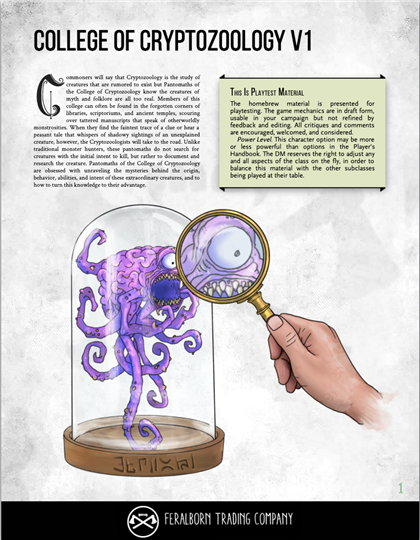
Commoners will say that Cryptozoology is the study of creatures that are rumored to exist but Pantomaths of the College of Cryptozoology know the creatures of myth and folklore are all too real. Members of this college can often be found in the forgotten corners of libraries, scriptoriums, and ancient temples, scouring over tattered manuscripts that speak of otherworldly monstrosities. When they find the faintest trace of a clue or hear a peasant tale that whispers of shadowy sightings of an unexplained creature, however, the Cryptozoologists will take to the road. Unlike traditional monster hunters, these pantomaths do not search for creatures with the initial intent to kill, but rather to document and research the creature. Pantomaths of the College of Cryptozoology are obsessed with unraveling the mysteries behind the origin, behavior, abilities, and intent of these extraordinary creatures, and to how to turn this knowledge to their advantage.
Bonus Proficiencies
When you join the College of Cryptozoology at 3rd level, you gain proficiency in Nature and Arcana.
(DM Note: Within The College of Cryptozoology, Nature normally refers to knowledge of beasts, dragons, giants, monstrosities, oozes, or plants, and Arcana normally refers to knowledge of aberrations, celestials, elementals, fey, fiends, and undead.)
Field Notes
By the time you reach 3rd level, you have spent a significant amount of time researching the scholarly papers surrounding creatures, including myths and legends - you have likely even had your fair share of harrowing encounters in the field. When you encounter a creature in the field you can use your action to make an Intelligence (Nature or Arcana) check (DC equals 5 + the creature's CR, minimum 1) to consult your notes in an attempt to quickly find pertinent information. If you have access to a library, university, scriptorium, or observe a creature outside of combat for at least an hour, the DC is lowered by 1 for each hour you devoted to research. If you are successful, you learn whether the creature has any known damage immunities, resistances, condition immunities, or vulnerabilities and what they are. You may also learn other significant information relating to the creature’s combat ability (CR), lore, habitat, harvesting, and other statistics. Once information is recalled in this way, the creature is recorded in your Field Notes and you no longer need to make an Intelligence check to recall information about this creature in the future.
[Your Field Notes. Your field notes are a collection of writings and sketches acquired over your tenure of scholarly study and enhanced by your empirical research in the field. Your field notes normally match your character's aesthetic and demeanor; maybe it's a worn leather journal, a combination of loose scrolls and manuscripts, or a well organized tome suitable for inclusion in a institute of higher learning. At your DMs discretion, a fun way to handle the Field Notes in game is to collect a copy of the creature's details, lore, and statistics sheet from the applicable 5e source book, and add your own notes in the margin.]
Applied Knowledge
Also at 3rd level, when you encounter a creature recorded in your Field Notes, you can use your knowledge of a creature’s abilities to fortify your defenses. Whenever a creature recorded in your Field Notes forces you to make a saving throw, you can use your reaction to expend one use of Sage Advice. Roll a Sage Advice die and add the number rolled to your saving throw. You can choose to do so after you roll the die for the saving throw, but before the DM tells you whether you succeed or fail.
Field of Study
By 6th level, your extensive research and experience dealing with a specific type of creature has unraveled many of the mysteries surrounding it.
Choose a type of creature for your Field of Study: aberrations, beasts, celestials, dragons, elementals, fey, fiends, giants, monstrosities, oozes, plants, or undead. You must have at least one creature of this type in your Field Notes.
You can use this acquired knowledge to augment your own abilities, tactics, and magical talents, and impart these insights whenever you give a creature a Sage Advice die. You must expend a use of Sage Advice if the acquired knowledge requires a roll of a Sage Advice die. Any other creature must have a Sage Advice die from you to use the acquired knowledge feature.
Field of Study - Acquired Knowledge
- Aberrations. You learn how to speak, read, and write Deep Speech. You can also speak telepathically to any creature you can see within 60 feet of you. The creature must be able to understand at least one language but does not need to share a language with you to understand your telepathic message. If the creature has a Sage Advice die from you, it can speak telepathically to you. To use this ability, the creature must be able to see you and must be within 60ft. When speaking with a creature telepathically, you can use your action, and expend a use of your Sage Advice, to force the creature to make an Intelligence saving throw using your spell save DC. On a failure the creature takes Psychic damage equal to double the number rolled on your Sage Advice die plus your intelligence modifier.
- Beasts. You can cast Animal Friendship at will, without expending a spell slot. While it is charmed by you, a creature is friendly to you and any creature that has a Sage Advice die from you. In addition, you learn the Enhance Ability spell and it doesn’t count against the number of spells you know. When you cast the spell you can expend a Sage Advice die instead of using a spell slot. When you cast the spell in this way, any creature with a Sage Advice die from you can also choose one of the spell's effects.
- Celestials. You learn how to speak, read, and write Celestial. You, or a creature with a Sage Advice die from you, can use an action to touch a creature and restore a number of hit points to the creature equal to the roll on the Sage Advice die plus your intelligence modifier. Alternatively, when a creature (this can be you) hits a target with an attack roll, it can roll a Sage Advice die to inflict additional Radiant damage to the target equal to the number rolled.
- Dragons. You learn how to speak, read, and write Draconic. A creature takes no damage if it uses a Sage Advice die and is successful against an effect that allows a Dexterity saving throw to take only half damage.
- Elementals. You learn how to speak, read, and write Primordial and gain resistance to either Cold, Fire, or Lightning damage. In addition, as a reaction to taking Cold, Fire, or Lightning damage, a creature (this can be you) can roll a Sage Advice die, to gain resistance to the damage type, including the triggering damage, until the end of its next turn. Alternatively, when a creature (this can be you) hits a target with an attack roll, it can roll a Sage Advice die to inflict additional Cold, Fire, or Lighting damage to the target equal to the number rolled.
- Fey. You learn how to speak, read, and write Sylvan. You, and creatures with a Sage Advice from you, have advantage on saving throws against being charmed. In addition, when a you, or creature with a Sage Advice die from you, casts an Enchantment spell, choose one of the targets. Roll the Sage Advice die. The creature must subtract the number rolled from the saving throw it makes.
- Fiends. You learn how to speak, read, and write Infernal or Abyssal. You also learn the Protection from Evil or Good spell and it doesn’t count against the spells you know. When you cast the spell you can expend a Sage Advice die instead of using a spell slot. While you are concentrating on this spell, creatures with a Sage Advice Die from you have advantage against being charmed, frightened, or possessed by fiends. In addition, you can use your action and expend a use of your Sage Advice to magically detect fiends. For the next 1 minute, you can sense the presence of any fiends within 60ft of you. This feature doesn’t reveal the creatures’ location or number, or anything about a creature’s abilities.
- Giants. You learn how to speak, read, and write Giant and you learn the Enlarge/Reduce spell. This spell doesn’t count against the number of spells you know. You can cast it once without expending a spell slot but when you do, you can only cause a creature to become larger. You regain the ability to cast the spell in this way after you finish a long rest. In addition, when a creature (this can be you) is attacked by a large or larger creature, it can use its reaction to roll a Sage Advice die and add the number rolled to its AC, after seeing the roll but before knowing whether it hits or misses.
- Monstrosities. You gain proficiency in Survival. When you roll a Survival (wisdom) check to track a creature or harvest parts from it, you can use your bonus action to expend a use of your Sage Advice and add the number rolled to the check. In addition, you can use your action to expend a use of your Sage Advice to touch a target and attempt to undo a debilitating effect caused by a creature. This can be the blinded, charmed, deafened, paralyzed, petrified, or poisoned condition. This attempt fails if the effect was caused by a creature with a CR greater than your level divided by 3 (rounded down).
- Oozes. You, and any creature with a Sage Advice die from you, have resistance to acid damage. In addition, as an action you can expend a use of Sage Advice to magically become amorphic. Until the end of your next turn you cannot take an action but you can move through a space as narrow as 1 inch wide without squeezing, have immunity to acid damage, and you can’t be grappled or restrained by nonmagical means.
- Plants. You learn the Speak with Plants spell, this spell doesn’t count against the number of spells you know, and you can cast it once without expending a spell slot. You regain the ability to cast the spell in this way after you finish a long rest. In addition, when a creature attempts to grapple you, you can use your reaction to expend a use of your Sage Advice and add the number rolled to your ability check to escape. If a creature, that has a Sage Advice die from you, uses the Sage Advice die on an ability check to escape a grapple, it can roll the Sage Advice die twice and take the better of the two results.
- Undead. You can use your action and expend a use of your Sage Advice to magically detect undead. For the next 1 minute, you can sense the presence of an undead creature within 60ft of you. This feature doesn’t reveal the creatures’ location or number, or anything about a creature’s abilities. You can also expend a use of your Sage advice to magically mimic the aura of undead. You and creatures with a Sage Advice from you, become invisible to undead creatures with a CR no greater than your level divided by 3 (rounded down). The aura lasts for one hour unless you end it (no action required) or anyone concealed within the aura attacks or casts a spell.
You choose one additional creature type, at 10th and 15th level. As you gain levels, your choices should reflect the types of monsters you have encountered on your adventures.
Aberrations
You learn how to speak, read, and write Deep Speech. You can also speak telepathically to any creature you can see within 60 feet of you. The creature must be able to understand at least one language but does not need to share a language with you to understand your telepathic message. If the creature has a Sage Advice die from you, it can speak telepathically to you. To use this ability, the creature must be able to see you and must be within 60ft. When speaking with a creature telepathically, you can use your action, and expend a use of your Sage Advice, to force the creature to make an Intelligence saving throw using your spell save DC. On a failure the creature takes Psychic damage equal to double the number rolled on your Sage Advice die plus your intelligence modifier.
Beasts.
You can cast Animal Friendship at will, without expending a spell slot. While it is charmed by you, a creature is friendly to you and any creature that has a Sage Advice die from you. In addition, you learn the Enhance Ability spell and it doesn’t count against the number of spells you know. When you cast the spell you can expend a Sage Advice die instead of using a spell slot. When you cast the spell in this way, any creature with a Sage Advice die from you can also choose one of the spell's effects.
Celestials.
Celestials. You learn how to speak, read, and write Celestial. You, or a creature with a Sage Advice die from you, can use an action to touch a creature and restore a number of hit points to the creature equal to the roll on the Sage Advice die plus your intelligence modifier. Alternatively, when a creature (this can be you) hits a target with an attack roll, it can roll a Sage Advice die to inflict additional Radiant damage to the target equal to the number rolled.
Dragons
Dragons. You learn how to speak, read, and write Draconic. A creature takes no damage if it uses a Sage Advice die and is successful against an effect that allows a Dexterity saving throw to take only half damage.
Elementals
Elementals. You learn how to speak, read, and write Primordial and gain resistance to either Cold, Fire, or Lightning damage. In addition, as a reaction to taking Cold, Fire, or Lightning damage, a creature (this can be you) can roll a Sage Advice die, to gain resistance to the damage type, including the triggering damage, until the end of its next turn. Alternatively, when a creature (this can be you) hits a target with an attack roll, it can roll a Sage Advice die to inflict additional Cold, Fire, or Lighting damage to the target equal to the number rolled.
Fey
Fey. You learn how to speak, read, and write Sylvan. You, and creatures with a Sage Advice from you, have advantage on saving throws against being charmed. In addition, when a you, or creature with a Sage Advice die from you, casts an Enchantment spell, choose one of the targets. Roll the Sage Advice die. The creature must subtract the number rolled from the saving throw it makes.
Fiends
Fiends. You learn how to speak, read, and write Infernal or Abyssal. You also learn the Protection from Evil or Good spell and it doesn’t count against the spells you know. When you cast the spell you can expend a Sage Advice die instead of using a spell slot. While you are concentrating on this spell, creatures with a Sage Advice Die from you have advantage against being charmed, frightened, or possessed by fiends. In addition, you can use your action and expend a use of your Sage Advice to magically detect fiends. For the next 1 minute, you can sense the presence of any fiends within 60ft of you. This feature doesn’t reveal the creatures’ location or number, or anything about a creature’s abilities.
Giants
Giants. You learn how to speak, read, and write Giant and you learn the Enlarge/Reduce spell. This spell doesn’t count against the number of spells you know. You can cast it once without expending a spell slot but when you do, you can only cause a creature to become larger. You regain the ability to cast the spell in this way after you finish a long rest. In addition, when a creature (this can be you) is attacked by a large or larger creature, it can use its reaction to roll a Sage Advice die and add the number rolled to its AC, after seeing the roll but before knowing whether it hits or misses.
Monstrosities.
Monstrosities. You gain proficiency in Survival. When you roll a Survival (wisdom) check to track a creature or harvest parts from it, you can use your bonus action to expend a use of your Sage Advice and add the number rolled to the check. In addition, you can use your action to expend a use of your Sage Advice to touch a target and attempt to undo a debilitating effect caused by a creature. This can be the blinded, charmed, deafened, paralyzed, petrified, or poisoned condition. This attempt fails if the effect was caused by a creature with a CR greater than your level divided by 3 (rounded down).
Oozes
Oozes. You, and any creature with a Sage Advice die from you, have resistance to acid damage. In addition, as an action you can expend a use of Sage Advice to magically become amorphic. Until the end of your next turn you cannot take an action but you can move through a space as narrow as 1 inch wide without squeezing, have immunity to acid damage, and you can’t be grappled or restrained by nonmagical means.
Plants
Plants. You learn the Speak with Plants spell, this spell doesn’t count against the number of spells you know, and you can cast it once without expending a spell slot. You regain the ability to cast the spell in this way after you finish a long rest. In addition, when a creature attempts to grapple you, you can use your reaction to expend a use of your Sage Advice and add the number rolled to your ability check to escape. If a creature, that has a Sage Advice die from you, uses the Sage Advice die on an ability check to escape a grapple, it can roll the Sage Advice die twice and take the better of the two results.
Undead.
Undead. You can use your action and expend a use of your Sage Advice to magically detect undead. For the next 1 minute, you can sense the presence of an undead creature within 60ft of you. This feature doesn’t reveal the creatures’ location or number, or anything about a creature’s abilities. You can also expend a use of your Sage advice to magically mimic the aura of undead. You and creatures with a Sage Advice from you, become invisible to undead creatures with a CR no greater than your level divided by 3 (rounded down). The aura lasts for one hour unless you end it (no action required) or anyone concealed within the aura attacks or casts a spell.
Expert Ethology
At 14th-level you can use your Applied Knowledge, or an Acquired Knowledge feature, a number of times per day equal to your proficiency bonus before needing to expend a use of your Sage Advice.
Comments