



 Base Class: Fighter
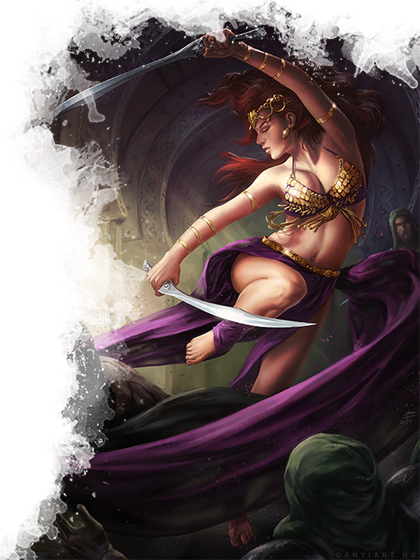
This archetype represents a fighter that is very mobile in combat. They are a whirlwind of blades attacking multiple enemies. Other names for this style could include Water Dancer, Whirling Blade, Jazst Dancer, Dervish, Invisible Blade, or plain old Knife Fighter.
Practitioners of this art use blades, typically small and slashing. The Bladesinging Spiral, Dual Wielder and Mobile feats are popular with blade dancers.
The Blade Dancer enamours friends and foes alike with their incredible dexterity and technique, building momentum to enhance their capabilities with their chosen weapon; from increasing reliability with light weapons to hitting harder with heavy weapons.
Dancing Leaf
At 3rd level, while you're using a weapon and are not wearing any armor, your Armor Class equals 10 + your Dexterity modifier + your Wisdom modifier.
Your fighting style looks more like a dance than a battle. You move nimbly between enemies, avoiding their strikes. Starting at 3rd level, you gain proficiency in the Acrobatics skill if you don't already have it.
When you are targeted by a melee attack, you can use your reaction to make a Dexterity (Acrobatics) check contested against the attacker's attack roll. If the result of your check beats their attack roll, you gain a +2 bonus to your AC.
In addition, every weapon, you are proficient with, is considered a finesse weapon
Art of the Dance
When calculating the maximum for your high jump and long jump, you use your dexterity rather than your strength. You gain Proficiency in the Performance skill
Momentum
At 7th level, you learn dances that affect how you can attack with your equipped weapons using momentum points.
Dances. You learn one dance of your choice, which are detailed under "Dances" below. You can begin a dance as a bonus action and your current dance affects how you can spend your momentum points. Each dance you learn has a prerequisite weapon type that you need to perform the dance: e.g. The Blizzard Rush dance requires that you have at least one light weapon equipped.
Momentum Points. You gain one momentum point when you successfully hit a creature, and when you successfully avoid an attack from a creature. The maximum amount of momentum points you can have at one time equals your proficiency bonus. If spending a momentum point allows you to hit a creature, you cannot gain any momentum points from that attack.
When you take damage you lose one momentum point; you cannot get below zero momentum points. You also lose all momentum points if you have not gained any for a minute.
The dances listed below determine how you can spend your momentum points.
Blizzard Rush
- Any creature within 5 feet of you that hits you while in this dance takes damage equalling your Dexterity modifier as your whirling dance cuts anyone nearby.
- Cost: 1 momentum points. If a creature misses you with a melee attack, you can use your reaction to attack it with a single melee attack.
- Cost: 3 momentum points. You can use one attack of your attack action to do a special melee attack. If you successfully hit a creature using this special attack, you can automatically hit the same creature if you attempt to attack them again during your current turn.
- Cost: 5 momentum points. You can use your action to attack any creature that enters your melee range during your movement, using a series of three swift strikes as you moves.
Boulder Quake
- Whenever you hit a creature with your weapon it gets knocked back 5 feet if the creature is considered large or smaller.
- Cost: 1 momentum point. If you get hit with a melee attack, you can use your reaction to gain advantage on your next attack against that creature.
- Cost: 3 momentum points. You can forego one attack of your attack action to build up inertia for your next melee attack. Your next melee attack deals the maximum possible amount of damage with the amount of damage dice you should roll + any relevant modifiers.
- Cost: 5 momentum points. You can use an action to deal a devastating blow to a creature within melee range of your weapon. The creature must make a Strength saving throw or takes the weapons damage + your current fighter level, and the creature gets knocked back 15 feet. On a save, the creature takes half damage and does not get knocked back.
Chaotic Tide
- Holding your versatile weapon with one hand gives you +1 to hit, while holding your versatile weapon with two hands gives you +1 to damage.
- Cost: 1 momentum point. When a creature within your weapons range hits an ally, you can use your reaction to attack the creature.
- Cost: 3 momentum points. You can forego one attack of your attack action to feint an attack and swiftly move 10 feet from your current position. This movement does not impose opportunity attacks.
- Cost: 5 momentum points. You can use an action to automatically critically hit a creature within range. The creature has to then make a Constitution saving throw or be stunned until the end of its next turn.
Iron Lightning
- The first attack targeted towards you in a round where you are dancing is made with disadvantage.
- Cost: 1 momentum point. When you hit a creature with a melee attack, you can use your reaction to move to another point within melee range of the target. This movement does not provoke opportunity attacks.
- Cost: 3 momentum points. You can use one attack from your attack action to attempt to disarm a creature. When you hit a creature with this special attack, the target takes the weapons damage as usual then the creature has to make a Strength saving throw or drop an object that it is holding (if any) on the floor at its feet.
- Cost: 5 momentum points. You can use an action to deliver a brutal combo to one target. When you target a creature with this action you can attempt to attack the target up to 6 times. If an attack misses as part of this action, then the action ends.
Sharpened Steps
Starting at 10th level, you have a bonus to initiative equal to your Wisdom modifier. Additionally, you gain expertise in Performance and Acrobatics and proficiency in Stealth.
Poise
At 15th level you have attained greater balance and adaptability in your form. You have advantage on saving throws against being knocked prone and you gain the Evasion ability. You can nimbly dodge out of the way of certain area Effects, such as a red dragon's fiery breath or an Ice Storm spell. When you are subjected to an Effect that allows you to make a Dexterity saving throw to take only half damage, you instead take no damage if you succeed on the saving throw, and only half damage if you fail.
Dance of Death
When you hit creature with a melee weapon atack, all enemy creatures within 5 feet of your target take damage equivalent to your Dexterity bonus.
Comments