



 Base Class: Rogue
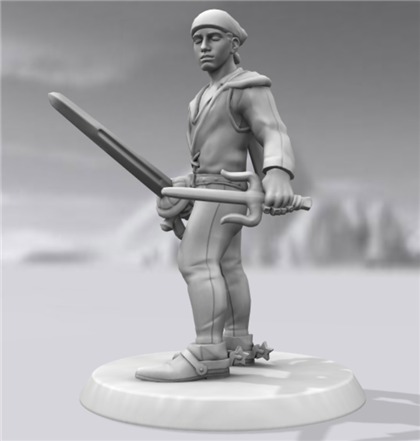
Brought up in the shadows as you may have been, you have nonetheless become a very much in-the-face, attack-is-best-defense type of rogue and you have done so by mastering a very specific type of weapon: the parrying dagger, or main-gauche.
This deadly tool is a category of small handheld weapons from the European late Middle Ages and early Renaissance. These weapons were used as off-hand weapons in conjunction with a single-handed sword such as a rapier. As the name implies they were designed to parry, or defend, more effectively than a simple dagger form, typically incorporating a wider guard, and often some other defensive features to better protect the hand as well. They may also be used for attack if an opportunity arises.
Battle Aficionado
You are af fanatic of war and absorb absolutely every detail you come across with about it. At level 3, you are proficient with investigation (INT) and history (INT) checks relating to war, warfare, battle, battle tactics, battle fields and battle maneuvers.
Comeback Superiority
When you choose this archetype at level 3, you become adept with a specific style of two-weapon dueling. You can wield a dagger in your off-hand as a main-gauche. While wielding this main-gauche you gain the following benefits:
- When you don't use your main-gauche on your turn, you can add half your proficiency modifier rounded down to your AC until the start of your next turn.
- You learn main-gauche manoevers that are fueled by special dice called superiority dice.
Maneuvers. You learn three maneuvers of your choice. The maneuvers are described below. Many maneuvers enhance an attack in some way. You can use only one maneuver per attack. You learn an additional maneuvers of your choice at 9th and 17th level. Each time you learn new maneuvers, you can also replace one maneuver you know with a different one.
Superiority Dice. You have four superiority dice, which are d6s. A superiority die is expended when you use it. You regain all of your expended superiority dice when you finish a short or long rest. You gain another superiority die at 9th level.
Saving Throws. Some of your maneuvers require your target to make a saving throw to resist the maneuver's effects. The saving throw DC is calculated as follows:
Maneuver save DC = 8 + your proficiency bonus + your Dexterity modifier
Disarming riposte
When a creature misses you with an attack, you can use your reaction to attack that creature with your main-gauche. If you hit the creature, one superiority die is expended and you attempt to disarm the target, forcing it to drop one item of your choice that it's holding. You add the superiority die to the attack's damage roll, and the target must make a Strength saving throw. On a failed save, it drops the object you choose. The object lands at its feet.
Distracting riposte
When a creature misses you with an attack, you can use your reaction to attack that creature with your main-gauche. If you hit the creature, one superiority die is expended and you distract the creature, giving your allies an opening. You add the superiority die to the attack's damage roll. The next attack roll against the target by an attacker other than you has advantage if the attack is made before the end of your next turn.
Feinting riposte
When a creature misses you with an attack, you can use your reaction to feint-attack that creature with your main-gauche. Expend one superiority die. You have advantage on your next attack roll against that creature before the end of his next turn. If that attack hits, add the superiority die to the attack's damage roll.
Goading riposte
When a creature misses you with an attack, you can use your reaction to attack that creature with your main-gauche. If you hit the creature, one superiority die is expended and you attempt to goad the target into attacking you. You add the superiority die to the attack's damage roll, and the target must make a Wisdom saving throw. On a failed save, the target has disadvantage on all attack rolls against targets other than you until the end of its next turn.
Greater riposte
When a creature misses you with an attack while you are wielding a main-gauche, you can use your reaction and expend one superiority die to make a melee weapon attack against the creature. If you hit, you add the superiority die to the attack's damage roll. Furthermore, for this attack you don't need advantage to use your Sneak attack feature.
Maneuvering riposte
When a creature misses you with an attack, you can use your reaction to attack that creature with your main-gauche. If you hit the creature, one superiority die is expended and you maneuver one of your comrades into a more advantageous position. You add the superiority die to the attack's damage roll, and you choose a friendly creature who can see or hear you. That creature can use its reaction to move up to half its speed without provoking opportunity attacks from the target of your attack.
Menacing riposte
When a creature misses you with an attack, you can use your reaction to attack that creature with your main-gauche. If you hit the creature, one superiority die is expended and you attempt to frighten the target. You add the superiority die to the attack's damage roll, and the target must make a Wisdom saving throw. On a failed save, it is frightened of you until the end of his next turn.
Precise riposte
When a creature misses you with an attack, you can use your reaction to attack that creature with your main-gauche. Expend one superiority die and add it to the roll. You can use this maneuver before or after making the attack roll, but before any effects of the attack are applied.
Pushing riposte
When a creature misses you with an attack, you can use your reaction to attack that creature with your main-gauche. If you hit the creature, one superiority die is expended and you attempt to drive the target back. You add the superiority die to the attack's damage roll, and if the target is Large or smaller, it must make a Strength saving throw. On a failed save, you push the target up to 15 feet away from you.
Rallying parry
When a creature misses you with an attack, you can use your reaction to fool the creature and bolster the resolve of one of your companions. Expend one superiority die and choose a friendly creature who can see or hear you. That creature gains temporary hit points equal to the superiority die roll + your Charisma modifier.
Responsive Footwork
When a creature misses you with an attack, you can use your reaction to move up to half your normal speed. Expend one superiority die, rolling the die and adding the number rolled to your AC until you stop moving.
Sweeping riposte
When a creature misses you with an attack, you can use your reaction to attack that creature with your main-gauche. If you hit the creature, one superiority die is expended and you attempt to damage another creature with the same attack. Choose another creature within 5 feet of the original target and within your reach. If the original attack roll would hit the second creature, it takes damage equal to the number you roll on your superiority die. The damage is of the same type dealt by the original attack.
Tripping riposte
When a creature misses you with an attack, you can use your reaction to attack that creature with your main-gauche. If you hit the creature, one superiority die is expended and you attempt to knock the target down. You add the superiority die to the attack's damage roll, and if the target is Large or smaller, it must make a Strength saving throw. On a failed save, you knock the target prone.
Uncanny parry
When another creature damages you with a melee attack, you can use your reaction and expend one superiority die to reduce the damage by the number you roll on your superiority die + your Dexterity modifier. If applicable, you can then use your uncanny dodge feature on the same reaction.
Cordial Brawl
Your enthusiasm for dueling and martial arts shines on your companions too. Starting on 9th level, you can spent a short rest sparring with a friendly humanoid. After finishing the short rest, your sparring partner is granted either a +1 on AC while not wearing heavy armor, or +1 on Attack rolls with one specific type of melee weapon. Either effect lasts for the next four hours. Only one creature can benefit from this feature at a time.
Code Of Honor
You stand for your sense of justice and are willing to defend it. Starting on 13th level, you can challenge a creature for a duel of honor. The creature must make a WIS save (DC 8 + your charisma modifier + your proficiency modifier). The creature automatically succeeds if it has an intelligence score below 6 or if you or your allies are fighting it. If the creature fails it safe, it must accept participating in a duel with you held within the next hour or obey your commands. You cannot challenge the same creature more then once per day.
During the duel, the following conditions apply. All the conditions are immediately terminated when a third creature interferes or interacts with one of the duelist during the duel.
- Both duelists start with 15 temporary hit points
- Initiative is rolled as normal and neither duelist can be surprised
- All attacks and damages are considered non-lethal
- When one of the duelists loses its last temporary hit point, it is overpowered and loses the duel
When you win the duel, you gain a +10 bonus on persuasion (CHA) and intimidation (CHA) checks made against the loser for the next hour. When you lose the duel, you instead get a -10 penalty.
Last Feet
At 17th level, you learn how to turn the tables against all odds. Once per long rest, you get an additional reaction, allowing you to use two reactions in one round. As an option, you can use this reaction whenever you are hit by a melee weapon attack, turning the hit into a miss. If you do so, you can then proceed to immediately use your Comeback Superiority feature on the same reaction.
Comments