



 Base Class: Monk
An ambusher leaps out of the trees, stiffening his fingers into the shape of claws. He tears into an orc raider's face, leaving the orc blind, bleeding and helpless. Standing alone at the foot of a temple a robed figure dodges and slips in behind his opponent's strike, wrapping his arms around his foe and bringing him to the ground. A group of bandits swarm a lone woman on a road, but she effortlessly glides around and through their clumsy attempts to surround her with a series of movements and stances, stunning, throwing and knocking back her opponents with every blow.
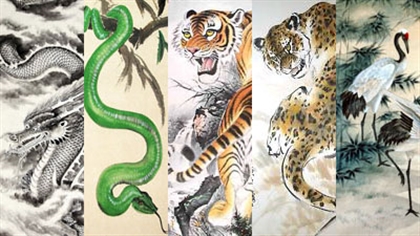
Monks who follow the Way of Five Animals research and seek to personify the natural world around them in their martial arts. They specifically study the movements of animals and emulate them to confuse , take down and defeat their opponents. The named animals here are those that are most commonly associated with this style of fighting. These forms only benefit the monk while wielding melee weapons they are proficient with or unarmed.
Level 3: The Five Animals
When you choose this path at level 3, you gain learn the Five Animal forms at their most basic levels. Upon either the roll of initiative or the initiation of combat, you can choose one of the Five Forms to start in. You do not gain any of the benefits if you are surprised at the start of combat. If you wish to change the form you are using, You must use either your action, or your bonus action to do so (or the extra actions provided by haste), and it cannot be changed in the middle of an attack action. Unless otherwise noted, the form that you end your turn in is the one that defines the benefits that you gain until your next turn. You can only switch between forms during your turn. The forms and their benefits are as follows:
Tiger: You may add your wisdom modifier to the first attack roll you make each round. You cannot use this on the same enemy twice in a row. The Tiger is an ambush predator and extremely powerful. It overwhelms opponents on first contact, often before they know what hits them.
Leopard: Your critical hit range is now 19-20. Leopards strike with precision and finality, ending fights quickly and efficiently.
Crane: If you hit an opponent with an attack while in this form, you gain a +1 bonus to AC against attacks from that opponent until the start of your next turn (max of +1 per target). This bonus to AC remains even if you change forms. Cranes fight defensively and are surprisingly difficult to hit as they batter foes with talon, beak and wings before quickly repositioning.
Snake: If an opponent within the area you threaten misses you with an attack, you can use your reaction to attempt to grapple them. The snake is quick and patient, striking without warning at the slightest opening.
Dragon: Opponents do not gain advantage on their attacks for flanking you. Dragons are powerful and wary. They have many tools at their disposal and can deal with threats from any direction.
Level 6: Mind and Body as One
You have mastered the physical aspects of the forms, and have begun to learn their deeper natures. You can now enhance your forms with advanced Ki techniques. The following abilities are now a part of your forms, allowing you to benefit from both levels simultaneously. All save DC's are based off your wisdom score. The abilities in the descriptions are assuming that you are in the stance that lists the benefit.
Tiger: When you hit an enemy with your first boosted attack, you may spend 2 ki points to attempt to blind the opponent as per the spell. This is a physical attack, not a spell or spell attack.
Leopard: When you roll a 1 or 2 for damage on an attack, you can spend a ki point to reroll the damage, taking the new roll. You can only do this once per attack.
Crane: When an opponent in your melee range hits you with an attack, you may use a ki point to make a retaliatory attack against them. You can only do this once per turn, and it does not count as a reaction.
Snake: When you use Step of the Wind, you may spend a Ki point to move through another creature's space without losing movement speed or making a contested roll. Each 5 feet of an opponent's space that you move through costs another Ki point.
Dragon: When you hit an opponent that is one size larger than you or smaller, you may spend 2 ki points to make a more powerful strike. You roll another damage die and the target must make a strength save, or be knocked back 10 feet. Targets that fail their save by 5 or more are knocked prone 10 feet away.
Level 11: Be like Water...
You have mastered the FIve forms. Your intensive training, practice and experience has begun to make the techniques and movements blend together and become like one interconnected set of movements. When switching between forms, you now have the option to use a Ki point to switch, rather than an attack or bonus action. You can now also switch forms at any point during your turn, including between your attacks. The form that you finish your turn in is still the one that carries it's benefits over until the next turn.
Level 17: ...Flow, Crash, Recover.
Your experience in adapting the movements of your animal muses has expanded your knowledge of your body's limits and how your energy flows, as well as how to surpass them. Once per long rest, after defeating an opponent by bringing their HP to 0, you can regain Ki points equal to half of your level.
Comments