



 Base Class: Fighter
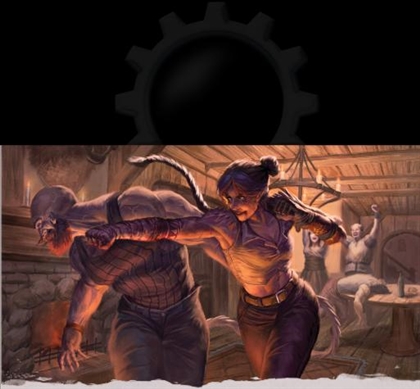
The taste of ale-soaked floorboards is a familiar flavour to Tavern Brawlers. Whether they’ve been thrown to the ground in a glorious takedown, blocked an improvised weapon with their teeth, or tackled a foe into a pile of flailing limbs, Tavern Brawlers cherish the memory of every scuffle that hasn’t been knocked out of their brains. Though most inns and pubs decry barroom brawls as unnecessarily damaging and expensive affairs, celebrated carpenter and philosopher Lottaw Ood proposed that without the constant kerfuffles, woodworkers and the entire lumber industry might collapse. In fact, more shrewd carpentry guilds have opened “Brawl-Inns”; taverns with dedicated brawling areas and a microtransaction economy that encourages fighters to purchase chairs with which to clout their fellow patrons.
Barroom Wrestler
3rd-Level Tavern Brawler Feature
Brawler Dice. You’ve learned techniques that are fueled by special dice called Brawler dice, which are d4s. You have a number of these dice equal to twice your proficiency bonus. You regain all your expended Brawler dice when you finish a long rest.
When you reach certain levels in this class, the size of your Brawler dice increases: at 5th level (d6), 11th level (d8), and 17th level (d10).
Saving Throws. Some of your techniques require your target to make a saving throw to resist the technique’s effects. The saving throw DC is calculated as follows: Technique save DC = 8 + your proficiency bonus + your Strength modifier.
Brawler Techniques. The techniques below use your Brawler dice. Creatures more than one size larger than you automatically succeed on any saving throws or contested checks against these techniques’ effects.
Bind. When you make an unarmed strike with a free hand against a creature you are grappling, you can expend one Brawler die to force an additional contested grappling check instead of an attack roll. On a success, you deal the strike’s normal damage plus additional damage equal to one roll of your Brawler die and the creature is restrained until the grapple ends or you use one of the hands you have grappling the target for something else.
Chokehold. While you have a humanoid restrained (for example, by your Bind technique) you can use an action to expend one Brawler die and attempt to cut off the creature’s blood supply. The creature must make a Constitution saving throw. On a failure, it takes damage equal to two rolls of your Brawler die plus your Strength modifier and immediately begins to be strangled until it is no longer restrained by you. On a failure, it takes half as much damage and doesn’t begin to be strangled. A creature that is being strangled remains conscious for a number of rounds equal to its Constitution modifier (minimum 1), and falls unconscious at the start of its next turn. A creature that is made unconscious in this manner regains consciousness if it takes any damage. If you continue to choke a creature beyond this point, it begins suffocating. If you release the creature, it remains unconscious for 1d20 + 10 minutes.
Smash. When you hit a creature with a melee weapon attack with an improvised weapon, you can expend one Brawler die to deal additional bludgeoning, piercing, or slashing damage (GM’s decision) equal to one roll of your Brawler die. The object takes an equal amount of damage, possibly destroying it.
Takedown. When you make an unarmed strike against a creature you are grappling, you can expend one Brawler die to force an additional contested grappling check instead of an attack roll. On a success, you deal the strike’s normal damage plus additional damage equal to one roll of your Brawler die as you throw the target to the ground where it lands prone
Strangulation & Suffocation Strangulation is a new concept introduced for this subclass and acts like a less extreme version of suffocating. In both cases, when a creature begins to be strangled or begins suffocating, it can act as normal for a number of rounds equal to its Constitution modifier (minimum of 1 round). At the start of the creature’s turn after this period has elapsed, the creature falls unconscious. The difference between being strangled and suffocating is that when a suffocating creature falls unconscious it also drops to 0 hit points and is dying, and can’t regain hit points or be stabilized until it can breathe again, whereas a strangled creature remains unconscious for 1d20 + 10 minutes, and wakes if it takes any damage.
Chokehold Example. On initiative count 10 of round 1, the Tavern Brawler (TB), who has a thug restrained, uses the chokehold technique on the thug. The thug fails its Constitution saving throw and begins to be strangled. Because the thug has a +2 Constitution modifier, it has 2 rounds to act before it falls unconscious. On initiative count 15 of rounds 2 and 3, the thug tries and fails to break the TB’s grapple, meaning it stays restrained and continues to be strangled. On initiative count 15 of round 4, the thug falls unconscious at the start of its turn and immediately begins suffocating. If the TB continues to maintain the grapple and thus keep the thug restrained, the strangulation continues. On initiative count 15 at the start of round 6, the thug would succumb to suffocation, drop to 0 hit points, and begin dying.
Inn-habitor
3rd-Level Tavern Brawler Feature
Your familiarity with patrons of bars and inns has left you adept at sensing their motives. You have advantage on Insight, Intimidation, and Persuasion checks against creatures that have been drinking.
Tavern Tussler
3rd-Level Tavern Brawler Feature
You’ve learned to use whatever weapons might be close at hand, often surprising foes with your ingenuity. You are proficient with improvised weapons and your unarmed strikes and improvised weapon attacks can deal damage equal to 1d4 + your Strength modifier on a hit. This damage die increases when you reach 5th level (1d6), 11th level (1d8), and 17th level (1d10) in this class. Improviser. You can pick up an object within your reach as part of the attack you make with that object. In addition, the first time you make an attack with an improvised weapon you picked up on that same turn, that attack scores a critical hit on a roll of 19 or 20.
Twisting Grapples
7th-Level Tavern Brawler Feature
You can attempt to grapple a creature as a bonus action on your turn, and you have advantage on attack rolls you make against creatures you are grappling. In addition, when you successfully apply the grappled condition to a creature, you can choose to painfully twist, dealing bludgeoning damage to the creature equal to a roll of your unarmed strike die plus your Strength modifier.
Uncanny Technique
10th-Level Tavern Brawler Feature
You can add double your proficiency bonus to contested Strength (Athletics) checks you make. When you make an ability check to [Tooltip Not Found] a creature or to escape a [Tooltip Not Found], you can treat a d20 roll of 9 or lower as a 10.
Tavern Regular
15th-Level Tavern Brawler Feature
Years spent anticipating conflict in inns and taverns has given you a preternatural danger sense. You have advantage on initiative rolls, and you gain proficiency in the Insight skill. If you have this proficiency from another source, you can add twice your proficiency bonus to checks you make using that skill. As a bonus action on your turn, you can make a Wisdom (Insight) check against a creature you can see. On a success, you learn the creature’s disposition towards you, such as whether it means you harm, views you as a friend, or wants something from you.
Grandstand Performer
18th-Level Tavern Brawler Feature
When you roll initiative and have no Brawler dice remaining, you regain two Brawler dice. You learn new techniques that use your brawler dice.
Piledriver. When you have a creature restrained (for example, by your Bind technique) and take the Attack action, you can forgo two of your attacks to expend one Brawler die in a complex crushing maneuver. The creature must make a Dexterity saving throw. On a failure, it takes bludgeoning damage equal to two rolls of your Brawler die plus your Strength modifier and is stunned until the end of your next turn. On a success, it takes half as much damage and isn’t stunned.
Throw. When you have a creature grappled and take the Attack action, you can forgo one of your attacks to expend one Brawler die and force the creature to make a Strength saving throw as you attempt to launch it. On a failure, you throw the creature horizontally away from you in a straight line up to 30 feet if it is a smaller size category than you, 20 feet if it is the same size as you, or 10 feet if it is one size category larger than you. The creature collides with the first solid object or creature in its path, causing both targets to take bludgeoning damage equal to one roll of your Brawler die plus your Strength modifier
Wrecking Ball. When you move at least 10 feet directly towards a creature immediately before making an attack as part of the Attack action, you can forgo the attack to expend one Brawler die as you throw your entire body at your target. Make a Strength (Athletics) check contested by the target’s Dexterity (Acrobatics) or Strength (Athletics) check (its choice). If you succeed, the target takes bludgeoning damage equal to two rolls of your Brawler die plus your Strength modifier, and you both land prone.
Comments