



 Base Class: Fighter
Eternal Blade
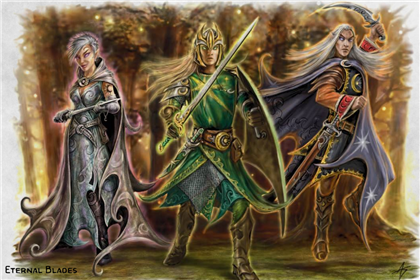
An Eternal Blade is an elf who learns a variety of fighting styles through the tutelage of a mighty, ancient elf warrior who manifests in the form of a blade guide. The Eternal Blades were, anciently, champions of Corellon who sought to protect the elves from all forces of evil, and the blade guides have been guiding them since their organization. Following a schism in the ranks, the Eternal Blades were disbanded, and are but a shadow of their former glory. It is said that one doesn't choose to become an Eternal Blade. A blade guide seeking a student chooses a young elf to become its student, often appearing in its dreams years before the elf is capable of becoming a warrior.
Restriction: Elves Only Only elves can become an Eternal Blade. The ancient order of Eternal Blades only consisted of elves, and each blade guide only chooses to confer knowledge upon one of their same race. Your DM may lift this restriction, as befits the campaign.
Eternal Blade Features |
|
|
Fighter Level |
Feature |
|
3rd |
Blade Guide |
|
7th |
Guided Strike |
|
10th |
Maneuver Insight |
|
15th |
Defensive Insight |
|
18th |
Guide Meld |
Blade Guide
When you choose this archetype at 3rd level, you gain a blade guide: the spirit of an ancient elf member of the Eternal Blades, who has thousands of years of combat knowledge. It provides you with advice, combat assistance, and training, but only as outlined in these features. The elf's spirit resides elsewhere on a plane of the DM's choice, and manifests to you in dreams as a spirit. Outside of dreams, it can manifest to you as a small mote of glowing white light. It uses your senses to see and hear, and communicates with you telepathically. It can speak to you regardless of your circumstances or situation, whether it manifests or not. Your blade guide is immune to damage and can't be dispelled or otherwise destroyed by any means. Your connection to your blade guide grants you the following benefits:
Eternal Knowledge. You can draw on your blade guide's vast wealth of knowledge accrued over millennia. You can use an action to ask your blade guide about a specific subject. The next time you make an Intelligence (Arcana or History) check concerning that subject within the next minute, you gain a bonus to the check equal to your proficiency bonus.
Eternal Training. Your blade guide offers you training based on its many years of combat experience. When you are in your trance during a long rest, your blade guide visits you in your dreams to train you. Specifically, you practice fighting against one type of creature. Choose one type of creature: aberrations, beasts, celestials, constructs, dragons, elementals, fey, fiends, giants, humanoid, monstrosities, oozes, plants, or undead. You gain a +2 bonus to damage rolls with weapon attacks against creatures of the chosen type. Whenever you finish a long rest, you can change your choice to a different creature type.
Guided Strike
Starting at 7th level, your blade guide can seek out a creature's weaknesses and guide you accordingly. As a bonus action on your turn, you can confer with your blade guide, asking about a creature within 30 feet of you that you can see. You have advantage on attack rolls against that creature until the end of the current turn. Once you use this feature, you must finish a short or long rest before you can use it again.
Maneuver Insight
Beginning at 10th level, you begin to practice combat tactics and maneuvers with your blade guide during your dreams. Practice as you might, you can only retain the knowledge of them for a short time. You gain superiority die equal to your intelligence modifier, which is a d8 (this die is added to any superiority dice you have from another source). You can use these superiority die (thus expending a use) to perform one maneuver of your choice from among those available to the Battle Master archetype in the fighter class, detailed in the Player's Handbook. Each time you use this feature, you can choose which maneuver to use. You regain your expended superiority die when you finish a short or long rest.
Some of your maneuvers require your target to make a saving throw to resist the maneuver’s effects. The saving throw DC is calculated as follows:
Maneuver save DC = 8 + your proficiency bonus + your Intelligence Modifier
Maneuvers
The maneuvers are presented in alphabetical order.
Commander’s Strike
When you take the Attack action on your turn, you can forgo one of your attacks and use a bonus action to direct one of your companions to strike. When you do so, choose a friendly creature who can see or hear you and expend one superiority die. That creature can immediately use its reaction to make one weapon attack, adding the superiority die to the attack’s damage roll.
Disarming Attack
When you hit a creature with a weapon attack, you can expend one superiority die to attempt to disarm the target, forcing it to drop one item of your choice that it’s holding. You add the superiority die to the attack’s damage roll, and the target must make a Strength saving throw. On a failed save, it drops the object you choose. The object lands at its feet.
Distracting Strike
When you hit a creature with a weapon attack, you can expend one superiority die to distract the creature, giving your allies an opening. You add the superiority die to the attack’s damage roll. The next attack roll against the target by an attacker other than you has advantage if the attack is made before the start of your next turn.
Evasive Footwork
When you move, you can expend one superiority die, rolling the die and adding the number rolled to your AC until you stop moving.
Feinting Attack
You can expend one superiority die and use a bonus action on your turn to feint, choosing one creature within 5 feet of you as your target. You have advantage on your next attack roll against that creature this turn. If that attack hits, add the superiority die to the attack’s damage roll.
Goading Attack
When you hit a creature with a weapon attack, you can expend one superiority die to attempt to goad the target into attacking you. You add the superiority die to the attack’s damage roll, and the target must make a Wisdom saving throw. On a failed save, the target has disadvantage on all attack rolls against targets other than you until the end of your next turn.
Lunging Attack
When you make a melee weapon attack on your turn, you can expend one superiority die to increase your reach for that attack by 5 feet. If you hit, you add the superiority die to the attack’s damage roll.
Maneuvering Attack
When you hit a creature with a weapon attack, you can expend one superiority die to maneuver one of your comrades into a more advantageous position. You add the superiority die to the attack’s damage roll, and you choose a friendly creature who can see or hear you. That creature can use its reaction to move up to half its speed without provoking opportunity attacks from the target of your attack.
Menacing Attack
When you hit a creature with a weapon attack, you can expend one superiority die to attempt to frighten the target. You add the superiority die to the attack’s damage roll, and the target must make a Wisdom saving throw. On a failed save, it is frightened of you until the end of your next turn.
Parry
When another creature damages you with a melee attack, you can use your reaction and expend one superiority die to reduce the damage by the number you roll on your superiority die + your Dexterity modifier.
Precision Attack
When you make a weapon attack roll against a creature, you can expend one superiority die to add it to the roll. You can use this maneuver before or after making the attack roll, but before any effects of the attack are applied.
Pushing Attack
When you hit a creature with a weapon attack, you can expend one superiority die to attempt to drive the target back. You add the superiority die to the attack’s damage roll, and if the target is Large or smaller, it must make a Strength saving throw. On a failed save, you push the target up to 15 feet away from you.
Rally
On your turn, you can use a bonus action and expend one superiority die to bolster the resolve of one of your companions. When you do so, choose a friendly creature who can see or hear you. That creature gains temporary hit points equal to the superiority die roll + your Charisma modifier.
Riposte
When a creature misses you with a melee attack, you can use your reaction and expend one superiority die to make a melee weapon attack against the creature. If you hit, you add the superiority die to the attack’s damage roll.
Sweeping Attack
When you hit a creature with a melee weapon attack, you can expend one superiority die to attempt to damage another creature with the same attack. Choose another creature within 5 feet of the original target and within your reach. If the original attack roll would hit the second creature, it takes damage equal to the number you roll on your superiority die. The damage is of the same type dealt by the original attack.
Trip Attack
When you hit a creature with a weapon attack, you can expend one superiority die to attempt to knock the target down. You add the superiority die to the attack’s damage roll, and if the target is Large or smaller, it must make a Strength saving throw. On a failed save, you knock the target prone.
Defensive Insight
Beginning at 15th level, your blade guide can give you tactical guidance during combat to improve your defenses. As a bonus action on your turn, you can choose a creature within 30 feet of you that you can see. That creature has disadvantage on attack rolls against you until the start of your next turn. Once you use this feature, you must finish a short or long rest before you can use it again.
Guide Meld
Beginning at 18th level, you can meld your mind with your blade guide, allowing it to guide your actions while you draw on its combat experience. This grants you the following benefits:
- You gain a +2 bonus to attack and damage rolls.
- You gain 20 temporary hit points, which last until the meld ends.
- Once during the meld, you can use your Maneuver Insight feature without expending the use of your superiority die.
The meld lasts for 1 minute. It ends early if you are knocked unconscious or if you end it as a bonus action. Once you use this feature, you can't use it again until you finish a long rest.
Comments