



 Base Class: Monk
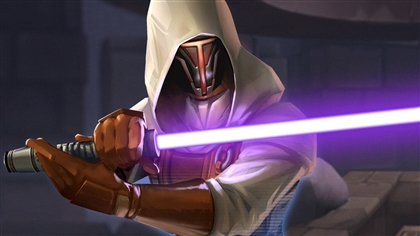
The Jedi are an order of intergalactic protectors able to use a powerful magic called "The Force" to defeat enemies. They wield powerful weapons called lightsabers, powered by a kyber crystal, which creates a plasma blade that can extend and contract from the metal hilt freely. The Jedi are against the Sith, who are also wielders of the Force but use it for evil purposes. To become one with the force and harness its powers, Jedi must give up all spell casting abilities and may not use magic under any circumstance. Jedi may also not wear armor or wield a shield, as it is seen against the way of the Jedi.
Level 3: Light Saber
At 3rd level, when you choose this subclass, you gain a specialized Jedi weapon called a lightsaber, which has a range of 5 ft. Only you can wield this weapon, and if it breaks, it takes 12 hours and 1,000 GP to craft a new saber. The lightsaber counts as a monk weapon, and you can either use your Dex. modifier or Wis. modifier on your attack rolls. The standard lightsaber deals 2d6 [ ] damage, the damage type being modified by what color of lightsaber you choose. Orange and Purple: Psychic damage- Blue and White: Force damage- Red and Black- Necrotic damage- Yellow and White- Radiant damage.
There are many types of Lightsabers, and each model grants you special benefits. Choose a lightsaber below that you have access to (you must fit the prerequisite.)
Dual Blade: (Cost: 800 gp) The dual-bladed lightsaber is a powerful weapon that has two plasma blades instead of the standard one. Special Feature: multiple attacks (after the first attack) have disadvantage, and if two enemies are attacking you, you may add one to your armor class as a reaction. Wielders include Darth Maul.
Standard: The most common and versatile form of light saber, used by many Jedi. Gives access to: Parry- as a reaction to an enemy succeeding in hitting you, you may add three to your armor class to try to stop that attack roll from succeeding.
Backhand (Shien): You carry a standard saber wielded in the style Shien. The Shien form involves the user holding the saber in reverse grip and uses many wrist movements. The Shien deals 1d10 [ ] damage instead of the usual 2d6. Gives access to: Parry- as a reaction to an enemy succeeding in hitting you, you may add three to your armor class to try to stop that attack roll from succeeding. Wielders include Ahsoka Tano.
Curved: The curved lightsaber, as its name implies, has a curved hit that allows for precise, powerful attacks. You may add 2 to any attack roll made with this lightsaber. Wielders of this lightsaber include Count Dooku.
Greatsaber: (Perquisite: creature size Large or more) The Greatsaber is a large weapon built for bigger Jedi. Only creatures of size Large or more can wield this weapon, and it deals 2d8 [ ] damage.
Tonfa: (Cost: 590 gp) are perpendicularly gripped lightsabers that are used by, most famously, Maris Brood. This lightsaber strikes very quickly. As a result, if you miss an attack roll with this weapon, you can roll again with disadvantage.
Lightwhip: (Cost: 590 gp)The lightwhip is a peculiar saber that has a flexible blade that is capable of hitting enemies far away. Instead of the usual range of 5 ft., the Lightwhip has a range of 20 ft. Wielders include Ona Nobis and Vernestra Rwoh.
Crossguard: (Cost: 250 gp) The crossguard saber has two shorter plasma blades extending from the sides. These give you a +1 bonus to your armor class and gives opportunity attacks against you disadvantage.
Level 3: The Force
You gain this feature at 3rd level. As a Jedi, you know how to use the powerful magic called the Force. Starting, you have a maximum of 100 force points. While you have over half of your force points, you gain the feature Advanced Dueling (detailed below). You also unlock many maneuvers depending on your level, each of which costs a different amount of force points. Each turn, you gain 5d10 force points.
Level 3: Advanced Dueling (Bonus Action): Jedis can use the force to pinpoint an enemy's weaknesses and where attackers are most likely to strike. While attacking, you can add your class level divided by five (Minimum of one, rounded down) to each attack roll you make. In addition, when attacked by a melee or ranged attack roll from someone you can see, roll a d6. On a 4-6, you can add your proficiency bonus divided by two (Minimum of one, round up) to your armor class.
Level 3: Pull/Choke (Bonus Action): For pull, you can move a creature within 60ft, Large or Small up to 120ft towards you, or 30ft away from you. However, doing so gives them an opportunity attack against you. This feature costs 25 force points. For choke, make a ranged weapon attack with advantage. If you hit, you deal 1d8 bludgeoning damage and grapple the target. You can continue the hold, dealing 1d4 bludgeoning damage for each turn spent afterwards, though you cannot use any other action, bonus action, or reaction while continuing the maneuver. This feature costs 25 force points per turn while it is active.
Level 4: Jump/Speed (Action): For jump, you use the force to propel yourself to insane heights. You spend a force point per foot traveled vertically, and for each foot vertically you move one foot horizontally. For speed, you use 10 force points to increase your speed by 120 feet. You then can move up to your speed, but each creature you pass can make an opportunity attack.
Level 5: Sense (Action): You can use the force to detect all creatures within 500 ft. of you. This feature costs 50 force points per minute it is active.
Level 11: Lightning (Action): You spread out your hands to reveal the full power of your mastery over the force. Each character in a 30ft by 30ft cube must make a DC 20 Dex saving throw or take 5d10 lightning damage. This attack uses all of your force points and also gives you three levels of exhaustion and the inability to regain any force points until you finish a long rest.
Level 6: Dual Wield
At 6th level, You can dual-wield Tonfas, Shien form, and regular sabers. You can use two-weapon fighting with these sabers, and you have advantage on attack rolls to do this. In addition, you can add +1 to your armor class (More weapons mean more protection!).
However, you must build your own lightsaber if you choose to use this feat.
Level 11: Force Prodigy
At 11th level, your knowledge and skill in using the force have allowed you to gain One of the following benefits:
Advanced Force: You now have 200 force points, which is something that only Jedi Masters could dream of. In addition, the range of your Sense and Pull ability is increased by 20.
Dark Side Prodigy: The damage of your Choke ability increases from 1d8 to 2d10 and 1d4 to 1d12, your Jump ability gains new heights (Pun intended) as it uses one force point per every two feet horizontally and two feet vertically, your Lightning abilities' damage increases from 5d10 to 10d10, and your Speed abilities' opportunity attacks now have disadvantage.
Additional Force Option: You can project a version of yourself up to 5,000 ft. away. This clone has the same weapon attacks you do, but it cannot use the Force. It has the same AC as you and has 1/4 of your health. You can play it like your own character, but for each turn it spends, it costs you 50 force points. If this clone dies or you run out of force points, it disappears with a coded message flashing above it. This message is created by you and can be up to 100 words long.
Additional Force Option
You can project a version of yourself up to 5,000 ft. away. This clone has the same weapon attacks you do, but it cannot use the Force. It has the same AC as you and has 1/4 of your health. You can play it like your own character, but for each turn it spends, it costs you 50 force points. If this clone dies or you run out of force points, it disappears with a coded message flashing above it. This message is created by you and can be up to 100 words long.
Advanced Force
You now have 200 force points, which is something that only Jedi Masters could dream of. In addition, the range of your Sense and Pull ability is increased by 20.
Dark Side Prodigy
The damage of your Choke ability increases from 1d8 to 2d10 and 1d4 to 1d12, your Jump ability gains new heights (Pun intended) as it uses one force point per every two feet horizontally and two feet vertically, your Lightning abilities' damage increases from 5d10 to 10d10, and your Speed abilities' opportunity attacks now have disadvantage.
Level 17: Jedi Master
After long last, you've finally done it! After 17 levels of hard work, your character is ready to call themselves a Jedi Master. You have now become one with the force in true accendency, you now have double your previous force points. In the event that you purposefully jump off a height, you will not take fall damage if the fall is less than 100ft.
Comments