



 Base Class: Bard
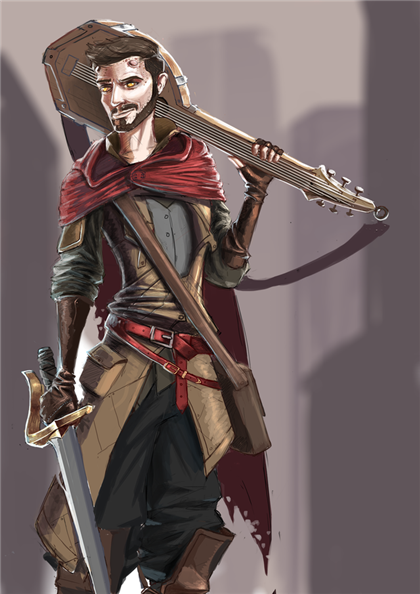
The man opens his mouth as his blade swings, and it almost seems as if it is the sword itself singing. He sings a song of pain and comfort, of sadness and joy, of life and death... But mostly death. His blade encases itself in a black haze, and it's not as if it's sucking in the light, but as if the light simply never existed around it. As the blade swings through the ogre's chest, flesh curls like burning paper. The creature falls to the ground, and in a moment is nothing but ash. The man turns, singing still, and arcs his sword into another foe.
Swordsingers are bards who have fashioned their words into weapons.
Sticks and stones may break my bones but words will leave my soul alone and death will come and find me.
They sing songs as some sort of whetstone for their blades, shaping the world around them. They deal damage of a type that can be determined by the DM, and of an amount that should be determined by the level at which the spell is created and cast. (Rounding down to the nearest die side amount; 1d10 + performance at level 1-10, so that if you roll a nine, said spell deals 1d8 damage extra when your blade hits, and 1d20 at level 11-20, so that a 16, the spell deals 3d4 extra damage on a hit.) Songs are learned as spells, and any song can be integrated, so if one wanted to, they could have their swordsinger singing Mary Had a Little Lamb, with emphasis on HAD. Each spellsong should be given a number of turns that it can last, as determined by the DM, and can be stopped when the singer is hit and fails a constitution save. Swordsingers should have the same number of spell slots as any other bards. Spellsongs stop working as spells once spell slots run out, but can still be sung as just songs.
If the DM so chooses, then the spellsongs known do not have to be limited, so long as the spell slots still apply. It is recommended though that you record the damage and turn amounts of each spellsong sung.
Song of Sorrow
When singing, you can discourage 1d4 enemies, who make a contested Wisdom save (vs. your persuasion). They have disadvantage on their next roll.
Bladesong
You gain the ability to attune to Swords of Power, which grant powerful spellsongs to their attuned bearers. The spellsong can only be sung while the singer holds the sword, and when not singing the songs, the singer has not even the slightest idea what the song is like, even if they have sung it hundreds of times. These Swords and spellsongs can be determined by the DM to fit the world, but I will compile all of the ones from the source that I am developing.
Sticks and Stones
When you sing, you can do so offensively, doing more harm to your enemies than you otherwise would with your weapon.
Comments