



 Base Class: Warlock
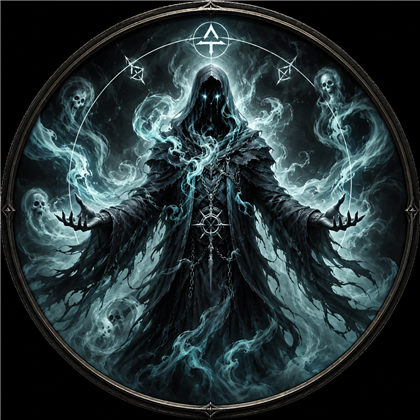
Your pact binds you to a being that refuses to remain among the dead. Your patron might be an ancient ghost, a powerful revenant, the lingering spirit of a forgotten ruler, or another entity whose will has endured beyond death.
Through this pact, you learn to loosen the connection between spirit and flesh. You can project your consciousness beyond your body, inhabit the bodies of others, and eventually force your way into creatures that resist your presence.
As your power grows, the boundary between your physical and spiritual existence becomes increasingly thin. You learn not merely to commune with the restless dead, but to wield the same unnatural freedom from the body that defines them.
For some warlocks, however, there may no longer be a patron at all. Their connection to the supernatural remains even after the being that granted it has vanished, leaving the warlock themselves as the restless spirit from which their power now flows.
Restless Spells
3rd-Level Restless Feature
Your connection to the restless dead grants you additional spells when you reach certain Warlock levels, as shown in the Restless Spells table. These spells are always prepared for you and don't count against the number of Warlock spells you can prepare.
| Warlock Level | Spells |
|---|---|
| 3rd | Dissonant Whispers, False Life, Blindness/Deafness, Phantasmal Force |
| 5th | Bestow Curse, Speak with Dead |
| 7th | Death Ward, Phantasmal Killer |
| 9th | Antilife Shell, Dominate Person |
Possession
3rd-Level Restless Feature
As an Action, you attempt to merge your body and spirit with a Humanoid you touch. The target must have at least 1 Hit Point and make a Charisma saving throw against your Warlock spell save DC. An Undead Humanoid makes this saving throw with advantage.
On a failed save, you merge completely with the target and possess its body for up to 1 minute.
Possessed Body. While possessing the target, you control its body and use its game statistics, except you retain your Intelligence, Wisdom, and Charisma scores, personality, memories, and alignment. You can use the host's traits, senses, movement, actions, Bonus Actions, Reactions, attacks, and Spellcasting. You can't use the host's Legendary Actions, Legendary Resistances, or Lair Actions.
While possessing a creature, you can't use your own species traits, class features, feats, spells, or other abilities.
Resisting Possession. At the start of each of the host's turns, it can repeat the Charisma saving throw, ending the possession on a success. An Undead host makes these saving throws with advantage.
If a creature succeeds on its initial saving throw against your Possession or successfully expels you, it has advantage on saving throws against your Possession for the next 24 hours.
Shared Pain. Whenever the host would take damage, you and the host each take that damage separately, applying your respective resistances, immunities, and vulnerabilities normally. Healing received by the host affects only the host and has no effect on you or the possession.
Shared Condition. While possessing the host, you are affected by conditions imposed upon its body. Conditions affecting only the host don't transfer to you when the possession ends. Any condition affecting you independently remains after you leave.
Self-Preservation. You can't directly cause the host to harm itself or knowingly move it into an immediately lethal hazard. If you attempt to do so, the possession ends before the harmful action or movement occurs.
Ending Possession. You can voluntarily end the possession on your turn as a Bonus Action. When the possession ends, you appear in an unoccupied space within 5 feet of the host.
If the host is reduced to 0 Hit Points or dies while you possess it, you are forcibly expelled, appear in an unoccupied space within 5 feet of it, and are Stunned until the end of your next turn.
If you are reduced to 0 Hit Points while possessing the host, the possession immediately ends. You appear Unconscious in an unoccupied space within 5 feet of the host and resolve being at 0 Hit Points normally.
You must end your current possession before you can attempt to possess another creature.
You can use Possession a number of times equal to your Proficiency Bonus, and you regain all expended uses when you finish a Long Rest.
Spectral Passage
6th-Level Restless Feature
As a Bonus Action on your turn, or as a Reaction when you begin falling, you enter a spectral state for 1 minute.
While in this state, you can move through creatures and nonmagical objects, but you can't end your turn inside them or perceive through solid objects.
When you move through a creature that is concentrating on a spell, that creature must immediately make a Constitution saving throw to maintain Concentration with Disadvantage. A creature can be affected by this part of the feature only once per turn.
While Spectral Passage is active, you descend at a rate of 60 feet per round while falling and take no damage from falling.
Spectral Mastery
10th-Level Restless Feature
At 10th level, your mastery over your spectral form deepens.
While Spectral Passage is active, you gain a Fly Speed equal to your Speed and can Hover.
The first time on a turn that you move through a creature, that creature must make a Wisdom saving throw against your Warlock spell save DC. On a failed save, it is Frightened of you until the end of your next turn.
In addition, when a creature you are possessing succeeds on a Charisma saving throw to expel you, you can use your Reaction to force it to reroll the saving throw and use the new result. You can use this benefit once during each possession
Spirit Severance
14th-Level Restless Feature
As an Action, choose one creature you can see within 30 feet of you. The target must make a Charisma saving throw against your Warlock spell save DC.
On a failed save, you partially tear the creature's spirit from its body for up to 1 minute. The creature is Stunned for the duration and immediately takes 3d8 Necrotic damage. You regain Hit Points equal to the Necrotic damage the creature takes.
At the end of each of its turns, the creature repeats the Charisma saving throw. On a failed save, it takes 3d8 Necrotic damage, and you regain Hit Points equal to the Necrotic damage it takes. On a successful save, Spirit Severance ends.
Spirit Severance ends early if you die or become Incapacitated.
Once you use this feature, you can't use it again until you finish a Long Rest.
Comments