



 Base Class: Wizard
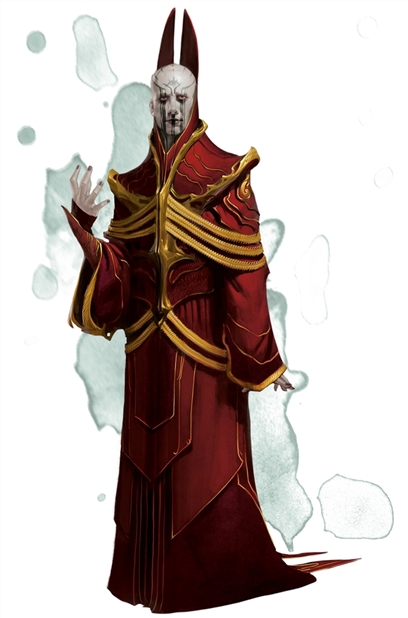
The Red Wizards are the masters of Thay, conquerors of that land’s native Rashemi, and would-be magical overlords of Faerûn. They shave their heads, wear crimson robes as a mark of rank, and inscribe their flesh with tattoos that bind them to a single school of magic. Ambition is their virtue. Mercy is a luxury they do not keep.
A Red Wizard does not merely study the Weave. The initiate is branded into a circle, taught the secret tongue of Thay, and drilled until every spell of the chosen school answers like a loyal hound. Where other traditions prize solitary genius, the Red Wizards prize hierarchy: apprentices feed power to a circle leader, and the leader spends that power without apology.
Restriction: Non-Good Humans Only
Only humans of a non-good alignment can choose the Red Wizard of Thay arcane tradition. In the land of Faerûn, the zulkirs closely guard the tattoos, the circle rites, and the language of their inner circles. The rites themselves are designed for human vessels; the order does not induct those it considers soft-hearted.
Circle of Thay
2nd-level Red Wizard feature
You are inducted into a Thayan circle. The tattoo is cut, the oath is spoken, and the first secrets of circle magic are opened to you. You gain all of the following benefits.
Thayan Tongue
You can speak, read, and write Thayan.
Crimson Mark
The shaved scalp, the red robe, and the school-tattoo are tools of state as much as of magic. You gain proficiency in the Intimidation and Deception skills, and expertise with the Arcana skill. You have advantage on such checks while dressed as a traditional Red Wizard of Thay.
Tattoo Focus
You inscribe a mystic tattoo that binds you to one school of magic, called your Focused School. Choose one of the eight schools of magic: abjuration, conjuration, divination, enchantment, evocation, illusion, necromancy, or transmutation. Your tattoo is an arcane focus for any spell you cast from your Focused School.
You gain the following benefits of the tattoo:
- Specialist’s Script. The gold and time you must spend to copy a spell of your Focused School into your spellbook are halved.
- Enhanced Specialization. Choose one school of magic other than your Focused School. That school is a prohibited school for you. After you gain this feature, you cannot copy spells of the prohibited school into your spellbook. You can still cast such spells if they are already in your spellbook, and you can still attempt to cast them from a spell scroll (making the ability check as normal).
- Specialist Defense. You gain a +1 bonus to saving throws against spells of your Focused School.
- Spell Power. When you cast a spell of 1st level or higher from your Focused School, you can intensify it. Choose one of the following: you add your Intelligence modifier (minimum of +1) to one damage roll of the spell, or one target of the spell has disadvantage on the first saving throw it makes against the spell. You can use this intensification a number of times equal to your proficiency bonus, and you regain all expended uses when you finish a long rest.
Scribe Tattoo
Over the course of a long rest, you can inscribe a Thayan circle-tattoo on a willing humanoid you touch. You can maintain a number of such tattoos equal to your Intelligence modifier (minimum of one). If you inscribe a tattoo beyond that number, you must choose one existing tattoo you scribed to fade harmlessly.
A creature bearing one of your circle-tattoos can serve as a secondary caster for a Circle spell you initiate even if that creature lacks the Spellcasting or Pact Magic feature. When a Circle Casting Option would require that creature to expend a spell slot, the creature can expend one Hit Die instead.
You can cause a tattoo you scribed to fade by touching the bearer during a short or long rest.
Circle Magic
You learn the Thayan art of circle magic. You can initiate Circle spells as a primary caster and contribute to them as a secondary caster, using the Circle Magic rules below.
In addition, when you are the primary caster of a Circle spell from your Focused School, you count as one additional secondary caster for the purpose of determining the numeric effects of a Circle Casting Option (range increase, area increase, duration bracket, number of safeguard cubes, and material cost reduction). This extra count does not satisfy a requirement that a secondary caster expend a spell slot.
Circle Magic Rules
Millennia ago, elf mages developed a technique by which many spellcasters working together could cast spells beyond the limit of any individual. Spellcasters in Thay reinvented the technique and bound it to their tattoos.
What Is a Circle Spell
When a group of spellcasters collectively channel their magic into a single spell, they can enhance and augment the spell’s magic. A spell cast in this way is a Circle spell.
Eligible Spells
Any spell that has a casting time of 1 action or 1 minute or longer and is cast using a spell slot can be cast as a Circle spell. Cantrips, bonus-action spells, reaction spells, and spells cast without a spell slot (including spells from magic items, racial traits, or similar features) cannot be Circle spells.
Casting a Circle Spell
A Circle spell has one primary caster (you, in these rules). Unless otherwise specified, you decide the spell’s targets, maintain concentration if the spell requires it, provide the spell’s components, expend the spell slot used to cast the spell, and decide any other options in the spell’s description. The spell’s effects originate from you.
Initiating a Circle Spell. You take an action to initiate casting a Circle spell. When you do so, choose which Circle Casting Option you are using for this casting; you must also meet any requirements described in that option’s text. Until the Circle spell’s casting is complete, you must maintain concentration on the spell (as if you were concentrating on a spell). If a reaction would trigger when a creature casts a spell—such as the reaction to cast counterspell—it also triggers when you take this action to initiate a Circle spell.
Secondary Casters. Casting a Circle spell requires one or more other creatures, called secondary casters, to lend their magic to the spell. A secondary caster must have the Spellcasting or Pact Magic feature to participate, unless a feature (such as your Scribe Tattoo benefit) says otherwise.
After you initiate the spell, each secondary caster takes an action to contribute to the spell. A secondary caster can take this action only while within 30 feet of you and before the start of your next turn.
At the DM’s discretion, an NPC spellcaster can meet a requirement to expend a spell slot by expending one or more limited uses of spells of the same level or higher.
Completing the Casting. If the spell has a casting time of 1 action, the Circle spell’s effects occur immediately after the final secondary caster takes the required action to contribute. You decide which secondary caster is the final one.
If the spell has a casting time of 1 minute or longer, you and each secondary caster must take an action on each of your turns for the entire casting time, and each of you must maintain concentration while you do so. If any caster’s concentration is broken, the spell fails.
Spell Failure. If a Circle spell fails, nothing happens. You don’t expend a spell slot, and any material components aren’t consumed. To cast the spell again, you must start over.
Circle Casting Options
You can use only one Circle Casting Option on a spell at a time, unless a later Red Wizard feature says otherwise.
Some spells in other sources have a “Casting as a Circle Spell” section. Instead of using one of the options below, you can create the effect described in that section when casting the spell as a Circle spell.
Augment. When you cast a spell with a range of at least 5 feet, you can increase the range of the spell by 1,000 feet per secondary caster contributing to the spell, up to a maximum increase of 1 mile.
Distribute. When you cast a spell that requires concentration, you can distribute the mental load of the spell among you and the secondary casters. Once the casting is complete, you and all secondary casters can maintain concentration on this spell. As long as at least one caster who contributed to the spell maintains this concentration, the spell’s effects remain active. A contributor who is maintaining this shared concentration can end their own concentration without ending the spell, provided at least one other contributor continues to concentrate.
Expand. When you cast a spell that creates an area of effect, you can increase one dimension of the spell’s area of effect for this casting by 10 feet per secondary caster contributing to the spell. For example, a 20-foot-radius sphere cast with two secondary casters could become a 40-foot-radius sphere. A line that is 5 feet wide and 300 feet long could become either 25 feet wide or 320 feet long.
Each secondary caster contributing to the spell must expend a spell slot (no action required). If the spell fails, these spell slots aren’t expended.
Prolong. When you cast a spell that has a duration of 1 minute or longer, you can increase the duration of the spell depending on the number of secondary casters contributing to the spell, as shown below. Each secondary caster contributing to the spell must expend a spell slot (no action required). If the spell fails, these spell slots aren’t expended.
| Secondary Casters | Duration Increases By… |
|---|---|
| 1–3 | 1 hour |
| 4–6 | 8 hours |
| 7 or more | 24 hours |
Safeguard. When you cast a spell that creates an area of effect, you can carve out a safe zone within that area that is unaffected by the spell for its duration. This safe zone consists of a number of 5-foot cubes equal to your Intelligence modifier plus the number of secondary casters contributing to the spell (minimum of one cube). You can arrange the cubes as you like, but each cube must be contiguous with at least one other cube. If the spell’s area of effect can be moved, the safe zone moves with it.
Supplant. When you cast a spell that requires at least one material component with a specified cost that is consumed by the spell, you can reduce the minimum cost of one such material component by 50 gp per secondary caster contributing to the spell (minimum cost of 0 gp). For example, casting revivify as a Circle spell with two secondary casters would reduce that component’s minimum cost to 200 gp.
Each secondary caster contributing to the spell must expend a spell slot of a level greater than or equal to the spell’s level (no action required). If the spell fails, these spell slots aren’t expended.
Spell Power
6th-level Red Wizard feature
The tattoo drinks deeper of the Weave, and your circle learns to move as one body. You gain all of the following benefits.
Deepened Tattoo
- Specialist Defense. The bonus to saving throws against spells of your Focused School increases to +2.
- Spell Power. When you cast a spell from your Focused School, you gain a +1 bonus to that spell’s attack rolls and save DC.
- Focused Recovery. When you use your Arcane Recovery feature, you can recover one additional spell slot, provided the additional slot is used to prepare or was expended on a spell of your Focused School (your choice when you recover).
Widened Circle
- Reach. Secondary casters can contribute to a Circle spell you initiate while within 60 feet of you, instead of 30 feet.
- Swift Initiation. When you initiate a Circle spell that has a casting time of 1 action, you can do so as a bonus action instead of an action. The spell is still completed only when the final secondary caster contributes, which must still occur before the start of your next turn.
- Shared Option Slots. When a Circle Casting Option requires secondary casters to expend spell slots, a secondary caster bearing one of your circle-tattoos can expend a spell slot of 1st level or higher regardless of the option’s usual slot-level requirement, or can still expend a Hit Die as described in Scribe Tattoo.
Circle Empowerment
You can perform the older Thayan rite that feeds a circle leader raw power rather than shaping a single spell. Over the course of 10 minutes, you can lead a circle with at least two willing secondary casters within 30 feet of you who can each take actions during the rite. Each secondary caster expends one spell slot, or a Hit Die if the creature bears your circle-tattoo and has no spell slot to give. You gain a number of circle bonus levels equal to the total of the expended slot levels plus 1 for each Hit Die expended.
Circle bonus levels last for 8 hours or until you finish a long rest. When you cast a spell from your Focused School, you can expend circle bonus levels to apply one of the following effects to that casting (you may split levels across multiple castings):
- Heighten. Expend a number of bonus levels equal to the increase. Treat the spell as if you had cast it using a spell slot a number of levels higher, up to a maximum of 9th. You still expend only the original slot.
- Empower. Expend 2 bonus levels. You can reroll a number of the spell’s damage dice up to your Intelligence modifier (minimum of one), and you must use the new rolls.
- Extend. Expend 1 bonus level. If the spell has a duration of 1 minute or longer, its duration is doubled, to a maximum of 24 hours.
Great Circle Leader
10th-level Red Wizard feature
You can stand at the center of a great circle, the rite reserved for tharchions and rising zulkirs. You gain all of the following benefits.
Master’s Tattoo
- Specialist Defense. The bonus to saving throws against spells of your Focused School increases to +3.
- Spell Power. The bonus to attack rolls and save DCs of spells from your Focused School increases to +2.
- Iron Mind of Thay. You have advantage on Constitution saving throws to maintain concentration on a spell from your Focused School and on any Circle spell you initiated.
Great Circle
- Two Options. When you cast a Circle spell, you can apply two different Circle Casting Options to the same casting, provided you meet each option’s requirements. Secondary casters who must expend spell slots to fuel an option do so only once, even if both options require slots.
- Doubled Contribution. When determining the numeric benefits of Augment, Expand, Prolong, Safeguard, and Supplant for a Circle spell you initiate, you treat the number of secondary casters as twice the number who actually contributed (this is applied after the extra count from Circle of Thay). Augment’s increase is still capped at 1 mile unless you also use Far Augment.
- Far Augment. The maximum range increase from Augment becomes 3 miles for a Circle spell you initiate.
- Prolonged Mastery. When you use Prolong, you can treat the circle as if it had two additional secondary casters for the purpose of the Prolong Duration table only.
Induct the Circle
When you use Scribe Tattoo on a willing creature that has the Spellcasting feature and can copy wizard spells into a spellbook, you can induct that creature into your circle. While the tattoo remains, the inductee can initiate Circle spells as a primary caster using the Circle Magic rules in this tradition, but only for spells of your Focused School. An inductee does not gain your other Red Wizard features.
Zulkir’s Mastery
14th-level Red Wizard feature
You wield circle and school as a zulkir does: the apprentices are instruments, the tattoo is a throne, and the spell is a decree. You gain all of the following benefits.
Zulkir’s Tattoo
- Specialist Defense. The bonus to saving throws against spells of your Focused School increases to +4.
- Unassailable Focus. When you succeed on a saving throw against a spell of your Focused School, you take no effect from the spell, including any damage or conditions it would still impose on a success.
- Signature of the School. Choose one 1st-level and one 2nd-level spell from your Focused School that are in your spellbook. You can cast each of those spells at its lowest level without expending a spell slot. If you want to cast either spell at a higher level, you must expend a spell slot as normal. You can change one or both selections whenever you finish a long rest.
Circle Sovereign
- Solitary Circle. Once per long rest, when you initiate a Circle spell, you can do so with no secondary casters. You treat the number of secondary casters as equal to your Intelligence modifier (minimum of two) for the purpose of Circle Casting Options. If an option would require secondary casters to expend spell slots, you expend one additional spell slot of a level equal to the Circle spell’s level as you complete the casting.
- Borrowed Origin. When you complete a Circle spell, you can cause the spell’s effects to originate from the space of any secondary caster who contributed and that you can see, instead of from yourself.
- Circle Recovery. When a Circle spell you initiated is completed (not failed), you can regain one expended spell slot of a level lower than the slot you used to cast the Circle spell. Once you use Circle Recovery, you cannot use it again until you finish a short or long rest.
- Throne of the Circle. The range at which secondary casters can contribute to a Circle spell you initiate becomes 120 feet. A secondary caster you have tattooed can contribute while within 1 mile of you, provided the tattooed caster can see you or is on the same plane of existence and you have spoken a one-word command to begin the circle (no action required) within the last minute.
Comments