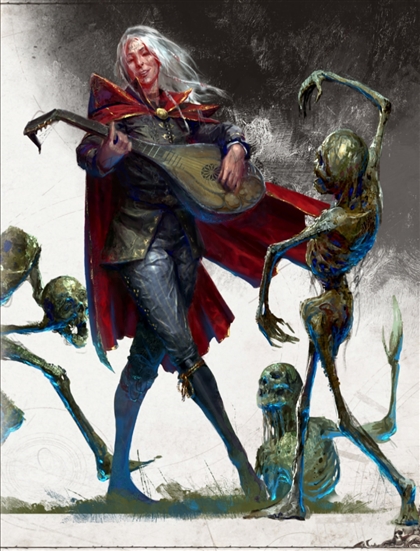
Base Class: Bard
Bards of the College of the Macabre do not merely sing of death—they revel in its artistry, crafting performances that pull back the veil between the living and the departed. Their voices stir the restless, their melodies call forth forgotten echoes, and their tales weave the fates of the present generation with the legacies of the past.
Many begin their journey as mourning minstrels, singing elegies at funerals or composing dirges for unmarked graves. Others are drawn to the macabre by personal encounters with death—a near-death experience, a message from a spectral muse, or the first time they heard the whispers of an unseen audience applauding their work. While their beginnings may vary, each takes on the role of death’s chroniclers, ensuring that no soul fades into obscurity, their stories carried forever in song.
But not all Macabre bards respect the dead. Some treat spirits as playthings, puppeteering their restless echoes for amusement or power. The laughter of these death-touched jesters rings through haunted halls, mingling with the hollow voices of those who can never laugh again. To them, death is not an end but a stage, an audience, and a chorus waiting to be conducted.
The College of the Macabre is not a structured institution—it is a tradition passed from master to apprentice, whispered in midnight performances and scrawled in ink mixed with blood on aging sheet music. Some bards learn their craft from spirits of forgotten maestros, their hands guided by phantom tutors as they play instruments that no longer exist. A few even claim to hear death’s applause silently urging them from beyond the grave, demanding they perfect their art.
Wherever they go, a Macabre bard’s presence is unsettling yet mesmerizing. A single note from their voice can hush a crowded tavern, a story told in whispers can send chills down the spine, and a waltz performed in an empty hall may draw an unseen audience to dance. Whether they seek to honor the dead, command them, or simply revel in the beauty of their passing, one thing is certain: when a bard of the Macabre raises their voice, the dead listen.
Level 3: Dirge of the Fallen
Your connection to the veil between life and death has begun to alter you, manifesting in both body and spirit as your performances take on a haunting resonance. You gain the following benefits:
- You know the thaumaturgy and soul scythe (see Chapter 7: Spells) cantrips. They count as bard spells for you.
- As a reaction when you or an ally within 30 feet of you makes a death saving throw, you can coax their spirit to stay. The target rolls a d4 and adds the number rolled to the result. Once you use this feature, you can’t do so again until you finish a long rest.
Soul Scythe:
Necromancy Cantrip
Casting Time: 1 action
Range: 30 feet
Components: V, S
Duration: Instantaneous
Classes: Cleric, Sorcerer, Warlock, Wizard
You conjure a spectral scythe of dark energy and strike at the soul of one creature within range. The target must succeed on a Charisma saving throw or take 1d8 necrotic damage. On a failed save, the target’s speed is reduced by 10 ft. until the start of your next turn. On a successful save, the target takes no damage and its speed is not reduced.
The spell’s damage increases by 1d8 when you reach 5th level (2d8), 11th level (3d8), and 17th level (4d8).
Dirge of the Fallen
As a reaction when you or an ally within 30 feet of you makes a death saving throw, you can coax their spirit to stay. The target rolls a d4 and adds the number rolled to the result. Once you use this feature, you can’t do so again until you finish a long rest.
Level 3: Macabre Inspiration
Your Bardic Inspiration carries the strength of the dead. When you grant Bardic Inspiration, the inspired creature can choose one of the following effects, which it gains in addition to the normal benefit:
Final Countdown. As a reaction when the inspired creature takes damage, it can use its Bardic Inspiration die to reduce the damage by the number rolled + your Charisma modifier (minimum of 1).
Wailing Dirge. When a creature uses its Bardic Inspiration die on an attack roll or ability check, it can force one creature within 30 feet of it to make a Wisdom saving throw against your bard spell save DC. On a failed save, the target is frightened of the inspired creature until the end of the target’s next turn.
Level 6: Ghostly Steps
Your presence drifts between the living and the dead, gliding across the battlefield as if carried by spectral hands. When you move, faint echoes of past dancers swirl around you, their ethereal forms pulling you between worlds.
You have resistance to necrotic damage. Additionally, when you take the Dash or Disengage action, you create a ghostly dancing partner that twirls around you. Until the start of your next turn, when a creature within 10 feet of you targets you with an attack, you can use your reaction to intensify the dance, forcing the attack roll to be made with disadvantage.
Level 6: Dance of the Dead
When a Small or Medium creature that is not a Construct dies within 30 feet of you, you can use your reaction to raise its spectral form in the same space. For 1 minute, it becomes a dancing revenant (see the Dancing Revenant section below). It shares your initiative, but it takes its turn immediately after yours. You can have a maximum number of dancing revenants equal to your proficiency bonus. If you raise another, the oldest one vanishes. Once you use this reaction, you can’t do so again until you finish a long rest, unless you expend a 3rd-level spell slot to use it again.
On each of your turns, you can use a bonus action to mentally command any or all revenants at the same time, issuing the same command to each one. You decide what action the creature will take and where it will move, or you can issue a general command. If you issue no commands, the creature only defends itself against hostile creatures. Your revenants remain if you fall unconscious, but they vanish into mist if you die, the duration ends, or you dismiss them (no action required).
Dancing Revenant. Each dancing revenant uses the specter stat block and gains additional benefits based on your level.
- At 10th level, its attacks count as magical, and it gains a +2 bonus to AC.
- At 14th level, its attacks deal extra necrotic damage equal to your proficiency bonus.
Macabre Conductor. As part of the bonus action to command your dancing revenants, you can expend a use of Bardic Inspiration to empower all of them. While empowered, they gain the following benefits:
- They gain a bonus to their attack and damage rolls equal to your Charisma modifier (minimum of +1).
- They gain temporary hit points equal to your bard level.
Level 14: Grand Masquerade
As an action, you can manifest a grand masquerade in a 30-foot radius around you for 1 minute, conjuring a ghostly ballroom where the living and the dead dance as one. Masked apparitions twirl through the air, moving between allies and enemies alike. For the duration, each of the following effects apply:
- Haunting Presence. When a hostile creature starts its turn within the area, it must make a Wisdom saving throw against your bard spell save DC. On a failed save, its speed is halved and it is frightened until the start of its next turn. Creatures normally immune to the frightened condition aren’t immune to this effect, but they have advantage on the saving throw.
If a creature is frightened in this way and it takes damage from an attack while in the area, it takes extra psychic damage equal to two rolls of your Bardic Inspiration die. When the creature takes this psychic damage, it can’t take it again until the end of its next turn.
- Ghostly Ball. You and creatures of your choice when you form this masquerade gain a flying speed of 30 feet while remaining within the area. If an affected creature leaves the area or ends its turn in midair when Grand Masquerade ends, the creature immediately floats gently down to the ground. Additionally, when an attack targets an affected creature flying within the area, the attacker must roll a d4 and subtract the result from the attack roll.
Once you use this feature, you can’t do so again until you finish a long rest, unless you expend a 5th-level spell slot to activate it again.