



 Base Class: Fighter
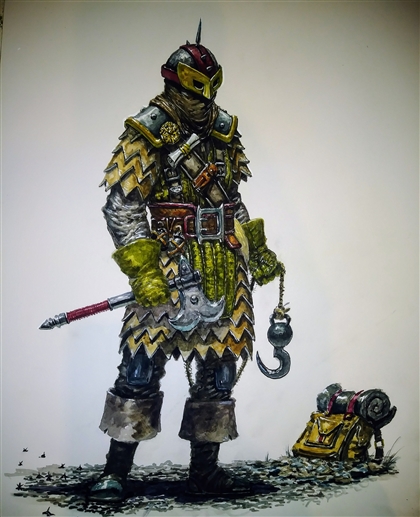
Though often regarded as simple fighters, Manhunters are trackers by nature. Their only mission is to seek their mark and destroy it, with no bells and whistles attached. Manhunters are well regarded for their seemingly infinite determination when pursuing their marks. To them, a mark is a promise, an oath that whomsoever bears it will be destroyed eventually. Manhunters are usually mercenaries when they have no active marks, but are quick to ditch the veneer of professionalism once their hunt has begun.
Mark Target
Starting at 3rd level you may spend up to 10 minutes to ruminate and gather insight on your next mark.
If you plan to mark an unnamed beast or a wild monster, you need only know the existence of its species. If you plan to mark a sentient being capable of evading your hunt, you must know their exact name and their last known location. You may also mark a creature if it misses a melee attack against you or when you hit a creature with a melee weapon attack.
You can have a number of marks equal to your Wisdom modifier (at least 1) active at any given time. You can remove and reassign marks during a short or long rest, following the rules of marking targets.
When a target is marked, you gain the following benefits:
- You gain advantage on Wisdom(Insight) and Charisma(Intimidation) checks against against your mark.
- If your mark misses with a melee weapon attack, you may use a reaction to make one melee weapon attack against them.
- When you take an attack of opportunity against your mark, you may grapple them instead of making a weapon attack.
Manhunter's Sense
Starting at 7th level your sense flare while you hunt for your mark. You gain expertise with insight and proficiency with a skill of your choice.
Manhunt
At 7th level, you may spend 1d4 hours whenever you enter an urban area or your mark's last known location to gather information on their whereabouts. This could include entering buildings, asking civilians, tracking prints, or even conversing with local authorities. Afterward, roll 1d20 to determine the result of your research, as expanded below. You may only gather information on a single mark at a time.
|
Roll |
Result |
|
20 |
You find out your mark's current location, their next destination, and how they intend to get there. |
|
14-19 |
You know your mark's current location but know nothing of their future plans. |
|
8-13 |
You have a few assumptions of where your mark might be and what they might do next. Some of them are wrong. |
|
2-7 |
You have a few ideas as to what exactly your mark plans to do next. Some of them might be wrong. |
|
1 |
You mark's own contacts catch wind of your investigation and alert them. You gain disadvantage with attacks, saving throws, and skill checks involving your mark for the next 24 hours. |
No Escape
At 10th level you become more careful in preventing your mark's escape. Whenever you hit a mark with a weapon attack, their movement speed is reduced by 5 feet until the start of their next turn.
Oh no, you don't!
At 15th level your awareness of your mark's actions is finetuned enough to know when they are about to lash out. When your mark attacks an ally within 5 feet of you, you may use a reaction to shove that ally out of the way, move into their space, and become the target of your mark's attack. If your mark's attack misses you, you may make a melee weapon
Showdown
At 18th level you become the living embodiment of your mark's promise of death. The first attack your mark makes against you on each turn has disadvantage. Additionally, you no longer require a reaction to attack your mark when they miss you with an attack. You can only attack after a miss once per turn, even if your mark misses you more than once.
Comments