



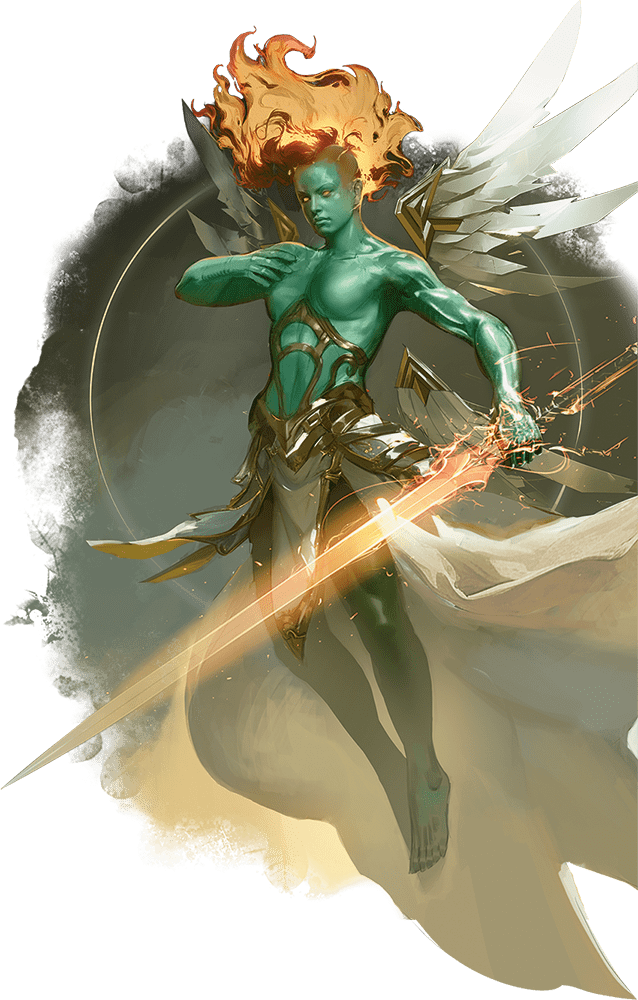
| Mod | Save | ||
|---|---|---|---|
| STR | 24 | +7 | +12 |
| DEX | 20 | +5 | +5 |
| CON | 24 | +7 | +12 |
| Mod | Save | ||
|---|---|---|---|
| INT | 19 | +4 | +4 |
| WIS | 22 | +6 | +11 |
| CHA | 25 | +7 | +12 |
Divine Awareness. The planetar knows if it hears a lie.
Exalted Restoration. If the planetar dies outside Mount Celestia, its body disappears, and it gains a new body instantly, reviving with all its Hit Points somewhere in Mount Celestia.
Magic Resistance. The planetar has Advantage on saving throws against spells and other magical effects.
Multiattack. The planetar makes three Radiant Sword attacks or uses Holy Burst twice.
Radiant Sword. Melee Attack Roll: +12, reach 10 ft. Hit: 14 (2d6 + 7) Slashing damage plus 18 (4d8) Radiant damage.
Holy Burst. Dexterity Saving Throw: DC 20, each enemy in a 20-foot-radius Sphere centered on a point the planetar can see within 120 feet. Failure: 24 (7d6) Radiant damage. Success: Half damage.
Spellcasting. The planetar casts one of the following spells, requiring no Material components and using Charisma as spellcasting ability (spell save DC 20):
At Will: Detect Evil and Good
1/Day Each: Commune, Control Weather, Dispel Evil and Good, Raise Dead
Divine Aid (2/Day). The planetar casts Cure Wounds, Invisibility, Lesser Restoration, or Remove Curse, using the same spellcasting ability as Spellcasting.
-
View User Profile
-
Send Message
Posted Feb 16, 2025Am I missing a new rule or is there nothing stopping you from using holy burst on the same group of people twice in the turn? Feels a bit weird to me.
-
View User Profile
-
Send Message
Posted Feb 19, 2025There’s nothing stopping you, and targeting the same group twice is probably the intended use case. Splitting the damage between two saves probably makes the effect a little less dangerous.
-
View User Profile
-
Send Message
Posted Apr 20, 2025Just a TLDR that in older editions & lore, the way angels dying worked was the opposite of Demons/Devils. An angel that dies on Mount Celestia would resurrect & gain a new body immediately, but one that dies elsewhere (Say on the material plane) died permanently. Personally I think this fits them better, and makes their actions all the more good/selfless/heroic, as they're actually risking their immortal lives when they help. and its a solid explanation for why they don't get directly involved in the blood war.
-
View User Profile
-
Send Message
Posted Apr 26, 2025I agree completely, going by that it makes more sense that more celestials and such aren't more involved with mortal affairs. It also means that if you see one, they mean business.
-
View User Profile
-
Send Message
Posted Jun 15, 2025source? I might just be dumb or blind, but im not finding where it says that they revive like that in older versions
-
View User Profile
-
Send Message
Posted Jul 9, 2025Why do they wanna help the evil dudes partner so much?
-
View User Profile
-
Send Message
Posted Aug 3, 2025So can it cast each spell under Divine Aid twice, or only use Divine Aid twice total, regardless of which spell it casts?
-
View User Profile
-
Send Message
Posted Aug 22, 2025yaaaaaaaaaaaaaaaayyyyy planetars finally have hair
-
View User Profile
-
Send Message
Posted Oct 7, 2025Divine Aid can be used twice/Divine Aid allows them to cast one of those spells as a Bonus action.
-
View User Profile
-
Send Message
Posted Sep 5, 2026Is it just me, or is it that they literlly CANAT BE KILLED if your fighting one on Mount Celestia?
-
View User Profile
-
Send Message
Posted Sep 21, 2026No, Mount Celestia is the only place where they can be killed permenantly.
-
View User Profile
-
Send Message
Posted Nov 7, 2026This is a limitation of the Archons, not of the Aasimon.
Technically in planescape 2nd edition aasimon planetars that died outside their deity plane would not truly die, but it would take them 40 years to reform.
I loved this because it gave some real consequences to the death of such a being.
Planescape's Exemplar races all had their own specific set of rules for dying outside their own plane. Another case of beautiful specificity and nuance that 5th edition decided to remove, unfortunately, replacing them with instantaneous resurrection.
Race
Cool Planescape stuff 5e did away with sadly
Tanar'ri (Abyss)
Powerful tanar'ri killed outside the Abyss can reform there, sometimes after lengthy periods or with diminished power. Lesser demons do not necessarily enjoy the same protection. Summoning is an important means of reaching the Prime, although it is not an absolute requirement for every tanar'ri.
Baatezu (Nine Hells)
Powerful baatezu destroyed outside Baator can return in a diminished form, potentially losing their former rank. They cannot normally enter the Prime without being summoned. Erinyes are an exception: they can enter unsummoned to tempt mortals, but cannot bring companions or possessions and can take only one mortal back to Baator.
Yugoloths (Gray Waste / Gehenna)
Some powerful yugoloths can reform after destruction outside their native planes, but this is not universally guaranteed. Their ancestral homeland is the Gray Waste, while Gehenna is a major centre of their power. The Book of Keeping contains rituals for summoning and controlling them.
Gehreleths (Carceri)
Their population is normally fixed at 9,999, divided equally among farastu, kelubar and shator. When one dies, a lesser gehreleth is promoted and a new farastu is created from a corpse in Carceri. The deceased individual does not automatically reform. Each carries an obsidian triangle connecting it to their creator, Apomps, and the collective memories of its race.
Aasimon (Upper Planes)
Aasimon destroyed outside their home planes can reform after substantial periods: light aasimon after 1 month, devas after 10 years, planetars after 40 years and solars after 70 years. However, they can suffer permanent death on the Upper Planes. Planetars are vulnerable throughout the Upper Planes, while solars, devas and light aasimon can only be permanently destroyed on their particular home planes.
Archons (Mount Celestia)
Archons originate as lawful-good petitioners and ascend through successive forms as they progress spiritually. Death outside Mount Celestia can result in eternal oblivion, rather than automatic reformation. They can visit the Prime, but excessive interference with mortals can lead to banishment.
Guardinals (Elysium)
Guardinals are unrestricted planar travellers, able to leave Elysium through innate abilities or conventional portals. Unlike eladrins, they need not conceal their identities. No universal death-and-reformation period is established for guardinals killed outside Elysium.
Celestial Eladrins (Arborea)
Greater eladrins can enter the Prime without being summoned but must assume the appearance of native inhabitants under the Veil. They cannot openly reveal powers incompatible with their disguise while mortals might witness them. Breaking the Veil forces them to return to Arborea and prohibits them from visiting the Prime for 1,001 years, usually after a brief grace period. No universal reformation period is established for eladrins killed outside Arborea.
Rilmani (Outlands)
Rilmani cannot be summoned directly, nor can they normally enter the Prime independently. They can, however, enter by accompanying the summoning of another extraplanar being of comparable status. This allows them to respond to disruptions of the cosmic Balance. No universal reformation period is established.
Modrons (Mechanus)
The modron hierarchy maintains fixed numbers at every rank. When one dies, a modron from the rank immediately below is promoted, triggering a cascade of promotions. The resulting vacancy among monodrones is filled by fission, when an existing monodrone divides into two. The deceased modron is replaced, not resurrected.
Slaadi (Limbo)
According to Planes of Chaos, slaadi may hunt and raid together but normally refuse to cooperate in individual combat. When several confront a lone opponent, they take turns fighting, usually sending the weakest first. This is typical behaviour rather than an absolute prohibition. No universal reformation period is established for slaadi killed outside Limbo.
Rakshasas (Acheron)
They can operate on the Prime without an established summoning requirement and are described as virtually immortal spirits. A single hit from a blessed crossbow bolt kills a rakshasa instantly. However, no explicit reformation mechanism is specified, leaving it to the DM to determine what happens to their spirits when slain outside Acheron. Rakshasas produce a new generation every century to replace those killed in battle.