



 Base Class: Bard
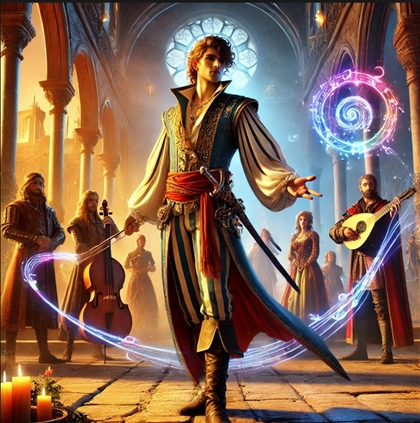
Bards of the College of the Troubadour are versatile adventurers who blend music, lore, stealth, and combat to navigate the world with charm and grace. Whether captivating an audience with tales of heroism or leading the charge in battle, the Troubadour thrives on adaptability and resourcefulness, inspired by ancient bardic traditions. This class is inspired by the ADnD 2nd extended edition rules for Bard, taking from the rogue, fighter, and wizard classes making for a jack-of-all-trades subclass.
Bonus Proficiencies
When you join the College of the Troubadour at 3rd level, you gain proficiency with medium armor, shields, and martial weapons.
Additionally, you gain proficiency in Sleight of Hand and with thieves' tools.
Fighting Style
At 3rd level, you can adopt a style of fighting that suits your blend of martial and arcane talents. Choose one of the following options. You can’t take a Fighting Style option more than once, even if you later get to choose again.
- Dueling: When you are wielding a melee weapon in one hand and no other weapons, you gain a +2 bonus to damage rolls with that weapon.
- Two-Weapon Fighting: When you engage in two-weapon fighting, you can add your ability modifier to the damage of the second attack.
- Archery: You gain a +2 bonus to attack rolls you make with ranged weapons.
Versatile Strikes
Also at 3rd level, you learn how to blend arcane power with martial precision. When you make a weapon attack, you can expend one use of your Bardic Inspiration to add a bonus to your attack roll equal to the result of your Bardic Inspiration die. If the attack hits, it deals additional damage equal to the number rolled on the Bardic Inspiration die. This extra damage can be either the weapon's damage type or a type from the following list (your choice): thunder, radiant, or psychic.
Troubadour’s Song
Starting at 3rd level, you can use your action to begin a magical performance, singing an ancient battle song that emboldens your allies and weakens your enemies.
While you are singing, all allies within 30 feet of you who can hear you are immune to the frightened condition, and if they are already frightened when you start singing, the condition is removed.
In addition, while the song continues, each ally within range who can hear you gains a bonus to attack rolls, saving throws, and ability checks equal to half your Bardic Inspiration die (rounded down). This bonus increases to your full Bardic Inspiration die at 15th level. If you are silenced or deafened, the song ends.
The song lasts for up to 10 minutes and requires concentration, as if concentrating on a spell. You can stop the song at any time without using an action. Once you use this ability, you can’t use it again until you finish a short or long rest.
Jack-of-All-Trades
Starting at 6th level, your mastery over a wide array of skills becomes even more pronounced. You can add half your proficiency bonus, rounded up, to any ability check that doesn’t already include your proficiency bonus.
In addition, when you roll a 9 or lower on an ability check, you can treat the die roll as a 10.
Arcane Flourish
At 6th level, your magic seamlessly flows into your combat, allowing you to enhance your attacks with spellcasting finesse. When you cast a Bard spell of 1st level or higher, you can make a weapon attack as a bonus action. Additionally, you can add your Charisma modifier to one damage roll of any spell that deals damage.
Song of Luck
Starting at 6th level, your song also imbues your allies with good fortune. While your Troubadour’s Song is active, all allies within range gain a +1 bonus to all saving throws. This bonus increases to +2 at 15th level and +3 at 20th level. This luck bonus applies to you as well.
Uncanny Dodge
Starting at 14th level, when an attacker that you can see hits you with an attack, you can use your reaction to halve the attack's damage against you.
Legendary Lore
Also at 14th level, your vast knowledge of arcane and mundane matters rivals the greatest scholars. When you make an Intelligence (Arcana, History, or Nature) check, you can treat a d20 roll of 14 or lower as a 15.
Additionally, you can learn two additional spells of your choice from any class's spell list. These spells must be of a level you can cast, and they count as Bard spells for you.
Comments