



 Base Class: Wizard
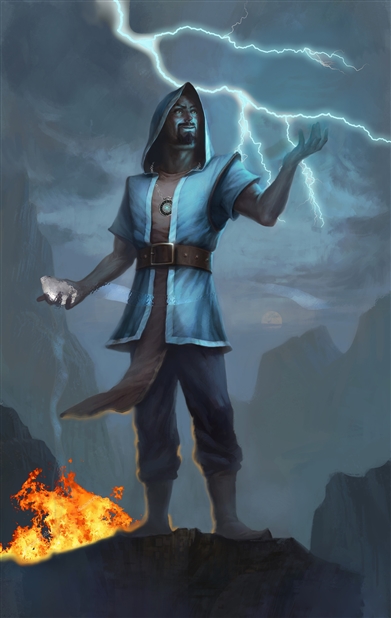
The Arcanist is a scolarly magic user which draws their ability to spell-cast from pure willpower and belief.
They study in many fields of Arcane Magic: Sympathy, Sygaldry, Alchemy and Naming.
A description of all these fields:
Sympathy:
The most basic and most studied field of an Arcanist.
This type of 'magic' is based on making a 'Sympathetic Binding' of some kind between two items.
For every extra Binding you want to create, you need to split up your mind.
This can be achieved through a lot of intense mental training.
The strength of a link is based on certain principles:
- The Doctrine of Correspondence: Similarity enhances sympathy.
- The Principle of Consanguinity: A piece of a thing can represent the whole of a thing.
- The Law of Conservation: Energy cannot be destroyed nor created, it can be lost or found.
- The Heart of Stone: A frame of mind in which a sympathist is able to shut out the distraction of emotions and focus rational thought to the utmost.
- Alar: "The riding-crop belief" is a faith controlled by personal will that is forceful enough to impose its energy upon reality. For example, a sympathist must have a firm Alar in order to maintain a belief that the wick of a candle will burst into flame. A common trick for training one's Alar is to split one's mind into separate parts and believe two conflicting things at once.
The more principles are met, the greater the link.
There are 7 known Bindings:
- Sympathetic Binding of Parallel Motion: The binding used to move an item by moving a similar one, bound by a 'Sympathetic Link'. It redirects part of the kinetic energy (force, not acceleration) of one body to another, in order for both to move parallel.
- 'Chemical, Second Catalytic': Although Sympathy is said to be a transfer of energy, it's also possible to transfer chemical properties, transferring some kind of 'alkaline'/'caustic basic' property through the link. g. dissolving oil by binding with soap.
- Capacitorial Kinetic Luminosity: The binding used to make light by transferring kinetic energy into luminosity.
- First Parallel Kinetic Binding: A binding which transfers acceleration (not force) of one body to another. Both items move at the same speed by transferring momentum.
- Binding for Linear Galvanic Attraction: Linear Galvanic Attraction is a way to control electric/galvanic attraction between bodies using excess of proportions, creating an equilibrium. The laws of physics imply; E.g. A thunder cloud being formed from vapor in the atmosphere: there is a contraction of volume, an excess of the pervading principle, which, by being transmitted to the earth beneath, produces lightning.
- 'Galvanic Binding': A Sympathetic link to redirect current from one linked item to another.
- 'Maxim of Variable Heat Transferred to Constant Motion': This is not a binding in and of itself, but a way to extract energy from the environment by using the temperature difference between and item and the surrounding environment. (It extracts energy from the 'heat flow')
Sygaldry:
The way to make sympathy permanent by rune-crafting:
There are almost 200 runes which when combined, can perform almost any effect sympathy can, but permanently.
The only drawback is that learning these runes is difficult and the slightest mistake can ruin the sygaldry.
Examples:
"Ule and doch are
Both for binding
Reh for seeking
Kel for finding
Gea key
Teh lock
Pesin water
Resin rock"
~ Song to remember certain runes
Bloodless Device
~ Device to stop arrows using sygaldry to cancel out kinetic energy with springs that release when a metallic item comes within a certain radius
This would be very hard to perform with sympathy since there are a lot of bindings involved at once
Alchemy:
The field of study for the ones who don’t have the knack for making sympathetic links.
With alchemy one can create powerful potions that cannot be achieved through chemistry or sympathetic bindings. This is similar to any other alchemy in other lore.
Naming:
The hardest and least studied field of Arcane Magics.
Naming is the hardest to describe with a logical reasoning and comes closer to straight up magic.
Once somebody learns the True Name of a thing, they gain complete control over that thing. This can be anything, from the wind, to a stone to the True Name of a creature.
Since a piece of a thing can represent the whole of a thing, they effectively gain control over all of the wind, any stone and any similar Creature.
The True Name of a thing can only be perceived by the ‘Sleeping Mind’ or the subconscious, since the amount of information to comprehend such a thing is too much for the ‘Waking Mind’ to handle.
There are instances where someone can call the Name of a thing after heavy emotional or physical trauma, without actually knowing the Name of that thing.
"And Taborlin the Great said to the stone: "BREAK!" and the stone broke..."
~ Folk tale of Taborlin the Great breaking out of a smooth stone cell
You recieve the following Class Features:
The Alar
At the 2nd level, you are beginning to grasp the way of thinking that 2 certain things are one and the same. You think beyond normal reasoning and convince yourself through sheer willpower.
This sensation of reasoning is called the 'Alar'.
You gain the ability to create 'Sympathetic Bindings' and split your mind into pieces to cast multiple at once.
- Alar Pool:
You start with an Alar Pool of 6, which increases every few levels with a maximum of 30.
Keep your available Alar Points in your Notes!
- Sympathetic Binding:
When unlocking the ability to use the 'Alar', you are able to cast 'Sympathetic Bindings'.
This Binding is a sort of link created between two targeted things within spell range.
When you create a bad Link, you have to put in extra energy (trough heat from your body or force from your muscles) because of the Law of Conservation of Energy.
You focus your Alar and mutter a binding, which intrinsicly connects two things within range through pure willpower.
If the targeted thing is a Creature, they must make a WIS saving throw.
You can cast this spell for every piece of Mind you have available. (See 'Split Mind' spell)
Spell slots aren't used up when casting 'Sympathetic Binding'.
In Combat, the utility of a Binding is determined by a d20 roll (plus modifier if cast at higher levels).
This value is then taken, times five, to give a link strength in percentage.
You or your teammates then interact with the item/creature the creature is bound to, to indirectly inflict damage.
The better the link, the more damage passes trough, and the less extra work you have to put in to get the wanted result.
You have to determine what kind of Binding you will create (Parallel Motion, Chemical, etc.)
For example:
You link a stone to a creature with a link strength of 50%.
Sincet stone and the Creature are linked, they both weight as much as both things combined: at 100% link strength, they would both have the same weight: Creatures weight + stone's weight. Since the Link is only at 50% efficiency, the weight is doubled and when you carry the stone, you are effectively carrying twice the sum of their masses.
Your next action is throwing the stone against the floor (since it's so heavy). The kinetic energy of the stone is transferred and the creature recieves blungeoning damage (decided by the DM) halved (since the link is 50%).
Or you throw the stone in a fire or link it to a torch. The creature recieves fire damage every turn (again, determined by the DM) halved, as long as the link is there.
A certain kind of Binding cannot be improved by overwriting (casting the same kind of Binding on top of another one). The link has to be disspelled and cast again, effectively losing a turn.
You can, however, stack different kinds of Bindings onto the same 2 objects.
For example binding a creature chemically (to a poison) and galvanically (to a fire) to inflict Acid and Fire damage simulteaniously.
In the books, this is used to take out a group of people as follows:
An opponent is killed and their corpse is linked to another opponent. Since they are both human, the link is pretty good. The corpse's throat gets slit and the other opponent drops dead with his throat slit. This is repeated, but with stabbing this time. The next opponent receives stab wounds... It progressively gets harder to injure the corpse because of all the links in place: damaging their skin begins to feel like trying to cut metal...
- Split Mind
You concentrate your Alar and try to split off a piece of your mind. This takes intense mental training and practice.
This spell takes 2 Alar Points at Character level 8.
It is very exhausting when doing this for extended periods of time, until mastered.
You try to imagine yourself believing 2 opposing things at once. It seems hard at first, but after a while you notice both sides of yourself are right and you can feel your mind effectively splitting up into two separate enities, thinking and processing information independently from each other.
It seems it is even possible to play hide and seek with yourself this way...
When at character level 8, To succeed splitting off a piecce of your mind, roll a d6 and get 5 or higher.
For every successful split off piece of your mind, it becomes progressively harder to split off more pieces.
split once: d6 > 4, split twice: d6 > 5 ,etc. -> limit: 2 pieces
When failing an attempt, you cannot try again for 3 rounds.
At higher levels: See spell info at Character level 8, 13, 17, 20
After disspelling the 'Split Mind' state, you gain +1 Exhaustion until Character level 13.
The Heart of Stone
At the 6th level, you can now cast the spell 'Heart of Stone' At Will.
The 'Heart of Stone' is a state of consciousness where the "user" abdicates from all his beliefs and opinions, forgetting all his emotions and prejudices.
It is used to think about things with reason rather than common sense, being used to think in a more rational way. Because it makes the user able to ignore things and not be concerned about feelings and emotions, it really helps to focus on things, so that when in 'Heart of Stone', a person gets a significantly stronger Alar (as he can focus all of himself into the Alar).
You start to concentrate, and feel your emotional and materialistic connections fade away. You can think clearly and without hindrance. You can fully focus with all of your mind on the task at hand...
Effects:
Any spell that requires Alar Points to cast, costs one less Alar Point while 'Heart of Stone' is active.
Although this state can be disspelled when losing Concentration, you can still cast other spells while in the 'Heart of Stone'.
It temporarily dispells any mental alteration spells like charms, intimidations etc. and you gain advantage on Perception, Investigation and Insight checks.
The state of mind lasts for 3 minutes.
The Art of Naming
At the 10th level, you have discovered the Art of Naming. You can try to call the True Name of a thing through the 'Call True Name' spell.
You gain the ability to enter 'Spinning Leaf'.
- Spinning Leaf
At the 10th level, you can enter a state of mind where you discard any rational thinking and let yourself be subject of your own mind, called 'Spinning Leaf'.
You do without thinking about how or why.
This is a Mental State that approaches Naming in a more convenient way:
When in 'Spinning Leaf', you do not try to comprehend the complexity of a thing.
The True Name becomes obvious more easily when not trying to comprehend what it means.
This is impossible to do through 'Heart of Stone'.
The Spinning Leaf is a Mental State, the opposite of the Heart of Stone. It's a mental state where the user simply "goes with the flow," letting his mind free to wander wherever it wants, talking and doing things without thinking twice about it, just doing it, no thinking.
You can enter 'Spinning Leaf' at will, but only when 'Heart of Stone' is inactive.
Entering 'Spinning Leaf' can be done and undone at will and instantaneously.
When in 'Spinning Leaf', you cannot create 'Sympathetic Bindings' or use 'Split Mind'.
When in this state, however, you can try to call the True Name of a thing you do not know.
- Call True Name
Starting from the 10th Character level, You can try to call the True Name of a thing you choose, or call Names you already learned.
Calling the True Name of a thing is the closest thing to 'real magic' an Arcanist can achieve.
When an Arcanist calls the True Name of a thing (through trying or knowing), it can command that thing fully and inevitably.
Master Namer pointed down the street. "What color is that boy's shirt?
"Blue."
"What do you mean by blue? Describe it."
I struggled for a moment, failed. "So blue is a name?"
"It is a word. Words are pale shadows of forgotten names. As names have power, words have power. Words can light fires in the minds of men. Words can wring tears from the hardest hearts. There are seven words that will make a person love you. There are ten words that will break a strong man's will. But a word is nothing but a painting of a fire. A name is the fire itself."
My head was swimming by this point. "I still don't understand."
He laid a hand on my shoulder. "Using words to talk of words is like using a pencil to draw a picture of itself, on itself. Impossible. Confusing. Frustrating."
~The Name of blue - book: The Name of the Wind by Patrick Rothfuss
There are 2 ways an Arcanist can call a True Name:
- Knowing the Name by studying the object for an extended period of time
- Trying to call the Name and succeeding
To learn the True Name of a thing, one must convey 60 workdays of study to that particular thing, and have access to it.
This way they can start to grasp the complexity of the thing that is being studied, and call it's Name at will.
To try to call the True Name of a thing, the Arcanist must have access to the 'Spinning Leaf' ability. (See: spell: 'Spinning Leaf')
"As I watched, gently dazed by the motion of the tree, I felt my mind slip lightly into the clear, empty float of Spinning Leaf. I realized the motion of the tree wasn’t random at all, really. It was actually a pattern made of endless changing patterns. And then, my mind open and empty, I saw the wind spread out before me. It was like frost forming on a blank sheet of window glass. One moment, nothing. The next, I could see the name of the wind as clearly as the back of my own hand."
~Seeing the Name of the Wind - book: The Wise Man's Fear by Patrick Rothfuss
Attempting to call a True Name is done by rolling a d20 3 times without modifiers and getting at least one 20. (No Damage is multiplied)
The effect of calling the True Name of the thing chosen is discussed with the DM.
The Name of the thing is immediately forgotten after calling it when it wasn't known to you, unless you are a lv20 Arcanist.
The Ketan
At the 14th level, you acquire a perfect Ketan. The Ketan is a series of movements that one can use to practice proper form as a form of training for fighting. It can be compared to tai chi or any martial arts kata. It originates from a civilisation of people who earn money by fighting as mercenaries to earn money for their people.
This series of movements is harder to to the slower you do them, but when performed perfectly, trains every muscle in your body and keeps up your stamina.
Empty your mind.
Be formless, shapeless,
Like Water.
Water can flow,
Or it can crash.
Be water my friend.~Bruce Lee
Effects:
Your reflexes get enhanced in hand to hand combat and you can fight more instinctively.
You cannot get hit by 'Unarmed Strike' from another Creature and you can parry with a 'Ketan Counter' of your own.
When in 'Spinning Leaf':
- You gain an extra Attack per Action.
- You can use the Action: 'Ketan Strike' when empty-handed, instead of 'Unarmed Strike'.
- You gain +1 Bonus Damage on Unarmed Strikes
- You gain +4 Bonus AC
- You gain +5 initiative
- You gain 20ft Movement Speed
- Ketan Strike
Only usable when in 'Spinning Leaf'.
You use one of the Moves from the Ketan to strike at your opponent: Damage: 3 + STR Modifier
DC: +4
- Ketan Counter
Only usable when in 'Spinning Leaf'.
You deflect Melee Attack moves with 'Break Lion' and 'Catching Rain' before you even notice, and take the opportunity to parry your opponents with a Ketan Strike whenever they miss their Melee Attack.
-
View User Profile
-
Send Message
Posted Nov 21, 2020That's so COOL I read the books and I love it!
-
View User Profile
-
Send Message
Posted Nov 13, 2019******* epic