



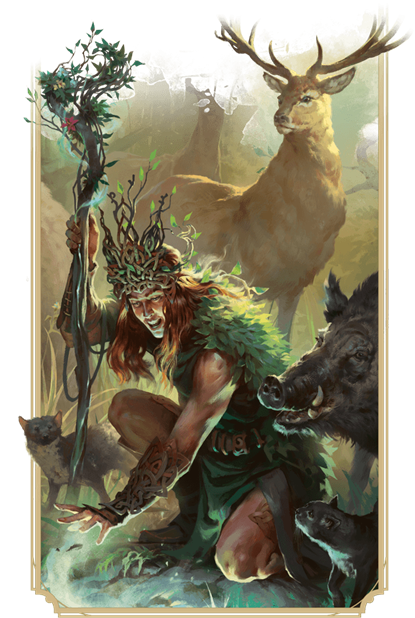
Druid Class Details
| Primary Ability | Wisdom |
|---|---|
| Hit Point Die | D8 per Druid level |
| Saving Throw Proficiencies | Intelligence and Wisdom |
| Skill Proficiencies | Choose 2: Animal Handling, Arcana, Insight, Medicine, Nature, Perception, Religion, or Survival |
| Weapon Proficiencies | Simple weapons |
| Tool Proficiencies | Herbalism Kit |
| Armor Training | Light armor and Shields |
| Starting Equipment | Choose A or B: (A) Leather Armor, Shield, Sickle, Druidic Focus (Quarterstaff), Explorer’s Pack, Herbalism Kit, and 9 GP; or (B) 50 GP |
Druids belong to ancient orders that call on the forces of nature. Harnessing the magic of animals, plants, and the four elements, Druids heal, transform into animals, and wield elemental destruction.
Revering nature above all, individual Druids gain their magic from nature, a nature deity, or both, and they typically unite with other Druids to perform rites that mark the passage of the seasons and other natural cycles.
Druids are concerned with the delicate ecological balance that sustains plant and animal life and with the need for people to live in harmony with nature. Druids often guard sacred sites or watch over regions of unspoiled nature, but when a significant danger arises, Druids take a more active role as adventurers who combat the threat.
Becoming a Druid...
As a Level 1 Character
- Gain all the traits in the Core Druid Traits table.
- Gain the Druid’s level 1 features, which are listed in the Druid Features table.
As a Multiclass Character
- Gain the following traits from the Core Druid Traits table: Hit Point Die and training with Light armor and Shields.
- Gain the Druid’s level 1 features, which are listed in the Druid Features table. See the multiclassing rules in chapter 2 to determine your available spell slots.
| ——Spell Slots per Spell Level—— | ||||||||||||||
|---|---|---|---|---|---|---|---|---|---|---|---|---|---|---|
| Level | Proficiency Bonus | Class Features | Wild Shape | Cantrips | Prepared Spells | 1 | 2 | 3 | 4 | 5 | 6 | 7 | 8 | 9 |
| 1 | +2 | Spellcasting, Druidic, Primal Order | — | 2 | 4 | 2 | — | — | — | — | — | — | — | — |
| 2 | +2 | Wild Shape, Wild Companion | 2 | 2 | 5 | 3 | — | — | — | — | — | — | — | — |
| 3 | +2 | Druid Subclass | 2 | 2 | 6 | 4 | 2 | — | — | — | — | — | — | — |
| 4 | +2 | Ability Score Improvement | 2 | 3 | 7 | 4 | 3 | — | — | — | — | — | — | — |
| 5 | +3 | Wild Resurgence | 2 | 3 | 9 | 4 | 3 | 2 | — | — | — | — | — | — |
| 6 | +3 | Subclass feature | 3 | 3 | 10 | 4 | 3 | 3 | — | — | — | — | — | — |
| 7 | +3 | Elemental Fury | 3 | 3 | 11 | 4 | 3 | 3 | 1 | — | — | — | — | — |
| 8 | +3 | Ability Score Improvement | 3 | 3 | 12 | 4 | 3 | 3 | 2 | — | — | — | — | — |
| 9 | +4 | — | 3 | 3 | 14 | 4 | 3 | 3 | 3 | 1 | — | — | — | — |
| 10 | +4 | Subclass feature | 3 | 4 | 15 | 4 | 3 | 3 | 3 | 2 | — | — | — | — |
| 11 | +4 | — | 3 | 4 | 16 | 4 | 3 | 3 | 3 | 2 | 1 | — | — | — |
| 12 | +4 | Ability Score Improvement | 3 | 4 | 16 | 4 | 3 | 3 | 3 | 2 | 1 | — | — | — |
| 13 | +5 | — | 3 | 4 | 17 | 4 | 3 | 3 | 3 | 2 | 1 | 1 | — | — |
| 14 | +5 | Subclass feature | 3 | 4 | 17 | 4 | 3 | 3 | 3 | 2 | 1 | 1 | — | — |
| 15 | +5 | Improved Elemental Fury | 3 | 4 | 18 | 4 | 3 | 3 | 3 | 2 | 1 | 1 | 1 | — |
| 16 | +5 | Ability Score Improvement | 3 | 4 | 18 | 4 | 3 | 3 | 3 | 2 | 1 | 1 | 1 | — |
| 17 | +6 | — | 4 | 4 | 19 | 4 | 3 | 3 | 3 | 2 | 1 | 1 | 1 | 1 |
| 18 | +6 | Beast Spells | 4 | 4 | 20 | 4 | 3 | 3 | 3 | 3 | 1 | 1 | 1 | 1 |
| 19 | +6 | Epic Boon | 4 | 4 | 21 | 4 | 3 | 3 | 3 | 3 | 2 | 1 | 1 | 1 |
| 20 | +6 | Archdruid | 4 | 4 | 22 | 4 | 3 | 3 | 3 | 3 | 2 | 2 | 1 | 1 |
Druid Class Features
As a Druid, you gain the following class features when you reach the specified Druid levels. These features are listed in the Druid Features table.
Level 1: Spellcasting
You have learned to cast spells through studying the mystical forces of nature. See chapter 7 for the rules on spellcasting. The information below details how you use those rules with Druid spells, which appear on the Druid spell list later in the class’s description.
Cantrips. You know two cantrips of your choice from the Druid spell list.
Whenever you gain a Druid level, you can replace one of your cantrips with another cantrip of your choice from the Druid spell list.
When you reach Druid levels 4 and 10, you learn another cantrip of your choice from the Druid spell list, as shown in the Cantrips column of the Druid Features table.
Spell Slots. The Druid Features table shows how many spell slots you have to cast your level 1+ spells. You regain all expended slots when you finish a Long Rest.
Prepared Spells of Level 1+. You prepare the list of level 1+ spells that are available for you to cast with this feature. To start, choose four level 1 spells from the Druid spell list.
The number of spells on your list increases as you gain Druid levels, as shown in the Prepared Spells column of the Druid Features table. Whenever that number increases, choose additional spells from the Druid spell list until the number of spells on your list matches the number on the table. The chosen spells must be of a level for which you have spell slots. For example, if you’re a level 3 Druid, your list of prepared spells can include six spells of levels 1 and 2 in any combination.
If another Druid feature gives you spells that you always have prepared, those spells don’t count against the number of spells you can prepare with this feature, but those spells otherwise count as Druid spells for you.
Changing Your Prepared Spells. Whenever you finish a Long Rest, you can change your list of prepared spells, replacing any of the spells with other Druid spells for which you have spell slots.
Spellcasting Ability. Wisdom is your spellcasting ability for your Druid spells.
Spellcasting Focus. You can use a Druidic Focus as a Spellcasting Focus for your Druid spells.
Level 1: Druidic
You know Druidic, the secret language of Druids. While learning this ancient tongue, you also unlocked the magic of communicating with animals; you always have the Speak with Animals spell prepared.
You can use Druidic to leave hidden messages. You and others who know Druidic automatically spot such a message. Others spot the message’s presence with a successful DC 15 Intelligence (Investigation) check but can’t decipher it without magic.
Level 1: Primal Order
You have dedicated yourself to one of the following sacred roles of your choice.
Magician
You know one extra cantrip from the Druid spell list. In addition, your mystical connection to nature gives you a bonus to your Intelligence (Arcana or Nature) checks. The bonus equals your Wisdom modifier (minimum bonus of +1).
Warden
Trained for battle, you gain proficiency with Martial weapons and training with Medium armor.
Level 2: Wild Shape
The power of nature allows you to assume the form of an animal. As a Bonus Action, you shape-shift into a Beast form that you have learned for this feature (see “Known Forms” below). You stay in that form for a number of hours equal to half your Druid level or until you use Wild Shape again, have the Incapacitated condition, or die. You can also leave the form early as a Bonus Action.
Number of Uses. You can use Wild Shape twice. You regain one expended use when you finish a Short Rest, and you regain all expended uses when you finish a Long Rest.
You gain additional uses when you reach certain Druid levels, as shown in the Wild Shape column of the Druid Features table.
Known Forms. You know four Beast forms for this feature, chosen from among Beast stat blocks that have a maximum Challenge Rating of 1/4 and that lack a Fly Speed. Whenever you finish a Long Rest, you can replace one of your known forms with another eligible form.
When you reach certain Druid levels, your number of known forms and the maximum Challenge Rating for those forms increases, as shown in the Beast Shapes table. In addition, starting at level 8, you can adopt a form that has a Fly Speed.
When choosing known forms, you may look in the Monster Manual or elsewhere for eligible Beasts if the Dungeon Master permits you to do so.
| Druid Level | Known Forms | Max CR | Fly Speed |
|---|---|---|---|
| 2 | 4 | 1/4 | No |
| 4 | 6 | 1/2 | No |
| 8 | 8 | 1 | Yes |
Rules While Shape-Shifted. While in a form, you retain your personality, memories, and ability to speak, and the following rules apply:
Temporary Hit Points. When you assume a Wild Shape form, you gain a number of Temporary Hit Points equal to your Druid level.
Game Statistics. Your game statistics are replaced by the Beast’s stat block, but you retain your creature type; Hit Points; Hit Point Dice; Intelligence, Wisdom, and Charisma scores; class features; languages; and feats. You also retain your skill and saving throw proficiencies and use your Proficiency Bonus for them, in addition to gaining the proficiencies of the creature. If a skill or saving throw modifier in the Beast’s stat block is higher than yours, use the one in the stat block.
No Spellcasting. You can’t cast spells, but shape-shifting doesn’t break your Concentration or otherwise interfere with a spell you’ve already cast.
Objects. Your ability to handle objects is determined by the form’s limbs rather than your own. In addition, you choose whether your equipment falls in your space, merges into your new form, or is worn by it. Worn equipment functions as normal, but the DM decides whether it’s practical for the new form to wear a piece of equipment based on the creature’s size and shape. Your equipment doesn’t change size or shape to match the new form, and any equipment that the new form can’t wear must either fall to the ground or merge with the form. Equipment that merges with the form has no effect while you’re in that form.
Level 2: Wild Companion
You can summon a nature spirit that assumes an animal form to aid you. As a Magic action, you can expend a spell slot or a use of Wild Shape to cast the Find Familiar spell without Material components.
When you cast the spell in this way, the familiar is Fey and disappears when you finish a Long Rest.
Level 3: Druid Subclass
You gain a Druid subclass of your choice. A subclass is a specialization that grants you features at certain Druid levels. For the rest of your career, you gain each of your subclass’s features that are of your Druid level or lower.
Level 4: Ability Score Improvement
You gain the Ability Score Improvement feat or another feat of your choice for which you qualify. You gain this feature again at Druid levels 8, 12, and 16.
Level 5: Wild Resurgence
Once on each of your turns, if you have no uses of Wild Shape left, you can give yourself one use by expending a spell slot (no action required).
In addition, you can expend one use of Wild Shape (no action required) to give yourself a level 1 spell slot, but you can’t do so again until you finish a Long Rest.
Level 7: Elemental Fury
The might of the elements flows through you. You gain one of the following options of your choice.
Level 15: Improved Elemental Fury
The option you chose for Elemental Fury grows more powerful, as detailed below.
Potent Spellcasting. When you cast a Druid cantrip with a range of 10 feet or greater, the spell’s range increases by 300 feet.
Primal Strike. The extra damage of your Primal Strike increases to 2d8.
Level 18: Beast Spells
While using Wild Shape, you can cast spells in Beast form, except for any spell that has a Material component with a cost specified or that consumes its Material component.
Level 19: Epic Boon
You gain an Epic Boon feat or another feat of your choice for which you qualify.
Level 20: Archdruid
The vitality of nature constantly blooms within you, granting you the following benefits.
Evergreen Wild Shape. Whenever you roll Initiative and have no uses of Wild Shape left, you regain one expended use of it.
Nature Magician. You can convert uses of Wild Shape into a spell slot (no action required). Choose a number of your unexpended uses of Wild Shape and convert them into a single spell slot, with each use contributing 2 spell levels. For example, if you convert two uses of Wild Shape, you produce a level 4 spell slot. Once you use this benefit, you can’t do so again until you finish a Long Rest.
Longevity. The primal magic that you wield causes you to age more slowly. For every ten years that pass, your body ages only one year.
Druid Subclasses
A Druid subclass is a specialization that grants you features at certain Druid levels, as specified in the subclass. Druids form loose associations, which they call circles.
Circle of the Land
Player’s Handbook
Celebrate Connection to the Natural World
The Circle of the Land comprises mystics and sages who safeguard ancient knowledge and rites. These Druids meet within sacred circles of trees or standing stones to whisper primal secrets in Druidic. The circle’s wisest members preside as the chief priests of their communities.
Level 3: Circle of the Land Spells
Whenever you finish a Long Rest, choose one type of land: arid, polar, temperate, or tropical. Consult the table below that corresponds to the chosen type; you have the spells listed for your Druid level and lower prepared.
Level 3: Land’s Aid
As a Magic action, you can expend a use of your Wild Shape and choose a point within 60 feet of yourself. Vitality-giving flowers and life-draining thorns appear for a moment in a 10-foot-radius Sphere centered on that point. Each creature of your choice in the Sphere must make a Constitution saving throw against your spell save DC, taking 2d6 Necrotic damage on a failed save or half as much damage on a successful one. One creature of your choice in that area regains 2d6 Hit Points.
The damage and healing increase by 1d6 when you reach Druid levels 10 (3d6) and 14 (4d6).
Level 6: Natural Recovery
You can cast one of the level 1+ spells that you have prepared from your Circle Spells feature without expending a spell slot, and you must finish a Long Rest before you do so again.
In addition, when you finish a Short Rest, you can choose expended spell slots to recover. The spell slots can have a combined level that is equal to or less than half your Druid level (round up), and none of them can be level 6+. For example, if you’re a level 6 Druid, you can recover up to three levels’ worth of spell slots. You can recover a level 3 spell slot, a level 2 and a level 1 spell slot, or three level 1 spell slots. Once you recover spell slots with this feature, you can’t do so again until you finish a Long Rest.
Level 10: Nature’s Ward
You are immune to the Poisoned condition, and you have Resistance to a damage type associated with your current land choice in the Circle Spells feature, as shown in the Nature’s Ward table.
| Land Type | Resistance |
|---|---|
| Arid | Fire |
| Polar | Cold |
| Temperate | Lightning |
| Tropical | Poison |
Level 14: Nature’s Sanctuary
As a Magic action, you can expend a use of your Wild Shape and cause spectral trees and vines to appear in a 15-foot Cube on the ground within 120 feet of yourself. They last there for 1 minute or until you have the Incapacitated condition or die. You and your allies have Half Cover while in that area, and your allies gain the current Resistance of your Nature’s Ward while there.
As a Bonus Action, you can move the Cube up to 60 feet to ground within 120 feet of yourself.
-
View User Profile
-
Send Message
Posted Feb 2, 2026Do you get the temp hp for expending a wild shape charge (like with a sub classes ability) or only when transforming into a beast? I assume only when you go beast mode, but it would be a little buff to the sea druid/stars druid that could be cool.
-
View User Profile
-
Send Message
Posted Jan 30, 2026why can't I be under dark like 2014
-
View User Profile
-
Send Message
Posted Jan 16, 2026This page only shows subclasses you have access to. If you're not seeing Circle of Stars here, it's because you don't own (or have access to through content sharing) the book it comes from, which is the Player's Handbook.
-
View User Profile
-
Send Message
Posted Jan 16, 2026Why isn’t Circle of the Stars here???
-
View User Profile
-
Send Message
Posted Jan 4, 2026Both the character builder and this page will only show subclasses that you actually have access to. If you're only seeing one, it's because you don't own the digital books that the others come from.
Circle of the Moon can be found in the Player's Handbook. Circle of Spores is from Tasha's Cauldron of Everything, while Circle of Dreams is from Xanathar's Guide to Everything. To use these subclasses in the character builder, you need to either purchase those books, or have access to them through content sharing in a campaign.
-
View User Profile
-
Send Message
Posted Jan 4, 2026Hi, I have a question. What happened to the other druid subclasses?
This will be my first time creating a character on this website, and from what I can see there is only one subclass available, even though as far as I know there are many more, for example: Circle of Spores, Circle of the Moon, Circle of Dreams.
Are all of these subclasses homebrew, or am I missing something in the character creation process?
-
View User Profile
-
Send Message
Posted Dec 20, 2025Do you own the Player's Handbook? Sometimes these class pages have issues with sections being missing for people who don't.
If you don't, you can still find that information in the Basic Rules here: https://www.dndbeyond.com/sources/dnd/br-2024/character-classes#Level3CircleoftheLandSpells
-
View User Profile
-
Send Message
Posted Dec 19, 2025Hey where is the table for the different druid of the land spells? I cant see it.
Edit: thank you so much @wagnarokkr that was very helpful!
-
View User Profile
-
Send Message
Posted Nov 30, 2025That's a subclass for the 2014 Druid class. This page is for the 2024 Druid class, which does still have a Circle of the Land subclass (but it's a little different).
You can find all the information for the 2014 Druid class, including all the subclasses for it you have access to, on the 2014 Druid class page here.
"Core Rules" refers to the latest version of the core books, which is the 2024 set. If you want to use content from the 2014 rules in the character builder, you want to enable "2014 Core Rules" instead.
-
View User Profile
-
Send Message
Posted Nov 29, 2025Where's Circle of the Land : Forest??
the page is here but I cant find it in core rules anymore in character creation
https://www.dndbeyond.com/subclasses/68-circle-of-the-land-forest?
-
View User Profile
-
Send Message
Posted Nov 27, 2025There is a long-standing bug where the text of those sometimes doesn't show up on this page if you don't own the Player's Handbook. They still appear in the actual text of the digital books (both the Player's Handbook and the free Basic Rules).
The gist of it is that the "Warden" option grants proficiency with martial weapons and medium armor, while the "Magician" option grants an extra cantrip from the Druid list and lets you add your Wisdom modifier to Arcana and Nature checks.
-
View User Profile
-
Send Message
Posted Nov 27, 2025Where are the Primal Orders?
-
View User Profile
-
Send Message
Posted Nov 27, 2025J
-
View User Profile
-
Send Message
Posted Nov 26, 2025I hope they decide to give the Moon Druid ,if not every Druid, the option to make their wild shape attacks equal to your Spell Attack Modifier ,the damage modifier equal to your wisdom modifier, and any Save DC the forms my have equal to your Spell Save DC ;or you could just keep using the forms stats (the players choice). It's the one pet peeve I have about the Wild Shapes.
-
View User Profile
-
Send Message
Posted Oct 22, 2025I meant like birds. They are both birds
-
View User Profile
-
Send Message
Posted Oct 21, 2025I mean, if you want to make sure no one ever wants to play a Druid again, this sounds like a great idea.
Also: eagles and pigeons are very much not the same species.
-
View User Profile
-
Send Message
Posted Oct 21, 2025Y’all hear me out about this: a Druid, but every time they shapeshift, they roll a d20. If it is above 10, they can shapeshift into whatever they want. But if it a ten or below, they shapeshift into the same species, but a different animal selected by the gm so if a eagle and u roll 3, it would be a pidgeon
-
View User Profile
-
Send Message
Posted Sep 13, 2025I agree 100% It’s an absolutely absurd subclass. The ability to impose vulnerability to common elemental damage types, too, is insane. Why is the saving throw to lose the vulnerabilities after the sphere is gone still DEX? Who knows. Is the power able to work on creatures with resistance or immunity to those damage types? Unless the general rules say those can’t be combined…yeah? Imagine you gave vulnerability to fire damage to a fire elemental…. And, oh yeah, at level 6 you can just make your attacks do any of those damage types, and go ahead and add your WIS modifier to STR and DEX saves! Oh yeah, and let level 14 take a third attack! This is the kind of super-cheesy nonsense I might have homebrewed when I was 9 years old.
Circle of Entropy… “The only way to restore the balance is to destroy…game balance.”
-
View User Profile
-
Send Message
Posted Sep 8, 2025Keep in mind it goes up to 8 forms by level 8, and you can swap one out every Long Rest. I've never seen anyone use that many different forms in a single day.
If you're Circle of the Moon, you might want a tanky form and a striker form depending on the situation. For other subclasses, you're probably not going to do a lot of Wild Shape in combat, so you want to look more at movement types, stealth, utility features, and general flavor.
-
View User Profile
-
Send Message
Posted Sep 8, 2025Only four options for wildshaping for any level is surprising. Never played druid yet curious what forms would be optional here for them with this limitation.
Going by the general layout of parties and the wildshape temporary hipoints now. Druids more or less are in the area of supportive damage and casting. So if 8th level and a form is needed for each movemnt type listed above, im seeing perhaps one for tanking, underwater, flying, and one with a feature which perhaps allows flanking??