



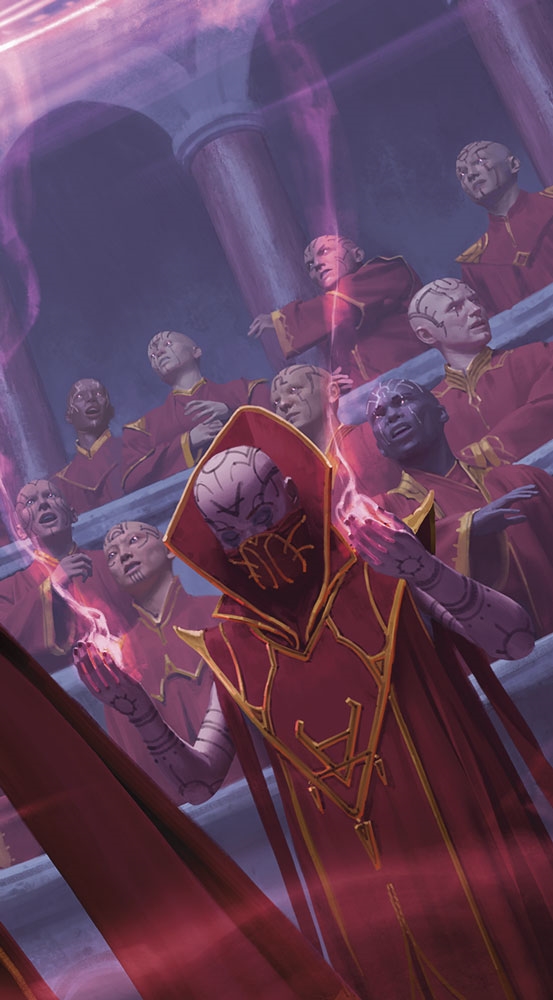
AC
15
Initiative
+2 (12)
HP
81
(18d8)
Speed
30 ft.
| Mod | Save | ||
|---|---|---|---|
| STR | 9 | −1 | −1 |
| DEX | 14 | +2 | +2 |
| CON | 11 | +0 | +0 |
| Mod | Save | ||
|---|---|---|---|
| INT | 17 | +3 | +6 |
| WIS | 12 | +1 | +4 |
| CHA | 11 | +0 | +0 |
Skills
Arcana +6, History +6, Perception +4
Gear
Wand
Senses
Passive Perception 14
Languages
Common and any three languages
CR
6 (XP 2,300; PB +3)
Actions
Multiattack. The mage makes three Arcane Burst attacks.
Arcane Burst. Melee or Ranged Attack Roll: +6, reach 5 ft. or range 120 ft. Hit: 16 (3d8 + 3) Force damage.
Spellcasting. The mage casts one of the following spells, using Intelligence as the spellcasting ability (spell save DC 14):
At Will: Detect Magic, Light, Mage Armor (included in AC), Mage Hand, Prestidigitation
2/Day Each: Fireball (level 4 version), Invisibility
1/Day Each: Cone of Cold, Fly
Bonus Actions
Misty Step (3/Day). The mage casts Misty Step, using the same spellcasting ability as Spellcasting.
Reactions
Protective Magic (3/Day). The mage casts Counterspell or Shield in response to the spell’s trigger, using the same spellcasting ability as Spellcasting.
-
View User Profile
-
Send Message
Posted Aug 18, 2025"Should it be common knowledge that everyone that isn't a PC just functions differently when it comes to magic?" — I think so. I believe that is the official stance for this edition (and for more than just magic). I also think you came to the right decision ultimately. It's more important that players enjoy their time and don't waste time trying to figure out NPC-specific mechanics that they have no means of deducing. I think the only way that players could be cued into this facet of Spell Attacks is if the NPC's actions are narrated in a way that leads to that conclusion. For example, if the DM says, "Without a word or gesture, the mage twitches its finger sending a pulse of force in your direction," the players might conclude that the mage uses no components for its attacks.
In the Wheel of Time, the author encountered a similar quandary: channelers can use their magic even if their hands are tied, they're blindfolded, etc. Essentially, the only real way to prevent them from channeling was (1) unconsciousness, (2) active "shielding" where one mage prevented another from using their magic, (3) special areas where magic doesn't work, (4) a magical collar that enslaved mages to other mages, and (5) a tea (a poison) that prevented the mages from using magic. I think a similar poison could serve you well. It also gives the mage a realistic means of escape down the line if their imprisonment is neglected—they could surreptitiously avoid taking the poison or build up an immunity. I'm just spitballing here. In sum, you're correct (in my opinion) in that this is a strange byproduct of the rules as written.
Edit: grammar
-
View User Profile
-
Send Message
Posted Aug 19, 2025I thought about this some more, and this is what I came up with. Total Cover prevents a creature from targeting another creature with Attacks. Thus, Total Cover would prevent the Mage from using Arcane Burst against anyone they saw (their jailers). The jailers could also prevent the Mage from using Spell components (Verbal with a gag, Somatic with hand bindings, and Material with careful provision of goods). This would essentially neutralize the Mage.
However, this leaves one possibility of escape: the Mage battering down its prison with Arcane Burst. Doors describes what kind of doors can be used to imprison the Mage, the strongest being a Metal Door with 72 HP (which could be double or tripled if the door is large, per the rules) and an AC of 19. As you can imagine, a Mage can chew through that door in a few minutes using Arcane Burst.
We can also impose guardrails on this kind of strategy. For instance, guards could hear the Mage attempting to destroy the door and rush in to stop (or punish them). There's no requirement that using Arcane Burst against a metal door be silent.
Alternatively, as a DM you are encouraged to retool or reframe NPCs and objects to fit the needs of your group (i.e., a potion of flying could be reframed as an anti-gravity potion in a futuristic space campaign). So, you can take the Rolling Stone from the DMG's hazard section and retool it to be the door blocking the Mage if you so desired. This would give you a barrier with an AC 17, HP 100, a Damage Threshold of 10, and Immunity to Poison and Psychic damage.
Lastly, you can simply add a Damage Threshold to a Door (See above) greater than the damage that the Mage could inflict. This is my least favorite solution to be honest because it requires a Damage Threshold of 51 to fully negate any possibility of the Mage damaging the door, but you could always couch that as a very specific effect of a specially prepared door—and whether those are ubiquitous is up to the DM.
-
View User Profile
-
Send Message
Posted Dec 18, 2025Since this is based on a Wizard, I'd say you could swap out a few of the spells for spells that you want him to have. If I run Curse of Strahd, I've already created two custom statblocks for both Kasimir and Victor that use this, but make the following changes:
- Arcane Burst uses two dice for damage instead of three, is exclusively a ranged attack, different damage type (fire for Kasimir, necrotic for Victor) and can be used twice per multiattack instead of once. I figure that since they'd be with the party for a long time instead of fighting them in a single battle, they shouldn't have the power to carry encounters single handedly.
- Kasimir has a silver shortsword that he can cast True Strike with if he gets in melee. Victor can stun Undead with his Arcane Burst instead of dealing damage, and he gets a rechargeable Arcane Prodigy ability that lets him cast Magic Missile or Ray of Sickness in lieu of one Arcane Burst
- they both have different spells
- they both have a spell like ability based on Spells of the Six from the third party book Chronicles of Eberron. Kasimir has Mockery's Snare and Victor has Keeper's Vault.
-
View User Profile
-
Send Message
Posted Dec 18, 2025This is where RAW vs RAI comes in. This statblock is SUPPOSED to be a Wizard, just simplified for more combat with multiple participants, and Arcane Burst is supposed to be a simplified version of all the offensive spells that the Wizard in question has at their disposal. As such, as a DM, I'd rule that it does involve somatic and verbal components. Possibly material, depending on my mood and if the Mage in question seems like they'd be the type to brandish a focus a lot in combat.
I might even be open to allowing the party to Counterspell a Mage using Arcane Burst, although I don't see many players wasting resources on maybe blocking an at will ability.
-
View User Profile
-
Send Message
Posted Dec 31, 2025Honestly these stat blocks, while certainly making combat much more simple, are a world building nightmare for anything but a one and done combat encounter. The biggest issue with CoS is what you do if the Mad Mage is the ally (Trying to avoid spoilers so not naming him). As you pointed out the base mage can hard carry a lot of encounters, but the Archmage stat block just out right demolishes Strahd, he can literally one turn him with high rolls or crits, and the vampire either Strahd or the new 2024 Vamp just doesn't stand a chance since they cannot charm thanks to Mind Blank and the Vampire having astonishingly low damage. Honestly the new Vamp is way worse in that fight since it doesn't even have regeneration to give it a fighting chance. These new spellcasters really cannot function as companions or long-term friendly NPCs without vastly outclassing the party, but again they do make one and done combat much more simple if you use them as just glass cannons. Even this baseline CR6 mage can 2 turn Strahd with high rolls or crits, and just outright can out damage the CR15 Strahd without getting creative with Strahd's spell casting.
I just create character sheets using player rules in the case of possible companions like Victor or Kasimir, it just feels more natural and prevents frankly awkward situations at the table. Had a new player say they couldn't wait to be able to do what the friendly allied archmage had done, meaning arcane burst, just to inform them that they will literally never be able to be that powerful even at max level. Which was awkward since in game that archmage was their mentor so trying to explain in game why it was that their magic functions completely differently and somehow they need all these components and words when technically nobody else does was a bit challenging in game. Or having the party realize that the quest giving mage is literally able to just carry the entire quest and doesn't have a reason to ask them for help. It's definitely a rather awkward side effect of the new game design choices, and for backwards compatibility can be a real nightmare with things like the Mad Mage or even worse trying to figure out how to modernize everything in OoTA. That all said they did certainly achieve their objective of simplifying them, so with every positive comes a negative to balance it out. They are better at the intended function of being useable straight out of the monster manual for new DMs, and far more simplistic, while any experienced DM would likely just do what You and most of us are doing and homebrewing to easily make everything work without much effort.
-
View User Profile
-
Send Message
Posted Jan 30, 2026I really dislike the asymmetric approach to how spell slots are handled. I'll be using the legacy approach.
-
View User Profile
-
Send Message
Posted Feb 12, 2026That sounds interesting, are these shared in D&D beyond homebew?
-
View User Profile
-
Send Message
Posted Feb 19, 2026The Arcane Burst ability is just way over tuned it seems like. That much reliable damage almost makes the spells not worth casting at all. Those can be counter spelled, or if they save the damage could be rather minimal by comparison to this which cannot be reduced in almost any reasonable way. I looked at other CR 6 creatures who are basically completely martial, and they don't do this damage, they're just more durable, but only arguably so because they're much easier to hit, like the Cyclops for example. What justification are they using for this ability? I mean the problem also with this is naturally what would come to a player's mind is 'why the hell can I not learn this?' as a spellcaster. This isn't like a monster whose biology allows for abilities a humanoid PC could never realistically have, this is just some 'mage' who has this extremely reliable MELEE OR RANGED attack at all times. Eldritch Blast needs to take some serious notes about this, good lord. If the CR wasn't this low it'd make a bit more sense, but this is crazy.
To put this into perspective (and I know Halaster has not been updated or anything, but still), he uses a Blast Scepter in which he can cast Thunderwave at 4th level which is his whole Action, and upcasted to this level only does 5d8 damage, HAS A SAVE FOR HALF, and the range, let's not forget, is FIFTEEN FEET. Now, I get it, he's got a bunch of deadly spells and things so he's likely going to use his high-level stuff and not do that, but why does a CR 23 caster not have anything CLOSE to what this random 'mage' does for free every 6 seconds??? If we scaled Arcane Burst to this guy's CR, it would be absolutely hilarious what the damage *should* be.
-
View User Profile
-
Send Message
Posted Sep 21, 2026To many hit die/hit points. 18 hit die? really? Seriously, they have more hp than many of their counterparts. Look at Warrior in the back of the book.
Also don't wizards (these are supposed to be wizards) have d6 for hit dice. Someone didn't pay attention while they edited this.
Monster Manual 2014 was better in a lot of ways (look a the mages in that book).